

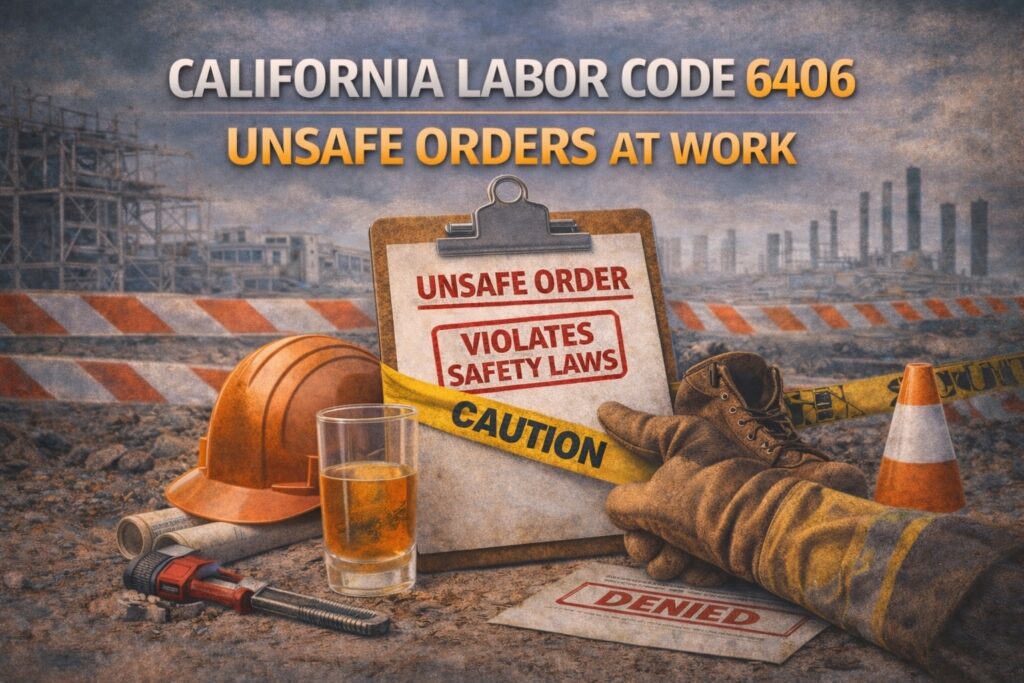
No employee should be forced to choose between doing their job and risking serious injury.
California Labor Code § 6406 makes one thing clear:
Employers cannot require employees to perform work that violates safety laws or puts them in danger.
When injuries happen because workers were ordered to do unsafe work, that order matters — both in workers’ compensation claims and in determining employer liability.
What Does Labor Code § 6406 Say?
Labor Code § 6406 prohibits employers from:
- Requiring employees to perform work that violates safety laws
- Issuing orders that expose workers to unsafe or unhealthy conditions
- Penalizing workers for refusing unsafe work
The law recognizes that unsafe orders create foreseeable injuries — and employers are responsible when those orders are given.
What Is an “Unsafe Order”?
An unsafe order can take many forms, including:
- Being told to work without required safety equipment
- Being instructed to ignore safety protocols to “save time”
- Being ordered to operate defective or dangerous machinery
- Being told to work in hazardous conditions without proper training
- Being pressured to continue working despite known safety risks
Unsafe orders don’t have to be written. Verbal instructions, implied expectations, or threats of discipline can all qualify.
“Do It Anyway” Is Not a Defense
A common employer response after an injury is:
“The worker should have known better.”
Labor Code § 6406 rejects that argument.
When a supervisor or employer orders or pressures an employee to do unsafe work, responsibility does not shift to the worker simply because they followed instructions.
How Unsafe Orders Impact Workers’ Compensation Cases
Unsafe orders often play a key role in workers’ comp cases by showing:
- The injury was foreseeable
- Safety laws were knowingly ignored
- The employer prioritized productivity over safety
These facts can support:
- Increased scrutiny of employer conduct
- Serious and willful misconduct claims
- Stronger leverage in disputed claims
Unsafe Orders and Retaliation
Labor Code § 6406 works alongside other safety-retaliation protections.
Employees are generally protected when they:
- Refuse to perform unsafe work
- Raise safety concerns
- Report violations to supervisors or regulators
Retaliating against workers for refusing unsafe orders can expose employers to additional legal consequences.
Unsafe Orders vs. “Assumption of Risk”
Employers sometimes argue that dangerous work is “part of the job.”
California law does not allow employers to:
- Ignore safety laws
- Shift responsibility to employees
- Excuse unsafe orders as normal job risks
Safety obligations apply regardless of industry.
Unsafe Orders and Third-Party Liability
In some cases, unsafe orders involve:
- General contractors
- Site owners
- Equipment suppliers
- Staffing agencies
When multiple parties control the work environment, unsafe orders can open the door to third-party injury claims beyond workers’ comp.
How Labor Code § 6406 Interacts With Other Workplace Safety Laws
Unsafe orders rarely exist in isolation. In most workplace injury cases, an unsafe order is part of a larger pattern of safety failures.
Labor Code § 6406 often overlaps with other California safety laws, including:
- Labor Code § 6400 – The employer’s non-delegable duty to provide a safe workplace
- Labor Code § 6401 – The requirement to implement and enforce effective safety programs
- Labor Code § 6403 – The obligation to conduct regular workplace safety inspections
- Cal/OSHA regulations – Specific safety rules governing equipment, procedures, and job-site conditions
When an employer issues an unsafe order, it frequently means that one or more of these other duties were already being ignored.
Unsafe Orders Often Reveal Systemic Safety Failures
In practice, unsafe orders are often the final link in the chain, not the root cause.
For example:
- A worker is ordered to perform a task without protective equipment → failure of safety programs
- A supervisor directs work around a known hazard → failure of safety inspections
- A worker is pressured to bypass safety rules → failure of safe workplace obligations
When these laws are violated together, employer liability becomes much harder to deny.
Unsafe Orders Are Not Excused by “Blame Shifting”
Employers sometimes attempt to shift focus after an injury by arguing:
- The worker should have refused
- The worker assumed the risk
- The task was routine or urgent
California safety law rejects these defenses when unsafe orders are involved.
If an employer:
- Knew or should have known the task was unsafe, and
- Directed or pressured the worker to perform it anyway
then responsibility does not disappear simply because the worker followed instructions.
Why This Matters in Workers’ Compensation Cases
When unsafe orders overlap with other safety violations, they can:
- Strengthen disputed workers’ comp claims
- Support serious and willful misconduct arguments
- Increase employer exposure beyond routine industrial injury
- Undermine employer credibility in litigation
Focusing on the worker’s conduct while ignoring unsafe directives and systemic safety failures often backfires.
The Bottom Line
Labor Code § 6406 exists to stop injuries before they happen.
When employers order workers to perform unsafe tasks, they create predictable harm — and California law holds them accountable.
If you were injured after being told to do something unsafe, that order matters.
Workers’ Comp vs. Personal Injury: Key Differences
| Workers’ Comp | Personal Injury |
|---|---|
| No fault required | Fault must be proven |
| Limited benefits | Full damages available |
| No pain & suffering | Pain & suffering allowed |
| No jury | Jury trial available |
Get Help From WIN Injury & Accident Trial Lawyers
Why Legal Representation Matters
Insurance companies often undervalue pain and suffering—offering minimal settlements that ignore your daily struggles. A skilled attorney can:
- Present powerful evidence of your emotional and physical suffering
- Retain expert witnesses to quantify your losses
- Use verdict data to justify higher multipliers or per diem rates
- Argue your case persuasively before a jury
At WIN Trial Lawyers, our team fights to ensure that your recovery reflects the full extent of your suffering—not just your bills.

At WIN Trial Lawyers, we know how personal injury claims can be can be. Victims often face mounting medical bills, lost wages, and emotional trauma. Our team has successfully taken on insurance companies and third parties, recovering millions for injured clients.
If you or a loved one has been injured in an accident, don’t leave your future in the hands of the insurance company. You need experienced trial lawyers who know how to prove liability and fight for maximum compensation.
If you or a loved one has been injured, don’t face this alone. The sooner you act, the stronger your case will be.
🔗 Related Posts:
Frequently Asked Questions About Labor Code § 6406
Unsafe Orders at Work (California Workers’ Compensation)
What is California Labor Code § 6406?
Labor Code § 6406 prohibits employers from requiring employees to perform work that violates safety laws or exposes them to unsafe or unhealthy conditions.
What is considered an “unsafe order” at work?
An unsafe order includes any instruction — written or verbal — that requires an employee to:
- Ignore safety laws or regulations
- Work without required protective equipment
- Use dangerous or defective equipment
- Perform tasks without proper training
- Work in hazardous conditions
Do unsafe orders have to be in writing?
No. Unsafe orders can be verbal, implied, or enforced through pressure, threats, or fear of discipline.
Can I refuse to perform unsafe work?
Yes. Employees are generally protected when refusing work that violates safety laws or presents an immediate danger.
Can my employer discipline me for refusing an unsafe order?
Retaliation for refusing unsafe work can expose employers to additional legal liability. Discipline does not automatically make the order lawful.
What if I was injured after following an unsafe order?
The unsafe order can be critical evidence in a workers’ compensation case and may increase employer exposure.
Does following an unsafe order mean the injury is my fault?
No. California law does not shift responsibility to employees simply because they followed instructions.
How does Labor Code § 6406 affect workers’ compensation claims?
Unsafe orders can help show that:
- The injury was foreseeable
- Safety laws were knowingly violated
- The employer prioritized productivity over safety
These facts can strengthen disputed workers’ comp claims.
Can unsafe orders support serious and willful misconduct claims?
Yes. Unsafe orders may support arguments that the employer knowingly exposed workers to serious hazards.
Does Labor Code § 6406 apply even if workers’ comp benefits are paid?
Yes. Payment of workers’ comp benefits does not erase unsafe conduct or eliminate additional employer exposure.
What if unsafe conditions are “part of the job”?
Employers cannot use job risk as an excuse to violate safety laws. Labor Code § 6406 applies regardless of industry.
Are construction workers protected under Labor Code § 6406?
Yes. Construction workers are among the most protected under unsafe order laws due to high-risk job conditions.
Can unsafe orders involve third parties?
Yes. Unsafe orders may involve:
- General contractors
- Site owners
- Staffing agencies
- Equipment operators
This can open the door to third-party injury claims.
What evidence shows an unsafe order was given?
Evidence may include:
- Witness testimony
- Supervisor statements
- Text messages or emails
- Safety reports
- OSHA citations
- Prior incidents
What if my supervisor “suggested” the unsafe task?
Suggestions, pressure, or implied expectations can still qualify as unsafe orders under the law.
Can an employer claim I assumed the risk?
No. California law does not allow employers to avoid responsibility by claiming employees assumed unsafe risks.
How does Labor Code § 6406 relate to OSHA violations?
Unsafe orders often involve OSHA violations and can be supported by regulatory findings.
Can unsafe orders increase settlement value?
They can. Unsafe orders may increase leverage, support penalties, and strengthen liability arguments.
What if I wasn’t fired but felt forced to comply?
Pressure, fear of discipline, or job loss can still establish that an unsafe order was given.
Does Labor Code § 6406 apply to temporary or contract workers?
Yes. Safety protections apply regardless of employment label or duration.
What should I do if I’m ordered to do something unsafe?
Document the conditions, report concerns when possible, seek medical care if injured, and avoid assuming the employer acted lawfully.
Why is Labor Code § 6406 important for injured workers?
Because unsafe orders can affect liability, benefits, penalties, and overall case value.
The Key Takeaway
Labor Code § 6406 exists to prevent injuries — not excuse them.
When employers order workers to perform unsafe tasks, California law places responsibility where it belongs.