

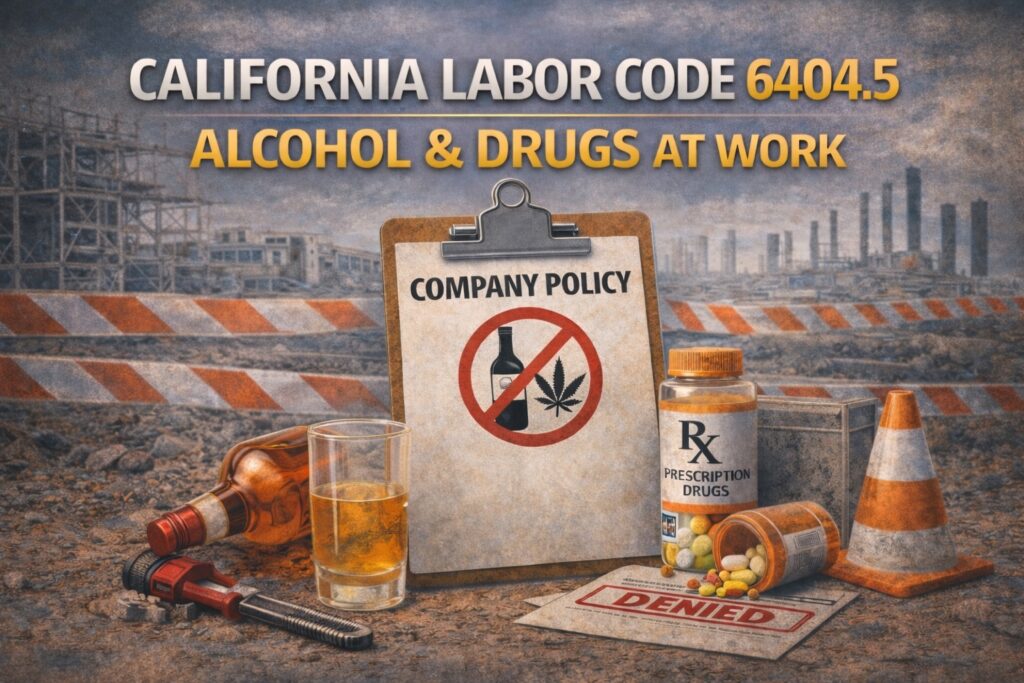
After a workplace injury, one of the first defenses employers and insurance companies look for is this:
Were alcohol or drugs involved?
California Labor Code § 6404.5 addresses alcohol and drug use in the workplace — but it does not automatically bar injured workers from receiving workers’ compensation benefits.
Understanding how this statute actually works is critical, because intoxication is one of the most commonly misunderstood and misused defenses in workers’ comp cases.
What Does Labor Code 6404.5 Say?
Labor Code § 6404.5 generally allows employers to:
- Prohibit the use of alcohol or drugs in the workplace
- Enforce workplace drug and alcohol policies
- Discipline employees for violating those policies
However, discipline policies and workers’ compensation eligibility are not the same thing.
The statute does not automatically deny workers’ compensation benefits simply because drugs or alcohol are alleged.
Does Alcohol or Drug Use Automatically Disqualify Workers’ Comp?
No.
Under California workers’ compensation law, an injury is not automatically denied just because:
- Alcohol was present in the worker’s system
- A drug test was positive
- The employer has a strict substance policy
To deny benefits, the employer or insurer generally must show that intoxication was the proximate cause of the injury — not just a contributing factor or a suspicion.
What Insurers Often Get Wrong
In practice, insurers frequently attempt to deny claims by:
- Pointing to a positive drug or alcohol test
- Claiming “violation of company policy”
- Suggesting impairment without proof
But policy violations are not the legal standard. The real question is:
Did alcohol or drugs actually cause the injury?
If unsafe equipment, poor training, lack of supervision, or workplace hazards contributed to the injury, workers’ comp benefits may still apply.
Common Scenarios Where Benefits Still Apply
Workers’ compensation may still be available even when:
- The worker tested positive but was not impaired
- The injury was caused by unsafe conditions or equipment
- The employer failed to enforce safety rules consistently
- Other employees engaged in similar conduct without discipline
- The injury would have occurred regardless of substance use
Each case turns on medical evidence, witness testimony, and causation, not assumptions.
Alcohol, Drugs, and Employer Safety Obligations
Labor Code § 6404.5 does not excuse employers from their core safety duties.
Even if intoxication is alleged, employers must still:
- Maintain safe workplaces
- Conduct safety inspections
- Enforce safety rules consistently
- Correct known hazards
If an employer allowed unsafe conditions to exist, intoxication allegations may fail as a defense.
Drug Testing After a Workplace Injury
Post-injury drug and alcohol testing is common, but it must still be:
- Lawful
- Properly administered
- Interpreted correctly
A positive test does not automatically prove impairment at the time of injury, and testing results can often be challenged.
How Labor Code 6404.5 Interacts With Other Safety Laws
Alcohol and drug issues often overlap with:
- Labor Code § 6400 (safe workplace duty)
- Labor Code § 6401 (safety programs)
- Labor Code § 6403 (safety inspections)
- OSHA regulations
When employers focus on intoxication to avoid liability while ignoring safety failures, that strategy often backfires.
The Bottom Line
Labor Code § 6404.5 allows employers to regulate alcohol and drugs at work — but it does not give insurers a free pass to deny legitimate workers’ compensation claims.
Injuries are denied only when intoxication is proven to be the actual cause, not merely present.
If your workers’ comp claim is being challenged based on alcohol or drug allegations, the facts — not labels — matter.
Workers’ Comp vs. Personal Injury: Key Differences
| Workers’ Comp | Personal Injury |
|---|---|
| No fault required | Fault must be proven |
| Limited benefits | Full damages available |
| No pain & suffering | Pain & suffering allowed |
| No jury | Jury trial available |
Get Help From WIN Injury & Accident Trial Lawyers
Why Legal Representation Matters
Insurance companies often undervalue pain and suffering—offering minimal settlements that ignore your daily struggles. A skilled attorney can:
- Present powerful evidence of your emotional and physical suffering
- Retain expert witnesses to quantify your losses
- Use verdict data to justify higher multipliers or per diem rates
- Argue your case persuasively before a jury
At WIN Trial Lawyers, our team fights to ensure that your recovery reflects the full extent of your suffering—not just your bills.

At WIN Trial Lawyers, we know how personal injury claims can be can be. Victims often face mounting medical bills, lost wages, and emotional trauma. Our team has successfully taken on insurance companies and third parties, recovering millions for injured clients.
If you or a loved one has been injured in an accident, don’t leave your future in the hands of the insurance company. You need experienced trial lawyers who know how to prove liability and fight for maximum compensation.
If you or a loved one has been injured, don’t face this alone. The sooner you act, the stronger your case will be.
🔗 Related Posts:
Frequently Asked Questions About Labor Code 6404.5
Alcohol & Drugs at Work (California Workers’ Compensation)
What is Labor Code § 6404.5?
Labor Code § 6404.5 allows employers to prohibit alcohol and drug use in the workplace, but it does not automatically disqualify injured workers from workers’ compensation benefits.
Does alcohol or drug use automatically deny a workers’ comp claim?
No. A claim is not automatically denied just because alcohol or drugs were present. The insurer generally must prove that intoxication was the actual cause of the injury.
What does “intoxication caused the injury” mean?
It means the employer or insurer must show that alcohol or drugs were the proximate cause of the accident — not merely present in the worker’s system.
Is a positive drug test enough to deny benefits?
No. A positive test alone does not prove impairment at the time of the injury and does not automatically bar workers’ compensation benefits.
What if I used legal prescription medication?
Lawful prescription medication does not automatically disqualify a claim. The issue is whether the medication actually caused impairment that led to the injury.
Can marijuana use affect a workers’ comp claim?
Marijuana cases are highly fact-specific. A positive test alone is usually not enough — insurers must still prove impairment and causation.
Can my employer deny workers’ comp because I violated company policy?
No. Violating a company alcohol or drug policy does not automatically eliminate workers’ comp rights. Policy violations are not the legal standard.
Can I be fired for violating a drug or alcohol policy?
Possibly — but termination does not automatically eliminate your right to workers’ compensation benefits.
Do I have to submit to a drug test after a workplace injury?
That depends on employer policy and circumstances. However, refusal alone does not automatically bar a workers’ comp claim.
Can unsafe working conditions override intoxication allegations?
Yes. If unsafe equipment, poor training, or hazardous conditions caused the injury, workers’ comp benefits may still apply even if intoxication is alleged.
Who decides whether intoxication caused the injury?
Causation is determined through medical evaluations, investigation, and legal analysis — not employer assumptions or policy language.
Can Labor Code 6404.5 be used as a defense by insurance companies?
Insurers often try to use it as a defense, but it is frequently misapplied. The statute does not create an automatic denial.
How does Labor Code 6404.5 interact with employer safety duties?
Employers must still comply with safety laws such as:
- Labor Code § 6400 (safe workplace)
- Labor Code § 6401 (safety programs)
- Labor Code § 6403 (safety inspections)
Intoxication allegations do not excuse safety violations.
What evidence is used to argue intoxication caused an injury?
Evidence may include:
- Drug or alcohol test results
- Medical opinions
- Witness testimony
- Accident reconstruction
- Safety condition evidence
No single factor is usually enough on its own.
Can prior substance use history be used against me?
Prior history alone is generally not enough. The focus is on impairment at the time of the injury.
Can a workers’ comp judge reject intoxication defenses?
Yes. Judges regularly reject intoxication defenses when causation is not proven.
Does Labor Code 6404.5 apply to all workplaces?
Yes, but how it applies depends on job duties, safety risks, employer policies, and the facts of the injury.
Can employers selectively enforce drug policies?
Selective enforcement can undermine employer defenses and raise credibility issues.
Can alcohol or drug allegations reduce settlement value?
They can — but only if supported by strong evidence. Unsupported allegations often fail.
What should injured workers do if intoxication is alleged?
Seek medical care, document conditions, avoid assumptions, and do not accept an automatic denial without review.
Why is Labor Code 6404.5 so often misunderstood?
Because employers confuse disciplinary authority with workers’ compensation eligibility — two very different legal standards.
The Takeaway
Labor Code § 6404.5 allows employers to regulate substance use — but it does not give insurers a free pass to deny legitimate workers’ compensation claims.
Causation, not accusation, controls.