

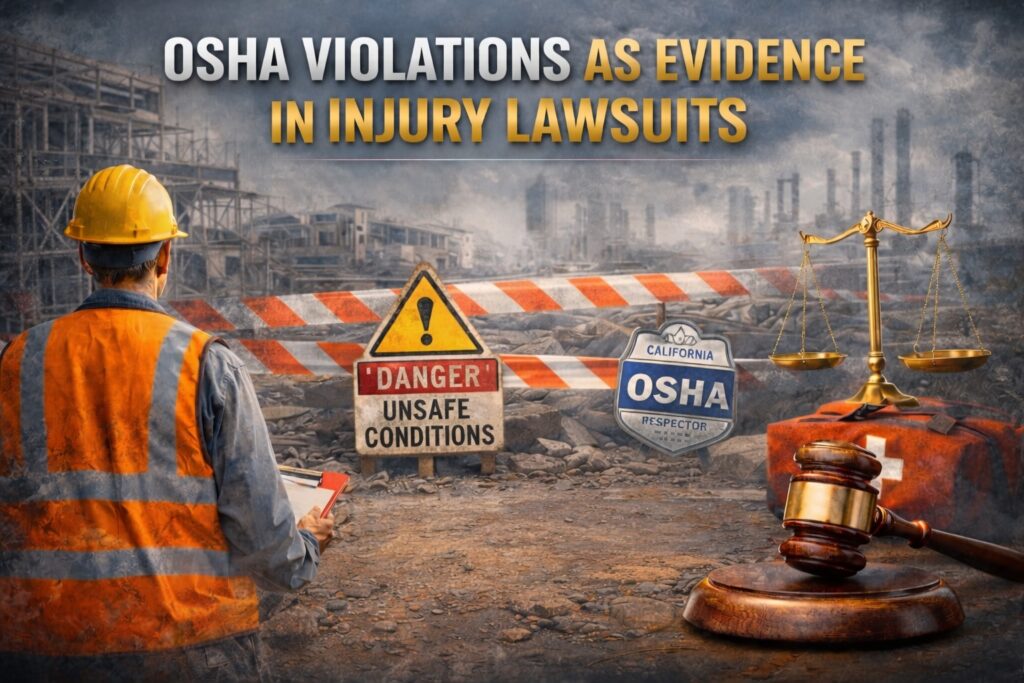
How OSHA Violations Can Be Used as Evidence in Injury Lawsuits
Workplace injuries are often caused by dangerous conditions that should never have existed. When an employer or contractor ignores basic safety rules, workers pay the price.
California Labor Code § 6304.5 plays a critical role in these cases. It allows OSHA safety violations to be used as evidence in civil personal injury lawsuits — even though workers’ compensation normally limits employee claims.
Understanding how this statute works can dramatically strengthen an injury or wrongful-death case.
What Does Labor Code § 6304.5 Say?
Labor Code § 6304.5 provides that:
Evidence of a violation of Cal/OSHA safety regulations may be admitted in a civil action to prove negligence or fault.
In simple terms:
If a defendant violated workplace safety rules, that violation can be shown to the jury.
This is powerful — because OSHA rules exist for one reason: to prevent serious injuries and deaths.
Why OSHA Violations Matter in Injury Cases
OSHA regulations are not suggestions or best practices. They are mandatory minimum safety standards designed to protect workers from foreseeable, serious harm.
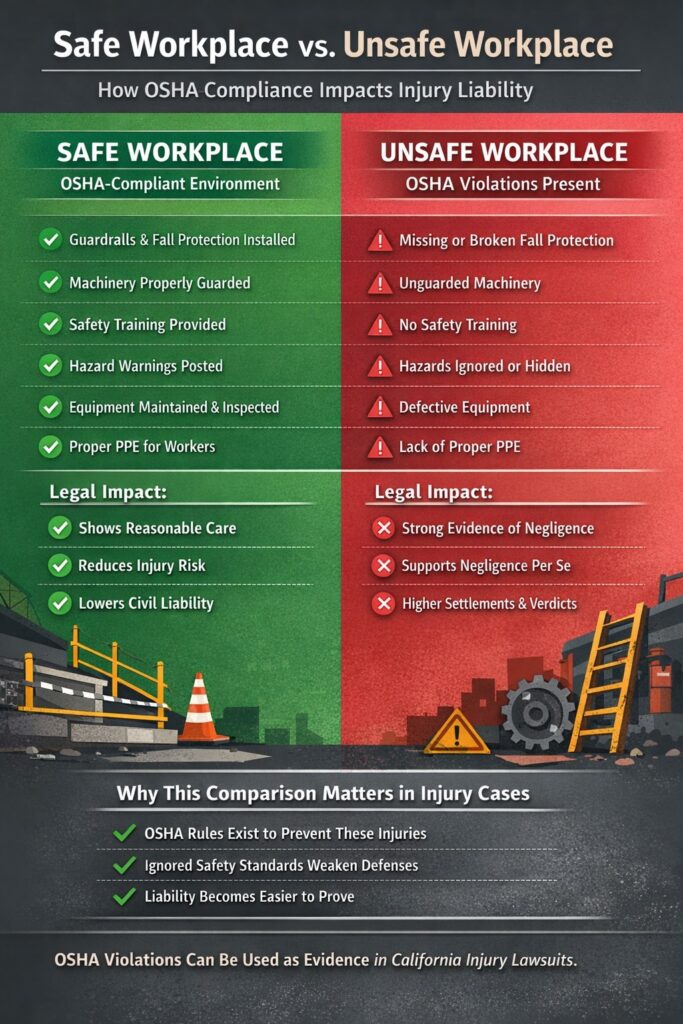
When OSHA or Cal/OSHA rules are violated, it often shows more than a simple mistake. It shows that:
- The danger was known or should have been known
Safety regulations exist because certain hazards are common, predictable, and well-documented. - Safer alternatives were available
OSHA rules are built around proven safety measures that are widely used and feasible. - The injury was preventable
Compliance with basic safety standards often eliminates or greatly reduces the risk of injury. - The defendant chose to cut corners or ignore risks
Violations frequently reflect cost-cutting, poor training, or a failure to enforce safety rules.
This is why OSHA violations carry so much weight in civil injury cases. They turn a defense claim of “accident” into evidence of avoidable danger.
Under Labor Code § 6304.5, injured workers and families are allowed to use OSHA and Cal/OSHA violations as evidence of negligence in civil court, particularly in cases involving third parties, contractors, or equipment manufacturers.
OSHA Violations as Proof of Negligence
In many injury cases, OSHA violations do more than show unsafe conditions — they help establish legal fault.
When a safety regulation applies to a situation and is violated, it often supports a negligence per se theory. In practical terms, that means:
- The law establishes a duty of care
OSHA regulations define what safety measures are required under specific conditions. - The safety rule was violated
The defendant failed to follow a clear, written safety requirement. - The injured worker was within the protected class
OSHA rules are designed to protect workers performing the type of work involved. - The injury was the type the rule was designed to prevent
The harm that occurred is exactly why the regulation exists.
When these elements are met, liability becomes much easier to prove. Instead of arguing over abstract concepts like “reasonable care,” the case focuses on whether a known safety rule was ignored — and what harm that decision caused.
In many cases, OSHA violations significantly increase jury risk, settlement pressure, and overall case value.
Common Situations Where OSHA Violations Apply
OSHA violations frequently appear in serious injury and wrongful-death cases, including:
Construction Site Accidents
- Unsafe scaffolding
- Missing fall protection
- Inadequate trench safety
- Lack of guardrails or harnesses
Industrial & Factory Injuries
- Unguarded machinery
- Lockout/tagout failures
- Inadequate training
- Poor machine maintenance
Warehouse & Logistics Accidents
- Forklift violations
- Overloaded shelving
- Inadequate safety protocols
- Poor traffic control
Electrical & Utility Injuries
- Improper grounding
- Exposed wiring
- Failure to de-energize equipment
- Inadequate protective gear
How LC § 6304.5 Helps Bypass “It Was Just an Accident”
Defendants often argue:
- “This was unavoidable”
- “The worker caused it”
- “It was just an accident”
OSHA violations undermine those defenses by showing:
- The hazard was recognized
- The rule existed before the injury
- Compliance would have reduced or eliminated the risk
That shifts the focus from blaming the injured worker to examining the defendant’s safety failures.
Workers’ Compensation vs. Civil Injury Claims
Workers’ compensation generally limits lawsuits against employers — but OSHA violations often arise in cases involving:
- Third-party contractors
- Property owners
- Equipment manufacturers
- Subcontractors
- Uninsured or illegally insured employers
In these cases, Labor Code § 6304.5 becomes a key tool in civil personal injury litigation, not just workers’ comp.
How OSHA Evidence Is Used in Court
OSHA-related evidence may include:
- Cal/OSHA citations
- Inspection reports
- Safety manuals and training records
- Prior violations
- Expert testimony on safety standards
- Internal safety audits
Even if OSHA did not issue a citation, the underlying safety rules may still be used to establish the applicable standard of care.
Why These Cases Require Trial Lawyers
OSHA-based injury cases are highly technical and aggressively defended. Employers and insurers often fight hard to limit the use of safety violations.
At WIN Injury & Accident Trial Lawyers, we know how to:
- Identify applicable OSHA standards
- Preserve safety evidence early
- Work with safety and engineering experts
- Tie violations directly to injury causation
- Present safety failures clearly to juries
Injured Due to Unsafe Working Conditions?
If you were seriously injured — or lost a loved one — because safety rules were ignored, you may have powerful civil claims beyond workers’ compensation.
📞 Contact WIN Injury & Accident Trial Lawyers
We fight for injured workers and families harmed by preventable safety violations across California.
Workers’ Comp vs. Personal Injury: Key Differences
| Workers’ Comp | Personal Injury |
|---|---|
| No fault required | Fault must be proven |
| Limited benefits | Full damages available |
| No pain & suffering | Pain & suffering allowed |
| No jury | Jury trial available |
Exclusivity determines which path—or both—are available.
Get Help From WIN Injury & Accident Trial Lawyers
Why Legal Representation Matters
Insurance companies often undervalue pain and suffering—offering minimal settlements that ignore your daily struggles. A skilled attorney can:
- Present powerful evidence of your emotional and physical suffering
- Retain expert witnesses to quantify your losses
- Use verdict data to justify higher multipliers or per diem rates
- Argue your case persuasively before a jury
At WIN Trial Lawyers, our team fights to ensure that your recovery reflects the full extent of your suffering—not just your bills.

At WIN Trial Lawyers, we know how personal injury claims can be can be. Victims often face mounting medical bills, lost wages, and emotional trauma. Our team has successfully taken on insurance companies and third parties, recovering millions for injured clients.
If you or a loved one has been injured in an accident, don’t leave your future in the hands of the insurance company. You need experienced trial lawyers who know how to prove liability and fight for maximum compensation.
If you or a loved one has been injured, don’t face this alone. The sooner you act, the stronger your case will be.
🔗 Related Posts:
Frequently Asked Questions: California Labor Code § 6304.5 (OSHA Violations & Negligence)
What is California Labor Code § 6304.5?
Labor Code § 6304.5 allows Cal/OSHA and OSHA safety regulations to be used as evidence of negligence in civil injury cases. While an OSHA violation does not automatically establish liability, it can be powerful proof that safety duties were breached.
What does Labor Code § 6304.5 actually do?
The statute removes older legal barriers and makes clear that workplace safety regulations are admissible in civil lawsuits to show negligence or fault.
Does an OSHA violation automatically prove negligence?
No. An OSHA or Cal/OSHA violation does not automatically equal negligence per se, but it is strong evidence that a defendant failed to act reasonably.
How is § 6304.5 different from negligence per se?
Negligence per se presumes negligence based on a statutory violation.
Labor Code § 6304.5 allows OSHA regulations to be considered as evidence, even if they do not create an automatic presumption.
Why is Labor Code § 6304.5 important in injury cases?
Because it lets injured workers and families show that:
- Safety rules existed
- The defendant knew or should have known them
- Those rules were violated
- The violation contributed to the injury
This often shifts leverage dramatically.
What types of cases commonly rely on § 6304.5?
This statute is frequently used in:
- Construction accidents
- Industrial and factory injuries
- Warehouse and logistics accidents
- Falls from height
- Machinery and equipment injuries
Can OSHA violations be used against employers?
They can be used as evidence, but workers’ compensation exclusivity often limits direct lawsuits against employers unless an exception applies.
Can OSHA violations be used against third parties?
Yes. This is where § 6304.5 is most powerful — against:
- General contractors
- Subcontractors
- Property owners
- Equipment manufacturers
- Vendors and maintenance companies
What if the employer was cited by Cal/OSHA?
Cal/OSHA citations, inspection reports, and findings are often critical evidence and may be admissible to show unsafe conditions.
What if no OSHA citation was issued?
A citation is not required. Expert testimony and safety standards can still establish that regulations were violated.
Can OSHA standards apply even if the injured person wasn’t the employer’s employee?
Yes. OSHA safety standards can apply to worksites and conditions that affect non-employees, such as subcontractors or visitors.
Do OSHA violations apply in wrongful death cases?
Yes. In fatal workplace accidents, OSHA violations are often central evidence in civil wrongful death claims.
Does § 6304.5 override workers’ compensation exclusivity?
No. It does not eliminate exclusivity, but it can:
- Support third-party claims
- Strengthen serious and willful misconduct arguments
- Increase leverage in related litigation
Can OSHA violations increase settlement value?
Yes. OSHA violations increase:
- Jury risk
- Defense exposure
- Settlement pressure
Insurers understand how dangerous OSHA evidence is at trial.
What kinds of OSHA violations are most impactful?
Common high-impact violations include:
- Fall protection failures
- Machine guarding violations
- Lock-out/tag-out violations
- Unsafe scaffolding or trenching
- Electrical safety violations
Can OSHA violations support punitive damages?
In some cases, yes — particularly where violations show conscious disregard for safety or repeated noncompliance.
Who determines whether OSHA evidence is admissible?
Judges decide admissibility, while juries determine how much weight the evidence deserves.
Can defendants argue OSHA rules don’t apply?
Yes, and they often do. These defenses require careful analysis of:
- Scope of the regulation
- Applicability to the defendant
- Nature of the work being performed
How are OSHA violations proven in civil cases?
Common evidence includes:
- OSHA or Cal/OSHA citations
- Inspection reports
- Safety manuals
- Training records
- Expert safety testimony
Can OSHA violations be used even if corrected later?
Yes. Subsequent repairs or changes do not erase prior safety failures, though admissibility rules apply.
Does Labor Code § 6304.5 apply only in California?
It applies to California cases, but OSHA regulations may still be relevant depending on jurisdiction and facts.
Why do defendants fight OSHA evidence so aggressively?
Because OSHA violations undermine claims that injuries were “accidents” and expose systemic safety failures.
Why do OSHA-based cases require experienced trial lawyers?
Because defendants often:
- Minimize safety rules
- Dispute applicability
- Attack expert testimony
- Push exclusivity defenses
These cases require deep regulatory and litigation experience.
How can WIN Trial Lawyers use Labor Code § 6304.5?
WIN Trial Lawyers leverages OSHA and Cal/OSHA violations to:
- Prove unsafe conditions
- Establish negligence
- Identify third-party liability
- Maximize recovery for injured workers and families
What should I do if I was injured at work and safety rules were violated?
Get medical care, preserve evidence, and speak with a lawyer who understands both workplace safety law and civil liability.