

What Is Labor Code § 6310?
California Labor Code § 6310 makes it illegal for an employer to retaliate against a worker for raising workplace safety concerns.
In simple terms, the law protects employees who:
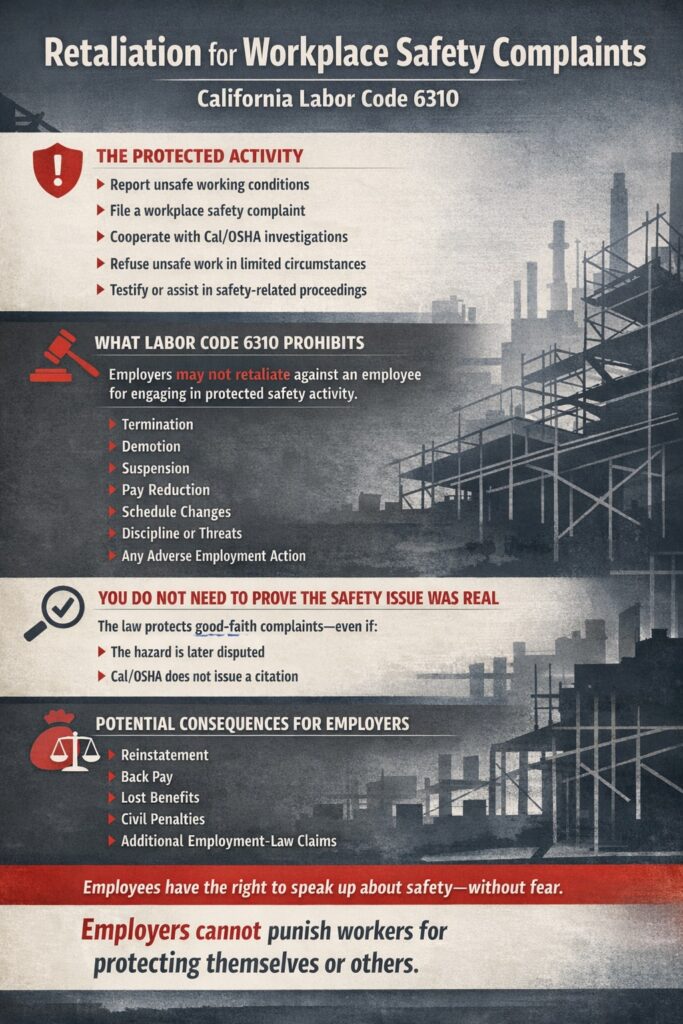
- Report unsafe working conditions
- File OSHA or Cal/OSHA complaints
- Cooperate in workplace safety investigations
- Refuse to work in unsafe conditions
If an employer punishes a worker for speaking up about safety, that retaliation is unlawful — even if no physical injury ever occurred.
This statute is a critical protection for workers who are pressured to stay silent about dangerous conditions.
What Counts as “Safety Retaliation”?
Retaliation under Labor Code § 6310 is broader than termination.
Unlawful retaliation can include:
- Firing or laying off an employee
- Demotion or loss of hours
- Pay cuts or loss of overtime
- Threats, discipline, or write-ups
- Harassment or intimidation
- Forced transfers to worse assignments
If the adverse action happens because the employee raised safety concerns, the law may be violated.
Protected Activities Under Labor Code § 6310
An employee is protected when they engage in any good-faith safety-related activity, including:
- Complaining to a supervisor about unsafe equipment
- Reporting hazards to Cal/OSHA
- Requesting safety gear or training
- Participating in an OSHA inspection
- Refusing unsafe work that violates safety laws
The employee does not need to be correct — they only need a reasonable, good-faith belief that conditions were unsafe.
Do Workers Have to Be Injured to Bring a Claim?
No.
One of the most important aspects of Labor Code § 6310 is that no physical injury is required.
A claim may exist even if:
- No accident occurred
- The hazard was corrected later
- The employer claims the complaint was “unnecessary”
The law focuses on retaliation, not whether the employer agrees the condition was dangerous.
How Labor Code § 6310 Interacts With Workers’ Compensation
Safety retaliation claims are separate from workers’ compensation.
This means:
- A worker may have both a workers’ comp claim and a retaliation claim
- Retaliation claims can allow civil damages, not just comp benefits
- Pain and suffering may be recoverable
- Attorney’s fees may be awarded
In many cases, Labor Code § 6310 becomes a powerful leverage statute alongside a comp claim.
Common Employer Defenses — and Why They Often Fail
Employers frequently argue:
- “The employee was fired for performance issues”
- “The timing was a coincidence”
- “There was no real safety issue”
But retaliation can be proven through:
- Timing (complaint followed by discipline)
- Shifting explanations
- Lack of prior discipline
- Comparators (others treated differently)
- Internal emails or texts
Retaliation is rarely admitted — it is proven through circumstantial evidence.
Remedies Available Under Labor Code 6310
When safety retaliation is proven, California law allows employees to recover powerful remedies that go far beyond standard workers’ compensation benefits.
These remedies are designed not just to compensate the worker, but to deter employers from punishing employees who speak up about unsafe conditions.
Reinstatement
Courts may order the employer to reinstate the employee to their prior position.
This can include:
- Restoration of the same job title and duties
- Reinstatement of seniority and benefits
- Placement into an equivalent position if the original role no longer exists
Reinstatement is meant to put the employee back in the position they would have been in but for the retaliation.
Back Pay and Lost Wages
Employees may recover wages lost due to retaliation, including:
- Past lost income from termination or reduced hours
- Lost overtime opportunities
- Missed bonuses or incentive pay
Back pay often runs from the date of retaliation through resolution of the case, which can make this category of damages substantial.
Civil Penalties
Labor Code 6310 authorizes statutory penalties against employers who retaliate.
These penalties serve an important purpose:
- They punish unlawful conduct
- They discourage employers from silencing safety complaints
- They reinforce the public policy favoring workplace safety
Penalties can apply even where wage losses are limited.
Attorney’s Fees and Costs
Successful employees may recover reasonable attorney’s fees and litigation costs.
This fee-shifting provision is critical because it:
- Allows workers to enforce safety rights without paying out of pocket
- Prevents employers from outspending employees into silence
- Encourages early compliance and settlement
In many cases, fee exposure becomes a major pressure point for employers.
Emotional Distress Damages
Unlike workers’ compensation, Labor Code 6310 claims may allow recovery for emotional harm.
This can include:
- Stress and anxiety caused by retaliation
- Humiliation or reputational harm
- Emotional suffering from being punished for doing the right thing
These damages recognize the real personal toll retaliation can take on workers.
Why These Remedies Matter
Workers’ compensation alone does not provide:
- Civil penalties
- Attorney’s fees
- Emotional distress damages
Labor Code 6310 fills that gap.
By allowing full civil remedies, the law ensures that employers fix unsafe conditions instead of retaliating against the workers who report them.
Why Labor Code § 6310 Is So Powerful for Workers
This statute exists for a reason:
Unsafe workplaces stay unsafe when workers are afraid to speak up.
Labor Code § 6310 removes that fear by holding employers accountable when they retaliate instead of fixing hazards.
Workers’ Comp vs. Personal Injury: Key Differences
| Workers’ Comp | Personal Injury |
|---|---|
| No fault required | Fault must be proven |
| Limited benefits | Full damages available |
| No pain & suffering | Pain & suffering allowed |
| No jury | Jury trial available |
Exclusivity determines which path—or both—are available.
Get Help From WIN Injury & Accident Trial Lawyers
Why Legal Representation Matters
Insurance companies often undervalue pain and suffering—offering minimal settlements that ignore your daily struggles. A skilled attorney can:
- Present powerful evidence of your emotional and physical suffering
- Retain expert witnesses to quantify your losses
- Use verdict data to justify higher multipliers or per diem rates
- Argue your case persuasively before a jury
At WIN Trial Lawyers, our team fights to ensure that your recovery reflects the full extent of your suffering—not just your bills.

At WIN Trial Lawyers, we know how personal injury claims can be can be. Victims often face mounting medical bills, lost wages, and emotional trauma. Our team has successfully taken on insurance companies and third parties, recovering millions for injured clients.
If you or a loved one has been injured in an accident, don’t leave your future in the hands of the insurance company. You need experienced trial lawyers who know how to prove liability and fight for maximum compensation.
If you or a loved one has been injured, don’t face this alone. The sooner you act, the stronger your case will be.
🔗 Related Posts:
Frequently Asked Questions: California Labor Code § 6310 (Safety Retaliation)
What is California Labor Code § 6310?
Labor Code § 6310 makes it illegal for an employer to retaliate against an employee for raising workplace safety concerns or exercising safety-related rights.
What does “safety retaliation” mean?
Safety retaliation occurs when an employer punishes an employee for:
- Reporting unsafe working conditions
- Complaining about health or safety hazards
- Refusing to perform unsafe work
- Cooperating with Cal/OSHA
What kinds of actions count as retaliation?
Retaliation can include:
- Termination or layoff
- Demotion
- Pay cuts or reduced hours
- Discipline or write-ups
- Threats or intimidation
- Harassment
- Blacklisting or refusal to rehire
Retaliation does not have to be extreme to be illegal.
Does an employee have to file an OSHA complaint to be protected?
No. Protection applies even if the employee:
- Complained internally
- Raised concerns verbally
- Refused unsafe work
- Assisted another employee
Formal complaints are not required.
What if the safety concern turned out to be wrong?
Employees are protected as long as the complaint was made in good faith. The safety hazard does not have to be proven later.
What if the employer says the termination was for “performance”?
Employers often claim retaliation was actually due to performance, restructuring, or policy violations. Courts closely examine:
- Timing
- Prior performance history
- Consistency of discipline
- Whether safety complaints preceded the action
Pretext is a common issue in § 6310 cases.
How soon after a safety complaint can retaliation occur?
Retaliation can occur immediately or over time. Close timing between a complaint and adverse action is often strong evidence.
Does Labor Code § 6310 protect employees who refuse unsafe work?
Yes. Employees are protected when they refuse work they reasonably believe would violate safety laws or pose serious danger.
Can an employer discipline an employee for safety complaints?
No — not if the discipline is based on the safety complaint itself or the act of reporting unsafe conditions.
Does § 6310 apply only to physical safety issues?
It primarily applies to health and safety hazards, including:
- Unsafe machinery
- Lack of protective equipment
- Exposure to chemicals
- Fall hazards
- Electrical dangers
Does safety retaliation apply in construction and industrial jobs?
Yes. § 6310 is frequently used in:
- Construction
- Warehouses
- Manufacturing
- Transportation
- Industrial and utility work
What if the employer never fixed the safety issue?
Failure to correct hazards can strengthen a retaliation claim by showing disregard for safety and employee rights.
Can an employee sue under Labor Code § 6310?
Yes. Employees may bring civil claims for retaliation under this statute.
What damages are available in a § 6310 retaliation case?
Potential damages include:
- Lost wages
- Back pay and front pay
- Reinstatement
- Emotional distress damages
- Civil penalties
- Attorney’s fees and costs
Is workers’ compensation the only remedy?
No. Safety retaliation claims are separate from workers’ compensation and can be pursued in civil court.
What if the employee was injured and then retaliated against?
An employee may have both:
- A workers’ compensation claim for the injury
- A retaliation claim for adverse actions taken afterward
Does § 6310 apply to supervisors or managers?
Yes, if they are employees covered by the statute and engaged in protected safety activity.
Can coworkers retaliate against someone for safety complaints?
Employer liability can arise if the employer allows or encourages coworker retaliation.
What if the employer threatens immigration consequences?
Threats related to immigration status in response to safety complaints can be strong evidence of retaliation and may violate additional laws.
How is retaliation proven?
Common evidence includes:
- Timing of complaints and discipline
- Emails or texts
- Witness testimony
- Performance reviews
- Changes in treatment after complaints
How long does an employee have to file a claim?
Deadlines apply, and delay can weaken claims. Employees should act promptly to preserve evidence and rights.
Why do employers retaliate over safety complaints?
Safety complaints can trigger:
- OSHA inspections
- Fines and citations
- Increased insurance costs
- Work stoppages
Retaliation is often an attempt to silence safety concerns.
Why are safety retaliation cases taken seriously?
Because retaliation discourages workers from reporting dangerous conditions, putting everyone at risk.
How can WIN Trial Lawyers help with safety retaliation claims?
WIN Trial Lawyers helps employees:
- Identify retaliation
- Preserve evidence
- Connect safety complaints to adverse actions
- Pursue full compensation under Labor Code § 6310
What should I do if I believe I was retaliated against for safety complaints?
Document everything, keep copies of communications, and speak with a lawyer experienced in workplace safety and retaliation law as soon as possible.