

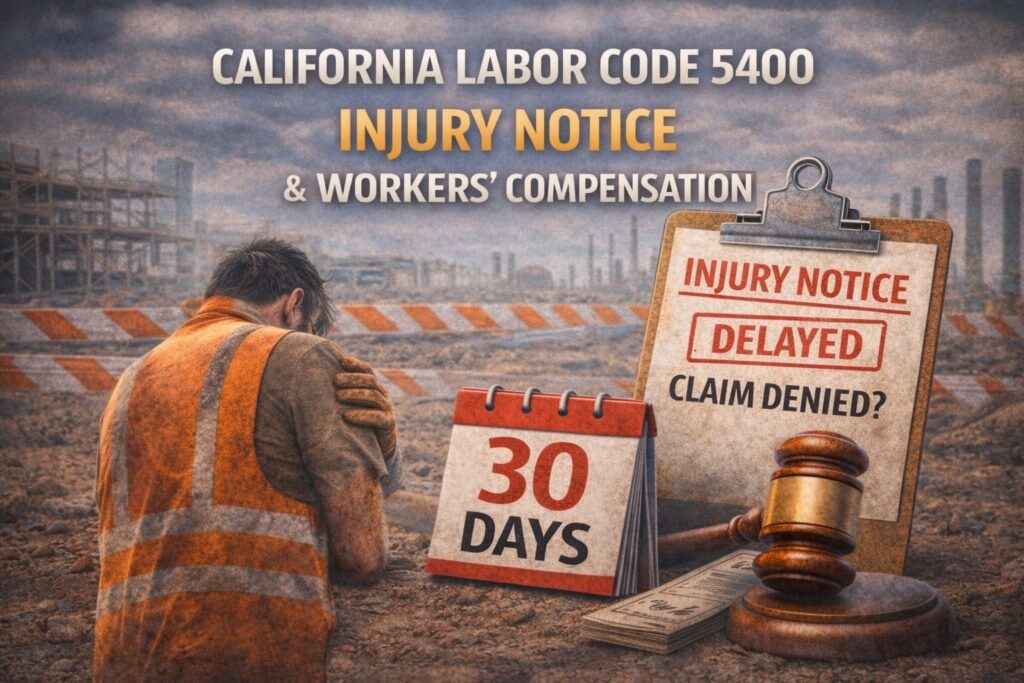
After a workplace injury, one of the most important — and most misunderstood — requirements is injury notice.
California Labor Code § 5400 governs how and when an injured worker must notify their employer of a work-related injury in order to preserve workers’ compensation benefits.
Insurance companies frequently rely on notice arguments to delay or deny claims. Knowing what the law actually requires — and what it doesn’t — can make a major difference in the outcome of a case.
What Does Labor Code § 5400 Require?
Labor Code § 5400 requires an injured worker to give notice of a work-related injury to their employer within a certain time frame.
The purpose of the statute is simple:
- To alert the employer that an injury occurred
- To allow the employer to investigate the claim
- To trigger workers’ compensation benefits
It is not intended to create technical traps for injured workers.
How Soon Must an Injury Be Reported?
In most cases, an injured worker must give notice to the employer within 30 days of:
- The date of injury, or
- The date the worker knew or should have known the injury was work-related
However, the law recognizes that not all injuries are immediately obvious.
Notice Is Broader Than Most People Think
One of the biggest misconceptions is that notice must be:
- In writing
- On a specific form
- Given to a specific manager
That is not true.
Notice may be satisfied by:
- Telling a supervisor or manager
- Reporting the injury verbally
- Seeking employer-provided medical treatment
- Filing an internal incident report
- Any communication that reasonably informs the employer of a work injury
Formal paperwork is not required to satisfy Labor Code § 5400.
What If the Injury Develops Over Time?
Many workplace injuries are cumulative or progressive, such as:
- Repetitive stress injuries
- Back, shoulder, or knee conditions
- Occupational illnesses
In those cases, the notice period generally begins when the worker:
- Becomes aware the condition is work-related, or
- Is told by a medical provider that work caused or contributed to the injury
Late notice arguments often fail in cumulative trauma cases.
Common Employer and Insurance Tactics
Insurers frequently attempt to deny claims by arguing:
- The injury was not reported “on time”
- The employer did not receive proper notice
- The worker failed to follow company policy
But company policy does not override California law.
If the employer had actual or constructive knowledge of the injury, notice is often considered satisfied.
When Late Notice Does NOT Bar a Claim
Even if notice was delayed, benefits may still be available if:
- The employer was not prejudiced by the delay
- The employer already knew about the injury
- The delay was reasonable under the circumstances
- The injury was cumulative or progressive
Labor Code § 5400 is applied practically, not rigidly.
Why Injury Notice Matters in Workers’ Compensation Cases
Injury notice issues often impact:
- Whether a claim is accepted or denied
- The start date of benefits
- Credibility disputes
- Settlement leverage
Early notice can help claims move faster, but late notice does not automatically defeat a legitimate case.
Injury Notice vs. Statute of Limitations
Injury notice under Labor Code § 5400 is not the same thing as the statute of limitations.
Failing to give immediate notice does not automatically eliminate the right to file a workers’ compensation claim — especially where the employer knew or should have known of the injury.
The Bottom Line
Labor Code § 5400 is meant to ensure employers are informed — not to punish injured workers.
If you were hurt at work and are being told your claim is denied because of “late notice,” that argument deserves close scrutiny.
In workers’ compensation, substance matters more than technicalities.
Workers’ Comp vs. Personal Injury: Key Differences
| Workers’ Comp | Personal Injury |
|---|---|
| No fault required | Fault must be proven |
| Limited benefits | Full damages available |
| No pain & suffering | Pain & suffering allowed |
| No jury | Jury trial available |
Exclusivity determines which path—or both—are available.
Get Help From WIN Injury & Accident Trial Lawyers
Why Legal Representation Matters
Insurance companies often undervalue pain and suffering—offering minimal settlements that ignore your daily struggles. A skilled attorney can:
- Present powerful evidence of your emotional and physical suffering
- Retain expert witnesses to quantify your losses
- Use verdict data to justify higher multipliers or per diem rates
- Argue your case persuasively before a jury
At WIN Trial Lawyers, our team fights to ensure that your recovery reflects the full extent of your suffering—not just your bills.

At WIN Trial Lawyers, we know how personal injury claims can be can be. Victims often face mounting medical bills, lost wages, and emotional trauma. Our team has successfully taken on insurance companies and third parties, recovering millions for injured clients.
If you or a loved one has been injured in an accident, don’t leave your future in the hands of the insurance company. You need experienced trial lawyers who know how to prove liability and fight for maximum compensation.
If you or a loved one has been injured, don’t face this alone. The sooner you act, the stronger your case will be.
🔗 Related Posts:
Frequently Asked Questions About Labor Code § 5400
Injury Notice in California Workers’ Compensation Cases
What is California Labor Code § 5400?
Labor Code § 5400 governs how and when an injured worker must notify their employer of a work-related injury to preserve workers’ compensation benefits.
How long do I have to report a work injury?
In most cases, you must give notice within 30 days of:
- The date of injury, or
- The date you knew or should have known the injury was work-related
Do I have to report my injury the same day it happens?
No. Same-day notice is not required. The law generally allows up to 30 days, and later notice may still be valid depending on the circumstances.
Does injury notice have to be in writing?
No. Injury notice does not need to be in writing. Verbal notice can be sufficient.
Who do I need to report the injury to?
Notice is usually satisfied by informing:
- A supervisor
- A manager
- Human resources
- Any person in a position of authority
What if I only told my supervisor verbally?
Verbal notice can satisfy Labor Code § 5400. Written reports are helpful but not required.
What if my employer says I never reported the injury?
Medical records, witness statements, emails, texts, prior complaints, or employer knowledge can establish notice even without formal paperwork.
What if my injury didn’t seem serious at first?
That is very common. The notice period often begins when the worker realizes the injury is work-related or is told so by a doctor.
How does notice work for cumulative trauma injuries?
For cumulative or repetitive injuries, notice typically starts when the worker:
- Learns the condition is job-related, or
- Is medically advised that work caused or contributed to the injury
Can my workers’ comp claim be denied for late notice?
Late notice alone does not automatically bar a workers’ compensation claim.
When does late notice NOT prevent benefits?
Benefits may still be available if:
- The employer was not prejudiced by the delay
- The employer already knew about the injury
- The delay was reasonable
- The injury developed over time
Does company policy control how notice must be given?
No. Company policies do not override California workers’ compensation law.
What if I reported the injury but my employer didn’t file paperwork?
The employer’s failure to act does not defeat your rights if notice was given.
Can an employer deny benefits because notice wasn’t “proper”?
Employers often argue technical notice issues, but courts look at whether the employer had actual or constructive knowledge of the injury.
What if I reported the injury but continued working?
Continuing to work does not invalidate injury notice or workers’ compensation rights.
Does seeking medical treatment count as notice?
In many cases, yes — especially if treatment was employer-provided or the employer was aware of the treatment.
Is injury notice the same as filing a workers’ comp claim?
No. Injury notice is different from formally filing a claim or Application for Adjudication.
What is the purpose of Labor Code § 5400?
The purpose is to inform the employer — not to create technical traps for injured workers.
Can notice affect the start date of benefits?
Yes. In some cases, delayed notice can impact benefit start dates, but it does not automatically defeat the claim.
What if my employer already knew I was hurt?
If the employer knew or should have known of the injury, notice is often considered satisfied.
Can injury notice impact settlement value?
Yes. Disputes over notice can affect leverage, but strong evidence of employer knowledge often neutralizes this issue.
What should I do if my claim is denied for late notice?
Late notice denials should be carefully reviewed. Many are legally weak and overturned.
Does Labor Code § 5400 apply to temporary or contract workers?
Yes. Workers’ compensation notice rules apply regardless of job title or classification.
Why do insurance companies focus so much on notice?
Because it is one of the easiest arguments to raise — even when it doesn’t hold up legally.
What’s the most important thing to remember about injury notice?
Notice is broader and more flexible than employers and insurers claim. Substance matters more than paperwork.
Key Takeaway
Labor Code § 5400 is meant to ensure employers are informed — not to deny legitimate claims on technicalities.
If you’re being told your claim is denied because of “late notice,” that issue deserves close scrutiny.