
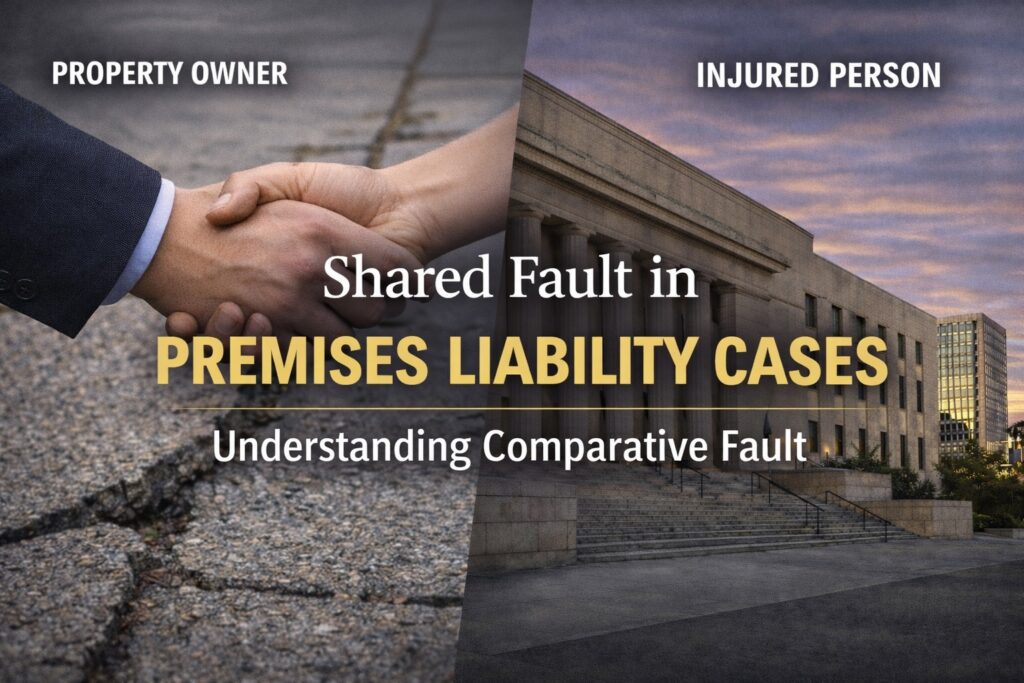
In many California premises liability cases, property owners do not deny that a dangerous condition existed. Instead, they argue that the injured person was at least partly to blame.
This defense is known as comparative fault. While it can reduce damages, it does not automatically defeat a premises liability claim.
Understanding how comparative fault works — and how insurers misuse it — is critical to protecting your recovery.
What Is Comparative Fault?
California follows a pure comparative fault system.
Under California law, an injured person may still recover damages even if they were partially responsible for the accident, with any recovery reduced only by their percentage of fault — and no level of shared fault automatically bars recovery.
In practical terms, if a jury finds a plaintiff 20% at fault and the property owner 80% at fault, the plaintiff may still recover 80% of their damages.
Comparative Fault Is Not a Defense to Dangerous Conditions
Property owners often treat comparative fault as if it excuses unsafe property conditions. It does not.
Comparative fault addresses how responsibility is divided, not whether the property owner breached their duty in the first place.
A property owner may still be liable when:
- A dangerous condition existed
- The risk of injury was foreseeable
- Reasonable steps to repair or warn were not taken
Shared fault does not erase these duties.
Common Comparative Fault Arguments Property Owners Use
Defendants frequently argue that the injured person:
- Was not paying attention
- Was distracted by a phone
- Wore improper footwear
- Ignored warning signs
- Chose an unsafe path
These arguments are common — and often overstated.
California law does not require people to anticipate negligence every time they walk onto someone else’s property.
Distraction Does Not Automatically Mean Fault
One of the most common comparative fault arguments is that the injured person was “distracted.”
But distraction is often foreseeable, especially in:
- Retail stores
- Parking lots and garages
- Apartment complexes
- Busy walkways
Property owners are expected to design and maintain property with normal human behavior in mind. A hazard that becomes dangerous only when someone is reasonably distracted may still support significant liability.
“Open and Obvious” Does Not Eliminate Comparative Fault
Property owners often argue that a hazard was “open and obvious.”
Even if a condition is visible:
- The owner may still have a duty to fix or warn
- Fault allocation is typically a jury question
- Visibility alone does not eliminate unreasonable risk
A visible hazard can still be dangerous.
Comparative Fault vs. Assumption of Risk
Comparative fault is different from assumption of risk.
Assumption of risk applies only in limited situations, typically involving:
- Inherently dangerous recreational activities
- Voluntary participation in known risks
Most everyday premises liability cases — including slip and falls, broken stairs, poor lighting, and negligent security — are governed by comparative fault, not assumption of risk.
How Fault Is Decided in Premises Liability Cases
Fault allocation is typically decided by a jury based on the totality of the circumstances.
Evidence influencing fault may include:
- Lighting and visibility conditions
- Warning signs and their placement
- Prior complaints or similar incidents
- Property layout and design
- Reasonableness of the injured person’s conduct
Comparative fault is rarely a simple, one-sided determination.
Why Comparative Fault Arguments Often Backfire
Overreliance on comparative fault can hurt property owners.
Juries often react negatively when:
- Known hazards are ignored
- Insurers shift blame instead of addressing safety
- Minor conduct is exaggerated to avoid responsibility
In many cases, aggressive comparative fault arguments increase the defendant’s perceived fault.
How WIN Injury & Accident Trial Lawyers Handles Comparative Fault
At WIN Injury & Accident Trial Lawyers, we confront comparative fault head-on.
Our approach includes:
- Reframing alleged “plaintiff fault” as foreseeable behavior
- Demonstrating how the dangerous condition created the risk
- Using evidence to show preventability
- Preventing blame-shifting from overshadowing unsafe property conditions
We ensure comparative fault is treated as a damages issue, not a liability escape hatch.
Injured on Unsafe Property? Shared Fault Does Not End Your Case.
If you were injured on dangerous property, being partially at fault does not eliminate your claim.
📞 Contact WIN Injury & Accident Trial Lawyers for a free consultation.
We’ll evaluate fault fairly, protect your recovery, and hold property owners accountable.
Get Help From WIN Injury & Accident Trial Lawyers
Why Legal Representation Matters
Insurance companies often undervalue pain and suffering—offering minimal settlements that ignore your daily struggles. A skilled attorney can:
- Present powerful evidence of your emotional and physical suffering
- Retain expert witnesses to quantify your losses
- Use verdict data to justify higher multipliers or per diem rates
- Argue your case persuasively before a jury
At WIN Trial Lawyers, our team fights to ensure that your recovery reflects the full extent of your suffering—not just your bills.

At WIN Trial Lawyers, we know how personal injury claims can be can be. Victims often face mounting medical bills, lost wages, and emotional trauma. Our team has successfully taken on insurance companies and third parties, recovering millions for injured clients.
If you or a loved one has been injured in an accident, don’t leave your future in the hands of the insurance company. You need experienced trial lawyers who know how to prove liability and fight for maximum compensation.
If you or a loved one has been injured, don’t face this alone. The sooner you act, the stronger your case will be.