

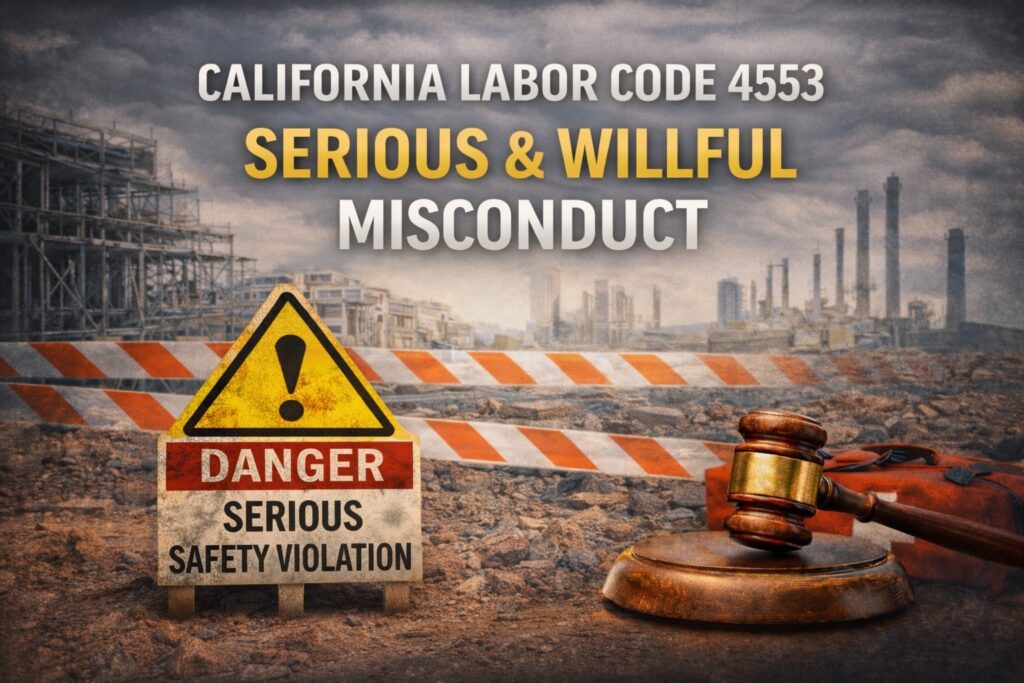
When a workplace injury happens, most California workers’ compensation claims are handled under a no-fault system. That means employees usually receive benefits regardless of who caused the accident — and employers are generally protected from additional liability.
But there is a major exception.
California Labor Code 4553 allows increased compensation when an employee’s injury is caused by the employer’s serious and willful misconduct.
This statute is designed to punish egregious safety violations, not ordinary negligence.
What Is “Serious & Willful Misconduct”?
“Serious and willful misconduct” is more than carelessness or a simple mistake.
It typically involves:
- A knowing or reckless disregard for employee safety
- Intentional failure to correct known hazards
- Deliberate violation of safety laws or regulations
- Conduct that shows indifference to the consequences
In short, the employer knew about a dangerous condition and failed to act, or intentionally exposed workers to danger.
How Labor Code 4553 Works
If serious and willful misconduct is proven:
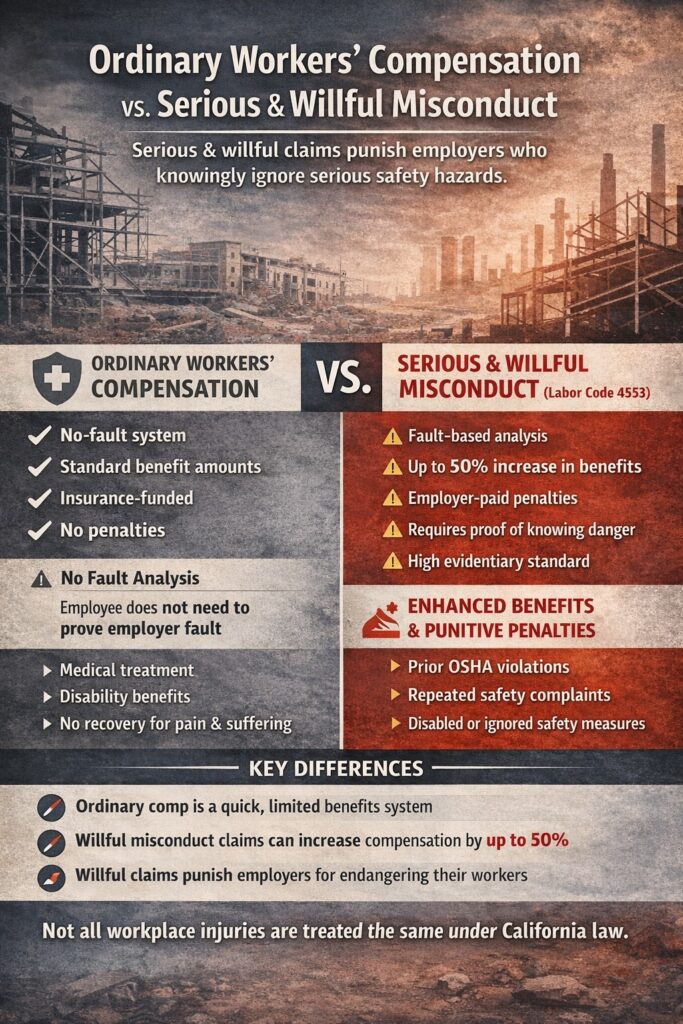
- The injured worker’s workers’ compensation benefits may be increased by up to 50%
- The increase applies to most compensation benefits
- The increase is paid by the employer, not the insurance carrier
This penalty is in addition to standard workers’ compensation benefits.
What an Injured Worker Must Prove
These cases are heavily litigated because the standard is high.
An injured worker generally must show:
- The employer knew of the dangerous condition
- The condition violated safety rules or standards
- The employer intentionally or recklessly failed to correct it
- The misconduct was a substantial cause of the injury
Evidence often includes prior complaints, safety citations, ignored warnings, training failures, or internal communications.
Common Examples of Serious & Willful Misconduct
Not every safety violation qualifies. Examples that may support a claim include:
- Ignoring known OSHA or Cal/OSHA violations
- Removing or disabling safety guards on machinery
- Requiring employees to work with defective equipment
- Forcing workers to perform dangerous tasks without required protection
- Repeated safety violations with no corrective action
Each case depends on its specific facts.
How This Differs from Ordinary Negligence
Most workplace injuries involve ordinary negligence, which does not trigger Labor Code 4553.
Serious and willful misconduct requires:
- Knowledge of the danger
- Conscious failure to act
- Conduct approaching recklessness
That distinction is why these claims are rare — but extremely powerful when supported by evidence.
Can an Employer Defend a Serious & Willful Claim?
Yes. Employers commonly argue:
- The hazard was unknown
- The injury was caused by employee misconduct
- Safety policies and training were in place
- The violation was accidental, not intentional
These defenses make early investigation critical.
Why These Claims Matter
A successful Labor Code 4553 claim can significantly increase the value of a workers’ compensation case and hold employers accountable for extreme safety failures.
Because the standard is high, these claims require experienced legal analysis, aggressive discovery, and strong evidence development.
Key Takeaway
Labor Code 4553 punishes employers who knowingly place workers in danger.
When safety violations cross the line from careless to reckless, the law allows injured workers to recover increased compensation.
Workers’ Comp vs. Personal Injury: Key Differences
| Workers’ Comp | Personal Injury |
|---|---|
| No fault required | Fault must be proven |
| Limited benefits | Full damages available |
| No pain & suffering | Pain & suffering allowed |
| No jury | Jury trial available |
Exclusivity determines which path—or both—are available.
Get Help From WIN Injury & Accident Trial Lawyers
Why Legal Representation Matters
Insurance companies often undervalue pain and suffering—offering minimal settlements that ignore your daily struggles. A skilled attorney can:
- Present powerful evidence of your emotional and physical suffering
- Retain expert witnesses to quantify your losses
- Use verdict data to justify higher multipliers or per diem rates
- Argue your case persuasively before a jury
At WIN Trial Lawyers, our team fights to ensure that your recovery reflects the full extent of your suffering—not just your bills.

At WIN Trial Lawyers, we know how personal injury claims can be can be. Victims often face mounting medical bills, lost wages, and emotional trauma. Our team has successfully taken on insurance companies and third parties, recovering millions for injured clients.
If you or a loved one has been injured in an accident, don’t leave your future in the hands of the insurance company. You need experienced trial lawyers who know how to prove liability and fight for maximum compensation.
If you or a loved one has been injured, don’t face this alone. The sooner you act, the stronger your case will be.
🔗 Related Posts:
Frequently Asked Questions (FAQs): Labor Code 4553 – Serious & Willful Misconduct
What is Labor Code 4553?
California Labor Code 4553 allows an injured worker to receive increased workers’ compensation benefits when the employer’s conduct rises to the level of serious and willful misconduct.
In short, it punishes employers who knowingly expose workers to dangerous conditions.
What does “serious and willful misconduct” mean?
It means more than ordinary negligence.
Serious and willful misconduct generally involves:
- Knowing a dangerous condition exists
- Understanding that serious injury is likely
- Failing to correct the hazard anyway
It reflects a conscious disregard for employee safety.
Is serious and willful misconduct the same as negligence?
No.
Negligence involves carelessness.
Serious and willful misconduct involves intentional or reckless indifference to safety.
The standard is much higher.
Do OSHA or Cal/OSHA violations matter?
Yes — significantly.
Prior or repeated OSHA violations can be strong evidence that:
- The employer knew about the hazard
- The employer ignored safety obligations
While a violation alone is not automatic proof, it often plays a central role.
Does the employer have to intend to hurt the worker?
No.
The employer does not need to intend injury.
What matters is that the employer knew the danger existed and failed to act.
How much does Labor Code 4553 increase benefits?
If proven, workers’ compensation benefits may be increased by up to 50%.
This increase applies to:
- Disability benefits
- Medical-related compensation
However, the increase is capped by statute.
Are pain and suffering damages available?
No.
Labor Code 4553 does not allow pain and suffering damages.
It only increases workers’ compensation benefits.
That said, it can significantly increase the total value of a comp case.
Who pays the increased benefits?
The employer, not the insurance carrier.
Insurance companies generally do not cover serious and willful penalties, which makes these claims especially high-pressure for employers.
Can an employee bring a serious and willful claim without a workers’ comp case?
No.
A Labor Code 4553 claim must be brought within a workers’ compensation case.
It is not a standalone civil lawsuit.
What kinds of conduct support a serious and willful claim?
Common examples include:
- Removing or disabling safety guards
- Ignoring repeated safety complaints
- Failing to repair known hazardous equipment
- Ordering employees to work in unsafe conditions
- Violating safety laws after prior warnings
Patterns matter more than isolated mistakes.
Does a single safety violation qualify?
Usually not — unless the violation is extreme.
Most successful claims involve:
- Repeated violations
- Prior warnings or inspections
- Long-standing unsafe practices
What evidence is used to prove serious and willful misconduct?
Key evidence often includes:
- OSHA or Cal/OSHA citations
- Prior accident reports
- Safety complaints or emails
- Maintenance and inspection records
- Supervisor testimony
These cases are evidence-heavy.
What is the burden of proof?
The injured worker has the burden to prove serious and willful misconduct by a preponderance of the evidence.
Because the standard is high, preparation matters.
Can an employer defend against a serious and willful claim?
Yes. Common defenses include:
- Lack of knowledge of the hazard
- Immediate corrective action
- Employee misconduct or misuse
- Compliance with safety regulations
These defenses often hinge on documentation and credibility.
How long do serious and willful claims take?
They often take longer than standard workers’ comp claims because:
- Additional discovery is involved
- Employer defenses are aggressively litigated
- Evidence must be developed in detail
Can serious and willful misconduct affect settlement value?
Absolutely.
Even when not fully proven, a well-supported claim can:
- Increase settlement leverage
- Pressure employers directly
- Change negotiation dynamics
Is serious and willful misconduct common?
No.
These claims are relatively rare because the legal standard is intentionally high — but when they apply, they are extremely powerful.
Can a worker bring both a serious and willful claim and a retaliation claim?
Yes.
It is common to see:
- Labor Code 4553 (increased comp benefits), and
- Labor Code 6310 (safety retaliation)
asserted together when employers respond badly to safety issues.
Should I talk to a lawyer before filing a serious and willful claim?
Yes.
These claims require:
- Early evidence preservation
- Strategic pleading
- Careful coordination with the underlying comp case
Mistakes can permanently weaken the claim.