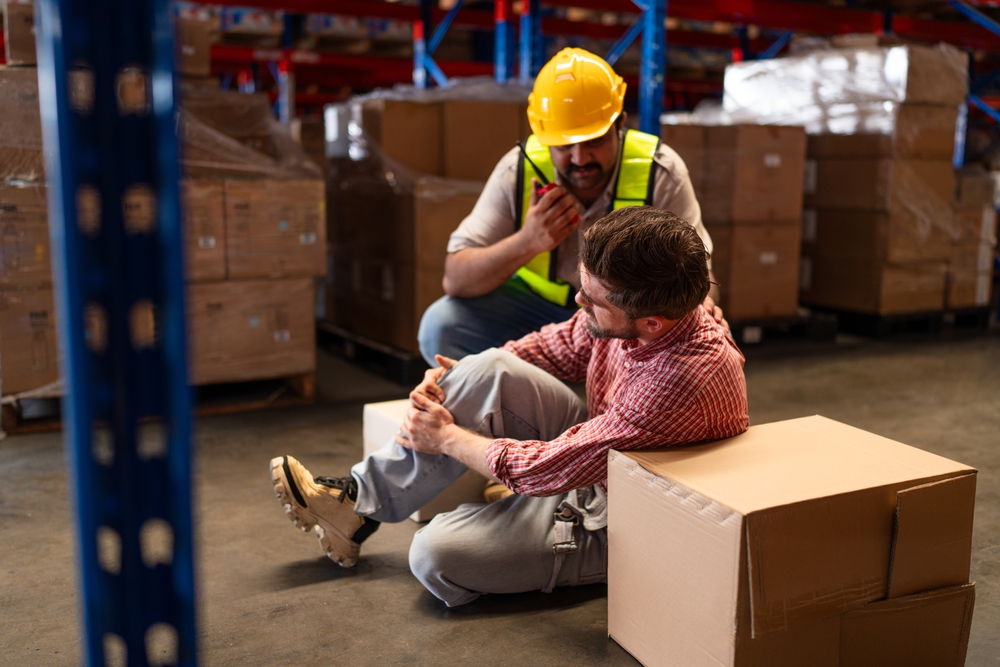
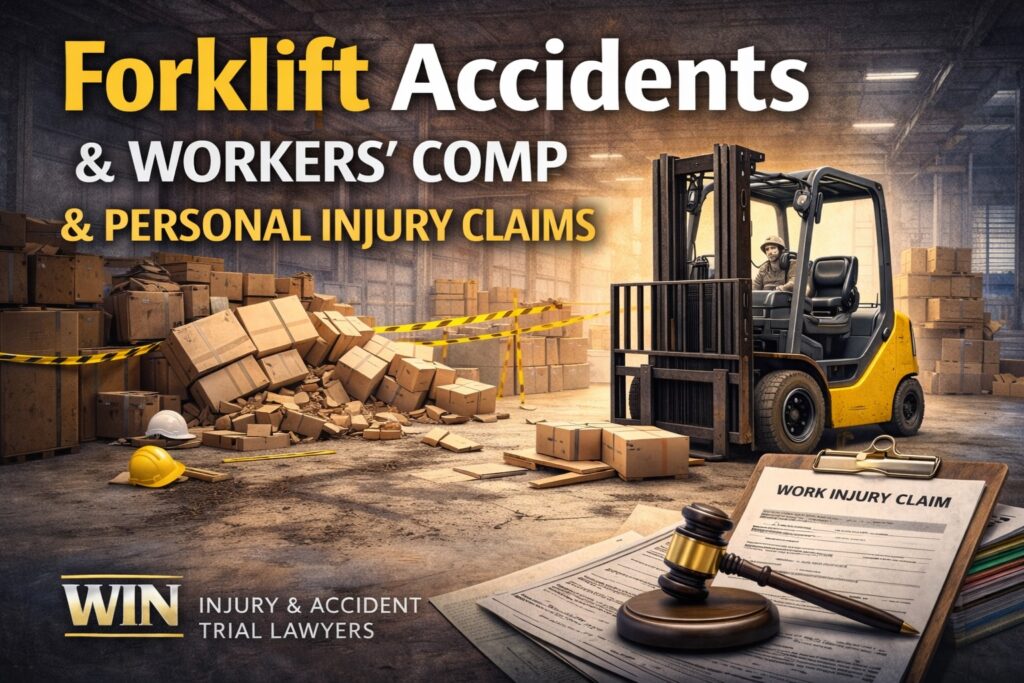
Forklifts are essential tools in warehouses, factories, construction sites, and distribution centers across California—but when something goes wrong, the consequences can be devastating. Forklift accidents frequently result in crushing injuries, amputations, spinal trauma, traumatic brain injuries, and fatalities.
What many injured workers and families don’t realize is that forklift accidents can involve more than one legal claim. Depending on how the accident happened, an injured person may be entitled to workers’ compensation benefits, a personal injury lawsuit, or both.
At WIN Injury & Accident Trial Lawyers, our attorneys handle forklift accident cases at the intersection of workers’ compensation and civil personal injury law, ensuring no source of compensation is left on the table.
WhWhy Forklift Accidents Are So Dangerous
Forklifts are deceptively dangerous pieces of industrial equipment. While they are a daily presence in warehouses, factories, ports, and construction sites, forklifts were not designed with the same safety margins as passenger vehicles. They weigh thousands of pounds, often operate without full enclosures, and are frequently used in environments where pedestrians, vehicles, and heavy materials occupy the same space.
Limited visibility is a major factor. Forklift operators often have blind spots caused by:
- The mast and forks
- Large or unstable loads
- Poor lighting or crowded aisles
Combined with tight deadlines and fast-paced operations, even a brief lapse in attention—or a split-second mechanical failure—can lead to catastrophic consequences.
Common forklift hazards include:
- Tip-overs and rollovers, especially during sharp turns or when carrying elevated loads
- Crushing injuries, where workers are pinned between a forklift and a wall, pallet rack, truck, or other equipment
- Pedestrian impacts, when workers on foot are struck in shared work zones
- Falling or shifting loads, which can strike workers from above
- Backover accidents, caused by blind spots and lack of spotters
- Mechanical or braking failures, including steering defects or faulty restraints
According to the Occupational Safety and Health Administration (OSHA), forklift accidents are consistently among the leading causes of serious and fatal injuries in industrial workplaces—particularly when training, maintenance, or site safety protocols are inadequate.
Common Forklift Accident Injuries
Because of the size, weight, and force involved, forklift accidents rarely result in minor injuries. Instead, they often cause severe, permanent, or life-altering harm, even at relatively low speeds.
Common forklift accident injuries include:
- Traumatic brain injuries (TBIs), caused by direct impact or falling objects
- Spinal cord injuries, which can result in partial or complete paralysis
- Amputations and crush injuries, particularly to hands, arms, legs, and feet
- Severe fractures, including broken hips, pelvises, legs, and arms
- Internal organ damage, often requiring emergency surgery
- Deep lacerations and permanent scarring, especially in crushing or falling-load incidents
- Fatal injuries, which tragically occur in some rollover or crushing accidents
These injuries frequently require extensive medical treatment, multiple surgeries, long-term rehabilitation, and time away from work. In many cases, injured workers face permanent disability or reduced earning capacity.
Because of the seriousness of these injuries and the long-term consequences they create, forklift accident claims are often high-value cases—particularly when both workers’ compensation benefits and personal injury claims are properly identified and pursued.
Workers’ Compensation for Forklift Accidents
If you were injured by a forklift while performing your job, you are generally entitled to workers’ compensation benefits, regardless of who was at fault.
Workers’ Compensation Benefits May Include:
- All reasonable and necessary medical treatment
- Temporary disability benefits for lost wages
- Permanent disability benefits
- Supplemental job displacement benefits
- Mileage and out-of-pocket reimbursements
Workers’ compensation is a no-fault system, meaning you do not need to prove negligence. However, workers’ comp does not provide damages for pain and suffering, which is where many injured workers fall short if they stop there.
When Forklift Accidents Also Involve a Personal Injury Claim
In many forklift accidents, someone other than your employer caused or contributed to the injury. When that happens, you may have a separate personal injury lawsuit in addition to your workers’ compensation claim.
These are known as third-party claims.
Common Third-ParCommon Third-Party Forklift Accident Scenarios
While workers’ compensation typically covers forklift injuries that occur on the job, many serious forklift accidents are caused by third parties, opening the door to a separate personal injury lawsuit. Identifying these third-party scenarios is critical, because they allow injured workers to recover damages that workers’ comp does not cover—such as pain and suffering and full lost wages.
Below are some of the most common third-party forklift accident scenarios.
1. Negligent Forklift Operators (Non-Employer)
Forklifts are often operated by individuals who are not employed by the injured worker’s direct employer. When that happens, the injured worker may have a personal injury claim against both the operator and their employer.
This commonly includes forklift operators who are:
- Subcontractors working on the same job site
- Vendors or delivery drivers making pickups or drop-offs
- Temporary staffing workers employed by a separate labor agency
These operators may be unfamiliar with the site layout, poorly trained, or rushed to meet deadlines—leading to collisions, crushing incidents, or pedestrian strikes.
If a non-employer forklift operator caused the accident through negligence, unsafe operation, speeding, distraction, or failure to follow safety rules, a third-party personal injury claim may apply, even though workers’ compensation benefits are also available.
2. Unsafe Property Conditions
Forklift accidents are frequently the result of dangerous site conditions, not operator error alone. In many warehouses, factories, and construction sites, forklifts operate in environments that were never properly designed for safe traffic flow.
Common hazardous property conditions include:
- Narrow, cluttered, or obstructed aisles
- Poor lighting that limits visibility
- Uneven, cracked, or slippery flooring
- Missing or faded safety markings and warning signage
- Improper traffic flow design that mixes forklifts and pedestrians
When these conditions contribute to an accident, property owners, warehouse operators, general contractors, or site managers may be liable for failing to maintain a reasonably safe environment.
These cases often fall under premises liability law, and liability may exist even if the injured worker does not work directly for the property owner.
3. Defective Forklifts or Equipment
Not all forklift accidents are caused by human error. Many are the result of mechanical failures or design defects that make the equipment unreasonably dangerous.
Defects commonly involved in forklift accidents include:
- Brake failures or delayed stopping
- Steering or control defects
- Hydraulic malfunctions causing dropped or shifting loads
- Faulty seatbelts or restraint systems
- Design flaws that increase rollover risk or instability
When a forklift malfunctions despite proper use, injured workers may have a product liability claim against:
- The forklift manufacturer
- Parts manufacturers
- Distributors or sellers
- Maintenance or repair companies
Unlike negligence claims, product liability cases often do not require proof of fault—only that the equipment was defective and caused injury.
4. Improper Training or Safety Violations
Forklift operators are required to receive proper training and certification before operating equipment. Accidents caused by lack of training or safety violations can expose third parties—and in rare cases, create exceptions to employer immunity.
Forklift accidents may involve liability where there is evidence of:
- Untrained or improperly certified operators
- Inadequate supervision or oversight
- Failure to enforce safety protocols
- Violations of industry or regulatory safety standards
According to the Occupational Safety and Health Administration (OSHA), inadequate training and failure to follow safety rules are leading contributors to forklift-related injuries and fatalities.
While workers’ compensation generally shields employers from lawsuits, serious safety violations or third-party training failures can sometimes create additional legal exposure that must be carefully evaluated.
Why Identifying Third-Party Liability Matters
Many injured workers assume workers’ compensation is their only remedy—but third-party forklift accident claims can dramatically change the outcome of a case.
Identifying third-party liability can:
- Unlock compensation beyond workers’ comp limits
- Allow recovery for pain and suffering
- Increase overall settlement value
- Hold negligent companies accountable
At WIN Injury & Accident Trial Lawyers, we investigate forklift accidents from every angle—operator conduct, property conditions, equipment defects, and safety compliance—to ensure no responsible party escapes liability.
Workers’ Comp vs. Personal Injury: Key Differences
| Workers’ Compensation | Personal Injury |
|---|---|
| No-fault system | Fault-based |
| Medical care covered | Medical care covered |
| Partial wage replacement | Full lost wages |
| No pain & suffering | Pain & suffering damages |
| Limited benefits | Potentially significant recovery |
The biggest mistake forklift accident victims make is assuming workers’ comp is their only option.
Can You Have Both a WC Claim and a Personal Injury Case?
Yes. In fact, many serious forklift accident cases involve both claims at the same time.
This strategy can:
- Maximize total compensation
- Recover damages workers’ comp does not cover
- Create settlement leverage
- Protect long-term financial security
When a third-party recovery occurs, workers’ comp may assert a lien—but even after reimbursement, injured workers often net substantially more than workers’ comp alone.
What to Do After a Forklift Accident
If you or a loved one was injured in a forklift accident:
- Report the injury immediately
- Seek medical treatment
- Do not give recorded statements without legal advice
- Preserve evidence (photos, witnesses, incident reports)
- Speak with an attorney experienced in both WC and personal injury
Early investigation is critical—forklift cases often involve quickly disappearing evidence and aggressive insurance defense strategies.
Why Forklift Accident Cases Require Specialized Legal Experience
Forklift accident cases sit at the crossroads of:
- Workers’ compensation law
- Personal injury litigation
- Product liability
- Insurance coverage disputes
Handling only one side of the case often leaves money on the table.
At WIN Injury & Accident Trial Lawyers, our team coordinates WC and civil litigation strategy to ensure injured workers receive every dollar the law allows.
Speak With a Forklift Accident Lawyer in California
Forklift accidents are serious—and so are the legal issues that follow.
If you were injured by a forklift at work or on a job site, you may have more rights than you realize.
Get Help From WIN Injury & Accident Trial Lawyers
Why Legal Representation Matters
Insurance companies often undervalue pain and suffering—offering minimal settlements that ignore your daily struggles. A skilled attorney can:
- Present powerful evidence of your emotional and physical suffering
- Retain expert witnesses to quantify your losses
- Use verdict data to justify higher multipliers or per diem rates
- Argue your case persuasively before a jury
At WIN Trial Lawyers, our team fights to ensure that your recovery reflects the full extent of your suffering—not just your bills.
At WIN Trial Lawyers, we know how personal injury claims can be can be. Victims often face mounting medical bills, lost wages, and emotional trauma. Our team has successfully taken on insurance companies and third parties, recovering millions for injured clients.
If you or a loved one has been injured in an accident, don’t leave your future in the hands of the insurance company. You need experienced trial lawyers who know how to prove liability and fight for maximum compensation.
If you or a loved one has been injured, don’t face this alone. The sooner you act, the stronger your case will be.
🔗 Related Posts:
Frequently Asked Questions About Forklift Accidents (Workers’ Comp & Personal Injury)
Is a forklift accident considered a work-related injury?
Yes. If the forklift accident occurred while you were performing job duties or on a job site, it is generally considered a work-related injury and covered under workers’ compensation—even if the accident was not your fault.
Do I qualify for workers’ compensation if I was injured by a forklift?
In most cases, yes. Workers’ compensation benefits apply regardless of fault and may cover medical treatment, temporary disability, permanent disability, and other benefits.
Can I file a personal injury lawsuit for a forklift accident?
Possibly. While workers’ comp typically prevents lawsuits against your employer, you may file a personal injury claim against third parties, such as:
- A subcontractor or outside forklift operator
- A property owner or general contractor
- A forklift manufacturer or maintenance company
- A delivery or logistics company
Many forklift accident cases involve both workers’ comp and personal injury claims.
What is a third-party forklift accident claim?
A third-party claim arises when someone other than your employer caused or contributed to the accident. These claims allow you to seek damages not available under workers’ comp, such as pain and suffering.
Can I have both a workers’ comp claim and a personal injury case at the same time?
Yes. This is common in serious forklift accidents. Handling both claims together often results in significantly higher overall compensation than workers’ comp alone.
What if the forklift operator was a coworker?
If the forklift operator was employed by your same employer, your remedy is usually limited to workers’ compensation. However, if that operator worked for a different company, you may have a personal injury claim.
What if I was hit by a forklift as a pedestrian?
Pedestrians injured by forklifts—especially in warehouses, loading docks, or job sites—often have strong claims. Liability may rest with:
- The forklift operator
- The operator’s employer
- The property owner
- The company responsible for site safety
Can I sue my employer for a forklift accident?
Generally, no. Workers’ compensation is the exclusive remedy against an employer. However, exceptions may apply in rare cases involving serious safety violations, fraudulent concealment, or dual-capacity scenarios.
What if faulty equipment caused the forklift accident?
If the forklift malfunctioned due to defective design, manufacturing defects, or improper maintenance, you may have a product liability claim against:
- The forklift manufacturer
- Parts suppliers
- Maintenance or repair companies
These claims can result in substantial compensation.
What injuries are common in forklift accidents?
Forklift accidents frequently cause severe injuries, including:
- Crush injuries and amputations
- Spinal cord injuries and paralysis
- Traumatic brain injuries (TBIs)
- Broken bones and pelvic fractures
- Internal organ damage
- Fatal injuries
Because of their severity, forklift cases are often high-value claims.
Does workers’ comp cover all my losses?
No. Workers’ comp does not cover:
- Pain and suffering
- Emotional distress
- Full lost wages
- Loss of enjoyment of life
These damages may only be recovered through a personal injury lawsuit.
What if I was injured because of poor training or lack of supervision?
Improper training, lack of certification, or safety violations may support:
- A third-party negligence claim
- A premises liability claim
- A product liability or negligent supervision theory
These facts should be investigated immediately.
What if OSHA safety rules were violated?
OSHA violations can strongly support liability in a personal injury case and may increase settlement value. While OSHA does not provide compensation directly, violations often serve as powerful evidence of negligence.
What should I do immediately after a forklift accident?
You should:
- Report the injury to your employer
- Seek medical treatment right away
- Document the scene if possible
- Identify witnesses
- Avoid giving recorded statements without legal advice
Early action protects both WC and PI claims.
Can insurance companies deny forklift accident claims?
Yes. Employers, workers’ comp carriers, and third-party insurers may dispute:
- Whether the injury was work-related
- The severity of injuries
- Liability
- Causation
Legal representation is critical in contested cases.
How long do I have to file a forklift accident claim in California?
- Workers’ comp: Injury must be reported promptly; delays can jeopardize benefits
- Personal injury: Generally two years from the date of injury
Deadlines are strict, and earlier action is always better.
Will workers’ comp take money from my personal injury settlement?
Possibly. Workers’ comp may assert a lien against a third-party recovery, but even after reimbursement, injured workers often recover far more than workers’ comp alone.
What if I was a temporary worker or independent contractor?
Coverage depends on classification and who controlled the worksite. Many “independent contractors” are legally misclassified and still qualify for workers’ comp and personal injury claims.
How much is a forklift accident case worth?
Value depends on:
- Severity of injuries
- Permanent disability
- Liability evidence
- Available insurance coverage
- Whether both WC and PI claims apply
Serious forklift cases can result in six- or seven-figure recoveries.
Do I need a lawyer for a forklift accident?
Yes—especially when injuries are serious or third parties are involved. Forklift cases require coordination between workers’ compensation and personal injury law, which many firms do not handle together.
Why choose WIN Injury & Accident Trial Lawyers for a forklift accident case?
WIN handles forklift accidents with a dual-track strategy, ensuring:
- Full workers’ comp benefits
- Identification of all third-party claims
- Maximum total recovery
- Protection against insurance tactics
We don’t stop at workers’ comp when more compensation is available.