

Dog bites are unfortunately common in California, particularly in densely populated areas like Los Angeles, Orange, Riverside, and San Bernardino Counties, where close-quarter living, shared outdoor spaces, and high foot traffic increase the risk of serious incidents. These injuries are often sudden and traumatic, and they can cause significant physical harm, including deep puncture wounds, nerve damage, infections, and permanent scarring. In more severe cases—especially involving children and seniors—dog bites can lead to long-term emotional trauma, fear of animals, and post-traumatic stress.
At WIN Injury & Accident Trial Lawyers, we represent dog bite victims throughout Southern California and understand how disruptive these injuries can be to a person’s life. We routinely help clients pursue compensation for medical bills, future treatment, lost income, pain and suffering, emotional distress, and permanent disfigurement. Dog bite cases are often aggressively defended by insurance companies, which may attempt to minimize injuries, dispute liability, or deny coverage altogether. Our firm conducts thorough investigations and strategic litigation to ensure negligent dog owners and insurers are held fully accountable.
This guide explains how California dog bite law works, why a dog owner can be liable even if the dog has never bitten anyone before, how insurance coverage and breed exclusions can affect recovery, and what steps you should take immediately after a bite to protect both your health and your legal rights.
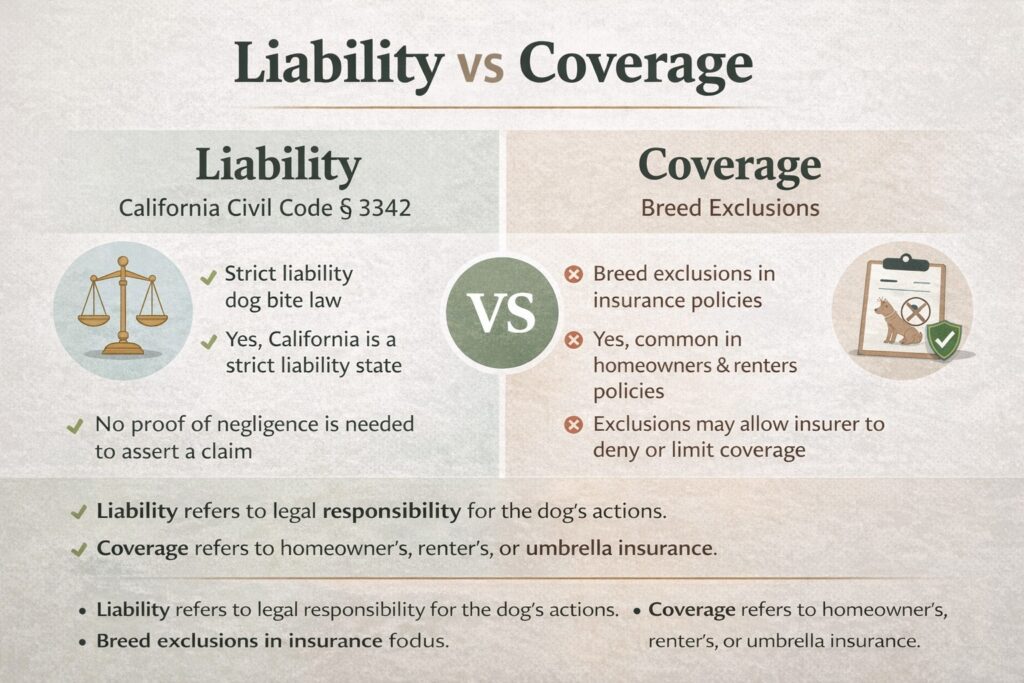
California’s Strict Liability Rule (Civil Code § 3342)
California has one of the most victim-friendly dog bite laws in the country. Under California Civil Code § 3342, the owner of a dog is strictly liable for damages if their dog bites someone while the victim is:
- In a public place, or
- Lawfully on private property (including the dog owner’s own property) at the time of the bite.
“Strict liability” is critical because it means that, in most cases, a dog bite victim does not need to prove negligence, prior attacks, or that the owner knew the dog was dangerous. There is no “one-bite rule” in California. Even a dog with no prior history of aggression can give rise to full legal liability after a single bite.
For victims in Los Angeles, Orange, Riverside, or San Bernardino County, this law allows a claim to be established based largely on the fact of the bite itself, combined with proof that the victim was lawfully present at the location where it occurred.
Being lawfully on private property can include:
- Being invited onto the property, either expressly or implicitly
- Performing work duties, such as mail delivery, package delivery, food delivery, or repair services
- Serving in an official or professional capacity, including utility workers, inspectors, or service providers
However, strict liability generally does not apply to trespassers. If a person was unlawfully on the property at the time of the bite, the analysis may shift to negligence-based claims instead, which can be more complex and fact-specific.
Because insurance companies often attempt to mischaracterize a victim’s presence or minimize the applicability of strict liability, having experienced legal representation is essential to ensure the statute is applied correctly and your rights are fully protected.
Dog Bite Defenses & Exceptions
Although California’s dog bite statute is intentionally victim-friendly, dog owners and their insurance companies often attempt to avoid or reduce liability by raising various defenses. These arguments are common, but they are highly fact-specific and frequently overstated by insurers.
Common defenses include:
- Trespassing or unlawful presence
Strict liability generally does not apply if the injured person was trespassing at the time of the bite. Insurance companies often try to stretch this defense by claiming a victim lacked permission, even when the person was lawfully present for work, delivery, or another legitimate purpose. - Victim provocation of the dog
Insurers may argue the victim provoked the dog by touching, startling, or interacting with it. Minor or accidental conduct, however, does not automatically defeat a claim and must be evaluated in context. - Law enforcement dogs in active duty
Special rules may apply when a police or military dog bites someone while performing official duties. These cases involve different legal standards and defenses, but liability is not automatically barred. - Assumption of risk in certain occupations
In limited circumstances—such as veterinarians, kennel workers, or groomers—defendants may argue the victim assumed the risk of being bitten as part of their job. Even then, this defense does not apply universally and depends on the specific facts and scope of the work being performed.
Even in strict liability cases, comparative fault principles may come into play. If the defense can show that the victim’s conduct meaningfully contributed to the incident, a court or jury may reduce the total recovery. Importantly, this does not eliminate liability—it only affects damages. Insurance companies routinely exaggerate these defenses, which is why careful investigation and legal advocacy are critical.
Breed Exclusions & Insurance Coverage Challenges
While dog breed does not generally affect legal liability under California Civil Code § 3342, it often plays a significant role when dealing with insurance coverage, which is where most dog bite claims are actually paid.
Many homeowners’ and renters’ insurance policies include breed restrictions or exclusions that limit or deny coverage for certain dogs. Commonly excluded or restricted breeds may include (but are not limited to):
- Pit bull–type dogs
- Rottweilers
- German Shepherds
- Dobermans
- Akitas
- Chow Chows
When an insurer relies on a breed exclusion, it may:
- Deny coverage entirely, leaving no insurance funds available
- Refuse to defend the dog owner, shifting the legal burden onto the owner personally
- Force the injured victim to pursue the dog owner’s personal assets instead of an insurance policy
These coverage disputes are especially common in Los Angeles, Orange, Riverside, and San Bernardino Counties, where renters’ insurance policies and cost-driven coverage limitations are widespread. In many cases, the insurance fight becomes as important as the liability case itself.
Insurance litigation can involve:
- Challenging improper breed determinations
- Disputing ambiguous or poorly drafted policy language
- Identifying alternative sources of coverage
- Holding insurers accountable for wrongful denial or bad-faith conduct
Because insurance companies are highly motivated to avoid large dog bite payouts—particularly in cases involving children or permanent scarring—coverage issues are often aggressively contested. Successfully navigating these challenges can make the difference between a minimal recovery and full compensation for the victim’s injuries.
Compensation Available in Dog Bite Cases
Victims of dog bites in California may seek compensation for both economic and non-economic losses. The severity of dog bite injuries is often underestimated, but these cases frequently involve significant medical treatment, permanent scarring, and lasting psychological effects—especially when the victim is a child.
Compensation may include:
- Emergency medical care and follow-up treatment, including urgent care, ER visits, and specialist referrals
- Surgery, stitches, wound care, and scar-revision procedures, which are common in facial and hand injuries
- Infection treatment and rabies-protocol costs, particularly when the dog’s vaccination status is unknown
- Lost wages and loss of future earning capacity if the injury affects the victim’s ability to work
- Pain and suffering, reflecting the physical pain and ongoing discomfort caused by the attack
- Emotional trauma, anxiety, or PTSD, which is especially common in children and seniors
- Permanent scarring and disfigurement, which can have lifelong physical, emotional, and social consequences
Insurance companies often attempt to minimize dog bite claims, downplay scarring, or argue that emotional injuries are exaggerated. This is particularly true in cases involving visible injuries or young victims, where the long-term impact may not be immediately apparent. Experienced legal representation is essential to properly document damages, work with medical and psychological experts, and pursue full and fair compensation through settlement or litigation when necessary.
Steps to Take After a Dog Bite in California
What you do in the hours and days after a dog bite can significantly affect both your health and your legal claim.
If you’ve been bitten in Los Angeles, Orange, Riverside, or San Bernardino County, you should:
- Seek medical care immediately
Dog bites carry a high risk of infection, even when the wound appears minor. Prompt treatment also creates critical medical documentation. - Document the injury thoroughly
Take photographs on the day of the bite and continue documenting healing, scarring, and complications over time. - Identify the dog and its owner
Obtain names, contact information, and—if possible—the dog’s vaccination and insurance details. - Report the bite to local animal control or law enforcement
Official reports help establish the incident and may uncover prior complaints involving the same dog. - Preserve physical evidence
Keep torn clothing, broken leashes, or any other items involved in the incident. - Avoid speaking with insurance adjusters before getting legal advice
Insurers often seek early statements to limit liability or reduce claim value. - Contact an experienced California dog bite attorney
Early legal involvement helps preserve evidence, address insurance coverage issues, and protect your rights from the outset.
Deadlines to Know
In California, the statute of limitations for most dog bite personal injury claims is two years from the date of the injury. Missing this deadline can permanently bar your right to recover compensation, regardless of how strong the case may be.
Special rules may apply in certain situations:
- Claims involving minors may have extended timelines
- Government-related claims (such as bites involving public entities) may have shorter notice requirements
Because these deadlines can vary and exceptions are limited, prompt legal evaluation is critical. Acting early helps ensure compliance with all filing requirements while allowing time to properly investigate and build the strongest possible case.
Why You Need a Local Dog Bite Attorney
Dog bite cases in Southern California often involve:
- Multiple defendants (owners, landlords, pet supervisors)
- Insurance coverage disputes and breed exclusions
- False defenses by insurers or owners
- Severe, life-altering injuries
At WIN Injury & Accident Trial Lawyers, we combine local knowledge of courts in Los Angeles, Orange, Riverside, and San Bernardino Counties with aggressive litigation experience to maximize compensation for seriously injured victims.
Get Help From WIN Injury & Accident Trial Lawyers
Why Legal Representation Matters
Insurance companies often undervalue pain and suffering—offering minimal settlements that ignore your daily struggles. A skilled attorney can:
- Present powerful evidence of your emotional and physical suffering
- Retain expert witnesses to quantify your losses
- Use verdict data to justify higher multipliers or per diem rates
- Argue your case persuasively before a jury
At WIN Trial Lawyers, our team fights to ensure that your recovery reflects the full extent of your suffering—not just your bills.

At WIN Trial Lawyers, we know how personal injury claims can be can be. Victims often face mounting medical bills, lost wages, and emotional trauma. Our team has successfully taken on insurance companies and third parties, recovering millions for injured clients.
If you or a loved one has been injured in an accident, don’t leave your future in the hands of the insurance company. You need experienced trial lawyers who know how to prove liability and fight for maximum compensation.
If you or a loved one has been injured, don’t face this alone. The sooner you act, the stronger your case will be.
🔗 Related Posts:
Frequently Asked Questions (FAQs): Dog Bites in California
Is California a strict liability state for dog bites?
Yes. California follows strict liability for dog bites under Civil Code § 3342. This means a dog owner is generally responsible for injuries caused by their dog even if the dog has never bitten anyone before and even if the owner did nothing “wrong.”
Do I have a claim if the dog never showed aggression before?
Yes. California does not follow the “one-bite rule.” A dog’s lack of prior aggression does not protect the owner from liability.
What if the dog bite happened at the owner’s home?
Strict liability still applies as long as you were lawfully on the property. This includes being invited over, attending a social gathering, or entering the property for work or delivery purposes.
What does “lawfully on private property” mean?
You are generally considered lawfully on private property if you were:
- Invited onto the property (expressly or implicitly)
- Performing job duties (delivery driver, mail carrier, contractor)
- Serving in an official or professional capacity
Trespassers are typically excluded from strict liability protection.
Can a dog owner escape liability by saying I provoked the dog?
Provocation is commonly argued but rarely dispositive. Minor or accidental conduct usually does not defeat a claim. At most, it may reduce compensation under comparative fault principles.
Does breed matter in California dog bite cases?
Not for liability. The law applies to any dog.
However, breed often matters for insurance coverage, as some policies contain breed exclusions that insurers use to deny claims.
What are breed exclusions?
Some homeowners’ and renters’ insurance policies exclude coverage for certain breeds. If an exclusion applies, the insurer may:
- Deny coverage
- Refuse to defend the owner
- Force the victim to pursue the owner’s personal assets
These exclusions are frequently disputed and aggressively litigated.
Can I still recover compensation if there is no insurance coverage?
Possibly. You may pursue:
- The dog owner’s personal assets
- Other responsible parties (such as landlords)
- Alternative insurance policies
Coverage issues do not eliminate legal liability.
Can a landlord be liable for a tenant’s dog bite?
In some cases, yes. A landlord may be liable if they:
- Knew the dog was dangerous
- Had the ability to remove or control the dog
- Failed to act despite prior incidents or complaints
Landlord liability is fact-specific and often contested.
What damages can I recover in a California dog bite case?
Compensation may include:
- Medical expenses and future treatment
- Lost wages and diminished earning capacity
- Pain and suffering
- Emotional distress or PTSD
- Permanent scarring or disfigurement
Children and facial-injury cases often involve particularly significant damages.
What if my child was bitten by a dog?
Dog bite cases involving children are taken extremely seriously. Children are more likely to suffer:
- Facial injuries
- Permanent scarring
- Psychological trauma
Courts and juries often recognize the long-term impact of these injuries.
What if the bite didn’t break the skin?
You may still have a claim. Even non-puncture bites can cause:
- Nerve damage
- Infections
- Psychological trauma
Medical evaluation and documentation are critical.
Do dog bite cases usually settle or go to trial?
Many cases settle, but insurance companies often fight hard—especially where scarring, children, or breed exclusions are involved. Some cases must be litigated to obtain fair compensation.
How long do I have to file a dog bite claim in California?
In most cases, you have two years from the date of the bite. Claims involving minors or public entities may follow different timelines. Missing the deadline can permanently bar recovery.
Should I talk to the insurance company before hiring a lawyer?
No. Insurance adjusters often seek early statements to minimize or deny claims. Speaking with a lawyer first helps protect your rights and preserves the value of your case.
Why should I hire a lawyer for a dog bite case?
Dog bite claims often involve:
- Insurance coverage disputes
- Breed exclusions
- Comparative fault arguments
- Scarring and long-term damages
Experienced representation helps level the playing field and maximize recovery.
Why choose WIN Injury & Accident Trial Lawyers?
WIN represents dog bite victims across Los Angeles, Orange, Riverside, and San Bernardino Counties and is experienced in:
- Strict liability dog bite law
- Insurance coverage and breed-exclusion disputes
- High-value scarring and child-injury cases
- Aggressive negotiation and litigation