

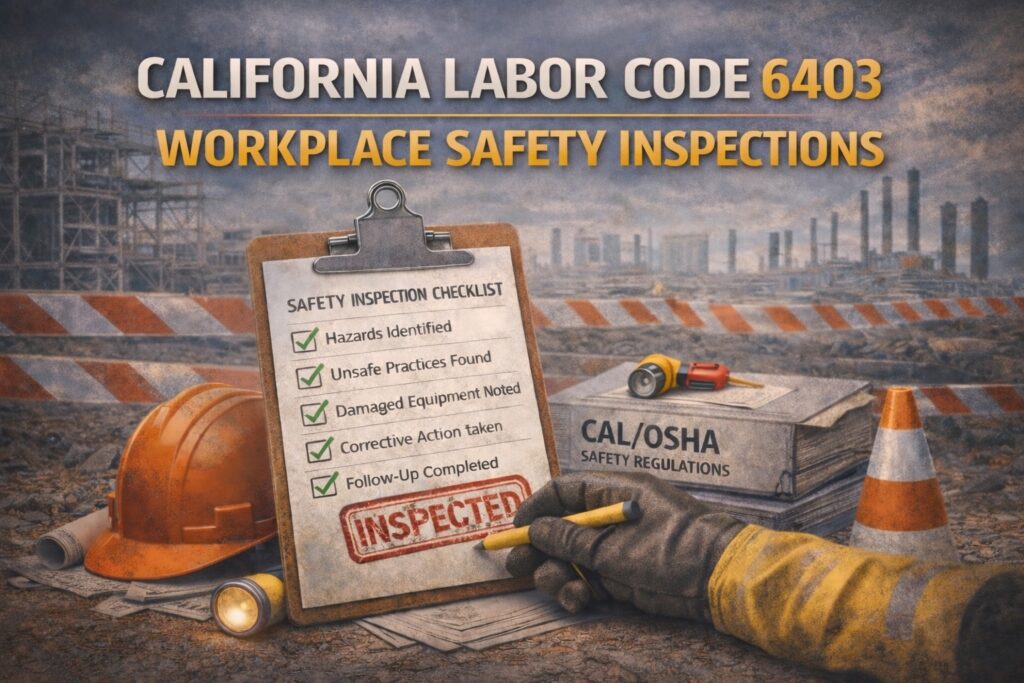
California law does not just require employers to talk about safety — it requires them to actively inspect the workplace for hazards.
Labor Code § 6403 imposes a clear duty on employers to conduct regular and effective safety inspections to identify and correct unsafe conditions before workers are injured.
When employers fail to inspect, injuries are often foreseeable and preventable — and that failure can carry serious legal consequences.
What Does Labor Code 6403 Require?
Labor Code 6403 places an affirmative duty on employers to actively monitor workplace safety. It is not enough to respond after an injury occurs.
Under the statute, employers are required to:
- Regularly inspect places of employment
Inspections must occur often enough to catch hazards before they cause harm. The frequency depends on the type of work, equipment used, and level of risk. - Identify unsafe or unhealthy conditions
Employers must look for physical hazards, environmental dangers, and conditions that could reasonably lead to injury or illness. - Detect unsafe work practices
The duty extends beyond equipment. Employers must also identify unsafe methods, shortcuts, or practices that put workers at risk. - Take timely action to correct hazards
Once a hazard is identified, the employer must act promptly. Delays or half-measures can violate the statute.
Inspections must be meaningful and ongoing. A quick walk-through, a box-checking exercise, or a one-time inspection does not satisfy the law.
Safety Inspections Must Be Proactive — Not Reactive
After a workplace injury, employers often claim:
“We didn’t know about the hazard.”
Labor Code 6403 exists to eliminate that excuse.
The statute requires employers to look for dangers before injuries occur, not wait for an accident to expose unsafe conditions. When inspections are not performed properly, the law treats that failure as significant.
A lack of proactive inspections often means:
- The hazard was known or should have been known
- The risk was foreseeable
- The injury was preventable
In many cases, the absence of inspections becomes evidence that safety was not taken seriously.
Common Safety Inspection Failures
In real-world cases, employers frequently claim that inspections were performed — but the evidence tells a different story.
Common inspection failures we see include:
- No written inspection records
Employers cannot show when inspections occurred or what was reviewed. - Inspections performed only after accidents
Reactive inspections do not satisfy the statute. - Generic or boilerplate checklists
One-size-fits-all forms that ignore job-specific risks are often meaningless. - Untrained supervisors
Supervisors assigned to inspect hazards without safety training frequently miss obvious dangers. - Identified hazards that were never corrected
Noting a hazard without fixing it is not compliance.
A “paper inspection” — one that exists only on a form — is not the same as a legally compliant safety inspection under Labor Code 6403.
Why Safety Inspections Matter in Injury Cases
Safety inspection failures play a critical role in both workers’ compensation and civil injury cases.
1. Workers’ Compensation Exposure
Failure to inspect can support:
- Serious and willful misconduct claims
- Increased benefit exposure
- Evidence that the employer ignored known risks
2. Personal Injury & Third-Party Claims
When inspections are not performed — especially on construction sites or shared workplaces — liability may extend beyond workers’ comp, including:
- Negligence claims
- Negligence per se arguments
- Claims against general contractors or third parties
Safety Inspections and OSHA Violations
Labor Code 6403 works closely with Cal/OSHA inspection requirements.
When an employer:
- Fails to inspect the workplace and
- Violates OSHA safety standards
those violations may serve as powerful evidence that the employer failed to meet its legal safety duties.
Construction Sites and High-Risk Workplaces
Safety inspections are especially critical in high-risk environments such as:
- Construction sites
- Warehouses
- Manufacturing facilities
- Industrial job sites
These workplaces require frequent and documented inspections due to constantly changing conditions.
Why Injured Workers Should Care About Safety Inspections
Injured workers often assume inspections are an internal employer issue. They are not.
Inspection failures can affect:
- Whether liability is disputed
- Whether penalties apply
- Whether third-party claims exist
- How much leverage exists in settlement negotiations
Understanding whether inspections were performed — and documented — can materially change the value of a case.
The Bottom Line
Labor Code § 6403 requires employers to actively inspect workplaces — not simply react after injuries occur.
When safety inspections are skipped, rushed, or ignored, injuries become predictable — and liability follows.
If you were injured at work and suspect safety inspections were not properly performed, that failure matters.
Workers’ Comp vs. Personal Injury: Key Differences
| Workers’ Comp | Personal Injury |
|---|---|
| No fault required | Fault must be proven |
| Limited benefits | Full damages available |
| No pain & suffering | Pain & suffering allowed |
| No jury | Jury trial available |
Get Help From WIN Injury & Accident Trial Lawyers
Why Legal Representation Matters
Insurance companies often undervalue pain and suffering—offering minimal settlements that ignore your daily struggles. A skilled attorney can:
- Present powerful evidence of your emotional and physical suffering
- Retain expert witnesses to quantify your losses
- Use verdict data to justify higher multipliers or per diem rates
- Argue your case persuasively before a jury
At WIN Trial Lawyers, our team fights to ensure that your recovery reflects the full extent of your suffering—not just your bills.

At WIN Trial Lawyers, we know how personal injury claims can be can be. Victims often face mounting medical bills, lost wages, and emotional trauma. Our team has successfully taken on insurance companies and third parties, recovering millions for injured clients.
If you or a loved one has been injured in an accident, don’t leave your future in the hands of the insurance company. You need experienced trial lawyers who know how to prove liability and fight for maximum compensation.
If you or a loved one has been injured, don’t face this alone. The sooner you act, the stronger your case will be.
🔗 Related Posts:
Frequently Asked Questions (FAQs): Labor Code 6403 – Workplace Safety Inspections
What is California Labor Code 6403?
California Labor Code 6403 requires employers to regularly inspect the workplace to identify unsafe conditions and unsafe work practices, and to correct hazards promptly.
The law is designed to prevent injuries before they occur by forcing employers to actively monitor workplace safety.
Who does Labor Code 6403 apply to?
Labor Code 6403 applies to most California employers, regardless of company size or industry.
If an employer has employees, they generally have a duty to conduct workplace safety inspections.
What is considered a workplace safety inspection?
A workplace safety inspection is a systematic review of work areas, equipment, and practices to identify hazards.
Inspections may include:
- Physical walk-throughs of job sites
- Review of equipment and machinery
- Evaluation of safety procedures
- Identification of unsafe employee practices
The inspection must be meaningful — not just a paper exercise.
How often must employers inspect the workplace?
The statute requires inspections to be conducted regularly and as necessary.
This typically includes:
- Periodic scheduled inspections
- Inspections after accidents or near misses
- Inspections when new equipment or processes are introduced
- Inspections when hazards are reported
There is no one-size-fits-all schedule, but inspections must be frequent enough to catch hazards.
Do inspections have to be documented?
Yes, in most cases.
Employers are expected to maintain records of inspections, including:
- When inspections occurred
- What hazards were identified
- What corrective actions were taken
Lack of documentation often becomes evidence that inspections were not properly performed.
What types of hazards must employers look for?
Employers must inspect for any condition that could reasonably cause injury, including:
- Unsafe machinery or tools
- Missing safety guards
- Electrical hazards
- Slip and trip hazards
- Fall hazards
- Exposure to chemicals or hazardous substances
- Unsafe work practices
The duty is broad and preventative.
What happens if an employer finds a safety hazard?
Once a hazard is identified, the employer must correct it in a timely manner.
Ignoring known hazards or delaying repairs can expose the employer to serious liability.
What if an employer fails to conduct inspections?
Failure to conduct proper inspections can result in:
- OSHA or Cal/OSHA violations
- Increased penalties
- Evidence of negligence
- Support for serious and willful misconduct claims
Inspection failures are often uncovered after a workplace injury.
Can Labor Code 6403 be used in a workers’ compensation case?
Yes.
While workers’ compensation is generally no-fault, violations of Labor Code 6403 can be used to:
- Support a serious and willful misconduct claim
- Establish employer knowledge of hazards
- Increase leverage in settlement negotiations
Can safety inspection violations support a civil lawsuit?
In certain cases, yes.
If workers’ compensation exclusivity does not apply — such as uninsured employer cases or third-party claims — inspection violations may help prove negligence.
Does Labor Code 6403 require employers to follow OSHA rules?
Yes.
Labor Code 6403 works together with Cal/OSHA regulations. Employers must inspect for conditions that violate OSHA safety standards.
Are employees allowed to participate in inspections?
Employees may participate or raise concerns during inspections, and employers cannot retaliate against workers for reporting hazards.
What if an employer only inspects after accidents?
Reactive inspections alone are usually insufficient.
The law requires proactive, preventative inspections, not just investigations after someone gets hurt.
Can employers delegate inspections to supervisors?
Yes, but delegation does not eliminate responsibility.
The employer remains legally responsible for ensuring inspections are conducted properly and hazards are corrected.
What evidence shows inspections were inadequate?
Common red flags include:
- No written inspection records
- Repeated accidents involving the same hazard
- Prior safety complaints ignored
- OSHA citations for known conditions
How does Labor Code 6403 relate to serious and willful misconduct?
Failure to inspect, combined with knowledge of hazards, can help establish conscious disregard for safety, a key element of serious and willful misconduct.
Can employees be disciplined for pointing out hazards?
No.
Disciplining or retaliating against employees for raising safety concerns is illegal and may create separate retaliation claims.
What industries commonly violate Labor Code 6403?
Violations frequently arise in:
- Construction
- Manufacturing
- Warehousing
- Transportation
- Healthcare
- Agriculture
Any industry with physical hazards is at risk.
How long do employers have to fix hazards?
Hazards must be corrected as soon as reasonably possible. Delays without justification can significantly increase liability.
Should I talk to a lawyer if inspections weren’t done?
Yes.
Failure to inspect can strengthen workers’ compensation claims and open the door to additional penalties and leverage.
How can WIN Injury & Accident Trial Lawyers help?
WIN represents injured workers in cases involving:
- Unsafe workplaces
- Inspection failures
- Serious and willful misconduct
- Uninsured employer exposure
We focus on holding employers accountable when safety duties are ignored.