

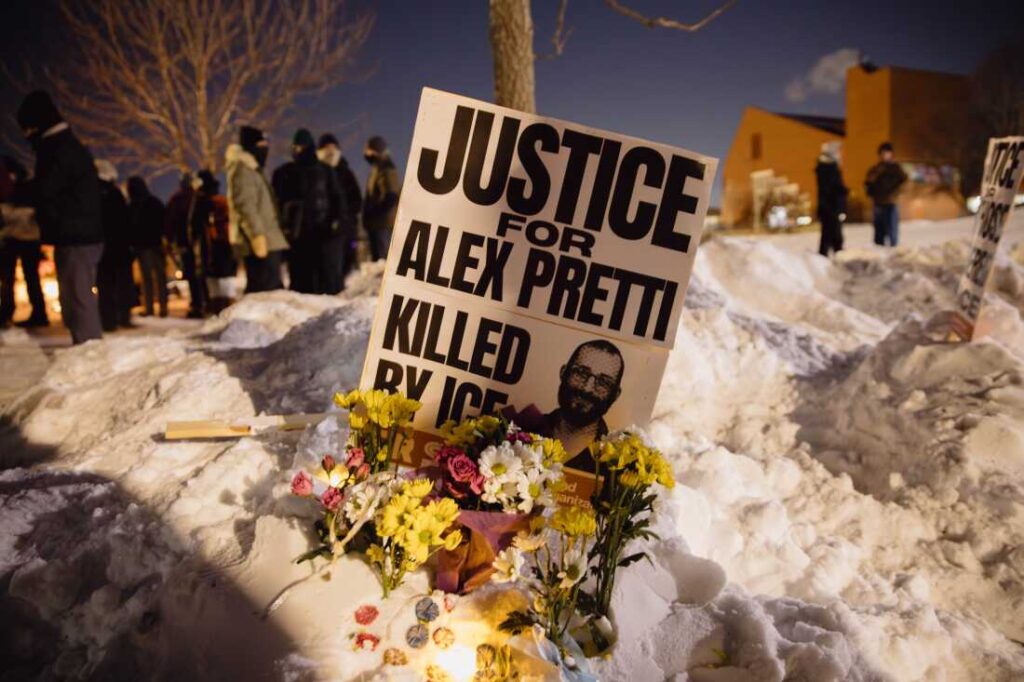
On January 24, 2026, a 37-year-old Minneapolis resident and ICU nurse, Alex Pretti, was fatally shot by a U.S. Immigration and Customs Enforcement (ICE) agent during an immigration enforcement operation in south Minneapolis. The incident came just weeks after another Minneapolis shooting earlier in January involving Renée Good, who was also fatally shot by an ICE agent.
Federal officials have framed the shooting as self-defense, claiming the agent feared for his life. However, eyewitness video reviewed by major news outlets showed Pretti had only a phone in hand at the time, leading to deep community outrage and protests.
The Minnesota governor and local leaders have condemned the incident, and state authorities have sued the federal government to preserve evidence after being blocked from accessing the shooting scene.
Why This Matters: Federal Agent Use of Force & Liability
This situation raises complex legal issues in two main areas:
1. Federal Versus State Authority
Federal law enforcement officers like ICE agents generally enjoy sovereign immunity and qualified immunity when acting within the scope of their official duties, particularly involving use of force. That can make it extremely difficult to prosecute or civilly sue them under state criminal or civil statutes.
- Qualified Immunity: Shields federal officers from personal liability unless it’s shown they violated a clearly established constitutional right under circumstances a reasonable officer would recognize.
- Sovereign Immunity: Barred many claims historically; victims sometimes must sue the government itself under the Federal Tort Claims Act (FTCA)—and even those suits have strict hurdles.
Thus, legal counsel must strategically consider federal immunities when assessing next steps.
2. Use of Deadly Force Standards
Both federal and Minnesota law allow use of deadly force only when there is a reasonable belief of imminent threat of serious injury or death. Independent video evidence — and conflicting official accounts — will be critical in determining whether that standard was met.
How a Claim or Lawsuit Would Proceed
Here’s a step-by-step look at how a civil wrongful death claim or liability action might unfold:
1. Investigation & Evidence Collection
Because state investigators are currently being denied access to key evidence, obtaining video, witness statements, medical data, and forensic reports quickly is essential. Preservation orders and litigation (like the state’s suit against the federal government) are often used to secure evidence.
2. Determining the Legal Framework for the Case
Depending on facts, a victim’s family or their counsel might pursue one or more of the following:
- Federal Tort Claims Act (FTCA) Claim: Against the United States for wrongful death caused by a federal employee acting within the scope of employment.
- Constitutional Claim: Arguing deprivation of civil rights under 42 U.S.C. § 1983 or related federal statutes — though qualified immunity may apply.
- State Tort Claims: In rare circumstances, if actions are clearly outside federal authority or were intentional wrongs not tied to official duties.
3. Exhausting Administrative Remedies
Under the FTCA, claimants usually must file an administrative claim with the federal agency before filing a lawsuit in federal court. If that claim is denied (or six months pass), they may proceed with litigation.
4. Litigation & Discovery
Once a lawsuit is filed:
- Discovery begins: gathering internal agent communications, training records, body cam footage, and expert testimony on use-of-force standards.
- Motions to dismiss are common early in federal civil rights cases — especially when defendants assert qualified immunity.
5. Settlement or Trial
Many wrongful death and excessive force cases resolve in settlement negotiations, but if immunity issues or legal standards are contested, a federal trial may be necessary.
Key Challenges in Cases Against Federal Agents
A case involving a federal agent’s use of force — like the Pretti shooting — faces unique legal hurdles:
✔ Immunity doctrines that protect agents unless courts clearly find rights violations.
✔ Jurisdictional limits under the FTCA and federal civil rights statutes.
✔ Political and prosecutorial discretion, especially when federal agencies control investigations.
✔ Conflicting narratives between eyewitness evidence and official statements.
Why Legal Representation Matters
An experienced wrongful death and civil rights attorney can:
- Navigate the FTCA claims process
- Push for full evidence preservation
- Engage experts on use-of-force standards
- Challenge qualified immunity defenses
- Seek maximum compensation for families harmed by excessive or unreasonable force
What’s Next? Legal & Community Developments
Calls for independent investigations — including by lawmakers on both sides of the aisle — are growing as public pressure and protests continue in Minneapolis and nationwide.
State prosecutors and civil rights groups are intensifying efforts to ensure a transparent process, and litigation over access to evidence could shape how future cases are handled when federal and state officials clash.
Conclusion
The Minneapolis ICE shooting involving Alex Pretti has reignited critical debates about federal law enforcement accountability, sovereign and qualified immunity, and the standards governing deadly force. From a legal perspective, families pursuing justice must understand the complex interplay of federal immunities, evidence challenges, and procedural hurdles — and why seasoned legal counsel is essential in pursuing wrongful death or civil rights claims in these cases.
Get Help From WIN Injury & Accident Trial Lawyers
Why Legal Representation Matters
Insurance companies often undervalue pain and suffering—offering minimal settlements that ignore your daily struggles. A skilled attorney can:
- Present powerful evidence of your emotional and physical suffering
- Retain expert witnesses to quantify your losses
- Use verdict data to justify higher multipliers or per diem rates
- Argue your case persuasively before a jury
At WIN Trial Lawyers, our team fights to ensure that your recovery reflects the full extent of your suffering—not just your bills.

At WIN Trial Lawyers, we know how personal injury claims can be can be. Victims often face mounting medical bills, lost wages, and emotional trauma. Our team has successfully taken on insurance companies and third parties, recovering millions for injured clients.
If you or a loved one has been injured in an accident, don’t leave your future in the hands of the insurance company. You need experienced trial lawyers who know how to prove liability and fight for maximum compensation.
If you or a loved one has been injured, don’t face this alone. The sooner you act, the stronger your case will be.
🔗 Related Posts:
Frequently Asked Questions About Police & Federal Agent Shooting Liability
Can a family sue after a police or ICE shooting?
Yes. Families may be able to bring a wrongful death or civil rights claim depending on who was involved, the facts of the shooting, and whether immunity applies. Cases involving federal agents often proceed under federal law rather than state law.
Is it harder to sue federal agents than local police?
Generally, yes. Federal agents often assert sovereign immunity or qualified immunity, which can limit or delay lawsuits. However, those protections are not absolute, and claims can still proceed in certain circumstances.
What is qualified immunity?
Qualified immunity is a legal doctrine that protects law enforcement officers from personal liability unless they violated a clearly established constitutional right that a reasonable officer would have known. It is frequently litigated early in these cases.
What law applies if ICE or another federal agency is involved?
Claims may proceed under:
- The Federal Tort Claims Act (FTCA) for negligence or wrongful death
- Federal civil rights law if constitutional violations are alleged
Each path has strict procedural rules and deadlines.
What is the Federal Tort Claims Act (FTCA)?
The FTCA allows individuals to sue the United States government for harm caused by federal employees acting within the scope of their duties. It requires filing an administrative claim first before going to court.
Do you have to file a claim before filing a lawsuit?
Yes. For FTCA cases, an administrative claim must be filed with the federal agency involved. If the agency denies the claim or does not respond within six months, a lawsuit may then be filed.
What evidence is critical in a police shooting case?
Key evidence often includes:
- Body camera or dash camera footage
- Surveillance or bystander video
- Dispatch and radio communications
- Use-of-force reports
- Autopsy and forensic reports
- Witness statements
Preserving evidence early is crucial.
What if police or federal agents control the evidence?
Courts can issue preservation orders, and attorneys can pursue litigation to prevent destruction or withholding of evidence. This is a common issue in officer-involved shootings.
Can state prosecutors bring criminal charges against federal agents?
It is rare but possible. More commonly, federal authorities review potential criminal liability. Civil cases are separate and can proceed even if no criminal charges are filed.
Does video evidence override an officer’s account?
Video evidence can be extremely powerful, but it is evaluated alongside all other evidence. Courts examine whether an officer’s belief of threat was objectively reasonable under the circumstances.
What damages can families recover in a wrongful death case?
Potential damages may include:
- Loss of financial support
- Loss of companionship and care
- Funeral and burial expenses
- Emotional suffering (depending on the claim)
Punitive damages are limited in cases involving government defendants.
How long do these cases take?
Police and federal shooting cases often take months or years due to investigations, immunity motions, and federal procedures. Early legal involvement can significantly impact the timeline.
Can these cases settle without going to trial?
Yes. Many cases resolve through settlement negotiations, especially after key evidence is disclosed. Others proceed to trial if immunity or liability is disputed.
Does the family have to prove the shooting was intentional?
Not always. Some claims focus on unreasonable or excessive force, while others involve negligence, improper tactics, or failure to follow training protocols.
What if the person shot was unarmed?
Whether someone was armed is an important factor, but not the only one. Courts focus on whether the officer’s perception of threat was reasonable at the moment force was used.
Can multiple agencies be held responsible?
Potentially. Liability may extend to:
- Individual officers or agents
- The employing agency
- Supervising entities (in limited circumstances)
Each defendant raises different legal issues.
Why should families speak with a lawyer quickly?
Early legal representation helps:
- Preserve evidence
- Navigate immunity defenses
- Meet strict federal deadlines
- Protect the family’s rights during investigations
Delays can permanently affect a case.
Does WIN Injury & Accident Trial Lawyers handle police shooting cases?
WIN Injury & Accident Trial Lawyers evaluates serious injury and wrongful death cases involving law enforcement and government actors, including complex liability and civil rights issues.