

When Unsafe Working Conditions Lead to Serious Injuries
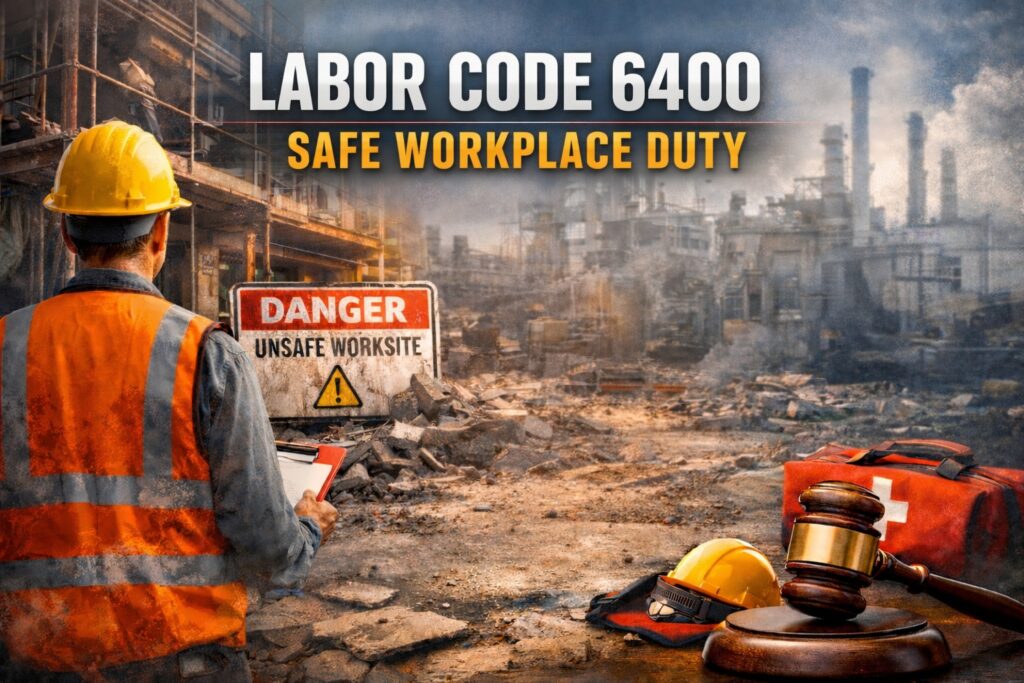
California law places a clear, non-delegable duty on employers to protect workers from unsafe conditions. When that duty is ignored and someone is injured, the legal consequences can extend far beyond workers’ compensation.
One of the most important statutes governing workplace safety is California Labor Code § 6400.
What Labor Code § 6400 Does
Labor Code § 6400 requires every employer to:
- Furnish a place of employment that is safe and healthful, and
- Do everything reasonably necessary to protect the life, safety, and health of employees
This is not a suggestion or a guideline. It is a statutory obligation.
The law applies across virtually all industries, including:
- Construction sites
- Warehouses and logistics facilities
- Manufacturing and industrial plants
- Restaurants and retail workplaces
- Transportation and delivery operations
When employers fail to meet this duty, injuries are often predictable — and preventable.
Example: Unsafe Workplace Conditions Cause Serious Injury
Consider this common scenario:
An employer fails to maintain equipment guards on industrial machinery or ignores known safety hazards on a jobsite. A worker is seriously injured when the machinery malfunctions or a hazardous condition goes unaddressed.
Labor Code § 6400 exists to prevent exactly this type of harm.
When unsafe conditions violate an employer’s statutory duty, the failure can become powerful evidence in a civil injury case — especially when third parties are involved.
Labor Code § 6400 and Workplace Safety Violations
Violations of Labor Code § 6400 often overlap with:
- Cal/OSHA regulations
- Safety order violations
- Industry safety standards
- Employer safety policies
These violations frequently show:
- Failure to inspect
- Failure to repair
- Failure to train
- Failure to warn
- Failure to enforce safety rules
When safety breakdowns are systemic, liability exposure increases dramatically.
How Labor Code § 6400 Affects Injury Claims
While many workplace injuries fall under workers’ compensation, Labor Code § 6400 plays a critical role in third-party injury cases, such as when:
- A subcontractor creates unsafe conditions
- A property owner fails to maintain safe premises
- A manufacturer supplies unsafe machinery
- A general contractor ignores site-wide safety obligations
In these cases, § 6400 helps establish that the unsafe condition was not accidental — it was the result of a statutory safety failure.
Labor Code § 6400, Negligence, and Liability
A violation of Labor Code § 6400 may be used to support liability by showing that:
- The employer knew or should have known about the hazard
- The hazard posed a foreseeable risk of injury
- Reasonable safety measures were not taken
In serious cases, safety violations can also support:
- Negligence per se theories
- Increased settlement leverage
- Punitive exposure when conduct shows conscious disregard
Common Injuries Caused by Unsafe Workplaces
Unsafe working conditions frequently result in severe injuries, including:
- Traumatic brain injuries
- Spinal cord and neck injuries
- Crush injuries and amputations
- Burns and electrocution injuries
- Orthopedic fractures
- Fatal workplace accidents
These injuries often involve long-term disability, permanent impairment, or wrongful death.
Common Employer Defenses — and Why They Often Fail
Employers and insurers frequently argue:
- “The employee should have been more careful”
- “The hazard was obvious”
- “We had safety rules on paper”
- “This was a one-time incident”
Labor Code § 6400 undermines these defenses. Employers cannot shift responsibility by pointing to worker conduct when the workplace itself was unsafe.
Paper policies mean little if safety rules were not enforced.
How Unsafe Workplace Cases Are Proven
Successful cases often rely on:
- Cal/OSHA citations and investigation records
- Safety manuals and training documents
- Maintenance and inspection logs
- Witness testimony
- Expert safety analysis
Early investigation is critical, as evidence can disappear quickly after a serious workplace injury.
Why Trial Lawyers Matter in Workplace Safety Cases
Unsafe workplace cases often involve:
- Multiple defendants
- Overlapping insurance policies
- Aggressive defense strategies
- Attempts to limit claims to workers’ comp
At WIN Trial Lawyers, we identify third-party liability, preserve safety evidence, and pursue full civil compensation when unsafe workplaces cause serious harm.
Related WIN Trial Lawyers Blog Posts
- Labor Code § 3852 — Third-Party Claims After Workplace Injuries
- Labor Code § 3706 — Uninsured Employers
- Evidence Code § 669 — Negligence Per Se
Injured Due to Unsafe Working Conditions?
If you were injured because your workplace was unsafe, your rights may extend beyond workers’ compensation.
📞 Contact WIN Trial Lawyers today for a free consultation.
We hold employers and third parties accountable when safety laws are ignored.
Get Help From WIN Injury & Accident Trial Lawyers
Why Legal Representation Matters
Insurance companies often undervalue pain and suffering—offering minimal settlements that ignore your daily struggles. A skilled attorney can:
- Present powerful evidence of your emotional and physical suffering
- Retain expert witnesses to quantify your losses
- Use verdict data to justify higher multipliers or per diem rates
- Argue your case persuasively before a jury
At WIN Trial Lawyers, our team fights to ensure that your recovery reflects the full extent of your suffering—not just your bills.

At WIN Trial Lawyers, we know how personal injury claims can be can be. Victims often face mounting medical bills, lost wages, and emotional trauma. Our team has successfully taken on insurance companies and third parties, recovering millions for injured clients.
If you or a loved one has been injured in an accident, don’t leave your future in the hands of the insurance company. You need experienced trial lawyers who know how to prove liability and fight for maximum compensation.
If you or a loved one has been injured, don’t face this alone. The sooner you act, the stronger your case will be.
🔗 Related Posts:
Frequently Asked Questions About California Labor Code § 6400
What is California Labor Code § 6400?
Labor Code § 6400 requires employers to furnish and maintain a place of employment that is safe and healthful for employees.
What does “safe workplace” mean under § 6400?
A safe workplace is one that:
- Is free from recognized hazards
- Complies with occupational safety and health standards
- Is maintained in a condition that does not expose workers to unnecessary risk
The duty is affirmative and ongoing.
Does Labor Code § 6400 apply to all employers?
Yes. It applies to nearly all employers in California, regardless of size or industry.
Is Labor Code § 6400 part of Cal/OSHA law?
Yes. Section 6400 is a foundational provision of California’s workplace safety laws and works alongside Cal/OSHA regulations.
What types of unsafe conditions violate § 6400?
Common examples include:
- Dangerous machinery or tools
- Lack of safety guards or protective equipment
- Unsafe work procedures
- Inadequate training or supervision
- Hazardous premises conditions
- Exposure to toxic substances
Does an employer violate § 6400 even if no one is injured?
Yes. A violation can exist even without an injury, but liability issues arise when unsafe conditions cause harm.
How does § 6400 relate to workers’ compensation?
Workers’ compensation generally covers injuries caused by unsafe conditions—but § 6400 violations can become critical when exceptions apply, such as:
- Uninsured employers
- Serious and willful misconduct
- Third-party liability
- Dual-capacity claims
Can an unsafe workplace lead to liability beyond workers’ comp?
Yes. While workers’ comp is often the exclusive remedy, unsafe conditions can create civil liability when:
- The employer is uninsured
- The employer’s conduct exceeds ordinary negligence
- A third party created or controlled the hazard
Does § 6400 apply if the employee was partially at fault?
Yes. The employer’s duty to provide a safe workplace exists regardless of employee conduct.
What is the difference between § 6400 and workers’ comp exclusivity?
- Labor Code § 6400 defines the employer’s safety duty
- Labor Code § 3600 limits remedies in many cases
- Labor Code § 3706 removes exclusivity for uninsured employers
These statutes must be read together.
Can § 6400 violations support a civil lawsuit?
They can, depending on the circumstances. Violations may:
- Support negligence claims against third parties
- Establish employer fault where exclusivity does not apply
- Increase leverage in serious and willful misconduct cases
What is “serious and willful misconduct”?
It refers to knowing or reckless disregard for worker safety. Repeated or egregious § 6400 violations may support such claims.
Does Cal/OSHA enforcement affect § 6400 claims?
Yes. Cal/OSHA citations can be powerful evidence that:
- Unsafe conditions existed
- The employer knew or should have known
- Safety laws were violated
Can employees sue Cal/OSHA for failing to enforce § 6400?
No. Cal/OSHA enforces the law, but civil liability depends on the employer’s conduct and applicable exceptions.
What if a third party created the unsafe condition?
If a third party (contractor, property owner, manufacturer) caused or controlled the hazard, the injured worker may pursue a separate personal injury claim.
Does § 6400 apply to construction sites?
Yes. Construction employers have extensive duties under § 6400 and related safety regulations, especially on multi-employer worksites.
Does § 6400 apply to office environments?
Yes. Unsafe office conditions—such as electrical hazards, blocked exits, or structural defects—can violate § 6400.
Can lack of training violate § 6400?
Yes. Failing to properly train employees on safe procedures can constitute an unsafe workplace.
What if safety equipment was available but not enforced?
Employers must not only provide safety equipment—they must ensure it is used and enforced.
Can § 6400 violations be used as evidence in court?
Yes. Violations may be used to:
- Establish negligence
- Support liability arguments
- Undermine employer defenses
Does § 6400 apply to temporary or contract workers?
Yes. Employers generally owe safety duties to all workers they control or supervise.
What should an injured worker do if conditions were unsafe?
They should:
- Seek medical care
- Report the injury
- Document unsafe conditions
- Speak with an attorney before assuming workers’ comp is the only remedy
How does WIN Injury & Accident Trial Lawyers use § 6400?
WIN uses § 6400 to:
- Identify unsafe workplace conditions
- Evaluate exceptions to workers’ comp exclusivity
- Build third-party and uninsured employer claims
- Maximize recovery beyond workers’ comp benefits
What is the key takeaway of Labor Code § 6400?
Employers have a legal duty to provide a safe workplace—and violating that duty can create liability beyond workers’ compensation in the right case.