

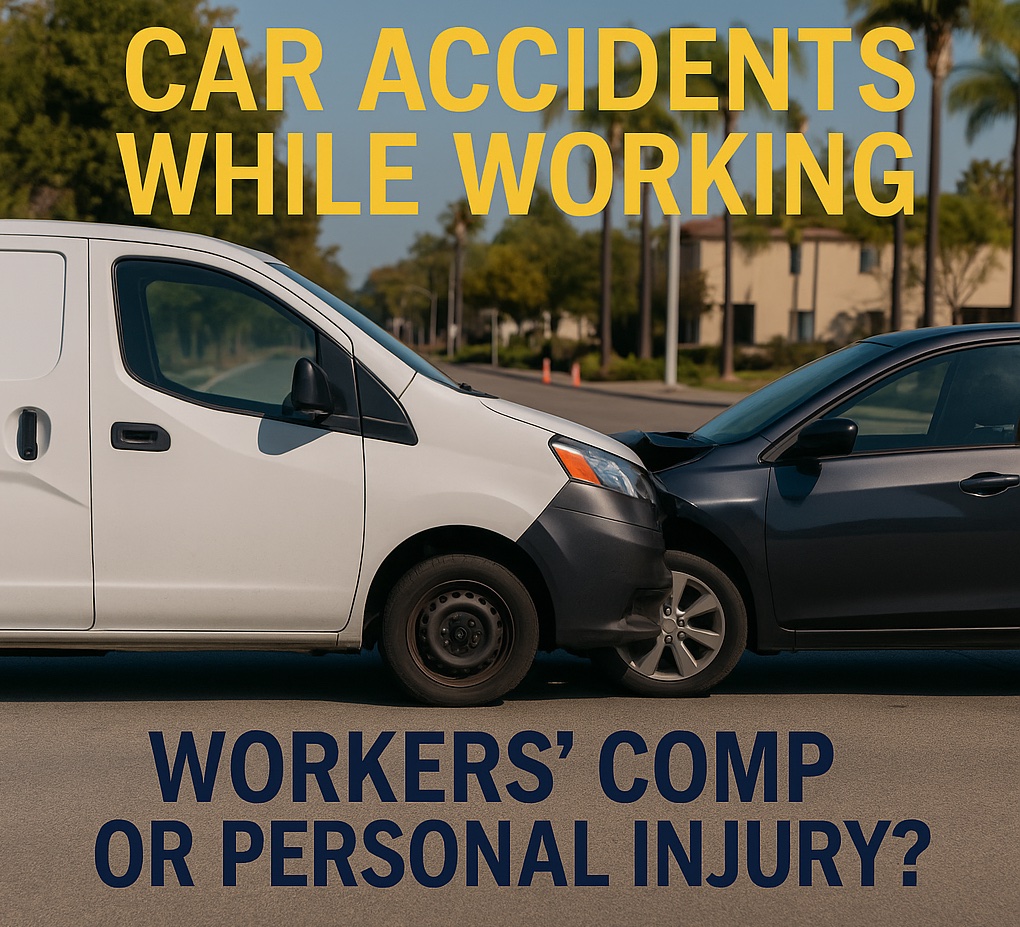
Understanding Your Rights When You’re Injured on the Job Behind the Wheel
If you were injured in a car accident while working, you may be entitled to two separate claims — one through workers’ compensation and another through a personal injury lawsuit.
Many employees don’t realize that these claims can overlap, and knowing how to handle them correctly can mean the difference between limited benefits and full financial recovery.
At WIN Trial Lawyers and Employees First Labor Law (EFLL), our attorneys work together to maximize every available dollar for injured workers who suffer auto accidents on the job.
When Car Accidents Count as Work-Related
Not every car crash that happens “while at work” qualifies for workers’ compensation, but many do. The key legal question is whether you were acting within the course and scope of your employment at the time of the accident.
Generally, you are covered if you were driving for a work-related purpose, including but not limited to:
- Making deliveries or transporting goods for your employer
- Traveling between job sites, offices, or client appointments
- Running work-related errands at your employer’s direction
- Driving a company-owned or employer-provided vehicle
- Attending a work event, trade show, training, or mandatory meeting
- Working as a rideshare driver, courier, home health aide, sales representative, or field technician
- Traveling for work where driving is a required part of your job duties
Importantly, you do not need to be “on the clock” in the traditional sense to qualify. Many workers are covered even when they are salaried, paid per job, or performing tasks outside normal business hours—so long as the driving benefited the employer in some way.
California law also recognizes exceptions to the general “coming and going” rule. While ordinary commuting to and from work is usually not covered, workers’ compensation may still apply if:
- Your employer required you to use your vehicle for work purposes
- You were paid for travel time or mileage
- You were traveling between job sites
- You were on a special errand or assignment for your employer
Another critical point many injured workers don’t realize: fault does not matter for workers’ compensation. Even if you were partially—or entirely—responsible for the accident, you are still entitled to workers’ comp benefits, including medical treatment, temporary disability payments, and potentially permanent disability benefits.
That said, determining whether a car accident qualifies as work-related can be highly fact-specific. Employers and insurance carriers often dispute these claims, arguing the worker was “off duty” or acting outside the scope of employment. That’s why it’s crucial to speak with an attorney who understands how workers’ compensation and personal injury claims intersect—before you give statements or accept benefits that could limit your recovery.
Workers’ Compensation vs. Personal Injury Claims
Here’s how the two claims differ — and when you can pursue both:
| Aspect | Workers’ Compensation | Personal Injury (Third-Party Claim) |
|---|---|---|
| Who Pays | Employer’s insurance | Negligent third party (e.g., another driver) |
| Proof Needed | No fault required | Must prove the other party’s negligence |
| Damages Covered | Medical bills, partial wages, disability | Pain & suffering, emotional distress, full wages, future loss |
| Filing Deadline | Report to employer within 30 days; 1 year to file | 2 years from the date of accident (6 months if government vehicle) |
| Attorney Needed? | Strongly recommended | Essential for maximizing compensation |
If another driver caused your crash, you can file a civil personal injury lawsuit in addition to your workers’ compensation claim.
Example Scenarios Where You Have Both Claims
- Delivery Driver Hit by a Distracted Driver
You’re making a delivery for work when a texting driver runs a red light.
→ Workers’ comp covers medical care and partial wages.
→ A personal injury claim against the at-fault driver covers pain, suffering, and full wage loss. - Salesperson Rear-Ended on the 210 Freeway While Traveling Between Clients
→ Workers’ comp pays immediate benefits.
→ The civil claim against the negligent driver covers total damages beyond comp limits. - Construction Foreman Struck by a Subcontractor’s Truck on a Job Site
→ Workers’ comp through employer
→ Third-party claim against the subcontractor’s company and insurer
In each scenario, two separate cases are possible — one administrative (workers’ comp) and one civil (personal injury).
Why You Should Pursue Both
Workers’ compensation provides essential benefits after a work-related injury, but it is limited by design. While it typically covers medical treatment and a portion of lost wages, it often falls far short of addressing the true physical, emotional, and financial toll of a serious car accident.
That’s where a personal injury claim becomes critical.
Unlike workers’ comp, a personal injury lawsuit allows injured workers to pursue full, real-world compensation when another party—such as a negligent driver, vehicle manufacturer, or third-party company—caused the crash. This type of claim recognizes that injuries affect far more than just a paycheck.
Through a personal injury claim, you may be able to recover compensation for:
- Pain and suffering, including ongoing physical pain, discomfort, and limitations
- Emotional distress, such as anxiety, depression, PTSD, or sleep disruption after the accident
- Loss of enjoyment of life, when injuries prevent you from engaging in hobbies, family activities, or daily routines
- Future lost earning capacity, if your injuries limit your ability to return to the same job, advance in your career, or work full-time
- Property damage, including repairs or replacement of your vehicle and other personal property
- Out-of-pocket expenses, such as transportation costs, home modifications, medical equipment, and uncovered medical bills
When these damages are combined, the difference between workers’ comp alone and a coordinated personal injury claim can be hundreds of thousands—or even millions—of dollars in additional recovery, depending on the severity of the injuries.
By pursuing both claims simultaneously and strategically, injured workers ensure that no source of compensation is left on the table. Just as importantly, coordinating these claims correctly helps avoid common pitfalls—such as offsets, liens, or statements that can be used to reduce one claim based on the other.
This dual-track approach is especially important in work-related car accident cases, where workers’ compensation and personal injury law intersect. Having attorneys who understand both systems working together can make the difference between limited benefits and a full financial recovery.
Timing and Strategy Are Critical
Workers’ compensation and personal injury claims may arise from the same accident, but they proceed under entirely different legal systems, each with its own rules, deadlines, and strategic considerations.
Workers’ compensation claims are governed by strict administrative timelines, including the requirement that injured workers notify their employer within 30 days of the injury and generally file a formal claim within one year. Missing these deadlines can jeopardize your right to benefits entirely.
Personal injury claims, by contrast, typically allow up to two years from the date of the accident to file a lawsuit—though that window can be much shorter if a government entity is involved, requiring special notice within months.
Because these timelines overlap but do not align, coordination matters. Settling one case too early—or without a full understanding of the other—can significantly reduce your overall recovery. For example, resolving a personal injury case before addressing workers’ compensation issues may trigger a workers’ comp lien, allowing the insurance carrier to seek reimbursement from your settlement. In some situations, poorly timed settlements can also limit future medical coverage or wage benefits.
Strategic sequencing is essential. The right approach depends on the nature of the injuries, the strength of the liability case, and the long-term medical and financial needs of the injured worker.
That’s why having one coordinated legal team—like Employees First Labor Law × WIN Trial Lawyers—is so important. When both claims are handled together, attorneys can align timing, manage liens, protect future benefits, and ensure that every decision in one case strengthens—not undermines—the other.
How EFLL × WIN Trial Lawyers Handle Dual Cases
Our integrated team approach means:
- Workers’ comp attorneys protect your benefits and medical treatment access
- Personal injury attorneys build and litigate the negligence case
- Both coordinate lien negotiations and settlement timing
- You have one unified strategy and one team managing communication and results
We handle everything — from your employer’s insurance carrier to the at-fault driver’s insurer — so you can focus on recovery.
Frequently Asked Questions: Work-Related Car Accidents in California
Can I file both a workers’ compensation claim and a personal injury lawsuit?
Yes. If you were injured in a car accident while working and another party (such as another driver) caused the crash, you may have two separate claims:
- A workers’ compensation claim against your employer’s insurance, and
- A personal injury claim against the at-fault third party.
These claims serve different purposes and can be pursued at the same time.
What does workers’ compensation cover that personal injury does not?
Workers’ compensation generally provides:
- Medical treatment
- Temporary disability (partial wage replacement)
- Permanent disability benefits, if applicable
However, workers’ comp does not cover pain and suffering, emotional distress, or full wage loss, which is why a personal injury claim is often critical.
What does a personal injury claim cover that workers’ comp does not?
A personal injury claim may allow recovery for:
- Pain and suffering
- Emotional distress and trauma
- Loss of enjoyment of life
- Future lost earning capacity
- Property damage (such as your vehicle)
- Out-of-pocket expenses
These damages often make up the largest portion of a serious injury recovery.
What if I was partially at fault for the accident?
Workers’ compensation is a no-fault system, so you can still receive benefits even if you caused the accident.
For personal injury claims, California follows comparative fault rules, meaning your recovery may be reduced by your percentage of fault—but you are not automatically barred from recovering compensation.
How long do I have to file each claim?
Deadlines are different and very important:
- Workers’ compensation:
- Notify your employer within 30 days
- File a claim generally within one year
- Personal injury:
- Typically two years from the date of the accident
- Shorter deadlines may apply if a government entity is involved
Missing a deadline can permanently bar your claim.
What is a workers’ compensation lien?
If workers’ comp pays benefits related to your injuries, the insurance carrier may assert a lien against your personal injury settlement to recover what it paid.
Handled incorrectly, liens can significantly reduce your net recovery—which is why timing and coordination are critical.
Should I settle one case before the other?
Not without legal guidance. Settling too early can:
- Trigger unnecessary liens
- Reduce future medical coverage
- Limit leverage in the remaining case
A coordinated legal strategy ensures settlements happen in the right order and at the right time.
Why does it matter if one firm handles both cases?
When workers’ comp and personal injury claims are handled by separate firms, communication gaps often lead to:
- Missed deadlines
- Poor lien negotiations
- Reduced overall recovery
At Employees First Labor Law and WIN Trial Lawyers, our teams work together to align strategy, protect benefits, manage liens, and maximize total compensation—not just one piece of the case.
Do I have to pay upfront to pursue both claims?
No. Personal injury cases are typically handled on a contingency fee basis, and workers’ comp cases are paid through a court-approved fee. You generally pay nothing upfront.
Call WIN Trial Lawyers × EFLL Today
📞 Free Consultation — No Fees Unless We Win
🌐 wintriallawyers.com | employeesfirstlaborlaw.com
If you were injured in a car accident while working, you may have more than one claim — and more rights than you realize. Let us help you recover everything you deserve.

At WIN Trial Lawyers, we know how devastating distracted driving accidents can be. Victims often face mounting medical bills, lost wages, and emotional trauma. Our team has successfully taken on insurance companies and distracted drivers, recovering millions for injured clients.
If you or a loved one has been injured in a speeding-related car accident, don’t leave your future in the hands of the insurance company. You need experienced trial lawyers who know how to prove liability and fight for maximum compensation.
If you or a loved one has been injured in a distracted driving accident, don’t face this alone. The sooner you act, the stronger your case will be.