

When a Jobsite Injury Opens the Door to Two Claims — and a Bigger Recovery
Construction work is among the most dangerous occupations in California. Workers face daily risks from falls, collapsing scaffolds, electrical shocks, heavy machinery, falling objects, and on-site vehicle traffic. These dangers are often magnified by the complexity of modern construction projects, where multiple employers, contractors, subcontractors, and vendors operate simultaneously on the same jobsite.
When a serious injury occurs, responsibility is not always limited to your direct employer. In fact, many construction injuries involve unsafe conditions created by third parties, defective equipment, or coordination failures between different companies on site.
If you were hurt on a construction site, you may qualify for both a workers’ compensation claim and a personal injury (third-party) claim—two distinct legal paths designed to address different types of losses. When pursued strategically and in coordination, these dual claims can dramatically increase the total compensation available to you, far beyond what workers’ compensation alone provides.
At WIN Trial Lawyers and Employees First Labor Law (EFLL), our teams work together to handle these complex construction injury cases. By coordinating workers’ compensation and civil litigation strategies under one roof, we help injured workers maximize every possible dollar available under California law while avoiding common pitfalls that reduce recovery.
Workers’ Compensation: The First Step
When you’re injured on the job, California law generally requires your employer to provide workers’ compensation benefits, regardless of who caused the accident. This system is intended to provide quick access to medical care and partial income replacement without requiring injured workers to prove fault.
Workers’ compensation benefits typically include:
- Medical care and rehabilitation, including surgery, physical therapy, medications, and follow-up treatment
- Temporary disability benefits while you are unable to work
- Permanent disability benefits if you suffer lasting impairment
- Partial wage replacement, calculated under statutory formulas
- Job retraining or vocational benefits if you cannot return to your prior position
Workers’ compensation is a no-fault system, meaning you do not need to show that your employer acted negligently to receive benefits.
However, workers’ comp is also limited by design. It does not compensate injured workers for:
- Pain and suffering
- Emotional distress
- Loss of enjoyment of life
- Full wage loss or long-term earning capacity
For construction workers who suffer serious or permanent injuries, these limitations often leave substantial losses uncompensated.
When a Third-Party Claim May Also Apply
A third-party claim—also known as a personal injury lawsuit—may be available when someone other than your employer or a direct co-worker contributed to your injury through negligence, unsafe practices, or defective products.
Construction sites are especially prone to third-party liability because they involve layers of responsibility and overlapping duties, often controlled by different companies.
Common third-party scenarios include:
- A general contractor or subcontractor fails to enforce safety rules or correct known hazards
- A property owner or developer allows unsafe conditions to persist on the site
- A manufacturer or distributor supplies defective scaffolding, ladders, power tools, or safety equipment
- A delivery driver or outside vendor causes a collision or strikes a worker on site
- An electrical contractor fails to properly mark, ground, or de-energize live electrical lines
In these cases, injured workers can receive workers’ compensation benefits and also pursue a personal injury lawsuit against the negligent third party—opening the door to recovery for damages not available under workers’ comp.
Example Scenarios
Defective Scaffold Collapse
A subcontractor improperly installs scaffolding, causing it to collapse and result in serious injuries such as fractures, spinal trauma, or head injury.
- Workers’ compensation covers medical treatment and disability benefits
- Third-party lawsuit against the negligent subcontractor recovers pain and suffering, emotional distress, and future wage loss
Electrical Shock From Faulty Equipment
A power tool malfunctions due to a design or manufacturing defect, causing severe electrical burns or nerve damage.
- Workers’ compensation provides medical care and wage replacement
- Product liability claim against the manufacturer recovers full civil damages, including long-term impairment and future care
Hit by a Vendor’s Truck on Site
You are struck by a third-party delivery driver while performing your job duties on the construction site.
- Workers’ compensation covers immediate medical care and disability benefits
- Personal injury claim against the driver and company recovers pain, suffering, and future damages
Why Coordination Matters
Pursuing workers’ compensation and third-party personal injury claims in isolation can significantly reduce your overall recovery. When these cases are handled separately—or without a unified strategy—critical issues can arise that limit how much compensation ultimately ends up in your pocket.
Poor coordination often leads to:
- Lien disputes, where workers’ compensation carriers seek reimbursement from your civil settlement
- Benefit offsets that reduce what you recover in one case based on payments made in the other
- Missed defendants, especially subcontractors, property owners, or manufacturers who may share liability
- Settlement strategies that favor one claim at the expense of the other, leaving substantial damages unrecovered
When handled correctly, however, coordinated dual claims can result in substantially higher total compensation, while still protecting your ongoing medical care and wage replacement benefits.
That’s why having coordinated legal teams—one focused on workers’ compensation and one on civil litigation—is critical. At WIN Trial Lawyers and Employees First Labor Law (EFLL), our integrated approach allows us to manage both claims strategically, ensuring your rights are protected on all fronts and that no recovery opportunity is overlooked.
Why Filing Both Claims Matters
Filing both a workers’ compensation claim and a third-party civil lawsuit can dramatically increase your overall recovery, particularly in serious construction injury cases.
Workers’ compensation is designed to address immediate needs, including medical treatment and partial income replacement. But it does not account for the full human cost of a serious injury.
A civil third-party claim allows you to pursue compensation for damages that workers’ comp simply does not cover, including:
- Pain and suffering related to physical injuries
- Emotional distress and psychological trauma
- Loss of enjoyment of life and limitations on daily activities
- Full wage loss and future earning capacity, not capped by workers’ comp formulas
- Out-of-pocket expenses related to treatment, travel, and care
- Punitive damages in cases involving extreme negligence or reckless conduct
Together, these two claims ensure you are not limited to basic workers’ compensation benefits and instead have access to the full range of damages allowed under California law.
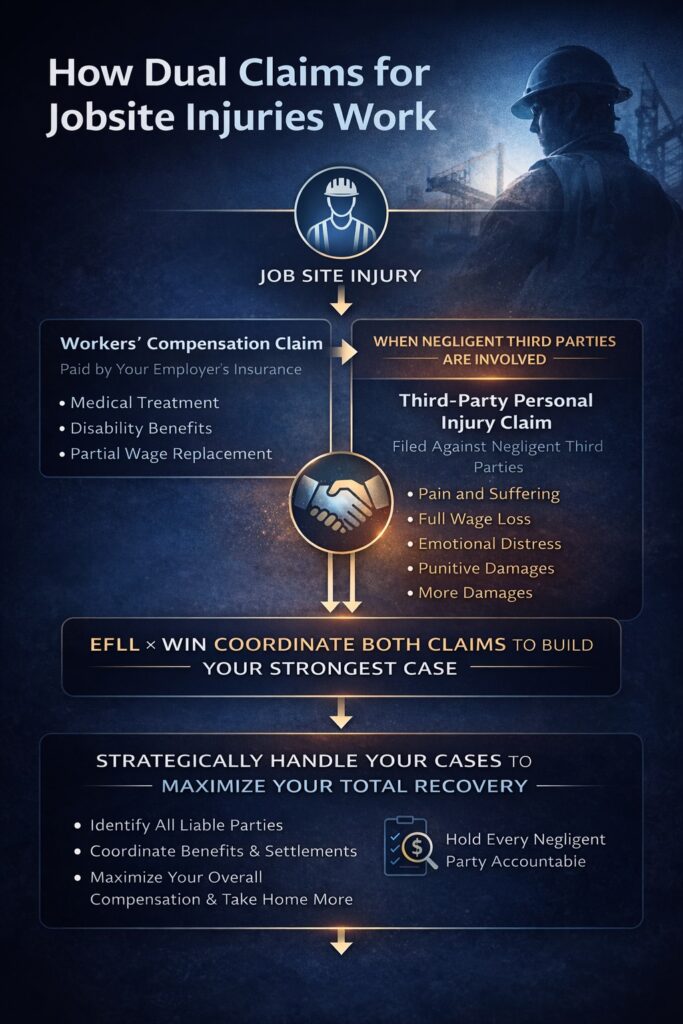
Coordinating the Two Claims
Successfully handling both claims requires careful planning and ongoing coordination between your workers’ compensation and civil litigation teams. Decisions made in one case can directly impact the outcome of the other.
At EFLL × WIN, our coordinated strategy includes:
- Identifying all potential third-party defendants early, before evidence disappears or deadlines pass
- Protecting your workers’ compensation benefits while simultaneously building a strong civil case
- Negotiating lien reductions so you keep more of your civil settlement or verdict
- Aligning timing, discovery, and medical evidence across both claims to maximize leverage
- Avoiding inconsistent positions that insurers and defendants may try to exploit
Our unified approach ensures that nothing slips through the cracks, every liable party is held accountable, and your case is positioned for the maximum recovery the law allows.
Deadlines Matter
Strict legal deadlines apply to both workers’ compensation and third-party personal injury claims, and missing even one deadline can permanently destroy your right to recover compensation—regardless of how serious your injuries are.
In California:
- Workers’ Compensation: You must generally report the injury to your employer within 30 days of the incident and file a workers’ compensation claim within one year. Delayed reporting can give insurers grounds to deny benefits, even in legitimate cases.
- Personal Injury (Third-Party Claims): You typically have two years from the date of injury to file a lawsuit against negligent third parties. If a public entity is involved—such as a city, county, or public utility—you may have as little as six months to file a government claim.
These timelines run separately, and complying with one does not protect your rights under the other. It is common for injured workers to secure workers’ compensation benefits but unknowingly lose their third-party claim—or vice versa—because deadlines were missed.
Early legal involvement is critical to preserving all available claims, identifying responsible parties, and ensuring proper notice and filings are made on time.
Who We Represent
Our firms represent construction workers across California who have been injured on the job and are facing medical uncertainty, lost income, and pressure from insurance companies.
We regularly represent:
- Roofers, electricians, and carpenters
- Plumbers and HVAC technicians
- Concrete, steel, and framing workers
- Heavy equipment operators and equipment laborers
- Day laborers and subcontractor crews
We understand the realities of construction work, including multi-employer jobsites, layered contracts, and the safety risks workers face every day. Our experience allows us to quickly identify third-party liability, defective equipment, and safety failures that others may overlook.
We have recovered millions of dollars for injured construction workers harmed by negligent contractors, unsafe jobsite conditions, and defective tools or machinery. Whether your injury occurred on a large commercial project or a smaller residential site, we are prepared to pursue every available avenue of recovery.
Call WIN Trial Lawyers × Employees First Labor Law
If you were hurt on a construction site, you may be entitled to far more than workers’ comp alone.
Our attorneys will evaluate your case, identify all responsible parties, and pursue every available claim.
📞 Free Consultation — No Fees Unless You Win

At WIN Trial Lawyers, we know how devastating distracted driving accidents can be. Victims often face mounting medical bills, lost wages, and emotional trauma. Our team has successfully taken on insurance companies and distracted drivers, recovering millions for injured clients.
If you or a loved one has been injured in a speeding-related car accident, don’t leave your future in the hands of the insurance company. You need experienced trial lawyers who know how to prove liability and fight for maximum compensation.
If you or a loved one has been injured in a distracted driving accident, don’t face this alone. The sooner you act, the stronger your case will be.
🔗 Related Posts:
Frequently Asked Questions (FAQs) About Construction Site Injuries and Dual Claims
Can I file a lawsuit if I was hurt on a construction site?
Yes—in many cases. While you generally cannot sue your direct employer, you may be able to file a third-party personal injury lawsuit against other negligent parties, such as contractors, subcontractors, property owners, manufacturers, or vendors.
Can I receive workers’ compensation and still sue someone else?
Yes. California law allows injured workers to receive workers’ compensation benefits and pursue a third-party lawsuit at the same time when someone other than the employer caused or contributed to the injury.
Who counts as a “third party” on a construction site?
Third parties may include:
- General contractors or subcontractors
- Property owners or developers
- Equipment or tool manufacturers
- Delivery drivers or outside vendors
- Electrical, plumbing, or other specialty contractors
Any non-employer whose negligence contributed to the injury may be liable.
What damages can I recover in a third-party claim that workers’ comp doesn’t cover?
A third-party claim allows recovery for damages not available under workers’ compensation, including:
- Pain and suffering
- Emotional distress
- Loss of enjoyment of life
- Full wage loss and future earning capacity
- Out-of-pocket expenses
- Punitive damages in extreme cases
Will filing a lawsuit affect my workers’ compensation benefits?
No. Filing a third-party claim does not cancel or reduce your workers’ compensation benefits. However, coordination is important to manage liens and protect your recovery.
Can my employer retaliate against me for filing a claim?
No. California law prohibits retaliation for filing a workers’ compensation claim or asserting your legal rights. Retaliation may give rise to additional legal claims.
What if multiple companies were responsible for the accident?
That is common on construction sites. Multiple parties may share responsibility, and each may be pursued for damages. Identifying all responsible parties early is critical.
What if I was partially at fault for the accident?
Workers’ compensation is no-fault, so you can still receive benefits. In a third-party claim, California’s comparative fault rules apply, meaning you may still recover compensation even if you share some fault.
What are the deadlines for filing claims?
- Workers’ Compensation: Report the injury within 30 days and file within one year.
- Third-Party Lawsuit: Generally two years from the date of injury (six months if a public entity is involved).
Missing a deadline can permanently bar your claim.
Why is it important to have coordinated legal teams?
Because decisions in one case affect the other. Coordinated teams help:
- Identify all liable parties
- Protect benefits
- Reduce liens
- Maximize total recovery
Firms that handle only one side often leave money on the table.
Do I need a lawyer experienced in both workers’ comp and personal injury?
Yes. Construction injury cases involving dual claims are complex and heavily defended. Having coordinated workers’ comp and civil litigation teams significantly increases your chances of a full recovery.