

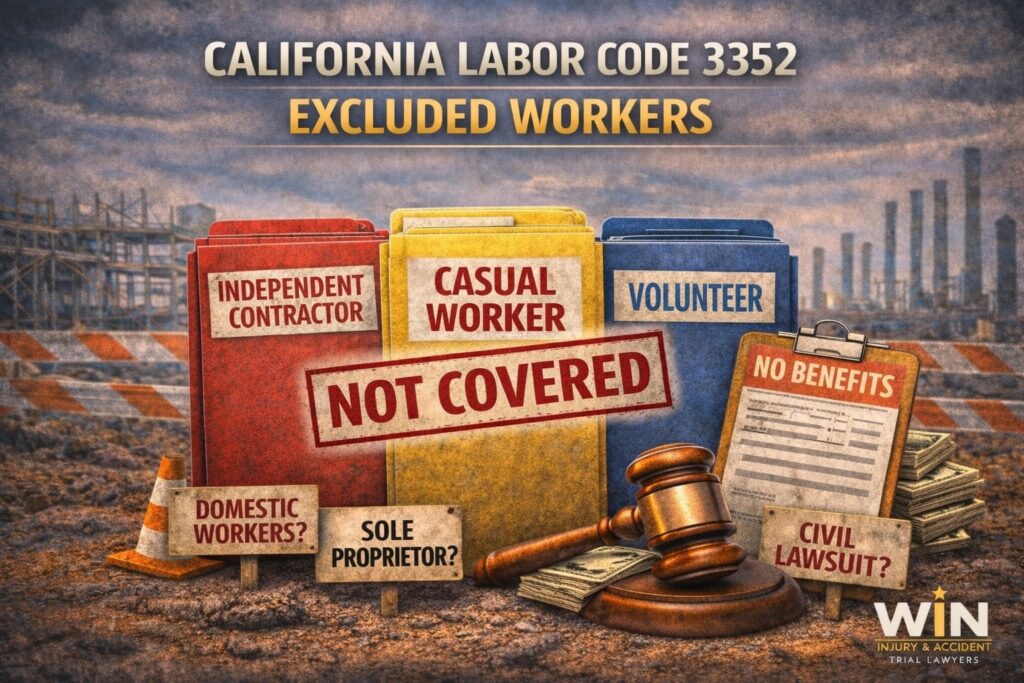
One of the first defenses employers raise after a workplace injury is:
“You’re not covered by workers’ comp.”
California Labor Code § 3352 lists certain categories of workers who are excluded from the statutory definition of “employee” for workers’ compensation purposes. But this statute is far narrower than employers and insurers claim — and it is frequently misapplied.
Understanding who is truly excluded (and who is not) can make the difference between a denied claim and full benefits.
What Is Labor Code § 3352?
Labor Code § 3352 identifies specific categories of individuals who are not considered employees for workers’ compensation coverage by default.
If a worker falls within one of these exclusions, workers’ compensation benefits may not automatically apply — but that does not end the legal analysis.
Related Workers’ Compensation & Injury Laws
Whether a worker is truly “excluded” often depends on how Labor Code § 3352 interacts with other key statutes:
- Labor Code 3351 – Employee Definition
Explains who qualifies as an employee for workers’ compensation coverage. - Labor Code 2750.3 – ABC Test & Misclassification
Determines whether workers labeled as independent contractors are actually employees. - Labor Code 3706 – Uninsured Employers
Allows injured workers to sue employers who failed to carry workers’ comp insurance. - Third-Party Injury Claims
Covers lawsuits against non-employers such as contractors, property owners, and equipment manufacturers.
Understanding these related laws often changes whether a case belongs in workers’ comp—or civil court.
Common Categories of “Excluded Workers”
Labor Code § 3352 includes several defined exclusions, such as:
Certain Independent Contractors
True independent contractors — not misclassified workers — may be excluded.
However, misclassification is extremely common, and many workers labeled as “contractors” are actually employees under California law.
Casual Employees
Workers hired for casual, irregular, or short-term work that is not part of the employer’s usual business may be excluded in limited circumstances.
This exclusion is narrow and often misunderstood.
Domestic Workers (Limited Situations)
Certain household workers may be excluded depending on:
- Hours worked
- Wages paid
- Nature of employment
Many domestic workers are still covered under other statutes.
Volunteers
Unpaid volunteers are generally excluded — unless the law specifically provides coverage.
Sole Proprietors and Partners
Business owners, partners, or sole proprietors may be excluded unless they opt into coverage.
What Labor Code § 3352 Does Not Do
Employers often misuse § 3352 to deny legitimate claims. The statute does not allow employers to exclude workers simply because:
- They are paid cash
- They receive a 1099
- They signed an “independent contractor” agreement
- The employer calls them a contractor
- Payroll taxes were not withheld
Labels do not control — the actual work relationship does.
Misclassification: Where § 3352 and § 3351 Collide
Labor Code § 3352 exclusions must be read together with Labor Code § 3351, which broadly defines who is an employee.
If a worker meets the legal definition of an employee under § 3351 or the ABC Test, § 3352 exclusions often do not apply, regardless of what the employer claims.
Excluded From Workers’ Comp ≠ No Legal Rights
Even when a worker is truly excluded from workers’ compensation coverage, that does not mean:
- The employer escapes liability
- The worker has no remedy
In many cases, excluded workers may pursue:
- Civil personal injury lawsuits
- Wage-and-hour claims
- Misclassification claims
- Third-party injury claims
Ironically, being excluded from workers’ comp may expand, not limit, legal options.
Why Employers Push the “Excluded Worker” Argument
Employers raise § 3352 because:
- It can lead to quick claim denials
- It shifts risk away from workers’ comp insurers
- It discourages injured workers from pushing back
But courts look closely at these claims — and improper exclusions often fail.
Real-World Examples of Disputed Exclusions
- A “contractor” doing core business work under supervision
- A temporary worker injured on a construction site
- A domestic worker exceeding coverage thresholds
- A worker paid cash with no formal paperwork
In many of these cases, § 3352 exclusions do not apply.
How Excluded Worker Status Affects Strategy
Whether a worker is excluded affects:
- Where the claim is filed (WCAB vs. civil court)
- Available damages
- Employer defenses
- Settlement leverage
This determination should never be made casually or based solely on what the employer says.
Key Takeaway
Labor Code § 3352 excludes specific, limited categories of workers — not everyone an employer wants to exclude.
Many workers told they are “not covered” actually qualify as employees under California law. And even when workers are excluded from workers’ comp, other powerful legal remedies may apply.
Workers’ Comp vs. Personal Injury: Key Differences
| Workers’ Comp | Personal Injury |
|---|---|
| No fault required | Fault must be proven |
| Limited benefits | Full damages available |
| No pain & suffering | Pain & suffering allowed |
| No jury | Jury trial available |
Exclusivity determines which path—or both—are available.
Get Help From WIN Injury & Accident Trial Lawyers
Why Legal Representation Matters
Insurance companies often undervalue pain and suffering—offering minimal settlements that ignore your daily struggles. A skilled attorney can:
- Present powerful evidence of your emotional and physical suffering
- Retain expert witnesses to quantify your losses
- Use verdict data to justify higher multipliers or per diem rates
- Argue your case persuasively before a jury
At WIN Trial Lawyers, our team fights to ensure that your recovery reflects the full extent of your suffering—not just your bills.

At WIN Trial Lawyers, we know how personal injury claims can be can be. Victims often face mounting medical bills, lost wages, and emotional trauma. Our team has successfully taken on insurance companies and third parties, recovering millions for injured clients.
If you or a loved one has been injured in an accident, don’t leave your future in the hands of the insurance company. You need experienced trial lawyers who know how to prove liability and fight for maximum compensation.
If you or a loved one has been injured, don’t face this alone. The sooner you act, the stronger your case will be.
🔗 Related Posts:
Frequently Asked Questions – Labor Code 3352 (Excluded Workers)
What does Labor Code 3352 mean?
Labor Code 3352 lists specific categories of workers who are excluded from the definition of “employee” for workers’ compensation purposes. If someone falls within these exclusions, they are generally not covered by workers’ comp — unless an exception or misclassification applies.
Does being “excluded” mean I have no legal rights?
No. Being excluded from workers’ compensation does not mean you have no rights. In many cases, excluded workers may instead have the ability to bring a civil personal injury lawsuit, which can include damages not available in workers’ comp, such as pain and suffering.
Who is commonly excluded under Labor Code 3352?
Some of the most commonly cited exclusions include:
- Certain independent contractors
- Domestic workers in limited circumstances
- Casual workers (short-term, irregular employment)
- Certain volunteers
- Sole proprietors without coverage elections
- Specific agricultural or family employment relationships
Each category is narrowly defined, and exclusions are often misapplied by employers or insurers.
What is a “casual worker” under Labor Code 3352?
A casual worker is someone hired for work that is irregular, occasional, or not part of the employer’s usual business. This is a very narrow classification. Many workers labeled “casual” are actually performing ongoing or core business work — and may still qualify for coverage.
Are independent contractors always excluded?
No. Labels do not control. If a worker is classified as an independent contractor but does not meet California’s legal tests (including the ABC test in many contexts), they may still be treated as an employee for workers’ comp purposes, despite what the contract says.
Can a misclassified worker still receive workers’ compensation benefits?
Yes. Misclassification is one of the most common reasons insurers wrongly deny claims. If the actual working relationship shows employer control, integration into the business, or lack of true independence, workers’ comp coverage may still apply.
What if my employer says I’m excluded but I was injured doing dangerous work?
Employer statements are not determinative. Coverage depends on the actual facts of the job, not what the employer claims after an injury occurs. Dangerous, core business work often points toward employee status.
Do excluded workers ever qualify for workers’ comp later?
Yes. Workers are sometimes found eligible after:
- A legal determination of misclassification
- Evidence showing the job was not truly “casual”
- Proof the employer exercised control inconsistent with an exclusion
Many initial denials are overturned after proper investigation.
If I’m excluded, can I sue my employer?
Often, yes. If workers’ compensation does not apply, the employer may lose the protection of exclusivity, opening the door to a civil injury lawsuit. This can significantly change the value and scope of a case.
How does Labor Code 3352 interact with employer immunity?
Employer immunity generally exists only when workers’ compensation applies. If a worker is excluded under Labor Code 3352, immunity may not apply — meaning the employer may face full civil liability.
Can insurers wrongly rely on Labor Code 3352 to deny claims?
Yes. Insurers frequently over-apply exclusions to deny coverage. Courts and the WCAB often scrutinize these denials closely, especially where the employer benefits from labeling workers as excluded.
What should I do if my claim was denied based on an “excluded worker” argument?
You should not assume the denial is correct. These cases are fact-intensive, and exclusions are interpreted narrowly. A legal review can determine whether workers’ comp applies or whether a separate civil case should be pursued.
Does being excluded affect third-party claims?
No. Even if a worker is excluded from workers’ compensation, they may still pursue claims against third parties, such as contractors, property owners, or equipment manufacturers.
Is Labor Code 3352 the final word on worker coverage?
No. Labor Code 3352 must be read together with other statutes, case law, and factual realities of the job. Many exclusions have exceptions, and misclassification issues are extremely common.
Why do these cases require careful legal analysis?
Because a single classification decision can determine whether a case is worth:
- Limited workers’ comp benefits, or
- Full civil damages, including pain and suffering
That difference can be life-changing after a serious injury.