

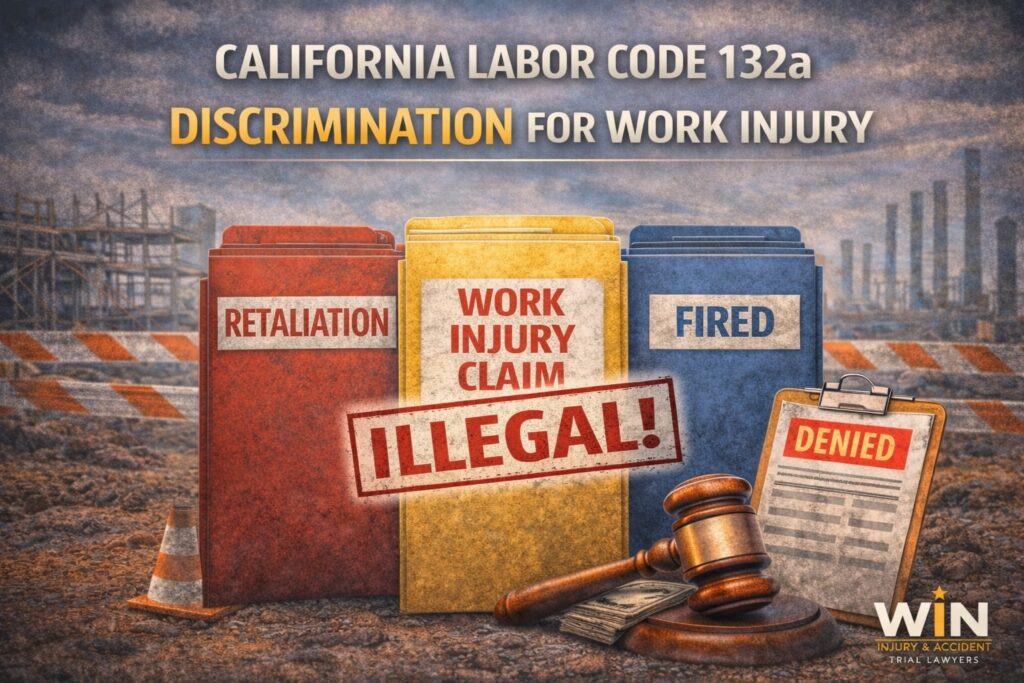
Getting hurt at work is hard enough.
But for many injured workers, the real problem starts after they report the injury.
California Labor Code § 132a makes it illegal for employers to discriminate against employees because they were injured on the job or filed a workers’ compensation claim.
Yet § 132a violations happen every day — often quietly, and often disguised as “business decisions.”
What Is Labor Code § 132a?
Labor Code § 132a prohibits employers from taking negative employment action against a worker because the worker:
- Suffered a work-related injury
- Filed a workers’ compensation claim
- Testified or intended to testify in a workers’ comp case
The law exists to ensure that workers can exercise their rights without fear of punishment.
The Core Rule: Injured Workers Are Protected
Under § 132a, an employer may not:
- Fire an employee for getting hurt at work
- Demote or discipline an employee for filing a claim
- Cut hours, pay, or job duties because of a workers’ comp injury
- Treat injured workers differently than similarly situated employees
If an employer does, they may face penalties and liability.
What Counts as Discrimination Under § 132a?
Discrimination doesn’t have to be obvious to be illegal.
Common § 132a violations include:
- Terminating an employee shortly after a work injury
- Writing up an employee for minor issues after a claim is filed
- Refusing to bring an employee back after medical clearance
- Claiming “no light duty available” while others receive accommodations
- Forcing an injured worker to quit by making the job impossible
Timing matters — and patterns matter.
Employers Often Hide Retaliation Behind “Policy”
Many employers claim they acted because of:
- Attendance rules
- Performance issues
- Restructuring or layoffs
But when these reasons appear only after an injury, courts and judges often see through it.
A lawful policy cannot be used as a pretext for retaliation.
What an Injured Worker Must Prove
To succeed on a § 132a claim, an injured worker generally must show:
- They suffered a work-related injury or filed a claim
- The employer took adverse action
- The injury or claim was a substantial motivating factor
Direct proof is rare — circumstantial evidence and timing often carry the case.
Penalties for Violating Labor Code § 132a
Employers who violate § 132a may face:
- Increased workers’ compensation benefits (up to 50%, capped)
- Reinstatement to the job
- Back pay and lost benefits
- Civil penalties
- Orders stopping discriminatory practices
While § 132a penalties are limited compared to civil lawsuits, they still carry serious consequences.
How § 132a Interacts With Other Laws
A § 132a claim may exist alongside other legal claims, including:
- FEHA disability discrimination
- Failure to accommodate
- Retaliation under other Labor Code sections
- Wrongful termination in violation of public policy
In some cases, workers’ comp retaliation becomes the gateway to broader employer liability.
Common Employer Myths About § 132a
“We can fire injured employees if they can’t do the job.”
Not automatically. Employers must follow accommodation and reinstatement rules.
“Workers’ comp protects us from lawsuits.”
Not from discrimination claims.
“We didn’t mean to retaliate.”
Intent is not required — impact matters.
Why § 132a Cases Are Often Undervalued
Many injured workers are told:
- “There’s nothing you can do”
- “Workers’ comp is all you get”
That’s not true.
While § 132a remedies are limited, these claims often:
- Strengthen the overall workers’ comp case
- Expose employer misconduct
- Support related employment-law claims
What Injured Workers Should Do If Retaliation Is Suspected
If you believe you’re being punished for a work injury:
- Document everything
- Keep copies of discipline, emails, and schedules
- Compare how others are treated
- Don’t quit without legal advice
- Speak with a lawyer familiar with § 132a claims
Early action matters.
Key Takeaway
Labor Code § 132a exists to protect injured workers from being punished for asserting their rights.
If your employer treated you differently after you were hurt at work, that may not be coincidence — it may be illegal discrimination.
Workers’ Comp vs. Personal Injury: Key Differences
| Workers’ Comp | Personal Injury |
|---|---|
| No fault required | Fault must be proven |
| Limited benefits | Full damages available |
| No pain & suffering | Pain & suffering allowed |
| No jury | Jury trial available |
Exclusivity determines which path—or both—are available.
Get Help From WIN Injury & Accident Trial Lawyers
Why Legal Representation Matters
Insurance companies often undervalue pain and suffering—offering minimal settlements that ignore your daily struggles. A skilled attorney can:
- Present powerful evidence of your emotional and physical suffering
- Retain expert witnesses to quantify your losses
- Use verdict data to justify higher multipliers or per diem rates
- Argue your case persuasively before a jury
At WIN Trial Lawyers, our team fights to ensure that your recovery reflects the full extent of your suffering—not just your bills.

At WIN Trial Lawyers, we know how personal injury claims can be can be. Victims often face mounting medical bills, lost wages, and emotional trauma. Our team has successfully taken on insurance companies and third parties, recovering millions for injured clients.
If you or a loved one has been injured in an accident, don’t leave your future in the hands of the insurance company. You need experienced trial lawyers who know how to prove liability and fight for maximum compensation.
If you or a loved one has been injured, don’t face this alone. The sooner you act, the stronger your case will be.
🔗 Related Posts:
Frequently Asked Questions About Labor Code 132a
Discrimination for Work Injuries in California
What is California Labor Code 132a?
Labor Code 132a makes it illegal for an employer to discriminate against an employee because they:
- Suffered a work-related injury
- Filed a workers’ compensation claim
- Testified or planned to testify in a workers’ comp case
What counts as discrimination under Labor Code 132a?
Discrimination includes any negative job action taken because of a work injury or claim, such as termination, demotion, discipline, reduced hours, or denial of reinstatement.
Can my employer fire me for getting hurt at work?
No. An employer may not fire you because you were injured or filed a workers’ comp claim.
Is retaliation illegal even if my employer follows company policy?
Yes. A neutral policy cannot be used as a pretext for retaliation against an injured worker.
Do I have to prove my employer intended to discriminate?
No. You do not need to prove intent. You must show the work injury or claim was a substantial motivating factor in the employer’s decision.
Does timing matter in a Labor Code 132a case?
Yes. Close timing between a work injury and adverse action is often strong evidence of discrimination.
What if my employer says there’s “no light duty available”?
If light duty exists for others but is denied only to injured workers, that can support a 132a claim.
Can cutting my hours count as discrimination?
Yes. Reducing hours, pay, or job duties after a work injury can qualify as unlawful discrimination.
What if I’m laid off after filing a workers’ comp claim?
Layoffs may be legitimate, but if injured workers are singled out or disproportionately affected, a 132a violation may exist.
Does Labor Code 132a apply to temporary or probationary employees?
Yes. Injured workers are protected regardless of job title, seniority, or employment status.
What remedies are available under Labor Code 132a?
Possible remedies include:
- Increased workers’ comp benefits (up to 50%, capped)
- Reinstatement
- Back pay and lost benefits
- Civil penalties
Is there a cap on Labor Code 132a penalties?
Yes. The increase in compensation is capped by statute, but the claim can still be strategically important.
Can I bring a Labor Code 132a claim and other claims?
Yes. A 132a claim may exist alongside:
- FEHA disability discrimination
- Failure to accommodate
- Retaliation claims
- Wrongful termination
Does workers’ comp exclusivity bar a 132a claim?
No. Labor Code 132a is separate from workers’ comp exclusivity rules.
How long do I have to file a 132a claim?
Strict deadlines apply. Delay can permanently bar the claim.
Can my employer discipline me for missing work due to a work injury?
Discipline tied to absences caused by a work injury can be discriminatory, depending on the facts.
What if my employer pressures me to quit after an injury?
Constructive termination — forcing someone out — may qualify as discrimination under 132a.
Is harassment after a work injury covered?
Yes. Harassment, hostility, or targeting tied to a work injury can support a discrimination claim.
Why do employers often deny 132a violations?
Because retaliation is rarely explicit. Employers rely on excuses like performance or policy enforcement.
Is a Labor Code 132a claim worth pursuing?
Often yes. Even though penalties are capped, these claims can:
- Increase leverage
- Expose employer misconduct
- Support related employment-law claims
What should I do if I think I’m being retaliated against?
Document everything, do not quit prematurely, and speak with a lawyer familiar with workers’ comp retaliation cases.