
In nearly every California premises liability case, property owners raise the same defense:
“We didn’t know about the dangerous condition.”
This argument — known as a lack of notice defense — sounds simple, but it rarely ends the case. California law does not require a property owner to admit knowledge of a hazard to be held liable.
Understanding how actual notice and constructive notice work — and how they are proven — is critical to establishing liability.
Why Notice Matters in Premises Liability Cases
To establish premises liability, an injured person generally must show that the property owner:
- Created the dangerous condition, or
- Knew about the condition, or
- Should have known about the condition through reasonable care
The third category — what the owner should have known — is where most premises liability cases are won.
What Is Actual Notice?
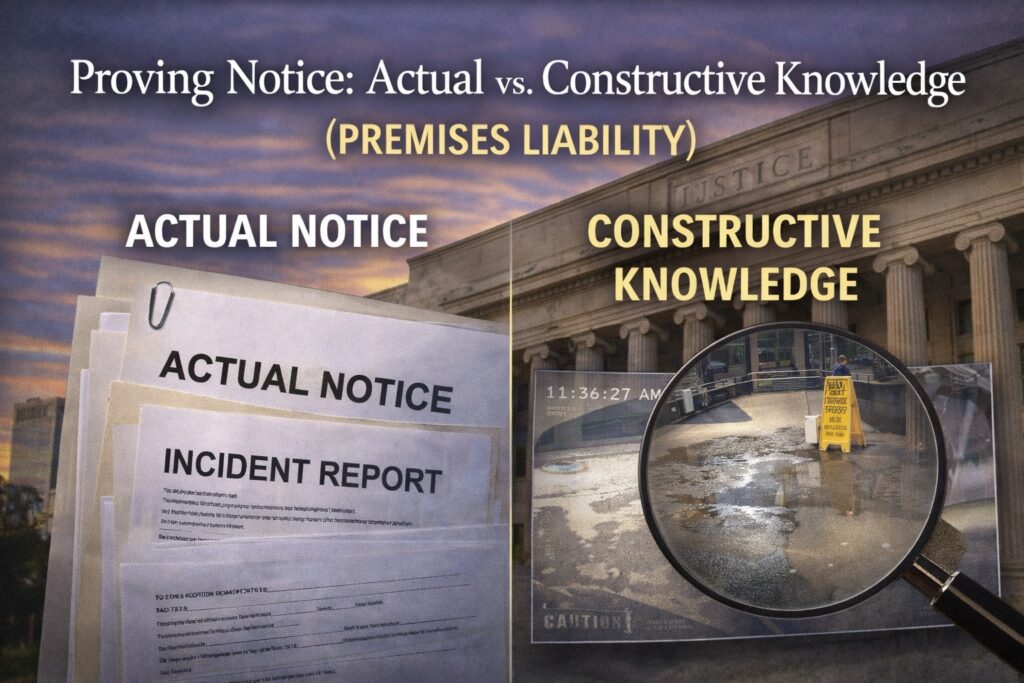
Actual notice exists when a property owner or its employees knew about the dangerous condition before the injury occurred.
Actual notice may be shown through:
- Prior complaints about the same hazard
- Incident or accident reports
- Maintenance requests or work orders
- Emails or internal communications discussing the condition
- Employees observing the hazard but failing to act
While actual notice is strong evidence, it is not required to prove a premises liability claim.
What Is Constructive Notice?
Constructive notice exists when a dangerous condition was present long enough — or occurred frequently enough — that the property owner should have discovered it through reasonable inspections.
This prevents property owners from avoiding liability simply by claiming ignorance.
Constructive notice may be established when:
- The hazard existed for a meaningful period of time
- The condition was recurring or predictable
- Reasonable inspection practices would have revealed it
- The condition was visible to employees or staff
Most premises liability cases turn on constructive notice, not admissions of actual knowledge.
How Long Is “Long Enough”?
There is no fixed time requirement.
Courts consider:
- The nature of the hazard
- The location of the condition
- How frequently the area should be inspected
- Whether similar hazards had occurred previously
A liquid spill in a grocery store may require inspections every few minutes, while a cracked sidewalk may establish notice over weeks or months.
Recurring Hazards Strengthen Constructive Notice
Constructive notice is especially strong when a hazard is recurring.
Examples include:
- Repeated water leaks
- Chronic lighting outages
- Ongoing drainage or flooding problems
- Regular debris accumulation
When a condition happens repeatedly, property owners are expected to anticipate and prevent it, not wait for someone to get hurt.
Inspection Policies Often Create — Not Defeat — Notice
Defendants often claim they had “reasonable inspection procedures.”
In reality, these policies frequently establish constructive notice when:
- Inspections were skipped or inconsistently performed
- Logs are incomplete or missing
- Employees were inadequately trained
- Inspection frequency was insufficient for the risk involved
A policy that exists only on paper does not shield a property owner from liability.
Who Must Have Notice?
Notice does not have to reach the owner personally.
Knowledge held by:
- Employees
- Property managers
- Maintenance personnel
- Security staff
is generally imputed to the property owner or entity responsible for the premises.
The “Temporary Condition” Defense Does Not End the Analysis
Property owners often argue that a hazard was “temporary” and therefore unforeseeable.
Temporary conditions can still establish notice when:
- They occur regularly
- They remain unaddressed for an unreasonable time
- Reasonable inspections would have detected them
Temporary does not mean unavoidable.
Proving Notice Through Targeted Discovery (RFPDs)
In many premises liability cases, notice is not proven by accident reports alone — it is proven through targeted discovery that exposes what the defendant tracked, inspected, and ignored.
Well-drafted Requests for Production (RFPDs) are one of the most effective tools for establishing both actual and constructive notice.
RFPDs That Establish Actual Notice
Targeted document requests can uncover direct proof that a defendant knew about the dangerous condition before the injury, including:
- Prior incident or accident reports involving the same hazard
- Written complaints from customers, tenants, or residents
- Emails, texts, or internal communications discussing the condition
- Maintenance requests or work orders referencing the hazard
- Photographs or videos taken before the incident
These materials often directly contradict claims that a condition was “unexpected” or “never reported.”
RFPDs That Establish Constructive Notice
Even when defendants deny actual knowledge, targeted RFPDs can prove that the condition should have been discovered.
Effective requests often seek:
- Inspection schedules and policies
- Inspection logs or checklists for the area at issue
- Cleaning or maintenance records
- Training materials for employees responsible for inspections
- Documents showing inspection frequency and procedures
Gaps, inconsistencies, or missing records frequently strengthen the constructive notice argument.
Surveillance and Digital Evidence
Surveillance footage is often decisive in notice disputes.
Targeted RFPDs should seek:
- Video footage from hours or days before the incident
- Camera retention and deletion policies
- Logs showing when footage was reviewed or overwritten
- Digital inspection or maintenance systems used by employees
Footage showing a hazard existing well before the incident is among the clearest forms of constructive notice.
Why Narrow, Targeted RFPDs Matter
Overly broad discovery requests invite objections. Targeted RFPDs tied to:
- A specific location
- A defined time window
- The precise condition at issue
are far more difficult to evade and far more likely to produce admissible evidence.
When defendants respond with boilerplate objections or claim documents do not exist, those responses often reinforce the notice argument by exposing inadequate inspection practices.
Discovery Failures Can Themselves Prove Notice
In some cases, a defendant’s failure to produce inspection or maintenance records becomes evidence of negligence.
Missing logs, destroyed footage, or inconsistent records can support arguments that:
- Inspections were not actually performed
- Safety procedures existed only on paper
- Critical evidence was not preserved
Courts and juries are often skeptical of “no records” defenses when routine inspections are claimed.
Why “We Didn’t Know” Often Backfires
Jurors are naturally skeptical of property owners who claim ignorance.
“No notice” defenses frequently fail when:
- Hazards were obvious
- Inspection practices were inadequate
- Records are incomplete or inconsistent
- Safety was deprioritized
In many cases, the defense itself becomes evidence of negligence.
How WIN Injury & Accident Trial Lawyers Proves Notice
At WIN Injury & Accident Trial Lawyers, we pursue notice evidence aggressively from the start.
Our approach includes:
- Early evidence preservation demands
- Detailed analysis of inspection and maintenance records
- Depositions of employees and managers
- Expert testimony on reasonable inspection standards
We focus on what the property owner should have known and prevented — not what they claim to have noticed.
Injured on Unsafe Property? Lack of Notice Is Not the End of the Case.
Property owners are not allowed to ignore dangerous conditions and then claim surprise when someone is hurt.
📞 Contact WIN Injury & Accident Trial Lawyers for a free consultation.
We’ll uncover the evidence, establish notice, and hold property owners accountable.
Get Help From WIN Injury & Accident Trial Lawyers
Why Legal Representation Matters
Insurance companies often undervalue pain and suffering—offering minimal settlements that ignore your daily struggles. A skilled attorney can:
- Present powerful evidence of your emotional and physical suffering
- Retain expert witnesses to quantify your losses
- Use verdict data to justify higher multipliers or per diem rates
- Argue your case persuasively before a jury
At WIN Trial Lawyers, our team fights to ensure that your recovery reflects the full extent of your suffering—not just your bills.

At WIN Trial Lawyers, we know how personal injury claims can be can be. Victims often face mounting medical bills, lost wages, and emotional trauma. Our team has successfully taken on insurance companies and third parties, recovering millions for injured clients.
If you or a loved one has been injured in an accident, don’t leave your future in the hands of the insurance company. You need experienced trial lawyers who know how to prove liability and fight for maximum compensation.
If you or a loved one has been injured, don’t face this alone. The sooner you act, the stronger your case will be.