
Why Trucks Have Lower Speed Limits and How Violations Affect Injury Claim
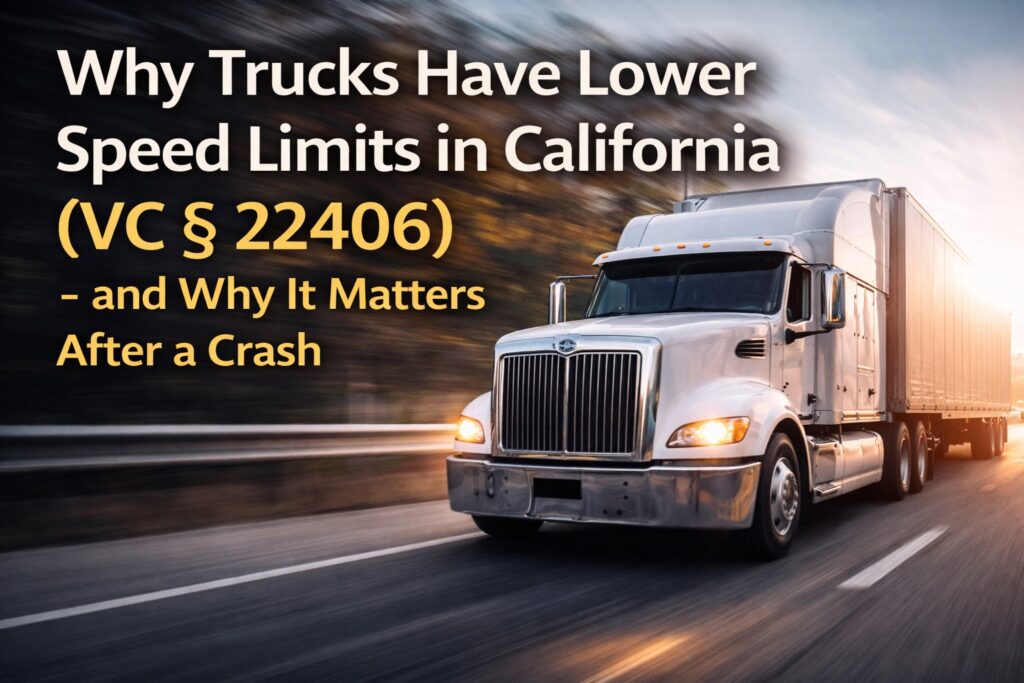
Large commercial trucks do not play by the same speed rules as passenger vehicles in California — and for good reason. When trucks travel too fast, the consequences are often catastrophic, not just inconvenient.
California Vehicle Code § 22406 sets lower maximum speed limits for certain trucks, buses, and vehicles towing trailers. Violations of this statute frequently become a central liability issue in serious truck-accident injury cases.
At WIN Injury & Accident Trial Lawyers, truck-speed violations are a recurring factor in high-severity injury and wrongful-death claims across California highways.
What Is VC § 22406 – Truck Speed Limits?
Vehicle Code § 22406 establishes reduced maximum speed limits for specific classes of vehicles, regardless of posted freeway speeds for passenger cars.
Under this statute, the following vehicles generally may not exceed 55 mph:
- Trucks with three or more axles
- Trucks towing another vehicle
- Passenger vehicles towing trailers
- School buses transporting students
- Farm labor vehicles transporting passengers
Even on freeways posted at 65 or 70 mph, these vehicles are still subject to the lower statutory limit.
Why California Imposes Lower Speed Limits on Trucks
The law reflects basic physics and safety realities:
- Trucks weigh far more than passenger vehicles
- Stopping distances are significantly longer
- High centers of gravity increase rollover risk
- Speed magnifies the severity of crashes
A fully loaded truck traveling at excessive speed can turn a routine traffic event into a multi-vehicle disaster.
Common Truck Speed Violations That Lead to Accidents
VC § 22406 violations often appear in cases involving:
- Rear-end freeway collisions
- Jackknife accidents
- Loss-of-control crashes
- Rollover accidents
- Chain-reaction multi-vehicle crashes
Speed is frequently compounded by:
- Driver fatigue
- Tight delivery schedules
- Inadequate braking distance
- Downhill grades
How VC § 22406 Affects Truck Accident Liability
When a commercial driver exceeds the statutory speed limit, liability issues shift quickly.
From an injury-case standpoint:
- Speed violations weaken defense arguments
- Comparative fault defenses narrow
- Jury exposure increases
- Settlement leverage rises
Speed-limit compliance is often one of the first issues examined by trucking insurers and defense counsel.
Negligence Per Se and Truck Speed Limit Violations
California recognizes negligence per se when a defendant violates a safety statute designed to protect the public.
VC § 22406 exists specifically to prevent the type of severe injuries caused by fast-moving heavy vehicles. When a truck driver violates this statute and causes a crash, the statutory violation may itself establish negligence in a civil lawsuit.
This can streamline liability proof and allow the injured party to focus on causation and damages, rather than debating whether the driver acted reasonably.
Truck Speed Limits vs. Posted Speed Limits
A common defense argument is: “Traffic was moving faster.”
That does not excuse a violation of VC § 22406.
Truck drivers are legally required to follow the statutory truck speed limit, even if:
- Other vehicles are traveling faster
- Traffic flow exceeds the limit
- The driver feels pressured to keep pace
The duty is absolute.
Evidence Used to Prove Truck Speed Violations
Proving that a truck was traveling too fast often depends on data and physical evidence, not just witness statements. In serious truck-accident cases, multiple sources are typically used together to establish speed and compliance with California law.
Key evidence often includes:
- Electronic logging device (ELD) data
ELDs record driving time, vehicle movement, and in many cases speed trends, helping show how fast a truck was traveling before a crash. - Engine control module (ECM) downloads
ECM data can capture pre-crash speed, braking, throttle input, and sudden deceleration in the moments leading up to impact. - GPS and fleet-tracking records
Many trucking companies track vehicle location and speed in real time. These records can reveal sustained speeding over long distances, not just at the moment of the crash. - Dashcam footage
In-cab and outward-facing cameras may show traffic flow, braking, road conditions, and how quickly the truck was moving relative to other vehicles. - Skid-mark and roadway analysis
The length and pattern of skid marks, debris fields, and final vehicle positions can help experts calculate vehicle speed at impact. - Accident-reconstruction expert opinions
Reconstruction specialists analyze all available data to provide an independent assessment of speed, stopping distance, and avoidability.
Preserving this evidence early is critical. Much of it can be overwritten, lost, or destroyed if it is not promptly requested and secured after a truck crash.
Injuries Commonly Seen in Speed-Related Truck Crashes
Truck-speed cases frequently involve:
- Traumatic brain injuries
- Spinal cord and disc injuries
- Crush injuries
- Multiple fractures
- Internal organ damage
- Fatal injuries
These cases often result in long-term disability or wrongful-death claims.
What to Do After a Truck Accident Involving Speed
If you suspect a truck was traveling too fast:
- Call 911 and ensure a full police report is made
- Seek immediate medical care
- Photograph vehicle positions and damage
- Identify witnesses and nearby cameras
- Do not speak with trucking insurers alone
- Contact a trial-focused truck-accident lawyer quickly
Speed-related truck evidence is time-sensitive.
Why Truck Speed Cases Require Trial Lawyers
Trucking companies and insurers defend these cases aggressively. Speed violations expose them to:
- Regulatory scrutiny
- Enhanced liability
- Potential punitive damages in extreme cases
At WIN Trial Lawyers, we prepare truck-speed cases for trial from day one — because leverage matters.
Speak With a California Truck Accident Lawyer
If you were injured in a crash involving a speeding truck, you may be entitled to significant compensation beyond initial insurance offers.
📞 WIN Injury & Accident Trial Lawyers
📍 Serving Los Angeles and throughout California
⚖️ No fee unless we win.
Get Help From WIN Injury & Accident Trial Lawyers
Why Legal Representation Matters
Insurance companies often undervalue pain and suffering—offering minimal settlements that ignore your daily struggles. A skilled attorney can:
- Present powerful evidence of your emotional and physical suffering
- Retain expert witnesses to quantify your losses
- Use verdict data to justify higher multipliers or per diem rates
- Argue your case persuasively before a jury
At WIN Trial Lawyers, our team fights to ensure that your recovery reflects the full extent of your suffering—not just your bills.

At WIN Trial Lawyers, we know how personal injury claims can be can be. Victims often face mounting medical bills, lost wages, and emotional trauma. Our team has successfully taken on insurance companies and third parties, recovering millions for injured clients.
If you or a loved one has been injured in an accident, don’t leave your future in the hands of the insurance company. You need experienced trial lawyers who know how to prove liability and fight for maximum compensation.
If you or a loved one has been injured, don’t face this alone. The sooner you act, the stronger your case will be.
🔗 Related Posts:
Truck Speed Limits (VC 22406) – Frequently Asked Questions
What is Vehicle Code 22406 in California?
Vehicle Code 22406 is the California law that sets lower maximum speed limits for certain vehicles, including large trucks, buses, and vehicles towing trailers, regardless of higher posted freeway speeds.
What is the truck speed limit under VC 22406?
In most situations, the maximum speed is 55 miles per hour for vehicles covered by VC 22406, even on freeways posted at 65 or 70 mph for passenger cars.
Which vehicles are subject to VC 22406?
Vehicles commonly subject to VC 22406 include:
- Trucks with three or more axles
- Trucks towing another vehicle
- Passenger vehicles towing trailers
- School buses transporting students
- Farm labor vehicles transporting passengers
Do truck speed limits apply even if traffic is moving faster?
Yes. Truck drivers must follow the statutory speed limit, even if surrounding traffic is exceeding it. “Keeping up with traffic” is not a legal excuse.
Does VC 22406 apply on all California freeways?
Yes. The statute applies statewide, regardless of whether the posted speed limit for passenger vehicles is higher.
Why do trucks have lower speed limits in California?
Lower truck speed limits reflect safety realities, including:
- Longer stopping distances
- Increased crash severity due to vehicle weight
- Higher rollover risk
- Reduced maneuverability
The law is designed to reduce catastrophic injuries.
Is violating VC 22406 just a traffic ticket?
From a criminal standpoint, it is typically a traffic infraction. However, in injury cases, a speed-limit violation can have major civil-liability consequences.
How does a VC 22406 violation affect a truck accident injury claim?
A truck-speed violation often:
- Strengthens liability against the truck driver
- Narrows defense arguments
- Increases settlement pressure
- Raises jury exposure
Speed is one of the first issues examined in serious truck crashes.
Can VC 22406 be used as negligence per se?
Often, yes. If a truck driver violated VC 22406 and that violation caused the type of harm the statute was designed to prevent, it may support negligence per se in a civil lawsuit.
What is negligence per se in truck accident cases?
Negligence per se allows an injured party to rely on the violation of a safety statute—rather than proving ordinary negligence—to establish fault, provided the violation caused the injury.
Do I need a speeding ticket to prove a truck was going too fast?
No. A citation helps, but liability can also be proven through:
- Electronic logging device (ELD) data
- Engine control module (ECM) downloads
- GPS and fleet-tracking records
- Dashcam footage
- Accident reconstruction analysis
How is truck speed proven after a crash?
Speed is often established using electronic data, physical evidence, skid-mark analysis, vehicle damage patterns, and expert reconstruction testimony.
What if the truck driver claims they didn’t know about the lower speed limit?
Lack of knowledge is not a defense. Commercial drivers are expected to know and comply with truck-specific speed laws.
Does VC 22406 apply to out-of-state trucks?
Yes. Any truck operating on California roadways must comply with California truck speed limits, regardless of where the vehicle or driver is based.
Are trucking companies responsible if a driver was speeding?
Potentially, yes. Employers may face liability for:
- Failing to enforce speed policies
- Unrealistic delivery schedules
- Inadequate training or supervision
- Encouraging unsafe driving practices
What types of accidents are commonly linked to truck speeding?
Truck speed violations are often involved in:
- Rear-end freeway crashes
- Jackknife accidents
- Loss-of-control crashes
- Rollovers
- Multi-vehicle chain-reaction collisions
What injuries are common in speed-related truck crashes?
These crashes frequently cause:
- Traumatic brain injuries
- Spinal cord injuries
- Crush injuries
- Multiple fractures
- Internal organ damage
- Fatal injuries
Can truck speed violations support punitive damages?
In extreme cases, yes. Excessive speed combined with other factors—such as fatigue or prior violations—may support punitive damages for conscious disregard of safety.
How do insurance companies handle truck speed cases?
Trucking insurers defend these cases aggressively and often attempt to:
- Minimize speed evidence
- Shift blame to passenger vehicles
- Dispute causation
Early evidence preservation is critical.
What should I do if I believe a truck was speeding?
You should:
- Call 911 and ensure a full police report
- Seek immediate medical treatment
- Photograph vehicle positions and damage
- Identify witnesses and cameras
- Avoid speaking with trucking insurers alone
- Contact a trial-focused truck accident lawyer quickly
How long do I have to file a truck accident lawsuit in California?
Most personal injury claims must be filed within two years of the accident. Shorter deadlines may apply if a government vehicle or roadway entity is involved.
Why are truck speed cases more complex than car accidents?
They involve:
- Federal and state regulations
- Multiple defendants (driver, carrier, broker)
- Complex electronic evidence
- High damages exposure
These cases require early, trial-level preparation.
Should I hire a lawyer for a truck accident involving speed?
Yes. Truck-speed cases involve sophisticated defenses and high stakes. Early legal involvement helps preserve evidence and maximize recovery.