

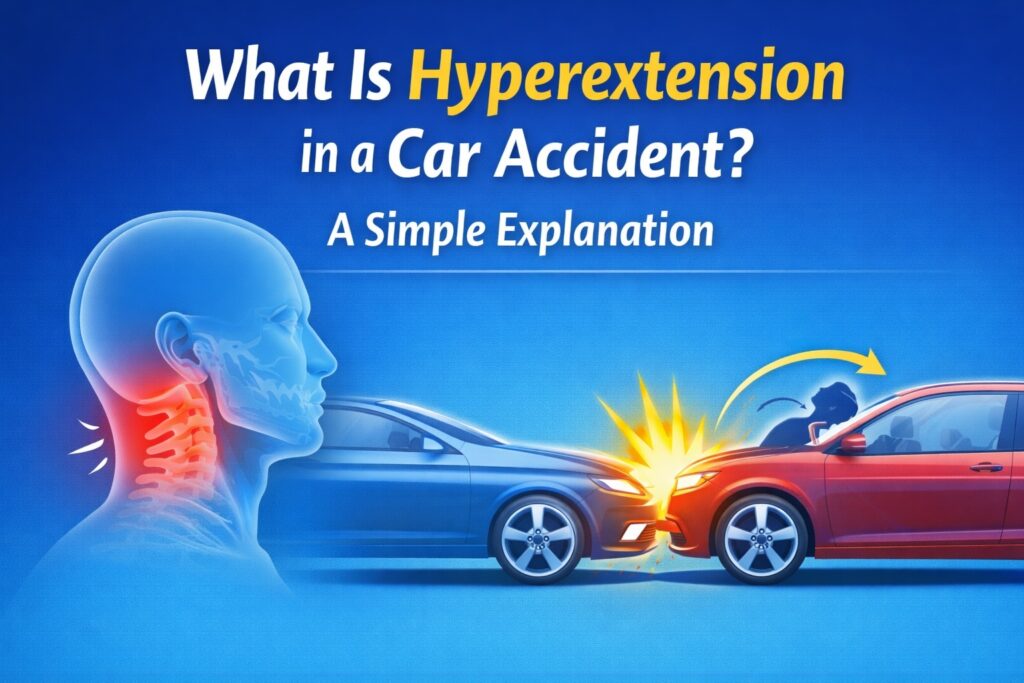
When people think of car accident injuries, they often imagine broken bones or obvious, visible trauma. But one of the most common — and most misunderstood — injuries is hyperextension, a sudden backward movement of the neck that can cause serious and lasting pain even when a crash seems “minor” on the surface.
Many people walk away from a rear-end collision believing they are “fine,” only to wake up days later with stiffness, headaches, limited range of motion, or sharp neck pain. Hyperextension injuries are a major reason why.
Below is a clear, client-friendly explanation of what hyperextension is, how it happens, and why it matters for both your health and your injury claim.

How Hyperextension Happens in a Car Accident
IIn most rear-end collisions, the seat and torso are thrust forward instantly by the force of impact. Your head, however, does not move at the same speed.
For a fraction of a second, your head lags behind your body. During that split second, the neck is forced to bend backward beyond its normal, safe range of motion. This overstretching of the neck’s soft tissues is called hyperextension.
The entire event happens in milliseconds — far faster than the body can react or protect itself. This backward snap is typically followed by a forward motion (hyperflexion), together forming what is commonly known as a whiplash injury.
Importantly, hyperextension can occur even at low speeds. You do not need a high-speed crash or major vehicle damage for this type of injury to occur.
Why Hyperextension Causes Neck Pain
Although hyperextension rarely causes broken bones, it can still cause significant damage to the structures that stabilize and protect your cervical spine, including:
- Neck muscles, which can be strained or torn
- Ligaments and tendons, which may become overstretched or inflamed
- Facet joints, small joints in the spine that help control movement
- Cervical nerves, which can become irritated or compressed
These injuries are often referred to as soft-tissue injuries, and they can be extremely painful and disruptive. Symptoms may include neck stiffness, reduced range of motion, headaches, shoulder pain, numbness, tingling, or pain that radiates into the arms.
Because soft-tissue injuries usually do not appear on standard X-rays, they are frequently misunderstood or minimized. MRI scans and clinical exams are often required to fully identify the damage.
Unfortunately, insurance companies routinely take advantage of this. If there is no fracture or dramatic imaging finding, adjusters may argue that the injury is “minor” or unrelated — even when the pain and limitations are very real.

Common Symptoms of Hyperextension
Symptoms of a hyperextension injury do not always appear right away. In many cases, adrenaline masks pain at the scene of the crash, and discomfort develops hours or even days later as inflammation sets in.
If you suffered hyperextension in a car accident, you may experience one or more of the following:
- Soreness or stiffness in the neck, especially after periods of rest
- Neck pain that worsens with movement, such as turning your head or looking up or down
- Headaches, often starting at the base of the skull and radiating forward
- Shoulder or upper-back tightness, sometimes mistaken for simple muscle tension
- Dizziness or lightheadedness, particularly when changing positions
- Difficulty turning your head or feeling “locked up” in certain positions
Some people also report fatigue, trouble concentrating, or pain that radiates into the arms — symptoms that can signal irritation of the cervical nerves.
These are classic signs of early soft-tissue trauma, even when imaging studies like X-rays appear normal. The absence of visible damage does not mean the injury is mild or insignificant.
Why You Shouldn’t Ignore Hyperextension After a Crash
EOne of the most dangerous misconceptions after a car accident is believing that minor vehicle damage equals minor injuries. In reality, the human neck is far more vulnerable than modern car frames and bumpers.
Even low-speed collisions can generate enough force inside the vehicle to violently snap the neck backward, damaging muscles, ligaments, joints, and nerves. When hyperextension injuries go untreated, inflammation and instability can worsen over time rather than improve.
Ignoring symptoms or delaying care can increase the risk of:
- Chronic neck pain that lasts months or years
- Reduced range of motion, making everyday activities uncomfortable
- Persistent or worsening headaches
- Muscle spasms and guarding, where the body tightens to protect injured tissue
- Difficulty sleeping, due to pain and stiffness
- Long-term whiplash syndrome, a condition associated with ongoing pain and functional limitations
Early medical treatment is critical — not only for your recovery, but also for documenting the injury properly. Care may include physical therapy, chiropractic treatment, targeted exercises, anti-inflammatory medications, or other conservative therapies designed to restore mobility and reduce pain.
From a legal perspective, prompt treatment also creates a clear record connecting your symptoms to the accident. Insurance companies often argue that delayed care means the injury was not serious or was caused by something else. Getting evaluated early helps protect both your health and your injury claim.
If you notice neck pain, stiffness, headaches, or limited movement after a crash — even days later — take it seriously. Hyperextension injuries are real, common, and treatable when addressed early.
Why Hyperextension Matters for Your Injury Claim
Just because an injury is not visible on an X-ray does not mean it is insignificant. Hyperextension injuries can require weeks or months of physical therapy, chiropractic care, pain management, or ongoing medical treatment.
Delayed treatment or dismissed symptoms can also allow the injury to worsen over time, leading to chronic neck pain or long-term mobility issues.
From a legal standpoint, documenting hyperextension early — through medical visits, consistent treatment, and proper records — is critical. It helps establish the connection between the crash and your symptoms and protects you from insurance tactics designed to downplay soft-tissue injuries.
If you were involved in a car accident and later developed neck pain, stiffness, or headaches, it is important to take those symptoms seriously — even if the crash seemed minor at the time.

Injured in a Car Accident? WIN Trial Lawyers Can Help
If you’re experiencing neck pain after a crash — even if it didn’t feel serious at the time — you may be suffering from hyperextension or whiplash. At WIN Trial Lawyers, we help injury victims get the medical care and compensation they need to fully recover.
Free Consultation • No Fees Unless We Win
You don’t have to navigate the process alone. Contact WIN Trial Lawyers today and let our team fight for you.
Why Choose WIN Trial Lawyers
Our firm combines deep knowledge of California accident law. We know how insurers operate — and how to maximize your recovery through aggressive negotiation and trial readiness.
If you were injured in a car accident, you deserve a team that fights for full compensation — medical costs, lost wages, and pain and suffering.
Learn more
- Car Accident Lawyer Pasadena
- What to Do After a Car Accident in Pasadena
- Back and Spinal Injuries After a Crash

At WIN Trial Lawyers, we know how devastating distracted driving accidents can be. Victims often face mounting medical bills, lost wages, and emotional trauma. Our team has successfully taken on insurance companies and distracted drivers, recovering millions for injured clients.
If you or a loved one has been injured in a speeding-related car accident, don’t leave your future in the hands of the insurance company. You need experienced trial lawyers who know how to prove liability and fight for maximum compensation.
If you or a loved one has been injured in a distracted driving accident, don’t face this alone. The sooner you act, the stronger your case will be.