

If you have a workers’ compensation claim in California, you may hear the term QME early in the process—often at a moment when your benefits, treatment, or work status are being questioned. Understanding what a QME is, how the process works, and why it matters can make a significant difference in the outcome of your case.
At WIN Injury & Accident Trial Lawyers, we regularly guide injured workers through the QME process and protect them from common mistakes that can negatively impact their claims.
What Does QME Stand For?
QME stands for Qualified Medical Evaluator.
A QME is a state-certified physician authorized by the California Division of Workers’ Compensation (DWC) to conduct independent medical-legal evaluations in workers’ compensation cases where there is a dispute. QMEs must meet strict licensing, training, and certification requirements set by the state.
Importantly, QMEs are not treating doctors. Their role is not to provide care or advocate for either side, but to evaluate disputed medical issues and issue a formal medical-legal report that can significantly impact the direction and value of a claim.
A QME’s opinions may directly affect:
- Whether your injury is work-related (industrial causation)
- What medical treatment the insurance company must provide
- Whether you qualify for temporary disability benefits
- Whether you are permanently disabled
- Your permanent disability (PD) rating, which influences settlement value
- Your work restrictions and ability to return to work
In many cases, the QME report becomes the most influential piece of medical evidence in the entire workers’ compensation claim.
When Is a QME Required?
A QME is typically required when there is a medical dispute between the injured worker and the insurance company. Common situations include:
- The insurance company denies the injury altogether
- There is disagreement about what caused your condition (work injury vs. non-industrial causes)
- Your employer disputes how serious your injury is
- The insurance company cuts off medical treatment
- Temporary disability payments are stopped
- There is a dispute over permanent disability
When the treating physician’s opinions are challenged or rejected by the insurer, the QME’s evaluation often becomes the deciding medical authority.
Because judges at the Workers’ Compensation Appeals Board frequently rely on QME opinions to resolve disputes, the QME process can shape the outcome of your case long before trial or settlement discussions.
How the QME Is Selected
The method for selecting a QME depends largely on whether you are represented by an attorney.
If You Do NOT Have an Attorney
If you are unrepresented, the insurance company will request a QME panel from the state. This panel consists of three certified QMEs in the medical specialty relevant to your injury (e.g., orthopedics, psychiatry, internal medicine).
Key points to understand:
- You must select one doctor from the three-doctor panel
- You must make your selection within strict statutory deadlines
- If you do not act in time, the insurance company may gain the right to choose
- Once selected, you generally must proceed with that evaluator
Unrepresented workers often underestimate how critical this selection is—and how limited their ability to change evaluators later can be.
If You DO Have an Attorney
If you are represented, your attorney and the insurance company may agree on an Agreed Medical Evaluator (AME) instead of using a QME panel.
An AME differs from a QME in important ways:
- The doctor is mutually agreed upon by both sides
- The AME’s opinions often carry greater legal weight
- The selection can be more strategic, based on specialty, reputation, and experience
- The process is typically more streamlined
Because AME reports are often given substantial deference by judges, choosing the right evaluator can be critical to the outcome of a case.
⚠️ Why Deadlines Matter
The QME process is governed by strict procedural deadlines. Missing a deadline can have serious consequences, including:
- Losing the right to choose the doctor
- Being forced to proceed with an unfavorable evaluator
- Delays in treatment or benefits
Once a QME or AME is selected and the evaluation occurs, it can be very difficult to undo the impact of that report.
What Happens at a QME Exam?
A QME appointment may feel similar to a routine medical exam, but its purpose is very different. Unlike your treating doctor, the QME is not there to diagnose, treat, or help you recover. The QME’s role is to evaluate disputed medical issues and create a report that will be used by the insurance company, attorneys, and potentially a judge.
Before the Exam
Before you ever walk into the appointment, the QME typically reviews:
- Medical records from your treating doctors
- Prior injury records or claims
- Diagnostic tests such as MRIs or X-rays
- Job descriptions and work duties
- Insurance company records and reports
What the QME reviews—and what is missing—can significantly influence their conclusions.
During the Exam
During the evaluation, the QME may:
- Ask detailed questions about how the injury happened
Including when, where, and what you were doing at the time. - Discuss your symptoms and limitations
Pain levels, physical restrictions, daily activities, and how the injury affects your ability to work. - Perform a physical examination
This may include testing range of motion, strength, reflexes, or observing how you move. - Ask about prior injuries or medical history
Including non-work injuries, pre-existing conditions, or prior claims. - Assess work capacity and restrictions
Whether you can return to work, need modified duties, or are unable to work at all.
Throughout the exam, the QME is evaluating credibility, consistency, and medical causation—not just symptoms. Inconsistencies between what you say, your medical records, and your physical presentation may be noted in the report.
What the QME Is Not Doing
It’s important to understand that the QME:
- Does not provide treatment
- Does not prescribe medication
- Does not act as your advocate
- Does not replace your treating doctor
The QME’s role is strictly evaluative and legal in nature.
Why the QME Report Is So Important
After the exam, the QME prepares a written medical-legal report addressing the disputed issues in your case. This report can shape the entire future of your workers’ compensation claim.
A QME report may determine:
- Whether your injury is industrial (work-related)
Or whether the insurance company can deny responsibility. - Whether your employer must continue providing medical treatment
Including surgery, therapy, or medications. - Whether you qualify for temporary disability benefits
And how long those payments should continue. - Whether you have permanent disability
And the extent of that disability. - Your permanent disability (PD) rating
Which directly affects settlement value and future benefits.
In many cases, the QME report becomes the primary medical evidence relied upon by the insurance company and the Workers’ Compensation Appeals Board.
How Judges Use QME Reports
Judges at the Workers’ Compensation Appeals Board frequently rely on QME opinions to resolve medical disputes—especially when there are conflicting opinions from treating doctors.
Unless successfully challenged, a QME’s conclusions may:
- Be adopted by the judge
- Override treating physician opinions
- Control the outcome of hearings and settlements
This is why the QME process is often described as one of the most important stages of a workers’ compensation case.
Why Preparation Matters
Because the QME report can carry so much weight, how the exam is handled—and whether you are properly prepared—can significantly affect the outcome of your claim. Even well-intentioned injured workers can harm their cases by misunderstanding the purpose of the exam or how information is interpreted.g disputes.
Common Mistakes Injured Workers Make at QMEs
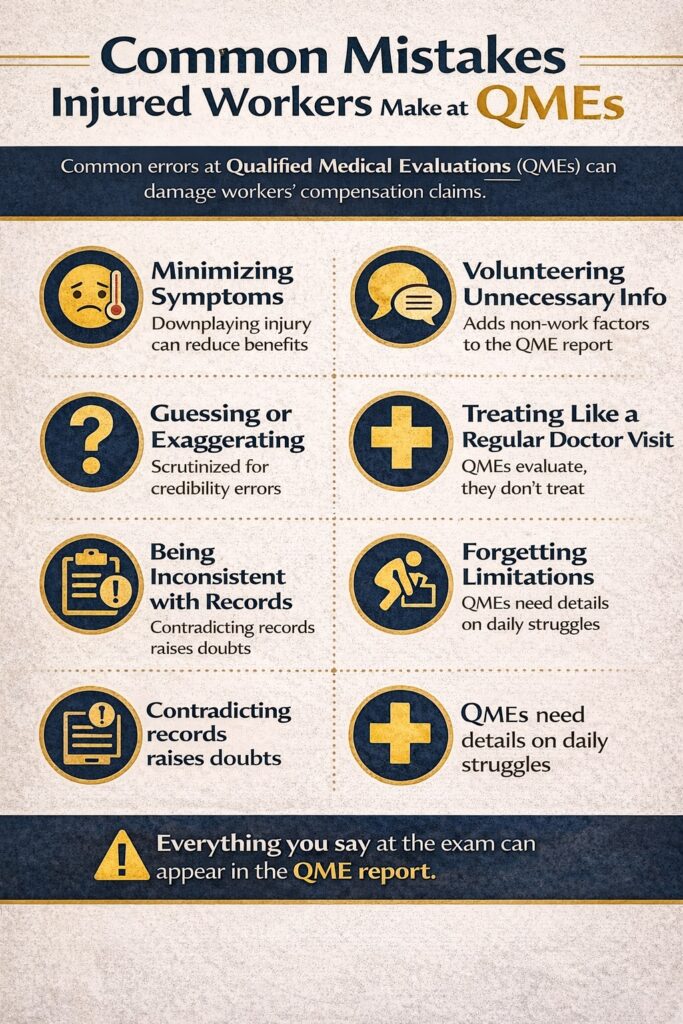
Many injured workers unintentionally damage their workers’ compensation claims during QME exams—not because they are dishonest, but because they misunderstand the purpose of the evaluation. A QME exam is not a treatment visit, and the way information is presented can significantly affect how the evaluator interprets your case.
Below are some of the most common mistakes injured workers make, and why they can be harmful.
Minimizing Symptoms
Some injured workers downplay their pain or limitations out of habit, pride, or optimism. Others do so because they don’t want to appear weak or complain.
Why this is a problem:
- The QME may conclude your injury is minor or resolving
- Work restrictions may be reduced or eliminated
- Temporary disability benefits may be cut off
- Permanent disability ratings may be lowered
If your symptoms fluctuate, failing to explain good days versus bad days can lead to an incomplete or misleading report.
Guessing or Exaggerating
Guessing dates, symptoms, or medical details—or exaggerating pain—can seriously undermine credibility.
Why this is a problem:
- Inaccurate statements may conflict with medical records
- The QME may question your reliability
- Even minor inconsistencies can be highlighted in the report
QMEs are trained to look for consistency across records, statements, and physical findings. If you are unsure about a detail, it is better to say so than to guess.
Being Inconsistent With Prior Medical Records
Statements made at a QME exam are often compared against:
- Treating doctor reports
- Prior injury records
- Diagnostic tests
- Employer injury reports
Why this is a problem:
- Inconsistencies may be interpreted as exaggeration or dishonesty
- The QME may attribute your condition to non-work causes
- Credibility concerns can weaken your entire claim
Even unintentional inconsistencies—such as describing pain differently—can be used against you.
Volunteering Unnecessary Information
Some injured workers overshare information they believe is helpful, such as:
- Old injuries unrelated to work
- Minor aches that resolved years ago
- Non-relevant personal details
Why this is a problem:
- The QME may attribute your condition to pre-existing issues
- The insurance company may argue your injury is not work-related
- Irrelevant details can distract from the actual work injury
Answer questions honestly, but do not speculate or offer extra information unless asked.
Treating the Exam Like a Regular Doctor Visit
Many injured workers mistakenly assume the QME is there to help them medically.
Why this is a problem:
- The QME does not treat or advocate for you
- Expressions of frustration or casual comments may be documented
- Statements like “I’m doing better” can be taken out of context
Everything said during the exam—casual or formal—can appear in the written report.
Failing to Describe Functional Limitations
Some workers focus only on pain and forget to explain how the injury affects daily activities, such as:
- Lifting
- Standing or walking
- Sleeping
- Driving
- Working a full shift
Without this information, the QME may underestimate the severity of your limitations.
Why These Mistakes Matter
The QME report is often relied upon by:
- Insurance companies
- Attorneys
- Workers’ compensation judges
Once issued, the report can be very difficult to undo. Small mistakes at the exam can have long-term consequences for medical care, benefits, and settlement value.
Can You Challenge a QME Report?
Yes. A QME report is not always final or untouchable. Depending on the situation, it may be possible to:
- Depose the QME
- Request supplemental reporting
- Challenge the report for legal or medical deficiencies
- Obtain a different evaluator in limited circumstances
However, these options are highly procedural and time-sensitive.
Why Legal Representation Matters in the QME Process
The QME process is not neutral in practice. Insurance companies understand how powerful these reports are—and they prepare accordingly.
An experienced workers’ compensation attorney can:
- Help select the right evaluator
- Prepare you for the exam
- Ensure accurate medical records are submitted
- Identify flaws or bias in QME reports
- Protect your right to benefits and fair compensation
How WIN Injury & Accident Trial Lawyers Helps Injured Workers
At WIN Injury & Accident Trial Lawyers, we represent injured workers throughout California in complex workers’ compensation cases. We understand how QMEs affect treatment, benefits, and settlement value—and we fight to ensure the process is handled fairly.
If you’ve been scheduled for a QME or have questions about your workers’ compensation claim, our team can help you understand your rights and next steps.
Get Help From WIN Injury & Accident Trial Lawyers
Why Legal Representation Matters
Insurance companies often undervalue pain and suffering—offering minimal settlements that ignore your daily struggles. A skilled attorney can:
- Present powerful evidence of your emotional and physical suffering
- Retain expert witnesses to quantify your losses
- Use verdict data to justify higher multipliers or per diem rates
- Argue your case persuasively before a jury
At WIN Trial Lawyers, our team fights to ensure that your recovery reflects the full extent of your suffering—not just your bills.

At WIN Trial Lawyers, we know how personal injury claims can be can be. Victims often face mounting medical bills, lost wages, and emotional trauma. Our team has successfully taken on insurance companies and third parties, recovering millions for injured clients.
If you or a loved one has been injured in an accident, don’t leave your future in the hands of the insurance company. You need experienced trial lawyers who know how to prove liability and fight for maximum compensation.
If you or a loved one has been injured, don’t face this alone. The sooner you act, the stronger your case will be.
🔗 Related Posts:
Frequently Asked Questions (FAQs) About QMEs
What is the purpose of a QME in workers’ compensation?
A QME’s role is to resolve medical disputes in a workers’ compensation case. The QME evaluates medical issues and issues a formal report that may influence benefits, treatment, disability status, and settlement value.
Is a QME the same as my treating doctor?
No. A QME does not provide treatment and is not responsible for your ongoing care. The QME’s role is evaluative and legal, not therapeutic.
Who chooses the QME doctor?
If you are unrepresented, a QME is selected from a three-doctor panel issued by the California Division of Workers’ Compensation.
If you are represented, your attorney and the insurance company may agree on an Agreed Medical Evaluator (AME) instead.
What happens if I miss a QME deadline?
Missing a deadline can result in losing your right to choose the doctor or being forced to proceed with an evaluator selected by the insurance company. Deadlines in the QME process are strict.
How long does a QME exam usually take?
Most QME exams last 30 to 90 minutes, depending on the complexity of the injury and the medical issues being evaluated.
Can I bring someone with me to the QME exam?
In most cases, no. QMEs generally require that injured workers attend the exam alone unless a translator or accommodation is formally approved.
Can I bring medical records to the QME exam?
You should not bring new records unless instructed by your attorney. Typically, records are submitted in advance, and bringing additional materials without authorization may create procedural issues.
What if the QME report is wrong or unfair?
A QME report can sometimes be:
- Challenged
- Supplemented
- Clarified
- Deposed (questioned under oath)
However, these options are procedural and time-sensitive, making legal guidance important.
How long does it take to receive the QME report?
QMEs generally have 30 days to issue their report after the exam, though extensions may occur in some cases.
How much weight does a QME report carry?
QME reports often carry significant weight with insurance companies and judges at the Workers’ Compensation Appeals Board, especially when medical opinions conflict.
Can a QME end my benefits?
A QME report can influence decisions about:
- Medical treatment
- Temporary disability payments
- Permanent disability ratings
However, benefits are not automatically terminated without proper legal process.
Should I prepare for a QME exam?
Yes. Because QME reports can shape the outcome of a case, understanding the purpose of the exam and avoiding common mistakes can make a meaningful difference.