
How Failing to Stop Creates Clear Injury Liability
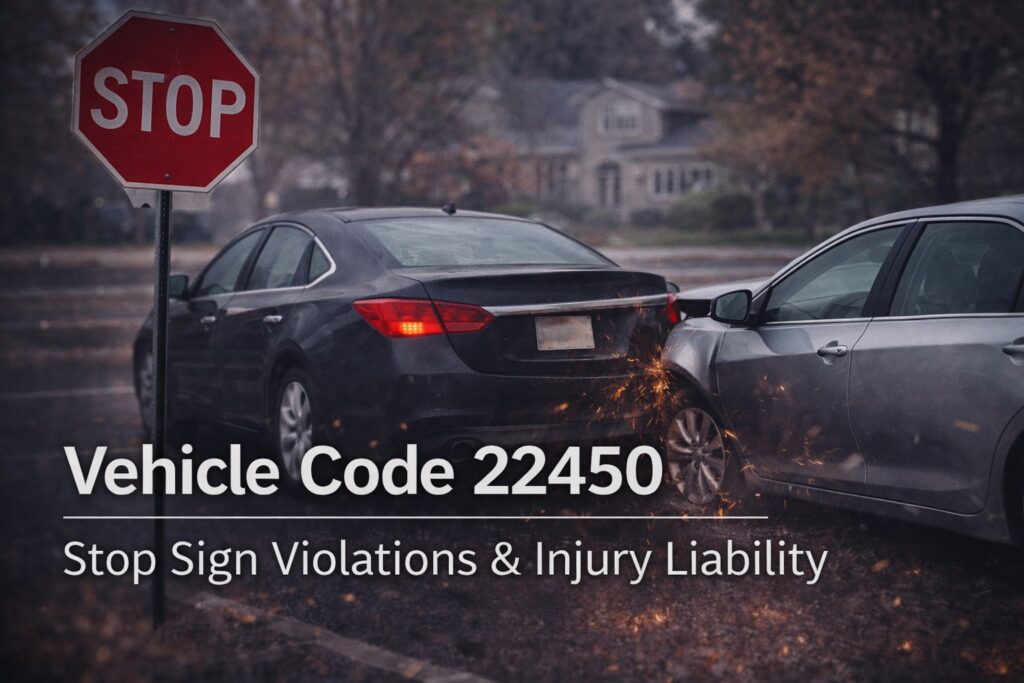
Stop signs exist to prevent some of the most dangerous and sudden crashes on California roads. When a driver ignores a stop sign — or performs a so-called “California stop” — the result is often a violent intersection collision that leaves innocent people seriously injured.
California law is unambiguous. If there is a stop sign, the driver must come to a complete stop. Slowing down is not enough.
Under Vehicle Code § 22450, drivers who fail to properly stop at stop signs often create clear, provable liability when an accident occurs. At WIN Injury & Accident Trial Lawyers, stop-sign cases are frequently among the strongest negligence claims we handle.
What Vehicle Code § 22450 Requires
Vehicle Code § 22450 provides that a driver approaching a stop sign must:
- Come to a complete stop
- Stop at the limit line, crosswalk, or before entering the intersection
- Proceed only when it is safe to do so
A rolling stop — even one where the vehicle slows significantly — violates the statute.
Key takeaway:
If the vehicle’s wheels do not fully stop, the law has been violated.
Why Stop Sign Violations Cause Serious Injuries
Stop-sign crashes are especially dangerous because:
- Other drivers assume cross-traffic will stop
- Impacts are often side-impact (T-bone) collisions
- Pedestrians and cyclists rely on drivers stopping
- Intersections provide little reaction time
Common injuries include:
- Traumatic brain injuries (TBI)
- Spinal and neck injuries
- Broken legs, hips, and arms
- Internal organ damage
- Fatal injuries in motorcycle and pedestrian cases
Negligence Per Se and Vehicle Code § 22450
A violation of Vehicle Code § 22450 frequently establishes negligence per se in California injury cases.
How Negligence Per Se Applies
Negligence per se applies when:
- A driver violates a statute
- The statute was designed to prevent the type of harm that occurred
- The injured person is within the class the law was meant to protect
- The violation caused the injury
Stop signs exist to prevent intersection collisions and protect drivers, passengers, pedestrians, and cyclists. When a driver fails to stop and causes a crash, these elements are usually met.
Why This Matters
When negligence per se applies:
- The driver’s breach of duty is presumed
- The defense cannot argue the driver was “being careful”
- The case focuses on causation and damages, not fault
This is why stop-sign cases are often liability-strong.
Common Insurance Company Pushback in Stop Sign Cases
Even with a clear statutory violation, insurers often try to deflect responsibility.
“They Slowed Down — That’s Close Enough”
It isn’t. The statute requires a complete stop, not a slowdown.
“Both Drivers Share Fault”
Comparative fault is commonly alleged, but failure to stop usually places the majority of fault on the violating driver.
“The Other Driver Was Speeding”
Speed arguments are frequently raised, but they rarely excuse a driver who unlawfully entered an intersection without stopping.
“There Were No Witnesses”
Stop-sign violations are often proven through vehicle damage patterns, intersection layout, and reconstruction — not just eyewitnesses.
How WIN Proves Stop Sign Violations
Stop-sign cases are evidence-driven and benefit from early investigation.
Key Evidence Includes:
- Intersection and surveillance video
- Dashcam footage
- Police collision reports
- Witness statements
- Vehicle damage patterns
- Skid marks and roadway evidence
Damage location often tells the story: a vehicle struck broadside in an intersection rarely entered unlawfully.
How These Cases Proceed for Clients
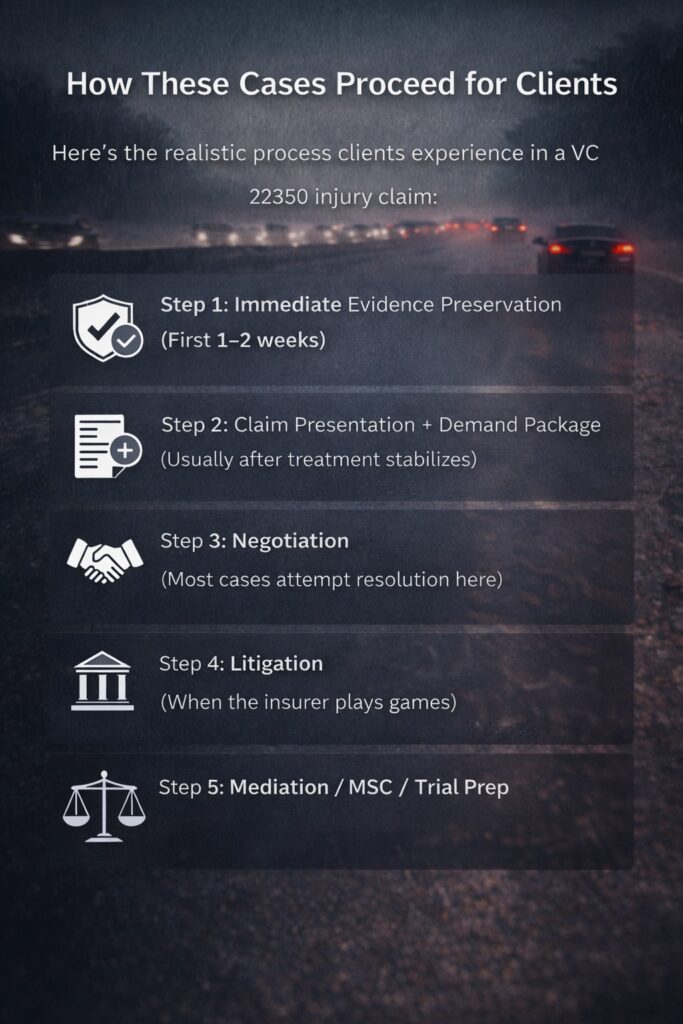
Here’s the realistic process clients experience in a VC § 22450 injury claim:
Step 1: Immediate Evidence Preservation (First 1–2 Weeks)
Video footage is often overwritten. Vehicles are repaired or totaled. Intersection conditions change.
Step 2: Claim Presentation + Demand Package
We assemble:
- Proof of the stop-sign violation
- Intersection and collision analysis
- Medical records and prognosis
- Wage-loss documentation
- A demand grounded in trial value, not adjuster math
Step 3: Negotiation
Some cases resolve here — if the insurer acts reasonably.
Step 4: Litigation (When the Insurer Pushes Back)
If liability or damages are disputed, we file suit and pursue:
- Written discovery
- Depositions
- Expert testimony
- Motions forcing defense positions
Step 5: Mediation / MSC / Trial Preparation
Most litigated cases still settle — but they settle for more when trial is real.
Do Stop Sign Cases Go to Trial?
Most stop-sign cases resolve before trial, but litigation is common when:
- Insurers dispute whether the driver fully stopped
- Comparative fault is improperly alleged
- Injuries are severe
WIN prepares every stop-sign case as a trial case. That leverage matters.
Damages Available in VC § 22450 Cases
Injured victims may recover:
- Medical expenses (past and future)
- Lost wages and diminished earning capacity
- Pain and suffering
- Permanent disability or disfigurement
- Property damage
- Wrongful death damages (when applicable)
Serious stop-sign crashes often result in six- or seven-figure recoveries.
Get Help From WIN Injury & Accident Trial Lawyers
Why Legal Representation Matters
Insurance companies often undervalue pain and suffering—offering minimal settlements that ignore your daily struggles. A skilled attorney can:
- Present powerful evidence of your emotional and physical suffering
- Retain expert witnesses to quantify your losses
- Use verdict data to justify higher multipliers or per diem rates
- Argue your case persuasively before a jury
At WIN Trial Lawyers, our team fights to ensure that your recovery reflects the full extent of your suffering—not just your bills.
At WIN Trial Lawyers, we know how personal injury claims can be can be. Victims often face mounting medical bills, lost wages, and emotional trauma. Our team has successfully taken on insurance companies and third parties, recovering millions for injured clients.
If you or a loved one has been injured in an accident, don’t leave your future in the hands of the insurance company. You need experienced trial lawyers who know how to prove liability and fight for maximum compensation.
If you or a loved one has been injured, don’t face this alone. The sooner you act, the stronger your case will be.
🔗 Related Posts:
Frequently Asked Questions – Vehicle Code § 22450
Stop Sign Violations in California
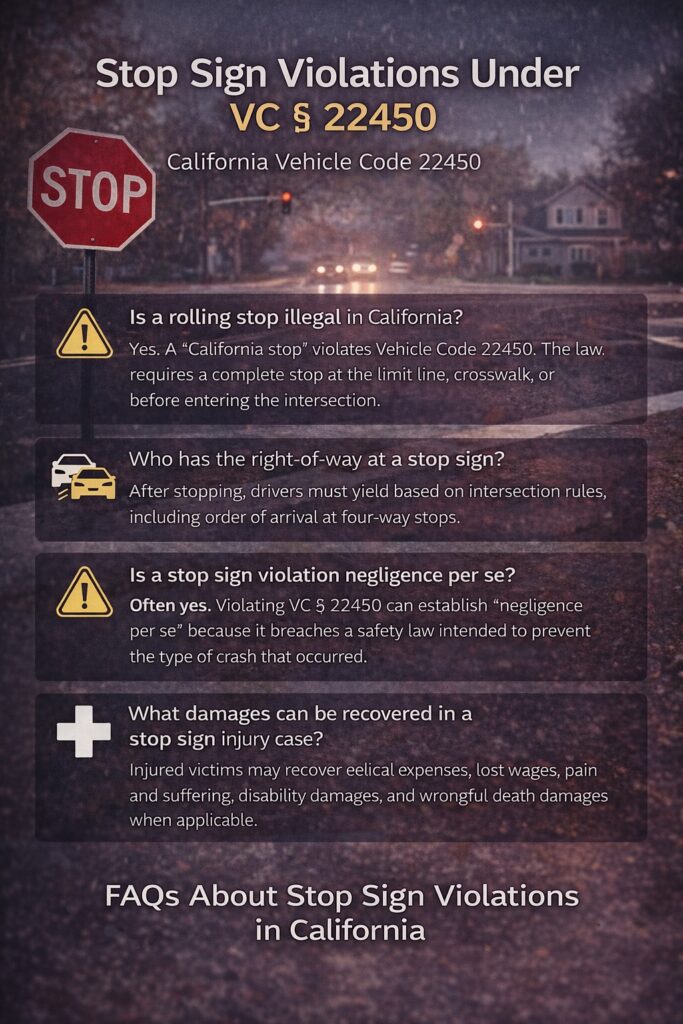
What does Vehicle Code § 22450 require?
Vehicle Code § 22450 requires drivers to come to a complete stop at a stop sign at the limit line, crosswalk, or before entering the intersection, and to proceed only when it is safe.
Is a rolling stop legal in California?
No. A rolling stop violates Vehicle Code § 22450. The vehicle’s wheels must come to a complete stop.
Does slowing down count as stopping?
No. Slowing down without fully stopping is still a violation of the law.
Who has the right-of-way at a stop sign?
After stopping, drivers must yield the right-of-way according to the rules of the intersection, including order of arrival at four-way stops.
Are stop sign violations common causes of accidents?
Yes. Stop sign violations are a leading cause of intersection crashes, especially side-impact (T-bone) collisions.
Are stop sign accidents dangerous?
Yes. These crashes often occur suddenly and involve side impacts, which frequently cause serious or fatal injuries.
Is violating a stop sign negligence per se?
Often, yes. A violation of Vehicle Code § 22450 can establish negligence per se if the violation caused the injury.
What is negligence per se?
Negligence per se means the law presumes a driver was negligent because they violated a safety statute designed to prevent the type of harm that occurred.
How does negligence per se help an injury case?
It removes debate over whether the driver acted reasonably and focuses the case on causation and damages.
Can a stop sign violation still be disputed?
Insurance companies may dispute whether the driver fully stopped, but physical evidence often resolves the issue.
What evidence proves a stop sign violation?
Common evidence includes dashcam footage, surveillance video, police reports, witness statements, vehicle damage patterns, and accident reconstruction.
Do police reports decide fault?
No. Police reports are important but not determinative. Civil liability depends on all available evidence.
What if there were no witnesses?
Stop sign cases can often be proven through vehicle damage, intersection layout, and expert reconstruction.
What if both drivers claim they stopped?
Order of arrival, vehicle positioning, damage patterns, and reconstruction often clarify fault.
What if the other driver was speeding?
Speed arguments are common but usually do not excuse a driver who failed to stop before entering the intersection.
Can comparative fault apply in stop sign cases?
Yes, but failure to stop often places the majority of fault on the violating driver.
Are pedestrians protected at stop sign intersections?
Yes. Stop signs are designed to protect pedestrians and cyclists as well as drivers.
Are bicycle accidents common at stop signs?
Yes. Cyclists are especially vulnerable when drivers fail to stop or yield.
Do stop sign cases often go to litigation?
They can, especially when insurers dispute whether a full stop occurred or when injuries are severe.
Do stop sign cases usually go to trial?
Most cases settle before trial, but trial readiness often increases settlement value.
What damages can be recovered in a stop sign injury case?
Damages may include medical expenses, lost wages, future earning capacity, pain and suffering, disability, and wrongful death damages when applicable.
How long do I have to file a claim?
Generally two years from the date of injury, with shorter deadlines if a government entity is involved.
Should I talk to the insurance company after a stop sign accident?
It’s risky. Insurance adjusters often seek statements that minimize liability. Consulting a lawyer first is usually best.
Why is early investigation important?
Video footage can be erased, vehicles repaired, and intersection conditions changed within days or weeks.
Can passengers recover damages?
Yes. Passengers are rarely at fault and often have strong claims against one or more drivers.
How does WIN Injury & Accident Trial Lawyers handle stop sign cases?
WIN investigates immediately, preserves evidence, and prepares each case as if it will be tried.
What should I do after a stop sign accident?
Seek medical care, document the scene if possible, and consult an experienced personal injury attorney promptly.