
How “Speed Unsafe for Conditions” Creates Liability in Injury Cases
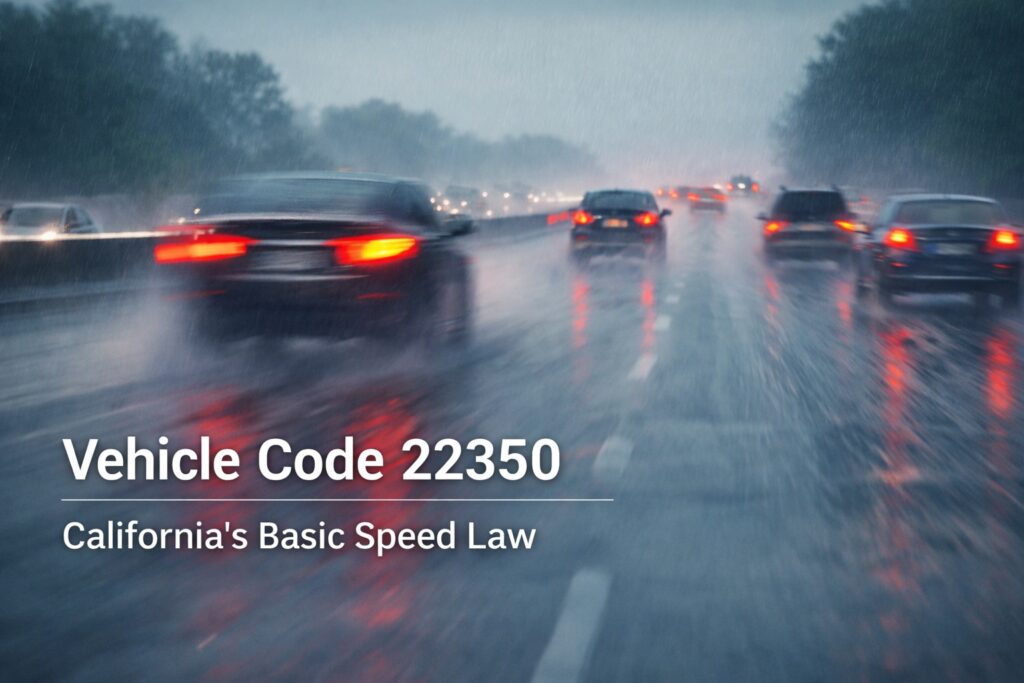
Speed doesn’t have to be above the posted limit to be illegal — or to make a driver financially responsible for a serious crash.
Under Vehicle Code 22350, California drivers must travel only at a speed that is reasonable and prudent for conditions such as weather, visibility, traffic, and the roadway surface and width. The statute specifically prohibits driving at a speed that endangers people or property.
At WIN Injury & Accident Trial Lawyers, we use VC 22350 constantly in injury cases where the police report says “speed unsafe for conditions,” or where the facts show the at-fault driver was moving too fast to stop, react, or maintain control — even if their speed was “under the limit.”
What Vehicle Code 22350 Actually Says
Vehicle Code 22350 provides (in substance) that no one may drive faster than is reasonable or prudent considering:
- weather
- visibility
- traffic
- the surface and width of the highway
…and in no event at a speed that endangers safety.
Translation: the speed limit is not a “free pass.” If conditions require slower driving, the law requires slower driving.
The Key Concept: “Too Fast for Conditions” (Even Below the Limit)
VC 22350 is the backbone of many “lost control” crashes, including:
- Hydroplaning and wet-road collisions
- Rear-end crashes in stop-and-go traffic
- Fog/low-visibility pileups
- Curve/grade crashes (mountain roads, freeway transitions)
- Construction-zone impacts
- Night driving where stopping distance exceeds visibility
This is why you’ll often see VC 22350 cited in a collision report even when the driver wasn’t clocked above the speed limit.
Negligence Per Se: Why VC 22350 Matters in Civil Injury Lawsuits
In California, a statutory violation can support negligence per se — a presumption of negligence — when certain elements are met. The doctrine is grounded in Evidence Code § 669 and is reflected in CACI 418.
How Negligence Per Se Works (Plain English)
If we prove the at-fault driver violated VC 22350 and that violation caused the crash, the law can presume the driver failed to use due care.
The Jury Instruction You Care About (CACI 706)
California’s civil jury instructions specifically address the Basic Speed Law. CACI 706 explains that driving at an unreasonable speed under VC 22350 is treated as negligence per se, and then the case turns to causation and damages.
What Negligence Per Se Does for Your Case
When it applies, it helps “lock in” the breach of duty so the defense can’t simply argue:
“He was being careful.”
Instead, the fight becomes:
- Did the speed cause the loss of control/impact?
- What injuries and financial losses did it cause?
How WIN Builds a VC 22350 Injury Case
Because “reasonable and prudent” depends on conditions, these cases are won with evidence, not slogans.
What We Immediately Investigate
- Weather history (rain intensity, fog advisories, wind, lighting)
- Road condition evidence (standing water, oil slick, gravel, potholes)
- Scene photos/video (including nearby business cams and dash cams)
- Vehicle data (EDR/“black box,” ECU data, telematics when available)
- Skid marks / yaw marks / debris fields
- Police report + bodycam and officer observations
- Witness statements (especially “they were flying,” “no headlights,” etc.)
Expert Reconstruction (When Needed)
In serious cases, we use accident reconstruction to prove:
- stopping distance vs. sight distance
- hydroplaning conditions and speed thresholds
- time-to-perception/reaction
- lane-change dynamics and loss-of-control mechanics
That is often what forces insurers to stop treating VC 22350 like “a vague ticket” and start valuing it like the liability driver it is.
Insurance Company Pushback We See All the Time
Speed-law injury cases often trigger predictable defenses. Here’s what insurers typically argue — and how we counter it.
1) “They weren’t speeding.”
Response: VC 22350 is not just about the number on the sign — it’s about conditions. The question is whether the speed was reasonable and prudent at that moment.
2) “It was an unavoidable accident.”
Response: Weather doesn’t excuse unsafe driving — it increases the duty to slow down. Hydroplaning is frequently a foreseeable risk at unsafe speeds in wet conditions.
3) “The road caused it, not the driver.”
Response: Sometimes roadway conditions contribute — and that can open additional claims — but it does not erase a driver’s duty to adjust speed for hazards that are visible or reasonably anticipated.
4) “Comparative fault—your client contributed.”
Response: California is comparative fault, but when the other driver loses control, rear-ends in traffic, or can’t stop in rain, the allocation often stays heavily on the unsafe-speed driver.
5) “Injuries aren’t related / are exaggerated.”
Response: We build causation through consistent medical documentation, imaging, biomechanics where appropriate, and a clean treatment timeline.
How These Cases Proceed for Clients
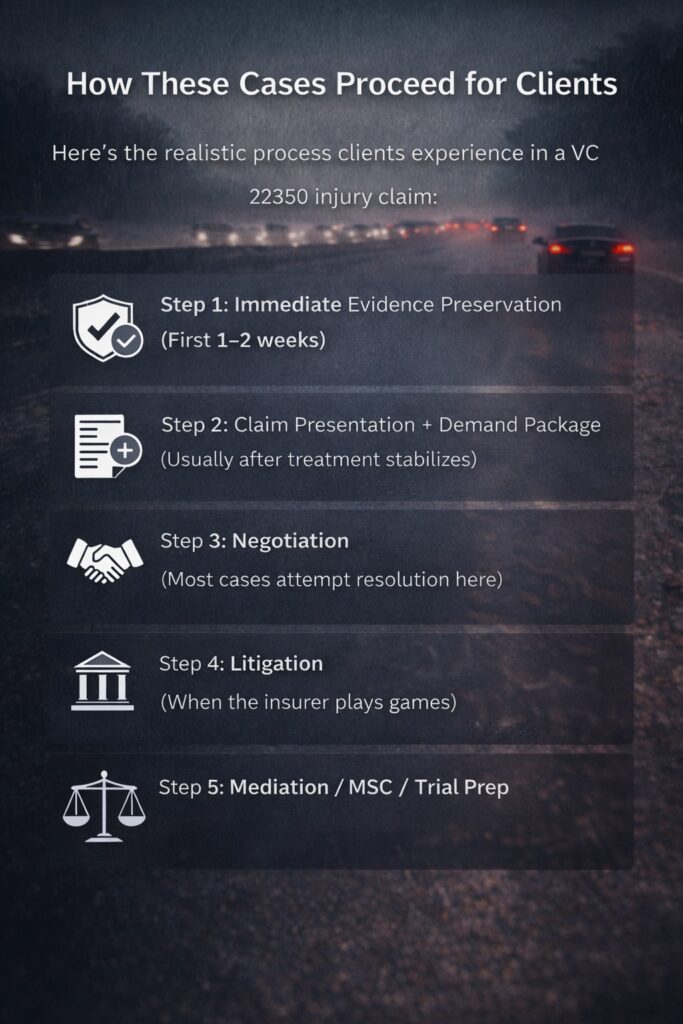
Here’s the realistic process clients experience in a VC 22350 injury claim:
Step 1: Immediate Evidence Preservation (First 1–2 weeks)
This is where cases are won or lost. Video disappears fast. Vehicles get repaired or totaled. Road conditions change.
Step 2: Claim Presentation + Demand Package (Usually after treatment stabilizes)
We assemble:
- liability evidence (VC 22350 facts + reconstruction if needed)
- injury proof (records, imaging, prognosis)
- wage loss documentation
- a demand anchored to trial math, not “adjuster math”
Step 3: Negotiation (Most cases attempt resolution here)
If the insurer acts reasonably, cases can settle without filing suit.
Step 4: Litigation (When the insurer plays games)
If the carrier denies liability, lowballs, or disputes injuries, we file and push:
- written discovery
- depositions
- independent experts
- motions that force the defense to commit to positions
Step 5: Mediation / MSC / Trial Prep
Most litigated cases still resolve before trial — but they resolve for more when the defense knows you’re ready to try it.
Do These Cases Usually Go to Litigation or Trial?
Most injury claims settle without a trial, but whether they settle early or late depends on:
- severity of injury
- clarity of liability
- quality of documentation
- insurance limits
- whether the defense believes the plaintiff’s firm will actually try the case
VC 22350 cases specifically tend to go to litigation more often when:
- there’s no clear video and the defense disputes “conditions”
- the crash is single-vehicle + involves passenger claims
- the insurer tries to reframe it as “bad luck”
- damages are substantial (surgery, TBI, permanent impairment)
Trial is less common than settlement, but WIN’s approach is to build each case like it will be tried — because that’s what drives value.
What Compensation Can You Recover?
Depending on the facts, VC 22350 injury victims may recover:
- medical expenses (past/future)
- lost income and diminished earning capacity
- pain and suffering
- disability/disfigurement
- property damage
- wrongful death damages (when applicable)
Get Help From WIN Injury & Accident Trial Lawyers
Why Legal Representation Matters
Insurance companies often undervalue pain and suffering—offering minimal settlements that ignore your daily struggles. A skilled attorney can:
- Present powerful evidence of your emotional and physical suffering
- Retain expert witnesses to quantify your losses
- Use verdict data to justify higher multipliers or per diem rates
- Argue your case persuasively before a jury
At WIN Trial Lawyers, our team fights to ensure that your recovery reflects the full extent of your suffering—not just your bills.
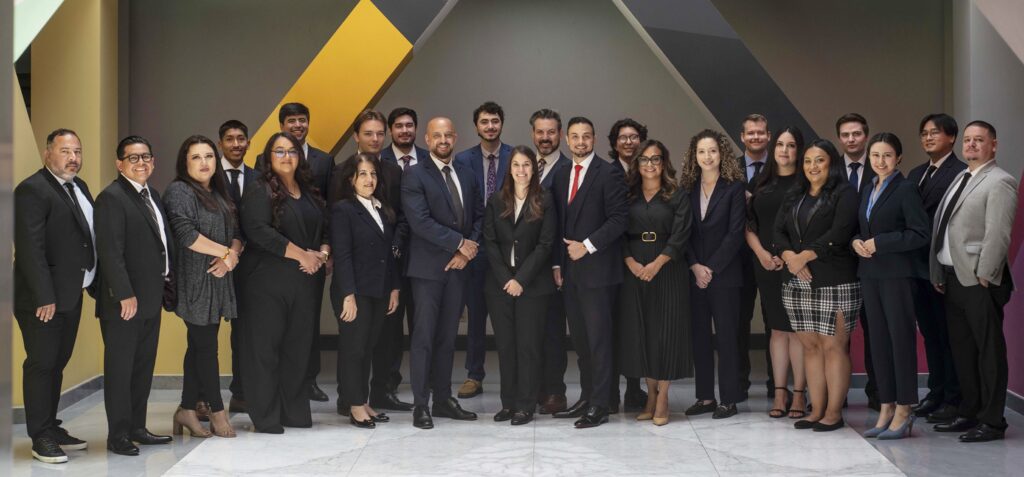
At WIN Trial Lawyers, we know how personal injury claims can be can be. Victims often face mounting medical bills, lost wages, and emotional trauma. Our team has successfully taken on insurance companies and third parties, recovering millions for injured clients.
If you or a loved one has been injured in an accident, don’t leave your future in the hands of the insurance company. You need experienced trial lawyers who know how to prove liability and fight for maximum compensation.
If you or a loved one has been injured, don’t face this alone. The sooner you act, the stronger your case will be.
🔗 Related Posts:
FAQs – Vehicle Code 22350 (Basic Speed Law)
What is Vehicle Code 22350?
Vehicle Code 22350 is California’s Basic Speed Law, which prohibits driving at a speed greater than is reasonable or prudent given weather, visibility, traffic, and road conditions.
Is it illegal to drive under the speed limit in California?
It can be. If conditions require slower driving, traveling under the posted speed limit may still violate Vehicle Code 22350.
What does “speed unsafe for conditions” mean?
It means a driver was traveling too fast to safely account for conditions such as rain, fog, traffic congestion, darkness, or road hazards.
Do you have to be speeding to violate VC 22350?
No. A driver can violate VC 22350 even if they are below the posted speed limit.
Why is VC 22350 important in injury cases?
Because it allows injured victims to establish liability when a driver’s speed was unsafe for conditions, even without proof of speeding.
Is a VC 22350 violation negligence per se?
It can be. Under California law and jury instructions, a violation of the Basic Speed Law may establish negligence per se if it caused the injury.
What is negligence per se?
Negligence per se means the law presumes a driver was negligent because they violated a safety statute designed to prevent the type of harm that occurred.
How does negligence per se help an injury claim?
It shifts the focus away from whether the driver was careful and toward whether the violation caused the injuries and how much compensation is owed.
What types of accidents involve VC 22350?
Common examples include hydroplaning crashes, rear-end collisions, loss-of-control accidents, fog-related pileups, and wet-road collisions.
Are rear-end crashes often Basic Speed Law cases?
Yes. Rear-end crashes frequently involve unsafe speed for traffic conditions, even at relatively low speeds.
Does rain or fog excuse a driver from liability?
No. Poor weather increases a driver’s duty to slow down and operate their vehicle safely.
Can a single-car crash still involve VC 22350?
Yes. Passengers injured in single-car crashes often have strong claims when the driver lost control due to unsafe speed.
What evidence is used to prove a VC 22350 violation?
Evidence may include weather reports, road-condition photos, skid marks, vehicle data, police reports, surveillance video, and expert reconstruction.
Can insurance companies argue the crash was unavoidable?
They often try, but unsafe speed for conditions is frequently foreseeable and preventable.
What if the driver claims they lost control due to hydroplaning?
Hydroplaning often occurs because the vehicle was traveling too fast for wet-road conditions.
Does a police citation decide the injury case?
No. Citations are helpful but not determinative. Civil liability depends on the evidence.
What if the police didn’t cite VC 22350?
A civil case can still succeed if the facts show unsafe speed for conditions.
Can comparative fault apply in Basic Speed Law cases?
Yes, but unsafe speed often places most or all fault on the driver who lost control or failed to stop.
What if I was partially at fault?
California’s comparative negligence system allows recovery even if you share some responsibility.
Do VC 22350 cases often settle?
Many do, but insurers frequently undervalue them unless the case is built for trial.
How often do VC 22350 cases go to litigation?
They go to litigation more often than clear speeding cases because insurers dispute what was “reasonable.”
Do many of these cases go to trial?
Most cases resolve before trial, but trial readiness significantly increases settlement value.
Why do insurers fight Basic Speed Law cases?
Because “reasonable speed” is subjective, insurers try to frame the crash as bad luck instead of negligence.
What damages are available in a VC 22350 injury case?
Damages may include medical expenses, lost income, pain and suffering, disability, and future care costs.
Are serious injuries more likely in unsafe-speed crashes?
Yes. Loss-of-control and rear-end crashes often cause traumatic brain injuries and spinal injuries.
How long do I have to file a claim?
Generally two years from the date of injury, though shorter deadlines apply in government cases.
Should I speak with the insurance company first?
It’s risky. Insurance adjusters often seek statements that reduce or deny liability.
Why does early evidence preservation matter?
Road conditions change quickly, vehicles get repaired, and video footage may be erased within days.
Can expert testimony make a difference?
Yes. Accident reconstruction experts are often decisive in VC 22350 cases.
Why hire a trial-ready law firm?
Because insurers pay more when they believe the case will be tried.
How does WIN Injury & Accident Trial Lawyers handle these cases?
WIN investigates immediately, preserves evidence, and builds cases designed to win — in settlement or at trial.
What should I do if my crash involved unsafe speed for conditions?
Document everything, seek medical care, and speak with an experienced injury attorney as soon as possible.