When Lane Changes Become Negligence in Injury Cases

Unsafe lane changes are a leading cause of freeway and roadway collisions in California. They happen in seconds, often without warning, and frequently leave injured drivers, motorcyclists, and passengers facing serious injuries — while insurance companies argue over who “came out of nowhere.”
California law is clear: drivers must ensure lane changes can be made safely before moving.
Under Vehicle Code § 22107, a driver may not turn or move right or left on a roadway unless the movement can be made with reasonable safety, and only after giving an appropriate signal when required.
At WIN Injury & Accident Trial Lawyers, unsafe lane change cases are common — and they are often far stronger than insurance companies want injured victims to believe.
What Vehicle Code § 22107 Requires
Vehicle Code § 22107 provides, in substance, that:
- A driver may not turn or move left or right unless the movement can be made with reasonable safety
- A driver must give an appropriate signal before changing lanes when required
This statute applies to:
- Freeways and highways
- Surface streets
- Multi-lane roads
- Traffic congestion and high-speed conditions
Key takeaway: Drivers must look, assess, and yield before changing lanes. If they don’t — and someone is hurt — liability often follows.
Common Unsafe Lane Change Scenarios
Unsafe lane change crashes frequently involve:
- Sudden lane changes without signaling
- Cutting off another vehicle
- Merging into an occupied lane
- Changing lanes in heavy traffic
- Weaving between lanes at speed
- Entering a lane without adequate clearance
These crashes often result in:
- Side-swipe collisions
- Loss-of-control crashes
- Multi-vehicle pileups
- Motorcycle knockdowns
- Chain-reaction rear-end impacts
Why Unsafe Lane Change Accidents Are So Dangerous
Lane-change crashes are dangerous because:
- They often occur at high speeds
- Drivers have little time to react
- Vehicles may be pushed into other lanes or barriers
- Motorcycles are especially vulnerable
Common injuries include:
- Traumatic brain injuries (TBI)
- Neck and spine injuries
- Shoulder and arm fractures
- Internal injuries
- Fatal injuries in severe freeway crashes
Negligence Per Se and VC § 22107
A violation of Vehicle Code § 22107 can support negligence per se in California injury cases.
How Negligence Per Se Applies
Negligence per se applies when:
- A driver violates a statute
- The statute was designed to prevent the type of harm that occurred
- The injured person is within the class the law was meant to protect
- The violation caused the injury
VC § 22107 exists to prevent unsafe vehicle movements that create sudden hazards. When a driver changes lanes without ensuring safety and causes a crash, these elements are often satisfied.
Why This Matters
When negligence per se applies:
- The driver’s breach of duty is presumed
- The defense cannot argue the driver was simply “being careful”
- The case focuses on causation and damages, not fault
Insurance Company Pushback in Unsafe Lane Change Cases
Despite clear statutory duties, insurers often fight these claims aggressively.
“They Didn’t Signal — But That’s Not the Cause”
Insurers may argue the lack of a signal didn’t cause the crash. In reality, signaling is part of assessing and ensuring safety — especially in heavy traffic.
“The Other Driver Was in the Blind Spot”
Blind spots do not excuse unsafe lane changes. Drivers must ensure the lane is clear before moving.
“It Was a Shared Fault Accident”
Comparative fault is commonly raised, but lane-change statutes place primary responsibility on the driver initiating the movement.
“Motorcycles Came Out of Nowhere”
This argument appears frequently and often fails. Drivers must account for motorcycles, even when visibility requires extra caution.
How WIN Proves Unsafe Lane Change Liability
Unsafe lane change cases are evidence-driven and require fast investigation.
Key Evidence Includes:
- Dashcam footage
- Traffic or freeway cameras
- Vehicle event data (EDR / black box)
- Skid marks and vehicle positioning
- Witness statements
- Police collision reports
- Accident reconstruction
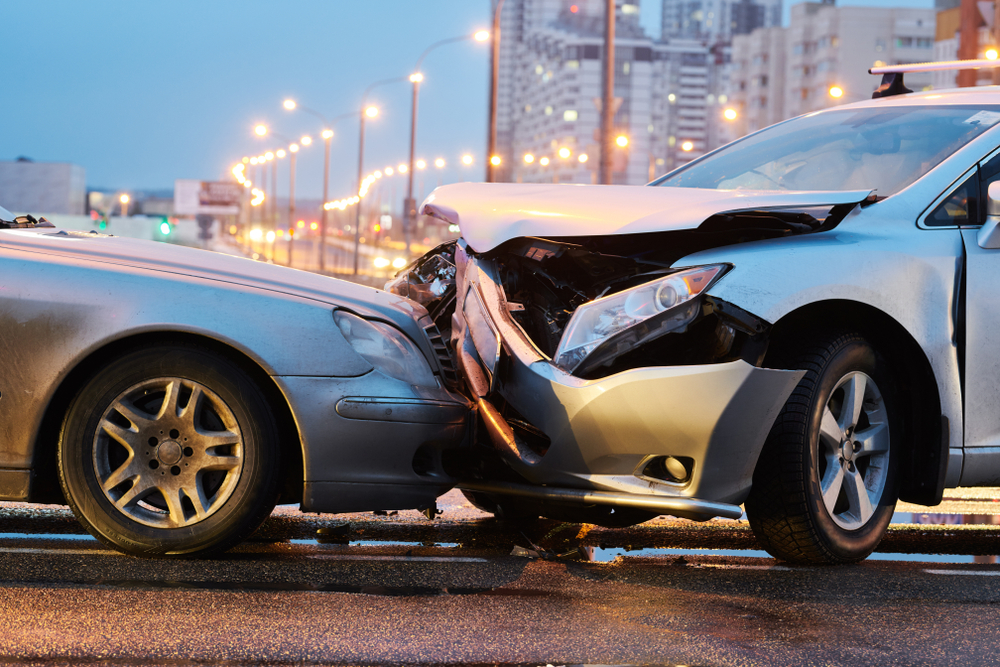
Vehicle damage patterns often show clear lateral impact — confirming an unsafe lane movement.
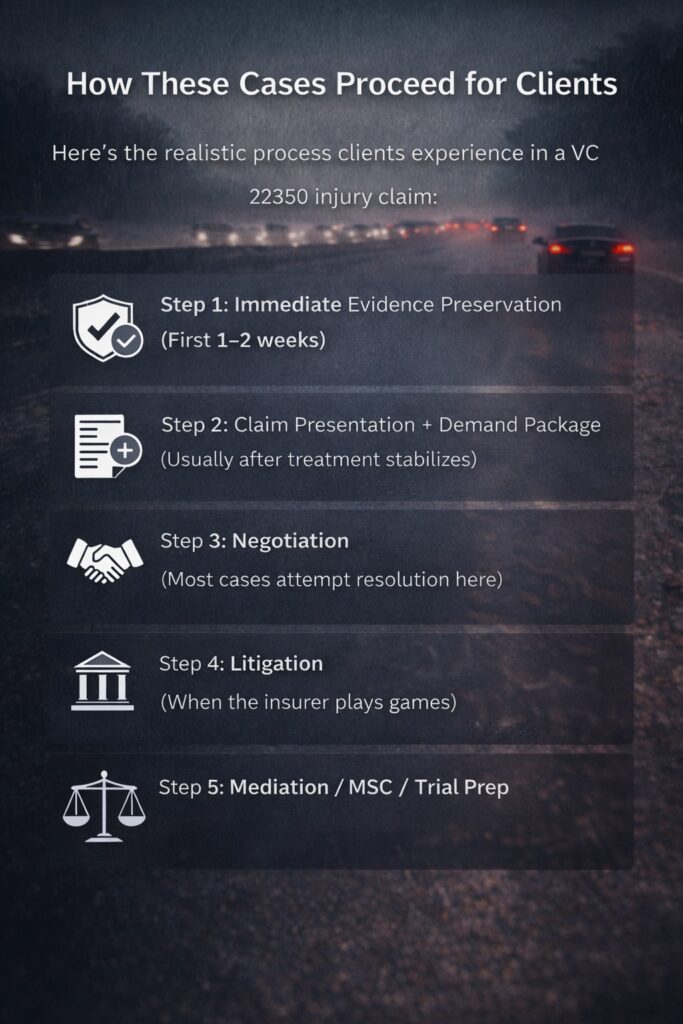
How These Cases Proceed for Clients
Here’s the realistic process clients experience in a VC § 22107 injury claim:
Step 1: Immediate Evidence Preservation (First 1–2 Weeks)
Dashcam footage is overwritten. Vehicles are repaired or totaled. Scene evidence disappears.
Step 2: Claim Presentation + Demand Package
We assemble:
- Proof of the unsafe lane change
- Video and physical evidence
- Medical records and prognosis
- Wage-loss documentation
- A demand based on trial value, not adjuster formulas
Step 3: Negotiation
Some cases resolve here — if the insurer acts reasonably.
Step 4: Litigation (When the Insurer Pushes Back)
If liability or injuries are disputed, we file suit and pursue:
- Written discovery
- Depositions
- Expert testimony
- Motions forcing defense positions
Step 5: Mediation / MSC / Trial Preparation
Most litigated cases still settle — but they settle for more when trial is real.
Do Unsafe Lane Change Cases Go to Trial?
Most cases resolve before trial, but unsafe lane change cases go to litigation frequently because:
- Fault is often disputed
- Insurers argue “he said / she said”
- Motorcycle cases are undervalued
- Serious injuries raise exposure
WIN prepares every case as a trial case. That posture drives results.
Damages Available in VC § 22107 Cases
Injured victims may recover:
- Medical expenses (past and future)
- Lost wages and reduced earning capacity
- Pain and suffering
- Permanent disability or disfigurement
- Property damage
- Wrongful death damages (when applicable)
Severe freeway lane-change crashes often result in six- or seven-figure recoveries.
Get Help From WIN Injury & Accident Trial Lawyers
Why Legal Representation Matters
Insurance companies often undervalue pain and suffering—offering minimal settlements that ignore your daily struggles. A skilled attorney can:
- Present powerful evidence of your emotional and physical suffering
- Retain expert witnesses to quantify your losses
- Use verdict data to justify higher multipliers or per diem rates
- Argue your case persuasively before a jury
At WIN Trial Lawyers, our team fights to ensure that your recovery reflects the full extent of your suffering—not just your bills.
At WIN Trial Lawyers, we know how personal injury claims can be can be. Victims often face mounting medical bills, lost wages, and emotional trauma. Our team has successfully taken on insurance companies and third parties, recovering millions for injured clients.
If you or a loved one has been injured in an accident, don’t leave your future in the hands of the insurance company. You need experienced trial lawyers who know how to prove liability and fight for maximum compensation.
If you or a loved one has been injured, don’t face this alone. The sooner you act, the stronger your case will be.
🔗 Related Posts:
Frequently Asked Questions – Vehicle Code § 22107
Unsafe Lane Changes in California
What does Vehicle Code § 22107 mean?
Vehicle Code § 22107 requires drivers to ensure that any lane change or lateral movement can be made with reasonable safety and, when required, only after giving an appropriate signal.
Is an unsafe lane change illegal in California?
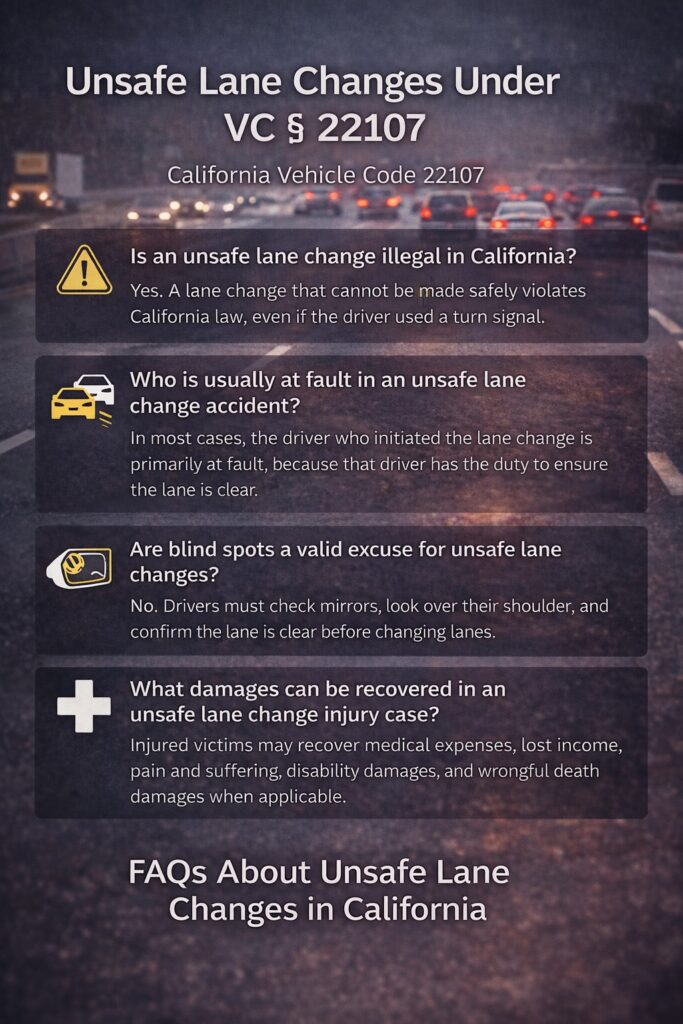
Yes. A lane change that cannot be made safely violates California law, even if the driver used a turn signal.
Is using a turn signal enough to make a lane change legal?
No. Signaling alone does not make a lane change lawful. The driver must also ensure the movement can be made safely.
Who is usually at fault in an unsafe lane change accident?
In most cases, the driver who initiated the lane change is primarily at fault, because that driver has the duty to ensure the lane is clear.
Are unsafe lane changes common causes of freeway accidents?
Yes. Unsafe lane changes are a leading cause of freeway sideswipes, multi-vehicle crashes, and motorcycle collisions.
Does VC § 22107 apply on freeways and surface streets?
Yes. The statute applies to all roadways, including freeways, highways, and city streets.
What is considered “reasonable safety” under VC § 22107?
Reasonable safety depends on traffic speed, lane spacing, visibility, weather, and whether another vehicle is already occupying the lane.
Are blind spots a valid excuse for unsafe lane changes?
No. Blind spots do not excuse liability. Drivers are required to check mirrors, look over their shoulder, and confirm the lane is clear before changing lanes.
How does VC § 22107 apply to motorcycles?
Motorcycles have the same right to their lane as other vehicles. Failing to see a motorcycle is not a defense.
Are unsafe lane change accidents dangerous?
Yes. These crashes often occur at high speeds and can cause loss of control, rollovers, or secondary impacts with other vehicles or barriers.
Can unsafe lane changes cause multi-vehicle accidents?
Yes. One unsafe lane change can trigger chain-reaction collisions involving multiple vehicles.
Is a violation of VC § 22107 negligence per se?
Often yes. If a driver violates VC § 22107 and causes injury, the violation may establish negligence per se under California law.
What is negligence per se?
Negligence per se means the law presumes a driver was negligent because they violated a safety statute designed to prevent the type of harm that occurred.
How does negligence per se help an injury claim?
It shifts the case away from whether the driver acted reasonably and toward whether the violation caused the injuries and how much compensation is owed.
What evidence is used to prove an unsafe lane change?
Evidence may include dashcam video, traffic cameras, vehicle damage patterns, police reports, witness statements, and accident reconstruction.
Do police reports decide fault in unsafe lane change cases?
No. Police reports are helpful but not determinative. Civil liability depends on all available evidence.
What if both drivers changed lanes at the same time?
Comparative fault may apply, but liability often depends on who initiated the movement and whether either driver failed to ensure safety.
Can passengers recover damages in unsafe lane change accidents?
Yes. Passengers are rarely at fault and often have strong claims against one or more drivers.
How do insurance companies defend unsafe lane change claims?
Insurers often argue comparative fault, claim the other driver “came out of nowhere,” or dispute whether the lane was occupied.
Do unsafe lane change cases often go to litigation?
Yes. These cases frequently go to litigation because insurers dispute fault and minimize injuries.
Do unsafe lane change cases usually go to trial?
Most cases settle before trial, but trial readiness significantly increases settlement value.
What damages can be recovered in a VC § 22107 injury case?
Damages may include medical expenses, lost wages, future earning capacity, pain and suffering, disability, and wrongful death damages when applicable.
How long do I have to file an unsafe lane change injury claim?
Generally two years from the date of injury, though shorter deadlines apply if a government entity is involved.
Should I talk to the insurance company after an unsafe lane change crash?
It’s risky. Insurance adjusters often seek statements that reduce liability. Speaking with an attorney first is usually advisable.
Why is early investigation important?
Dashcam footage may be overwritten, vehicles repaired, and physical evidence lost within days or weeks.
How does WIN Injury & Accident Trial Lawyers handle unsafe lane change cases?
WIN investigates immediately, preserves evidence, and prepares every case as if it will be tried.
What should I do after an unsafe lane change accident?
Seek medical care, document the scene if possible, and consult an experienced personal injury attorney promptly.