
When Where a Car Is Parked Becomes a Safety Violation
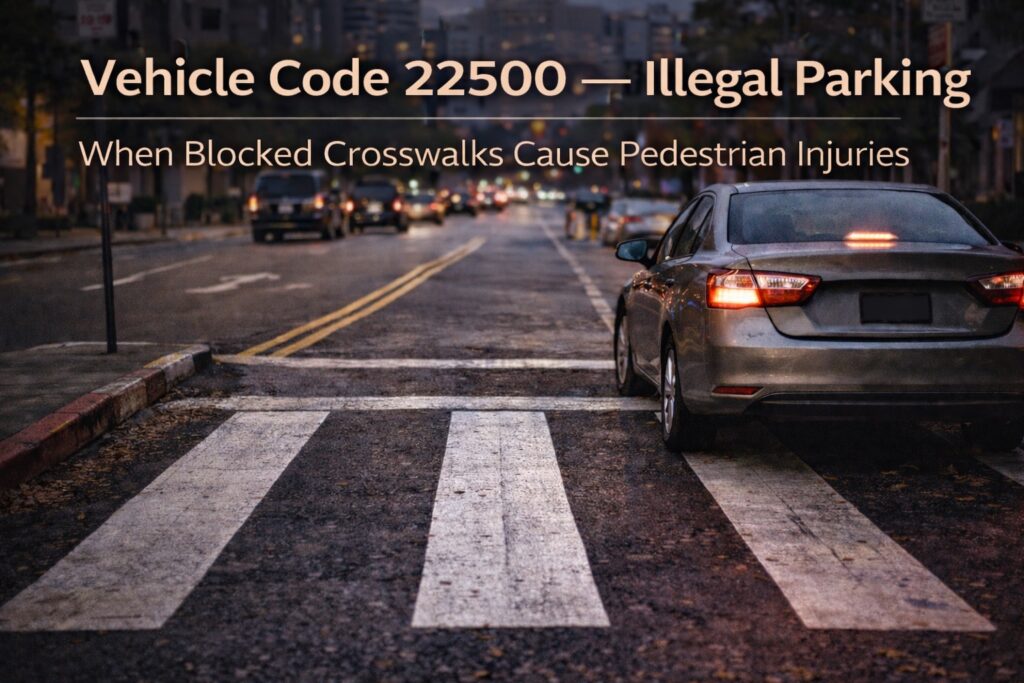
Illegal parking is often dismissed as a minor infraction. In reality, where a vehicle is parked can directly cause serious pedestrian injuries.
Cars parked too close to crosswalks, in red zones, in bike lanes, or blocking visibility routinely create blind spots that lead to pedestrians being struck — especially children, seniors, and people with disabilities.
Vehicle Code § 22500 exists to prevent these exact dangers. When drivers ignore parking restrictions and someone is injured as a result, liability is often clear and provable.
At WIN Injury & Accident Trial Lawyers, pedestrian injury cases involving illegal parking frequently involve statutory negligence, negligence per se, and aggressive insurance resistance despite strong liability law.
What Vehicle Code § 22500 Prohibits
Vehicle Code § 22500 makes it illegal to stop, park, or leave a vehicle in numerous dangerous locations, including (among others):
- In or too close to crosswalks
- Within intersections
- In front of driveways
- In red zones or fire lanes
- In bike lanes
- Blocking sidewalks or curb ramps
- Where visibility is obstructed
- In ways that interfere with pedestrian movement
Key takeaway:
Parking laws are safety laws. They are designed to protect pedestrians — not just regulate convenience.
📍 New 20-Foot “Daylighting” Requirement (AB 413)
California recently amended Vehicle Code § 22500 to strengthen pedestrian safety near crosswalks by adding a 20-foot parking restriction. Under Assembly Bill 413, often called the Daylighting Law, it is now illegal to stop, stand, or park a vehicle within 20 feet of the vehicle approach side of any marked or unmarked crosswalk — even if there is no red curb or signage present. In locations where a curb extension (bulb-out) exists, the no-parking distance is 15 feet.
This provision took effect January 1, 2025, and citations may be issued regardless of paint or posted signs. The goal of the daylighting rule is to improve visibility between drivers and pedestrians at crosswalks, reducing blind spots that contribute to pedestrian injuries. Leaving at least 20 feet (about the length of a typical parking space) between your vehicle and a crosswalk helps ensure pedestrians are visible before stepping into the roadway.
How Illegal Parking Causes Pedestrian Injuries
Illegal parking commonly leads to pedestrian injuries by:
- Blocking sightlines between drivers and pedestrians
- Forcing pedestrians into traffic lanes
- Obstructing curb ramps used by wheelchair users
- Preventing drivers from seeing children entering crosswalks
- Encouraging unsafe mid-block crossings
These conditions frequently result in:
- Pedestrians being struck in crosswalks
- Sidewalk-to-street collisions
- Bicycle-pedestrian conflicts
- Multi-vehicle reaction crashes
Why Pedestrian Injuries from Illegal Parking Are Often Severe
Pedestrians have no physical protection. When illegal parking creates blind spots, drivers often have no warning before impact.
Common injuries include:
- Traumatic brain injuries (TBI)
- Neck and spine injuries
- Shoulder and arm fractures
- Internal injuries
- Fatal injuries in severe freeway crashes
Children and elderly pedestrians are especially vulnerable.
Negligence Per Se and Vehicle Code § 22500
Illegal parking frequently supports negligence per se in pedestrian injury cases.
How Negligence Per Se Applies
Negligence per se may apply when:
- A driver violates a statute (illegal parking)
- The statute was designed to prevent the type of harm that occurred
- The injured pedestrian is within the protected class
- The violation caused the injury
VC § 22500 is specifically intended to prevent visibility-related pedestrian injuries. When a parked vehicle blocks sightlines or pedestrian access and causes harm, these elements are often satisfied.
Why This Matters
Negligence per se:
- Presumes breach of duty
- Limits “it was just parked” defenses
- Shifts the case to causation and damages
This is a powerful liability tool.

Common Insurance Company Pushback in Illegal Parking Cases
Despite clear safety rules, insurers often resist responsibility.
“The Driver Who Hit the Pedestrian Is the Only One at Fault”
Multiple parties can share liability. The illegally parked vehicle may be a substantial contributing cause.
“Parking Violations Don’t Cause Accidents”
They do — especially when visibility is obstructed near crosswalks and intersections.
“The Pedestrian Should Have Been More Careful”
Pedestrians have the right to rely on clear sightlines and lawful parking.
“The Car Was Only Parked Briefly”
Duration does not excuse a safety violation.
Who Can Be Liable in Illegal Parking Pedestrian Cases
Liability may extend to:
- The driver who parked illegally
- The driver who struck the pedestrian
- A commercial vehicle owner
- A rideshare or delivery company
- A government entity (in limited circumstances)
These cases often involve multi-party claims.
How WIN Proves Illegal Parking Liability
Illegal parking cases require early scene investigation.
Key Evidence Includes:
- Photos showing vehicle position and distance from crosswalks
- Measurements of sightlines and curb distance
- Surveillance or traffic camera footage
- Witness statements
- Police reports and parking citations
- City parking regulations and signage
Once a vehicle moves, evidence disappears — speed matters.
How These Cases Proceed for Clients
Here’s the realistic process clients experience in a VC § 22500 pedestrian injury claim:
Step 1: Immediate Evidence Preservation (First 1–2 Weeks)
Vehicles move. Visibility changes. Early documentation is critical.
Step 2: Claim Presentation + Demand Package
We assemble:
- Proof of illegal parking
- Visibility and causation analysis
- Medical records and prognosis
- Wage-loss documentation
- A demand grounded in trial-level value, not citation fines
Step 3: Negotiation
Some cases resolve early once insurers recognize shared liability.
Step 4: Litigation (When Insurers Push Back)
If liability is disputed, we pursue:
- Written discovery
- Depositions
- Expert testimony (visibility, traffic safety)
- Motions establishing statutory violations
Step 5: Mediation / Trial Preparation
Most cases resolve before trial — but readiness drives value.
Do Illegal Parking Pedestrian Cases Go to Trial?
They can, particularly when:
- Multiple defendants dispute responsibility
- Injuries are severe or fatal
- Insurers minimize the role of illegal parking
WIN prepares these cases as jury cases from the outset.
Damages Available in VC § 22500 Cases
Injured pedestrians may recover:
- Medical expenses (past and future)
- Lost wages and diminished earning capacity
- Pain and suffering
- Permanent disability
- Wrongful death damages (when applicable)
Pedestrian cases involving illegal parking often result in significant six- or seven-figure exposure.
Injured as a Pedestrian Due to Illegal Parking?
If you or a loved one was injured because a vehicle was parked where it shouldn’t have been, Vehicle Code § 22500 may be central to your case.
WIN Injury & Accident Trial Lawyers knows how to prove illegal-parking liability, overcome insurer defenses, and pursue full compensation — whether through settlement or trial.
Get Help From WIN Injury & Accident Trial Lawyers
Why Legal Representation Matters
Insurance companies often undervalue pain and suffering—offering minimal settlements that ignore your daily struggles. A skilled attorney can:
- Present powerful evidence of your emotional and physical suffering
- Retain expert witnesses to quantify your losses
- Use verdict data to justify higher multipliers or per diem rates
- Argue your case persuasively before a jury
At WIN Trial Lawyers, our team fights to ensure that your recovery reflects the full extent of your suffering—not just your bills.

At WIN Trial Lawyers, we know how personal injury claims can be can be. Victims often face mounting medical bills, lost wages, and emotional trauma. Our team has successfully taken on insurance companies and third parties, recovering millions for injured clients.
If you or a loved one has been injured in an accident, don’t leave your future in the hands of the insurance company. You need experienced trial lawyers who know how to prove liability and fight for maximum compensation.
If you or a loved one has been injured, don’t face this alone. The sooner you act, the stronger your case will be.
🔗 Related Posts:
Frequently Asked Questions – Vehicle Code 22500
Illegal Parking, Pedestrian Safety & Injury Liability in California
What does Vehicle Code 22500 prohibit?
Vehicle Code 22500 prohibits stopping, parking, or leaving a vehicle in locations where it creates safety hazards, including crosswalks, intersections, bike lanes, sidewalks, red zones, and areas that block visibility or pedestrian access.
Why does illegal parking matter for pedestrian safety?
Illegal parking often blocks sightlines, forces pedestrians into traffic, and prevents drivers from seeing people entering crosswalks, dramatically increasing the risk of pedestrian injuries.
Can illegal parking actually cause a pedestrian accident?
Yes. Parked vehicles that obstruct crosswalks, corners, or curb ramps are a common contributing cause of pedestrian crashes.
Is parking too close to a crosswalk illegal?
Yes. Parking in or too close to a crosswalk violates VC § 22500 and is specifically intended to prevent visibility-related pedestrian injuries.
What if the car was parked but not moving?
A vehicle does not need to be moving to cause an accident. Stationary vehicles can still be a substantial factor in causing pedestrian injuries.
Is illegal parking considered negligence per se?
Often, yes. If illegal parking violates a safety statute designed to protect pedestrians and causes injury, negligence per se may apply.
What is negligence per se in an illegal parking case?
Negligence per se means the law presumes negligence because the defendant violated a statute intended to prevent the type of harm that occurred.
Does negligence per se automatically win the case?
No. It establishes breach of duty, but the injured pedestrian must still prove causation and damages.
Can more than one party be liable in an illegal parking pedestrian case?
Yes. Liability may be shared between:
- The driver who parked illegally
- The driver who struck the pedestrian
- A commercial vehicle owner or employer
- A rideshare or delivery company
- A government entity (in limited circumstances)
Can the driver who hit the pedestrian blame the parked car?
Yes. Fault can be apportioned when illegal parking materially contributed to the collision.
What if the illegally parked car belonged to a business?
Businesses and employers may be liable for vehicles parked illegally in the course of work or deliveries.
Can a government entity be liable for illegal parking conditions?
In limited cases, yes — particularly if dangerous conditions were known and unaddressed. These claims have strict deadlines.
Are children more vulnerable in illegal parking accidents?
Yes. Children are especially at risk because illegally parked vehicles often block sightlines at lower heights.
Are elderly or disabled pedestrians more at risk?
Yes. Illegal parking frequently blocks curb ramps and sidewalks, forcing vulnerable pedestrians into traffic.
What injuries are common in illegal parking pedestrian accidents?
Common injuries include traumatic brain injuries, spinal injuries, fractures, internal injuries, permanent disability, and fatal injuries.
Does a parking citation matter in a civil case?
Yes. A citation can be powerful evidence of a statutory violation, though it is not required to prove liability.
What if no parking ticket was issued?
Lack of a ticket does not prevent a civil claim. Liability can be proven through photos, witnesses, and expert analysis.
What evidence is important in illegal parking cases?
Key evidence includes photographs of vehicle placement, distance measurements from crosswalks, surveillance footage, witness statements, and police reports.
Why is early investigation important?
Vehicles move quickly, and once sightlines change, critical evidence can be lost.
Do insurance companies fight illegal parking claims?
Yes. Insurers often minimize the role of parked vehicles and attempt to place all blame on the striking driver or pedestrian.
Can pedestrians be blamed for not seeing around a parked car?
Pedestrians are entitled to reasonably clear sightlines and are not required to anticipate illegal parking hazards.
Can comparative fault apply in these cases?
It can, but comparative fault must be supported by evidence — not assumptions about pedestrian behavior.
Do illegal parking cases often go to litigation?
They can, especially when insurers dispute shared liability or minimize the role of illegal parking.
Do these cases go to trial?
Most settle before trial, but trial readiness often increases settlement value.
What damages can injured pedestrians recover?
Damages may include medical expenses, lost wages, future earning capacity, pain and suffering, permanent disability, and wrongful death damages.
How long do I have to file a claim?
Generally two years from the date of injury, with much shorter deadlines for claims involving public entities.
What should I do after a pedestrian accident involving illegal parking?
Seek medical care, document the scene if possible, preserve photos or video, and consult an experienced injury attorney promptly.
How does WIN Injury & Accident Trial Lawyers handle illegal parking cases?
WIN investigates immediately, proves statutory violations, defeats insurer minimization tactics, and prepares every case as trial-ready.