
When Failure to Yield Causes Preventable Collisions
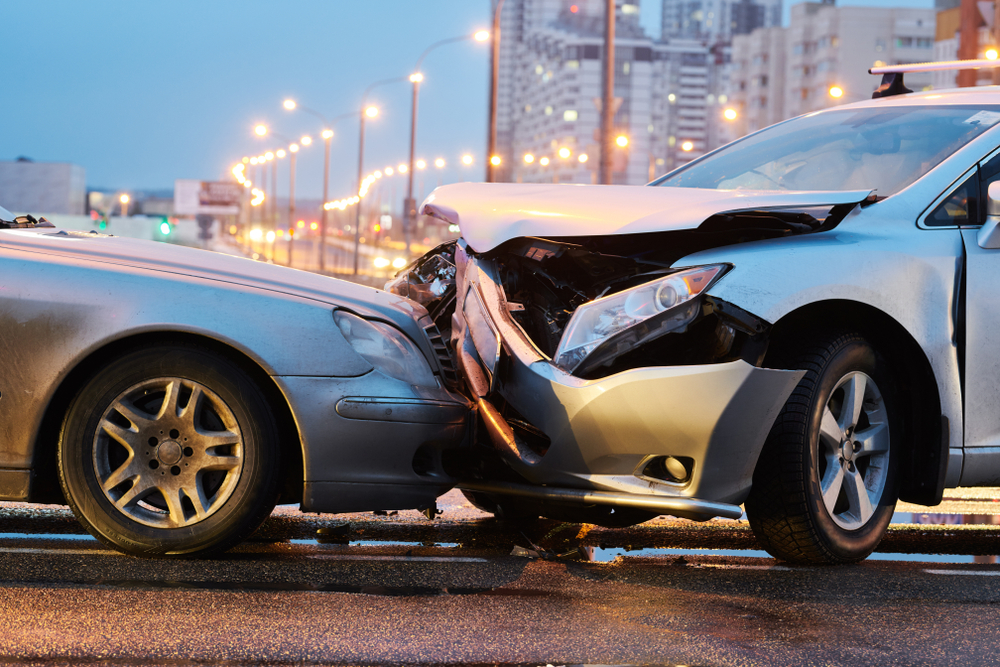
Crashes caused by drivers pulling into traffic from a stop are among the most avoidable accidents on California roads. Whether exiting a driveway, private road, parking lot, or shoulder, drivers often underestimate speed, misjudge gaps, or simply fail to look.
California law is clear: the driver entering traffic must yield.
Vehicle Code § 21804 places a heavy duty on drivers entering a roadway from a stopped position. When that duty is violated, liability is frequently straightforward — and insurers know it.
At WIN Injury & Accident Trial Lawyers, VC § 21804 cases often involve clear right-of-way violations, strong negligence-per-se arguments, and predictable insurance pushback.
What Vehicle Code § 21804 Requires
Vehicle Code § 21804 provides, in substance, that:
- A driver about to enter or cross a roadway from:
- A stopped position
- A private road or driveway
- A parking lot
- The shoulder or curb
must yield the right-of-way to all traffic approaching on the roadway that is close enough to constitute an immediate hazard.
Once the driver has yielded and entered traffic safely, other vehicles must then yield to that vehicle.
Key takeaway:
The duty to yield belongs to the driver entering traffic, not the driver already on the roadway.
Common VC § 21804 Accident Scenarios
Entering-traffic crashes commonly involve:
- Vehicles pulling out of driveways
- Cars exiting parking lots or garages
- Drivers entering traffic from the shoulder
- Delivery or rideshare vehicles re-entering lanes
- Commercial trucks exiting private roads
These crashes often occur suddenly, leaving through-traffic with little or no time to react.
Why Entering-Traffic Crashes Are So Dangerous
Entering-traffic collisions are dangerous because:
- The entering vehicle disrupts traffic flow
- Through drivers reasonably expect a clear lane
- Impacts often occur at speed
- Motorcycles, cyclists, and pedestrians are frequently struck
Common Injuries Include:
- Traumatic brain injuries (TBI)
- Neck and spine injuries
- Shoulder and arm fractures
- Internal injuries
- Fatal injuries in severe freeway crashes
Negligence Per Se and Vehicle Code § 21804
Violations of VC § 21804 often support negligence per se.
How Negligence Per Se Applies
Negligence per se may apply when:
- A driver violates VC § 21804
- The statute was designed to prevent the type of harm that occurred
- The injured person is within the class of people the law was meant to protect
- The violation caused the injury
VC § 21804 exists to prevent collisions caused by unsafe roadway entry. When a driver fails to yield and causes a crash, these elements are often satisfied.
Why This Matters
Negligence per se:
- Presumes breach of duty
- Narrows liability disputes
- Shifts the case to causation and damages
This often accelerates resolution — or strengthens trial posture.
Common Insurance Company Pushback in VC § 21804 Cases
Despite clear right-of-way rules, insurers often attempt to dilute fault.
“The Other Driver Was Speeding”
Speed arguments are common but rarely excuse a failure to yield when entering traffic.
“There Was Enough Room”
Hindsight does not replace statutory duty. Misjudging a gap is not a defense.
“The Driver Had Already Entered the Lane”
Partial entry does not eliminate the initial duty to yield safely.
“Comparative Fault Applies”
Comparative fault requires evidence — not assumptions about reaction time.
Who Can Be Liable in Entering-Traffic Accidents
Liability may extend to:
- The driver entering traffic
- A commercial or delivery employer
- A rideshare company
- A property owner (in limited cases involving sightline obstructions)
Multi-party liability is common in driveway and parking-lot exits.
How WIN Proves VC § 21804 Liability
Entering-traffic cases often turn on objective evidence.
Key Evidence Includes:
- Surveillance or dashcam footage
- Vehicle damage angles and crush patterns
- Skid marks and roadway measurements
- Witness statements
- Police reports
- Visibility and sightline analysis
Early evidence preservation is often decisive.
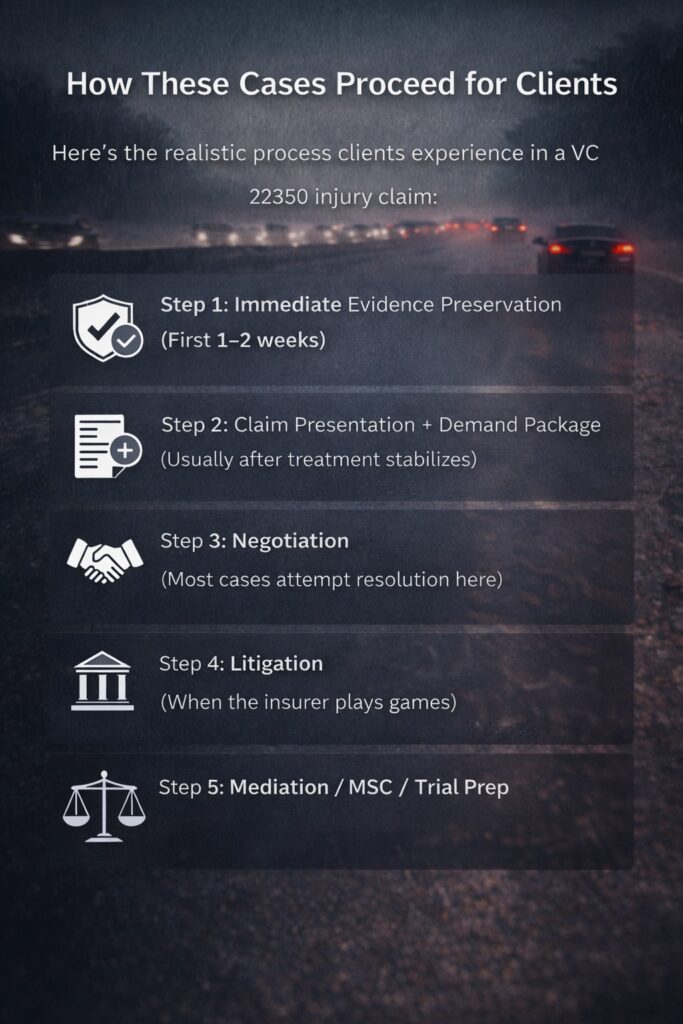
How These Cases Proceed for Clients
Here’s the realistic process clients experience in a VC § 21804 injury claim:
Step 1: Immediate Evidence Preservation (First 1–2 Weeks)
Video footage disappears quickly. Vehicles are repaired. Scene documentation matters.
Step 2: Claim Presentation + Demand Package
We assemble:
- Proof of right-of-way violation
- Statutory analysis of VC § 21804
- Medical records and prognosis
- Wage-loss documentation
- A demand based on trial-level exposure, not adjuster formulas
Step 3: Negotiation
Many cases resolve here once insurers recognize liability.
Step 4: Litigation (When Pushback Persists)
If fault or damages are disputed, we pursue:
- Written discovery
- Depositions
- Expert testimony
- Motions locking in statutory duties
Step 5: Mediation / Trial Preparation
Most litigated cases still settle — but readiness drives value.
Do Entering-Traffic Cases Go to Trial?
Most settle before trial due to:
- Clear right-of-way law
- Objective evidence
- Predictable jury reaction
When trials occur, exposure can be significant.
WIN prepares every case as trial-ready from day one.
Damages Available in VC § 21804 Cases
Injured victims may recover:
- Medical expenses (past and future)
- Lost wages and diminished earning capacity
- Pain and suffering
- Permanent disability
- Wrongful death damages (when applicable)
Serious entering-traffic crashes often involve six- or seven-figure exposure.
Injured by a Driver Entering Traffic?
If you were injured because a driver failed to yield while entering traffic, Vehicle Code § 21804 may be central to your case.
WIN Injury & Accident Trial Lawyers knows how to prove right-of-way violations, defeat insurance defenses, and pursue full compensation — whether through settlement or trial.
Get Help From WIN Injury & Accident Trial Lawyers
Why Legal Representation Matters
Insurance companies often undervalue pain and suffering—offering minimal settlements that ignore your daily struggles. A skilled attorney can:
- Present powerful evidence of your emotional and physical suffering
- Retain expert witnesses to quantify your losses
- Use verdict data to justify higher multipliers or per diem rates
- Argue your case persuasively before a jury
At WIN Trial Lawyers, our team fights to ensure that your recovery reflects the full extent of your suffering—not just your bills.

At WIN Trial Lawyers, we know how personal injury claims can be can be. Victims often face mounting medical bills, lost wages, and emotional trauma. Our team has successfully taken on insurance companies and third parties, recovering millions for injured clients.
If you or a loved one has been injured in an accident, don’t leave your future in the hands of the insurance company. You need experienced trial lawyers who know how to prove liability and fight for maximum compensation.
If you or a loved one has been injured, don’t face this alone. The sooner you act, the stronger your case will be.
🔗 Related Posts:

Frequently Asked Questions – Vehicle Code 21804
Entering Traffic from a Stop & Failure-to-Yield Accidents in California
What does Vehicle Code 21804 require?
Vehicle Code 21804 requires a driver entering or crossing a roadway from a stopped position to yield the right-of-way to approaching traffic that constitutes an immediate hazard.
When does VC 21804 apply?
The statute applies when a driver enters traffic from:
- A driveway
- A private road
- A parking lot or garage
- The shoulder or curb
- Any stopped position off the main roadway
Who has the right-of-way under VC 21804?
Drivers already traveling on the roadway have the right-of-way. The entering driver must yield.
Is the entering driver usually at fault in these crashes?
Yes. Failure to yield while entering traffic is one of the clearest right-of-way violations under California law.
What is considered an “immediate hazard”?
Traffic close enough that a reasonable driver should not proceed. Misjudging speed or distance does not excuse the duty to yield.
Does VC 21804 apply to driveways?
Yes. Driveways and private roads are expressly covered by the statute.
What about parking lots or garages?
Yes. Drivers exiting parking lots or garages must yield before entering traffic.
Are these crashes common?
Yes. Entering-traffic crashes are a frequent cause of side-impact and high-speed collisions.
Why are entering-traffic accidents dangerous?
Because through-traffic often has little time to react, resulting in sudden impacts at speed.
Are motorcycles and cyclists especially vulnerable?
Yes. Motorcycles, cyclists, and pedestrians are often harder to see and frequently injured in VC 21804 violations.
Is violating VC 21804 negligence per se?
Often, yes. A violation may establish negligence per se if the failure to yield caused the injury.
What is negligence per se?
Negligence per se means the law presumes negligence because a safety statute was violated and caused harm.
How does negligence per se help an injury case?
It removes debate over whether the driver acted reasonably and focuses the case on causation and damages.
Can the entering driver argue they “almost made it”?
No. Near-miss reasoning does not excuse a statutory duty to yield.
What if the other driver was speeding?
Speed arguments are common but rarely excuse a failure to yield when entering traffic.
Does partial entry into the lane change liability?
No. The duty to yield applies until the entering vehicle has safely joined traffic.
Can comparative fault apply?
It can, but only with evidence. Entering-traffic violations often place primary fault on the entering driver.
Do police reports decide fault?
No. Police reports are helpful but not determinative in civil cases.
What evidence is important in VC 21804 cases?
Key evidence includes dashcam footage, surveillance video, vehicle damage angles, skid marks, witness statements, and police reports.
Why is early investigation important?
Video footage may be overwritten, vehicles repaired, and scene conditions changed quickly.
Do these cases often settle?
Yes. Many resolve once insurers recognize the strength of the right-of-way violation.
Do VC 21804 cases go to trial?
Most settle before trial, but trial readiness often increases settlement value.
What damages can injured victims recover?
Damages may include medical expenses, lost wages, future earning capacity, pain and suffering, disability, and wrongful death damages when applicable.
How long do I have to file a claim?
Generally two years from the date of injury, with shorter deadlines for government-related claims.
Should I talk to the insurance company?
It’s risky. Adjusters often seek statements to minimize fault. Consulting an attorney first is usually advisable.
What should I do after an entering-traffic accident?
Seek medical care, document the scene if possible, preserve photos or video, and consult an experienced injury attorney promptly.
How does WIN Injury & Accident Trial Lawyers handle these cases?
WIN investigates immediately, preserves evidence, establishes statutory violations, and prepares every case as trial-ready.