
California law gives pedestrians strong protections — especially when they are lawfully crossing the street. When a driver ignores those rules and someone is hurt, liability is often clear.
One of the most important statutes in pedestrian injury cases is California Vehicle Code § 21950, which governs a driver’s duty to yield to pedestrians in crosswalks.
What Vehicle Code § 21950 Does
Vehicle Code § 21950 requires drivers to yield the right-of-way to pedestrians who are crossing the roadway within marked or unmarked crosswalks at intersections.
In plain terms:
- Drivers must slow down or stop for pedestrians in crosswalks
- The duty applies even when there are no painted lines
- Intersections almost always include an unmarked crosswalk unless clearly prohibited
This law exists to protect pedestrians from one of the most dangerous situations on the road: vehicle–pedestrian collisions.
Example: Driver Fails to Yield at an Intersection
Consider this common scenario:
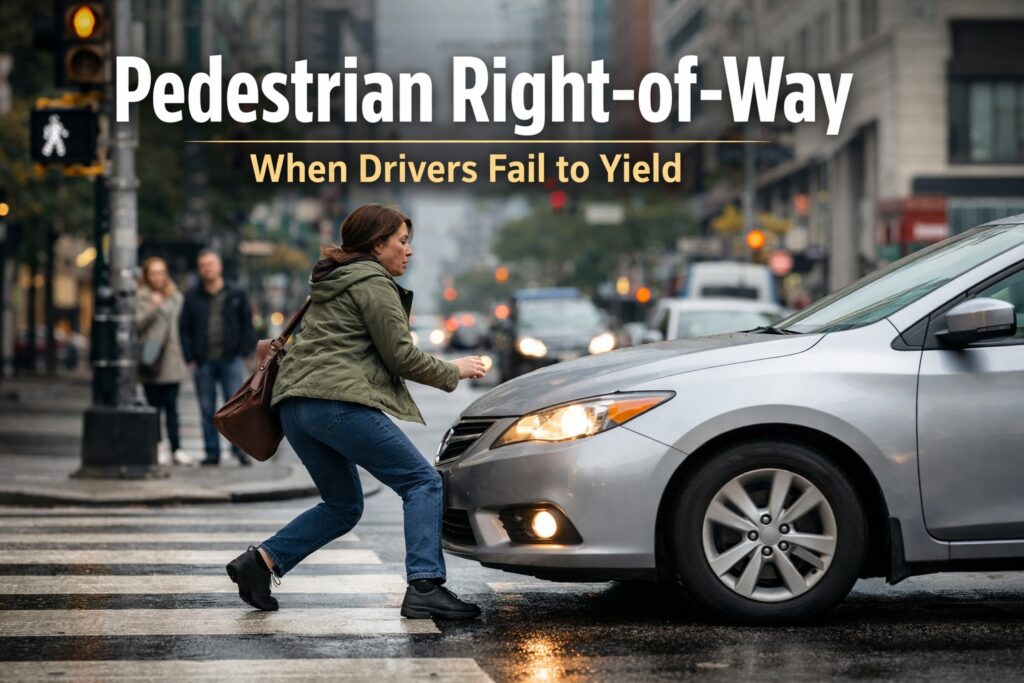
A pedestrian is lawfully crossing at an intersection within an unmarked crosswalk. A driver makes a turn without yielding and strikes the pedestrian, causing serious injuries.
This is exactly the type of harm Vehicle Code § 21950 was designed to prevent.
When a driver fails to yield under these circumstances, the statute strongly supports liability, often making fault difficult to dispute.
Marked vs. Unmarked Crosswalks
Many drivers mistakenly believe they only must stop for pedestrians in painted crosswalks. That is incorrect.
Under California law:
- Marked crosswalks are painted or signposted crossings
- Unmarked crosswalks exist at most intersections, even without paint
If a pedestrian is crossing at an intersection where crossing is permitted, Vehicle Code § 21950 applies.
VeVehicle Code § 21950 and Negligence Per Se
A violation of Vehicle Code § 21950 — California’s pedestrian right-of-way statute — can strongly support a claim of negligence per se.
Negligence per se applies when a driver violates a safety law designed to protect a specific group of people (here, pedestrians) and that violation causes injury. Vehicle Code § 21950 fits squarely within that framework because it exists to protect pedestrians from being struck by vehicles while lawfully crossing the street.
When negligence per se applies in a pedestrian accident case:
- The law presumes the driver was negligent
The statutory violation itself establishes negligence. The injured pedestrian does not need to prove that the driver acted unreasonably under the circumstances. - The pedestrian does not need to litigate “reasonable driving”
Arguments about reaction time, judgment calls, or momentary inattention are largely sidelined. The focus shifts to whether the driver failed to yield as required by law. - The burden shifts to the defense
The driver and their insurance company must attempt to explain why the statutory violation should be excused — a difficult task when a pedestrian is struck in a crosswalk.
In real-world litigation, this shift is critical. Once a failure to yield under Vehicle Code § 21950 is established, pedestrian cases often move quickly past disputes over fault and become focused on the severity of the injuries, long-term medical needs, lost income, and overall damages.
This is why pedestrian accident cases involving crosswalks frequently present significant exposure for drivers and insurers.
For a deeper explanation of how negligence per se works under California law, see our prior blog post:
👉 Evidence Code § 669 — Negligence Per Se
Understanding how these statutes work together is often the key to holding drivers fully accountable when pedestrians are seriously injured.
CCommon Injuries in Pedestrian Accidents
Pedestrian collisions frequently result in severe or catastrophic injuries because pedestrians have no physical protection against the force of a moving vehicle. Even low-speed impacts can transmit tremendous force directly to the body.
Common injuries in pedestrian accidents include:
- Traumatic brain injuries (TBIs)
Head trauma can occur when a pedestrian strikes the hood, windshield, or pavement, often leading to long-term cognitive and neurological impairment. - Spinal cord and neck injuries
Sudden impact and secondary falls can cause herniated discs, spinal cord damage, paralysis, or chronic pain. - Pelvic, leg, and orthopedic fractures
Lower-body injuries are especially common, including broken hips, femurs, knees, and ankles that may require surgery and lengthy rehabilitation. - Internal organ damage
Blunt-force trauma can injure internal organs such as the lungs, liver, or spleen, sometimes with life-threatening complications. - Wrongful death
Tragically, pedestrian accidents are often fatal, particularly when vehicles are traveling at higher speeds or fail to brake in time.
Because of the vulnerability of pedestrians, these cases often involve long-term medical care, permanent disability, or loss of life, significantly increasing the stakes of the claim.
Driver Defenses — and Why They Often Fail
In pedestrian accident cases, drivers and insurance companies frequently attempt to shift blame away from the motorist by arguing:
- “The pedestrian came out of nowhere”
- “The pedestrian wasn’t in a crosswalk”
- “I didn’t see them in time”
- “The pedestrian was partially at fault”
While pedestrians do have a duty to exercise reasonable care, drivers bear the primary responsibility to yield under Vehicle Code § 21950. A driver’s failure to observe a pedestrian, slow down, or stop as required by law is rarely excused.
These defenses often collapse when examined against objective evidence such as:
- The layout and visibility of the intersection
- Traffic signal timing and pedestrian signals
- Vehicle speed and stopping distance
- Surveillance footage, dash cams, or eyewitness testimony
In many cases, claims that a pedestrian was “hard to see” or “appeared suddenly” actually reinforce the driver’s failure to maintain a proper lookout — a core duty under California law.
Comparative Fault Does Not Eliminate Liability
California follows comparative fault rules, meaning fault can be shared. However, a driver’s failure to yield under Vehicle Code § 21950 often carries substantial weight and limits the defense’s ability to shift blame.
Even if fault is disputed, injured pedestrians may still recover compensation.
Why Pedestrian Cases Require Trial Lawyers
Pedestrian accident cases often involve:
- Serious injuries
- Aggressive insurance defenses
- Attempts to blame the pedestrian
- High jury risk for defendants
At WIN Trial Lawyers, we know how to:
- Lock in statutory violations
- Use roadway design and traffic laws to prove fault
- Counter victim-blaming tactics
- Maximize recovery for injured pedestrians and families
Related WIN Trial Lawyers Blog Posts
- Evidence Code § 669 — Negligence Per Se
- Vehicle Code § 23152 — DUI Accidents
- Pedestrian Accidents: Your Rights After Being Hit by a Car
Injured While Crossing the Street?
If you were hit by a vehicle while walking — even in an unmarked crosswalk — you may have stronger legal rights than you realize.
📞 Contact WIN Trial Lawyers today for a free consultation.
We hold drivers accountable when they fail to yield and pedestrians pay the price.
Get Help From WIN Injury & Accident Trial Lawyers
Why Legal Representation Matters
Insurance companies often undervalue pain and suffering—offering minimal settlements that ignore your daily struggles. A skilled attorney can:
- Present powerful evidence of your emotional and physical suffering
- Retain expert witnesses to quantify your losses
- Use verdict data to justify higher multipliers or per diem rates
- Argue your case persuasively before a jury
At WIN Trial Lawyers, our team fights to ensure that your recovery reflects the full extent of your suffering—not just your bills.

At WIN Trial Lawyers, we know how personal injury claims can be can be. Victims often face mounting medical bills, lost wages, and emotional trauma. Our team has successfully taken on insurance companies and third parties, recovering millions for injured clients.
If you or a loved one has been injured in an accident, don’t leave your future in the hands of the insurance company. You need experienced trial lawyers who know how to prove liability and fight for maximum compensation.
If you or a loved one has been injured, don’t face this alone. The sooner you act, the stronger your case will be.
🔗 Related Posts:
Frequently Asked Questions: Pedestrian Accidents & Right-of-Way
What rights do pedestrians have in California crosswalks?
Pedestrians have the right-of-way in both marked and unmarked crosswalks at intersections. Drivers are required to slow down or stop to allow pedestrians to cross safely.
What is an unmarked crosswalk?
An unmarked crosswalk exists at most intersections, even if there are no painted lines on the road. Many pedestrian accidents occur in unmarked crosswalks where drivers mistakenly believe pedestrians do not have priority.
Does Vehicle Code § 21950 apply if there are no crosswalk lines?
Yes. Vehicle Code § 21950 protects pedestrians in both marked and unmarked crosswalks, as long as crossing is permitted at that location.
Is a driver automatically at fault for hitting a pedestrian?
Often, yes. If a driver fails to yield to a pedestrian in a crosswalk, that violation can strongly support liability and may constitute negligence per se.
What is negligence per se in a pedestrian accident?
Negligence per se means the law presumes the driver was negligent because they violated a safety statute designed to protect pedestrians. This shifts the burden toward the defense.
Do pedestrians ever share fault in an accident?
Pedestrians have a duty to exercise reasonable care, but drivers bear the primary duty to yield under § 21950. Claims that pedestrians are at fault are closely scrutinized and often fail.
What if the driver says they didn’t see the pedestrian?
Failing to see a pedestrian is not a valid excuse. Drivers are required to maintain a proper lookout and adjust their driving to road conditions, visibility, and pedestrian activity.
What if the pedestrian was crossing slowly?
Drivers must yield and allow pedestrians to complete their crossing safely. Impatience or misjudging speed does not excuse a failure to yield.
What injuries are common in pedestrian accidents?
Common injuries include traumatic brain injuries, spinal injuries, broken legs or hips, internal organ damage, and fatal injuries. Even low-speed impacts can be devastating.
Are pedestrian accident cases more serious than car-on-car accidents?
Yes. Pedestrians lack any physical protection, which often leads to more severe injuries and higher damages compared to typical vehicle collisions.
Can a pedestrian recover damages even if partially at fault?
Yes. California follows comparative fault rules. Even if fault is shared, injured pedestrians may still recover compensation.
What damages can be recovered in a pedestrian accident case?
Potential damages include medical expenses, future medical care, lost income, pain and suffering, permanent disability, and wrongful death damages where applicable.
How is fault proven in a pedestrian accident?
Fault is established through evidence such as police reports, traffic signal timing, surveillance footage, witness statements, vehicle data, and roadway design.
What if the driver fled the scene?
Hit-and-run pedestrian accidents are serious crimes. Civil claims can still proceed using witness testimony, video footage, and uninsured motorist coverage.
Do I need a police report for a pedestrian injury claim?
A police report is highly important and often critical in documenting right-of-way violations and driver statements.
How long do I have to file a pedestrian accident claim?
California statutes of limitation apply. Waiting too long can permanently bar your claim and result in lost evidence.
Should I talk to the driver’s insurance company?
No. Insurance adjusters are trained to minimize payouts. You should speak with a lawyer before providing any statements.
Why do insurance companies fight pedestrian cases?
Pedestrian cases often involve serious injuries, clear statutory violations, and high jury risk, making insurers more aggressive in defense.
Why should I hire a trial lawyer for a pedestrian accident?
Pedestrian cases often involve blame-shifting, complex liability issues, and significant damages. Trial-ready lawyers create leverage that drives results.
How can WIN Trial Lawyers help after a pedestrian accident?
WIN Trial Lawyers aggressively represents injured pedestrians by:
- Locking in right-of-way violations
- Using negligence per se to establish liability
- Countering victim-blaming defenses
- Pursuing full compensation for serious injuries
What should I do if I was hit by a car while walking?
Seek medical care immediately, report the incident, preserve evidence, and contact a trial lawyer as soon as possible.