
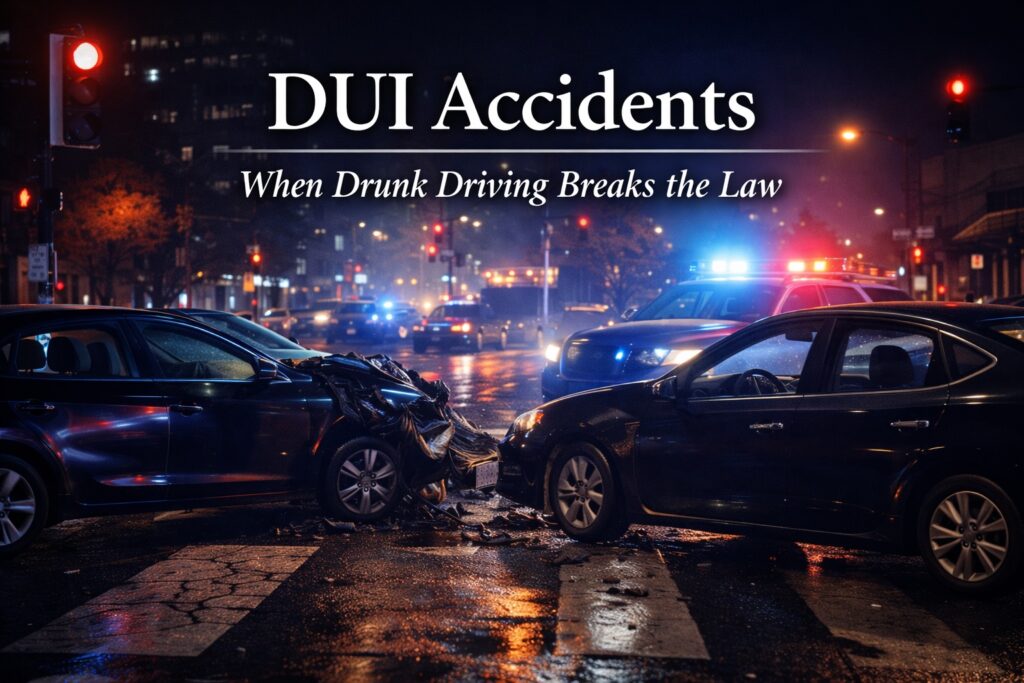
Driving under the influence is not just reckless — it is illegal.
When a drunk or drug-impaired driver causes a crash, California law provides powerful tools to hold them accountable.
One of the most important is California Vehicle Code § 23152, the state’s primary DUI statute. When a driver violates this law and causes injuries, it can dramatically strengthen a personal injury or wrongful death case.
What Vehicle Code § 23152 Prohibits
California Vehicle Code § 23152 makes it unlawful for a person to drive:
- While under the influence of alcohol
- With a blood alcohol concentration (BAC) of 0.08% or higher
- While under the influence of drugs
- While under the combined influence of alcohol and drugs
The law exists for one reason: to protect the public from impaired drivers who pose a serious and predictable danger on the road.
Example: DUI Crash Causing Serious Injuries
Consider this common scenario:
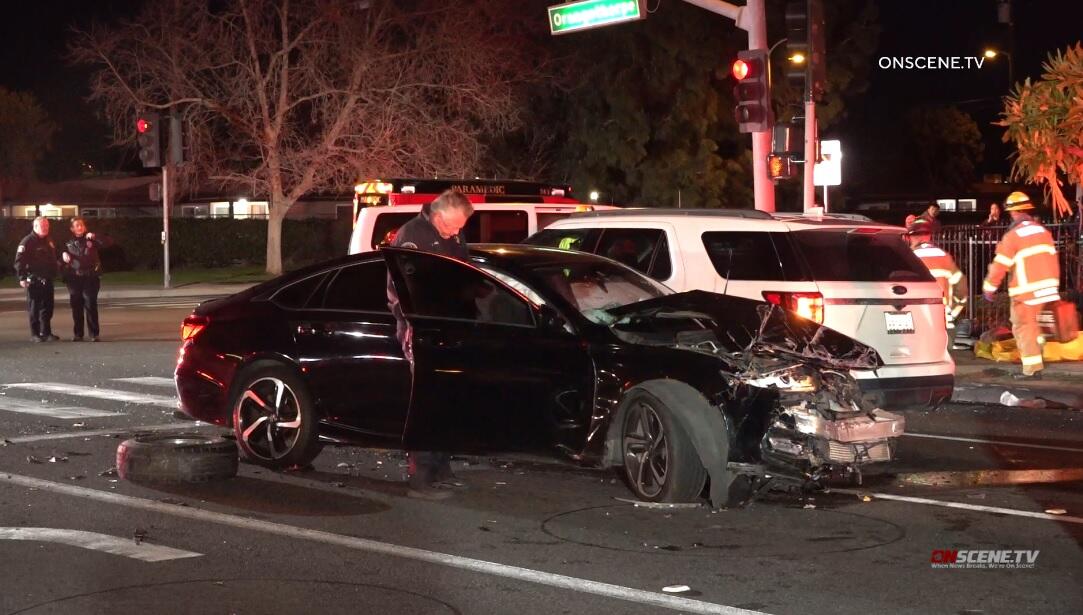
A driver leaves a bar late at night, gets behind the wheel with a BAC above the legal limit, and runs a red light at a busy intersection. The impaired driver slams into another vehicle, seriously injuring the innocent driver inside.
This is exactly the type of harm Vehicle Code § 23152 is designed to prevent.
When a DUI violation causes a crash:
- The driver’s conduct is not just careless — it is illegal
- The violation strongly supports negligence per se
- Liability becomes much harder for the defense to deny
DUI and Negligence Per Se
When a driver violates Vehicle Code § 23152 by driving under the influence and causes a crash, courts often treat that violation as negligence per se.
Negligence per se is powerful because it replaces subjective arguments about “reasonable driving” with an objective legal standard. The Legislature has already decided that driving while impaired is inherently dangerous. When that law is broken and someone is injured, the legal consequences are severe.
Specifically, negligence per se means:
- The law presumes the impaired driver was negligent
The injured victim does not need to prove that the driver acted unreasonably. The statutory violation itself establishes negligence. - The burden shifts to the defense
Instead of the injured party having to prove fault, the defense must now attempt to explain why the violation should be excused — an argument that is rarely persuasive in DUI cases. - Liability becomes difficult to contest
Most DUI accident cases no longer hinge on who caused the crash, but rather on how much harm was caused.
In practice, once a DUI violation is established, the case often moves quickly past fault and focuses on damages, including medical expenses, lost income, pain and suffering, and long-term impairment.
Why DUI Accident Cases Are Different
DUI crashes are not treated like ordinary car accidents — by courts, juries, or insurance companies — because they involve conduct that society has expressly deemed unacceptable.
Unlike momentary distraction or simple negligence, DUI cases involve:
- A clear violation of a public safety statute
Vehicle Code § 23152 exists specifically to prevent serious injuries and deaths caused by impaired drivers. - Foreseeable and preventable harm
The dangers of drunk or drug-impaired driving are well known. The harm that results from DUI crashes is not accidental or surprising — it is predictable. - Conscious disregard for public safety
Choosing to drive while impaired reflects a decision to ignore the safety of others on the road.
Because of this, DUI injury cases often carry consequences far beyond those seen in typical auto accidents, including:
- Higher settlement values
Insurance carriers understand that DUI cases present serious jury risks and are often forced to value these claims more aggressively. - Greater jury anger toward the defendant
Jurors tend to have little sympathy for impaired drivers, particularly when innocent people are injured or killed. - Potential punitive damages
In cases involving serious injury or wrongful death, DUI conduct may support punitive damages designed to punish reckless behavior and deter similar conduct in the future.
For injured victims, this distinction matters. DUI cases are not just about compensation — they are about accountability.
Injuries Commonly Caused by DUI Crashes
Because impaired drivers have slowed reaction times and poor judgment, DUI accidents frequently result in:
- Traumatic brain injuries (TBIs)
- Spinal cord and neck injuries
- Broken bones and orthopedic trauma
- Internal organ damage
- Fatal injuries and wrongful death
These crashes are often high-speed and occur at intersections, on freeways, or during late-night hours.
Evidence Used to Prove DUI Liability
Strong DUI injury cases are built on evidence such as:
- Police reports and DUI arrest records
- Breathalyzer or blood test results
- Dash-cam and body-cam footage
- Witness statements
- Bar or restaurant receipts
- Expert toxicology testimony
Even if the driver avoids a DUI conviction, civil liability can still be proven.
What If the Drunk Driver Was Never Convicted?
A criminal conviction is not required to pursue a civil injury claim.
Civil cases have a lower burden of proof, and DUI liability can often be established through:
- Officer observations
- Chemical test results
- Driving behavior before the crash
- Independent witnesses
Can Punitive Damages Apply in DUI Accident Cases?
Yes. Driving under the influence can qualify as malice or conscious disregard for safety, which opens the door to punitive damages in serious injury and wrongful death cases.
Punitive damages are designed to:
- Punish extreme misconduct
- Deter similar behavior
- Go beyond simple compensation
Punitive Damages and Civil Code § 3294
Under California Civil Code § 3294, punitive damages may be awarded when a defendant’s conduct involves malice, oppression, or fraud. In DUI accident cases, punitive damages most often arise under the malice standard.
Civil Code § 3294 defines malice as conduct that is carried out with a willful and conscious disregard for the rights or safety of others.
Driving under the influence can meet this standard because:
- The dangers of impaired driving are universally known
- The decision to drive while intoxicated is voluntary
- The risk of serious injury or death is obvious and foreseeable
When a DUI driver causes a crash, courts and juries may conclude that the conduct goes beyond ordinary negligence and rises to the level of conscious disregard for public safety.
If proven, punitive damages may be awarded to:
- Punish the impaired driver
- Deter similar conduct by others
- Reinforce the seriousness of DUI violations
In catastrophic injury and wrongful death cases, the availability of punitive damages under Civil Code § 3294 significantly increases both litigation risk and settlement pressure on defendants and insurers.
Related WIN Trial Lawyers Blog Posts
- Evidence Code § 669 — Negligence Per Se
- Fatal Car Accidents Caused by Drunk Drivers: Legal Options for Families
- Punitive Damages in California Personal Injury Cases
Injured by a Drunk or Drug-Impaired Driver?
If you or a loved one were injured by a DUI driver, time matters. Evidence disappears quickly, and insurance companies move fast to protect themselves.
📞 Contact WIN Trial Lawyers today for a free consultation.
When the law is broken, we know how to prove it — and we know how to win.
Get Help From WIN Injury & Accident Trial Lawyers
Why Legal Representation Matters
Insurance companies often undervalue pain and suffering—offering minimal settlements that ignore your daily struggles. A skilled attorney can:
- Present powerful evidence of your emotional and physical suffering
- Retain expert witnesses to quantify your losses
- Use verdict data to justify higher multipliers or per diem rates
- Argue your case persuasively before a jury
At WIN Trial Lawyers, our team fights to ensure that your recovery reflects the full extent of your suffering—not just your bills.

At WIN Trial Lawyers, we know how personal injury claims can be can be. Victims often face mounting medical bills, lost wages, and emotional trauma. Our team has successfully taken on insurance companies and third parties, recovering millions for injured clients.
If you or a loved one has been injured in an accident, don’t leave your future in the hands of the insurance company. You need experienced trial lawyers who know how to prove liability and fight for maximum compensation.
If you or a loved one has been injured, don’t face this alone. The sooner you act, the stronger your case will be.
🔗 Related Posts:
Frequently Asked Questions (FAQs): Car Accidents Caused by a DUI Driver
What should I do if the other driver was drunk or drug-impaired?
Call 911 immediately, request medical help, and make sure law enforcement responds. A police report documenting impairment is critical in DUI injury cases.
Does a DUI make the other driver automatically at fault?
Often, yes. A DUI violation under Vehicle Code § 23152 can support negligence per se, meaning the law presumes the impaired driver was negligent.
What is negligence per se and why does it matter in DUI cases?
Negligence per se allows the court to presume fault when a driver violates a safety statute, such as DUI laws. This shifts the focus of the case away from fault and toward damages.
Do I still have a case if the drunk driver wasn’t convicted?
Yes. A criminal conviction is not required. Civil injury cases have a lower burden of proof, and liability can be established through evidence of impairment.
What if the DUI driver claims they “weren’t that drunk”?
Impairment is not limited to a specific BAC. Officer observations, driving behavior, witness testimony, and toxicology evidence can all establish impairment.
Can I sue even if the DUI driver has insurance?
Yes. In fact, most DUI injury claims are paid through insurance. However, insurers often fight harder in DUI cases due to exposure to punitive damages.
What injuries are common in DUI accidents?
DUI crashes frequently cause:
- Traumatic brain injuries
- Spinal cord and neck injuries
- Broken bones
- Internal injuries
- Fatal injuries in severe cases
Are DUI accident cases worth more than regular car accidents?
Often, yes. DUI cases tend to involve higher settlement values due to statutory violations, jury anger, and the potential for punitive damages.
Can I recover punitive damages if I was hit by a drunk driver?
Possibly. DUI conduct may qualify as conscious disregard for safety under Civil Code § 3294, supporting punitive damages in serious injury cases.
What if the DUI driver was working at the time of the crash?
Additional parties — including employers — may be liable under vicarious liability theories, depending on the facts.
What if the DUI driver fled the scene?
Hit-and-run DUI cases are serious. Liability can still be proven through witnesses, surveillance footage, and forensic evidence.
Do DUI accidents involve both criminal and civil cases?
Yes. The criminal DUI case is separate from your civil injury claim. You do not need to wait for the criminal case to resolve before pursuing compensation.
Will the DUI driver’s insurance try to settle quickly?
Sometimes — but often for less than full value. Early offers rarely account for long-term medical needs or punitive exposure.
Should I give a recorded statement to the insurance company?
No. You should speak with a lawyer first. Insurance adjusters are trained to minimize payouts.
What evidence helps prove a DUI injury case?
Key evidence includes:
- Police reports and DUI arrest records
- Breath or blood test results
- Body-cam or dash-cam footage
- Witness statements
- Bar or restaurant receipts
- Expert testimony
How long do I have to file a DUI injury claim?
California statutes of limitation apply. Waiting too long can permanently bar your claim.
What if I was partially at fault?
California follows comparative fault rules. However, DUI violations often significantly limit the defense’s ability to shift blame.
Why should I hire a trial lawyer for a DUI accident case?
DUI cases involve high stakes, complex evidence, and aggressive insurers. Trial-ready lawyers create leverage that leads to better outcomes.
How can WIN Trial Lawyers help after a DUI accident?
WIN Trial Lawyers aggressively pursues DUI injury cases by:
- Locking in statutory violations
- Preserving critical evidence
- Pursuing punitive damages when appropriate
- Maximizing recovery for injured victims and families
What should I do next if I was hit by a drunk driver?
Get medical care, preserve evidence, and speak with a trial lawyer as soon as possible. Early action can dramatically affect the outcome of your case.
Who should I contact for DUI criminal defense?
If you have been accused or arrested for a DUI, the civil injury issues discussed above are separate from your criminal exposure. DUI charges carry serious consequences, including jail time, license suspension, fines, and long-term record impacts.
For criminal DUI defense, we recommend contacting Power Trial Lawyers, led by Matthew Barhoma.
Power Trial Lawyers is known for:
- Aggressively challenging DUI stops and arrests
- Attacking breath and blood test reliability
- Obtaining dismissals, reductions, and not-guilty verdicts
- Protecting clients’ licenses and freedom
You can learn more or contact their team here:
https://www.powertriallawyers.com/practice-areas/criminal-defense/dui-defense-southern-california/
Important: DUI criminal defense requires immediate action. Deadlines move fast, and early representation can make a critical difference.