
Liability, Negligence Per Se, and Injury Claims After Backing Accidents
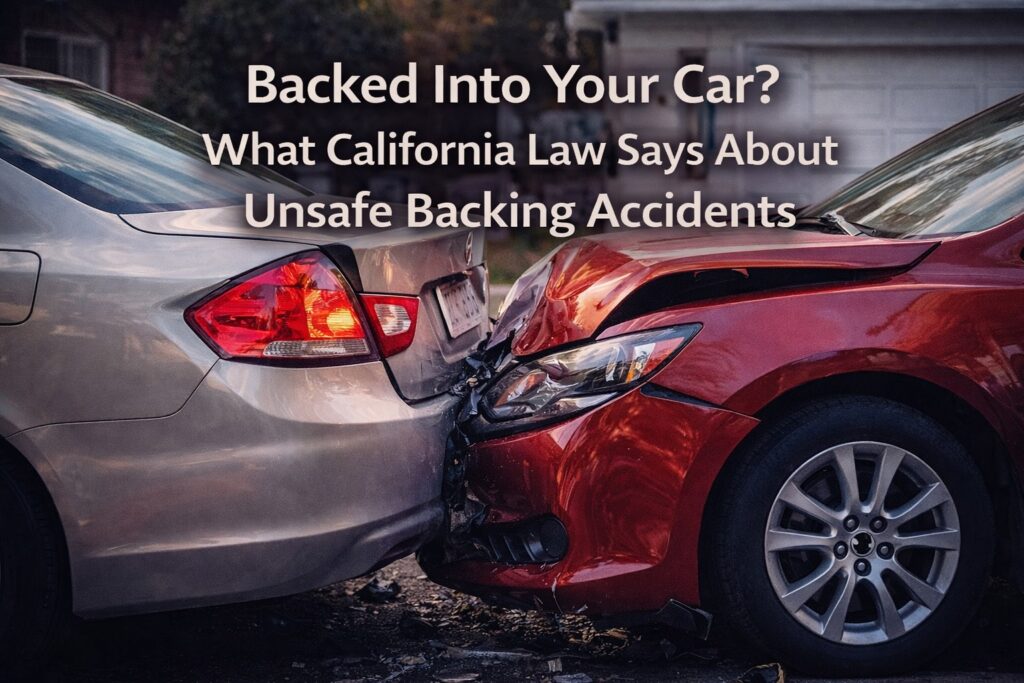
Many serious accidents happen at low speeds — in driveways, parking lots, and residential streets — when a driver backs up without paying proper attention.
California Vehicle Code § 22106 governs unsafe backing and is frequently used to establish fault when a driver reverses a vehicle and causes a collision. While these accidents are often dismissed as “minor,” they regularly result in real injuries and strong liability cases.
At WIN Injury & Accident Trial Lawyers, unsafe backing is a recurring issue in pedestrian, vehicle, bicycle, and parking-lot injury claims.
What Is VC § 22106 – Unsafe Backing?
California Vehicle Code § 22106 states that:
A driver may not back a vehicle unless the movement can be made with reasonable safety and without interfering with other traffic.
In simple terms, drivers have an affirmative duty to ensure it is safe before backing up. If a driver reverses without adequate visibility or awareness and causes a collision, they are often presumed at fault.
Common Unsafe Backing Scenarios
Unsafe backing frequently occurs in:
- Parking lots and garages
- Driveways backing into traffic
- Residential streets
- Loading zones
- Commercial delivery areas
Common fact patterns include:
- Backing into a moving vehicle
- Striking a pedestrian or cyclist
- Reversing without checking mirrors or cameras
- Backing out of a driveway into oncoming traffic
Who Is Usually at Fault in a Backing Accident?
In most cases, the backing driver bears primary responsibility.
California courts and insurers generally treat backing vehicles as having a heightened duty of care, because reversing reduces visibility and increases risk.
While comparative fault can apply in rare situations, unsafe backing cases often involve clear liability.
Negligence Per Se and VC § 22106
California recognizes negligence per se when a defendant violates a safety statute designed to protect the public.
VC § 22106 exists to prevent exactly the type of harm caused by careless backing maneuvers. When a driver violates this statute and causes injury, that violation may itself establish negligence in a civil lawsuit.
This allows the injured person to focus on causation and damages, rather than debating whether the backing driver acted reasonably.
Unsafe Backing and Personal Injury Claims
Backing accidents can cause significant injuries, including:
- Pedestrian knockdown injuries
- Bicycle accidents
- Whiplash and soft-tissue injuries
- Broken bones
- Head injuries
- Crush injuries in tight spaces
Even low-speed backing collisions can lead to long-term medical issues, particularly for pedestrians and older adults.
Parking Lot Accidents and Unsafe Backing
Parking lots are among the most common locations for VC § 22106 violations.
Despite the informal feel of parking areas, traffic laws still apply. Drivers backing out of parking spaces must:
- Yield to moving vehicles
- Watch for pedestrians
- Use mirrors, cameras, and visual checks
Failure to do so frequently results in liability.
Do You Need a Traffic Citation to File a Claim?
No.
A traffic citation is not required to pursue a personal injury claim.
Civil liability can be established through:
- Police reports
- Witness testimony
- Surveillance or dashcam footage
- Vehicle damage patterns
The absence of a citation does not bar recovery.
Comparative Fault in Unsafe Backing Cases
California follows pure comparative negligence, meaning fault can be shared.
However, insurers often attempt to unfairly shift blame to:
- Pedestrians
- Drivers already in motion
- Cyclists lawfully passing
Early investigation and evidence preservation are critical to counter these defenses.
What to Do After an Unsafe Backing Accident
If you are injured in a backing collision:
- Call 911 and request a police report
- Seek medical treatment immediately
- Take photos of vehicle positions and surroundings
- Identify witnesses or nearby cameras
- Avoid recorded statements to insurers
- Contact a trial-focused injury lawyer promptly
Backing accidents are often decided on early evidence.
Why Unsafe Backing Cases Still Require Trial Lawyers
Insurance companies routinely downplay backing accidents as “minor.” In reality, these cases can involve:
- Serious injuries
- Clear statutory violations
- Strong jury appeal
At WIN Trial Lawyers, we prepare unsafe backing cases with the same trial-level rigor as high-speed crashes.
Speak With a California Accident Lawyer
If you were injured because a driver backed up unsafely, you may be entitled to compensation for medical bills, lost income, and pain and suffering.
📞 WIN Injury & Accident Trial Lawyers
📍 Serving Los Angeles and throughout California
⚖️ No fee unless we win.
Get Help From WIN Injury & Accident Trial Lawyers
Why Legal Representation Matters
Insurance companies often undervalue pain and suffering—offering minimal settlements that ignore your daily struggles. A skilled attorney can:
- Present powerful evidence of your emotional and physical suffering
- Retain expert witnesses to quantify your losses
- Use verdict data to justify higher multipliers or per diem rates
- Argue your case persuasively before a jury
At WIN Trial Lawyers, our team fights to ensure that your recovery reflects the full extent of your suffering—not just your bills.
At WIN Trial Lawyers, we know how personal injury claims can be can be. Victims often face mounting medical bills, lost wages, and emotional trauma. Our team has successfully taken on insurance companies and third parties, recovering millions for injured clients.
If you or a loved one has been injured in an accident, don’t leave your future in the hands of the insurance company. You need experienced trial lawyers who know how to prove liability and fight for maximum compensation.
If you or a loved one has been injured, don’t face this alone. The sooner you act, the stronger your case will be.
🔗 Related Posts:
AQs: VC 22106 Unsafe Backing
What is Vehicle Code 22106 in California?
Vehicle Code 22106 is California’s “unsafe backing” law. It generally prohibits backing up unless the movement can be made with reasonable safety and without interfering with other traffic.
What does “unsafe backing” mean in plain English?
It means a driver cannot reverse unless it’s safe to do so. If backing up creates a collision risk—because the driver didn’t check, didn’t yield, or couldn’t see—insurance companies and juries often treat that as fault.
Does VC 22106 apply in parking lots?
Yes. Unsafe backing frequently happens in parking lots, and the same safety duties usually apply. Backing drivers must look carefully, yield as needed, and avoid interfering with vehicles or pedestrians already moving through the lane.
Does VC 22106 apply in driveways?
Yes. Backing out of a driveway into a street is one of the most common VC 22106 scenarios. Drivers must ensure it’s safe and yield to traffic and pedestrians.
Who is usually at fault in a backing accident?
In many cases, the backing driver is primarily at fault because reversing reduces visibility and creates a higher duty to confirm the path is clear. That said, comparative fault can apply in some fact patterns.
Can the moving car be at fault if it hits a backing car?
Sometimes. If the moving vehicle was speeding through a parking lot, distracted, or ignoring right-of-way, fault can be shared. But insurers often start from the assumption the backing driver caused the problem—evidence matters.
What if both cars were backing up?
Fault can be split. When both drivers reverse at the same time, each may be responsible for failing to ensure the movement could be made safely.
Is unsafe backing a crime or just a ticket?
Typically it’s a traffic infraction (a ticket), not a misdemeanor. The bigger issue is how the violation impacts civil liability after an injury.
Do I need a ticket or police report to win my claim?
No. A ticket helps, but it’s not required. Liability can be proven through photos, witness statements, vehicle damage patterns, and video.
Can VC 22106 be used as negligence per se in an injury case?
Often, yes. If a driver violated a safety statute like VC 22106 and that violation caused the type of harm the law was designed to prevent, it can support negligence per se, strengthening liability.
What evidence helps prove unsafe backing?
Common evidence includes:
- Photos showing vehicle position and sightlines
- Damage location (rear of backing vehicle vs front/side of other vehicle)
- Surveillance footage (parking lots, homes, businesses)
- Dashcam video
- Witness statements
- Measurements showing limited visibility or obstructions
What if the driver says they “didn’t see” the other car?
That frequently supports unsafe backing. Not seeing what is there is often the problem—drivers must confirm it is safe before reversing.
What if the backing driver had a backup camera?
A backup camera doesn’t eliminate the duty to back safely. Drivers must still look, check mirrors, and ensure the path is clear.
What if a pedestrian is hit by a backing car?
Backing-into-pedestrian cases are often strong liability claims because pedestrians are exactly who the law aims to protect in low-speed areas like lots and driveways.
What if a child is hit while a car is backing out?
These are among the most serious backing cases. Liability often centers on visibility, supervision, driver attention, speed, and whether the driver used reasonable caution before and during the reverse movement.
Are cyclists protected under unsafe backing rules?
Yes. Cyclists passing through a lane, parking lot aisle, or roadway can be injured by unsafe backing, and VC 22106 issues often arise.
What injuries are common in backing accidents?
Even low-speed crashes can cause:
- Whiplash and soft-tissue injuries
- Wrist/arm injuries from bracing
- Knee injuries
- Concussions
- Pedestrian knockdown injuries
- Hip/shoulder injuries (especially for older adults)
What should I do immediately after an unsafe backing accident?
- Call 911 if anyone is hurt
- Get medical care
- Photograph vehicle positions, lane markings, and sight obstructions
- Identify witnesses
- Look for nearby cameras (homes, retail, garages)
- Avoid recorded statements until you understand liability issues
How long do I have to file a lawsuit in California?
Most personal injury claims have a two-year deadline from the date of injury. Property damage claims often have a longer deadline. Special rules and shorter deadlines apply if a government entity is involved.
Can insurance companies deny my claim because it happened in a parking lot?
They may try, but parking-lot crashes are still valid claims. The key is proving fault and damages with early evidence.
What if the other driver says I was speeding in the parking lot?
That’s a common defense. If there’s evidence of speeding or inattentive driving, comparative fault can reduce recovery—but it doesn’t automatically eliminate a claim.
What if I was walking behind the car when it backed into me?
Pedestrians typically have strong protection in backing cases. The driver must ensure the backing movement can be done safely and watch for people in the path.
What damages can I recover after an unsafe backing injury?
Potential damages include medical bills, lost wages, future care costs, pain and suffering, and out-of-pocket expenses. The value depends on injury severity and documentation.
Do these cases ever go to trial?
They can—especially if injuries are serious or insurers try to minimize fault because the collision happened at “low speed.” Trial readiness often drives fair settlement outcomes.