
How UCL Claims Intersect with Products Liability Cases
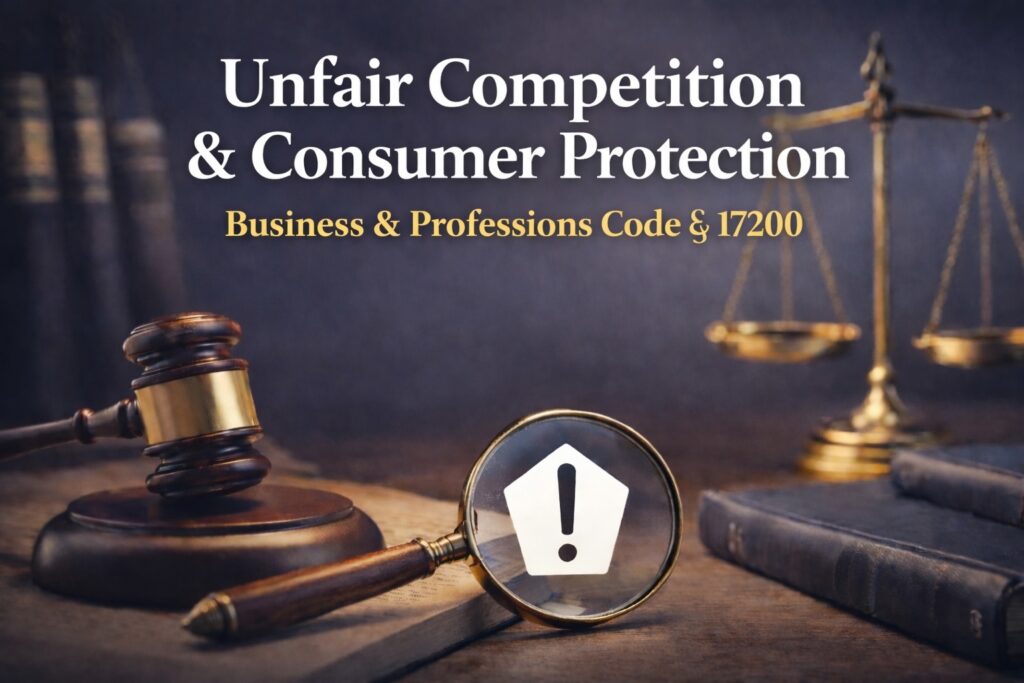
California’s Unfair Competition Law (UCL)—Business & Professions Code 17200—is not a traditional products-liability statute. It does not replace strict liability, negligence, or warranty claims.
But in the right case, it can be a force multiplier.
In products liability litigation, the UCL is often used to target systemic misconduct surrounding how a product is designed, marketed, labeled, sold, or kept on the market—especially when the harm extends beyond a single defective unit.
What Is Business & Professions Code 17200?
Business & Professions Code 17200 prohibits unlawful, unfair, or fraudulent business acts or practices.
A plaintiff need only prove one of these three prongs.
In product cases, the statute is frequently used to challenge:
- Deceptive marketing or advertising
- Failure to disclose known product risks
- Ongoing sales of unsafe products
- Corporate practices that prioritize profit over safety
The focus is not just on injury—but on business conduct.
How UCL Claims Fit into Products Liability Cases
Traditional products liability claims focus on:
- A defective product
- Causation
- Injury
UCL claims focus on:
- How the product was sold, represented, or kept on the market
- Whether consumers were misled or denied material safety information
- Whether unlawful or unfair practices were systemic
In many cases, both theories apply simultaneously.
The Three UCL Prongs in Products Liability Litigation
1. Unlawful Practices
The “unlawful” prong allows plaintiffs to borrow violations of other laws and treat them as unfair competition.
In product cases, this may include violations of:
- Consumer protection statutes
- Labeling or disclosure laws
- Safety regulations
- Advertising standards
- Warranty statutes
Even if the underlying law does not provide a private right of action, a UCL claim may still proceed.
2. Unfair Practices
The “unfair” prong is especially powerful in products cases.
Courts evaluate whether the conduct:
- Offends established public policy
- Is immoral, unethical, oppressive, or unscrupulous
- Causes harm that outweighs any legitimate business justification
This prong is commonly used where manufacturers:
- Continue selling products despite known safety risks
- Delay recalls or safety warnings
- Shift blame to users while suppressing defect data
- Rely on fine-print disclosures to avoid accountability
Even conduct that technically complies with minimum regulations may still be deemed unfair.
3. Fraudulent Practices
UCL fraud does not require intent or actual reliance.
The standard is whether members of the public are likely to be deceived.
In products liability cases, this often involves:
- Misleading marketing claims
- Omission of known risks
- Downplaying severity of potential injuries
- Safety representations that contradict internal testing or data
Failure to disclose a material safety risk can be sufficient—even without an affirmative misrepresentation.
Who Can Bring a UCL Claim in a Product Case?
UCL claims may be brought by:
- Injured consumers
- Purchasers of unsafe products
- Classes of consumers exposed to deceptive practices
Plaintiffs must show:
- Loss of money or property
- Economic injury caused by the unfair practice
This is why UCL claims are frequently paired with class actions, representative actions, and public-injunctive relief claims in products cases.
Remedies Available Under the UCL
The UCL provides equitable relief, not traditional tort damages.
Available remedies include:
- Injunctions stopping unlawful or unsafe practices
- Restitution of money obtained through unfair practices
- Public injunctive relief to protect consumers at large
The UCL does not allow:
- Pain and suffering damages
- Punitive damages
- Compensatory damages for personal injury
However, when paired with products liability causes of action, UCL claims often increase leverage, exposure, and settlement value.
Strategic Value of UCL Claims in Products Liability Cases
UCL claims are particularly effective when:
- The misconduct is systemic, not isolated
- The product remains on the market
- The defendant profited from concealing or minimizing risks
- Regulatory compliance is used as a shield
- Public safety is implicated
They allow plaintiffs to:
- Shift the focus from a single incident to corporate behavior
- Seek injunctive relief beyond individual damages
- Challenge misleading narratives about product safety
Why UCL Matters in Products Liability Litigation
Products liability law focuses on injury.
The UCL focuses on conduct.
When manufacturers put unsafe products into the stream of commerce—or keep them there—the Unfair Competition Law provides courts with a tool to stop harmful practices, protect the public, and hold companies accountable beyond a single verdict.
At WIN Injury & Accident Trial Lawyers, we use UCL claims strategically in complex products liability cases to expose systemic misconduct and pursue meaningful relief for injured consumers.
For a broader overview of California product-injury law, see our Products Liability Master Guide.
Get Help From WIN Injury & Accident Trial Lawyers
Why Legal Representation Matters
Insurance companies often undervalue pain and suffering—offering minimal settlements that ignore your daily struggles. A skilled attorney can:
- Present powerful evidence of your emotional and physical suffering
- Retain expert witnesses to quantify your losses
- Use verdict data to justify higher multipliers or per diem rates
- Argue your case persuasively before a jury
At WIN Trial Lawyers, our team fights to ensure that your recovery reflects the full extent of your suffering—not just your bills.

At WIN Trial Lawyers, we know how personal injury claims can be can be. Victims often face mounting medical bills, lost wages, and emotional trauma. Our team has successfully taken on insurance companies and third parties, recovering millions for injured clients.
If you or a loved one has been injured in an accident, don’t leave your future in the hands of the insurance company. You need experienced trial lawyers who know how to prove liability and fight for maximum compensation.
If you or a loved one has been injured, don’t face this alone. The sooner you act, the stronger your case will be.