

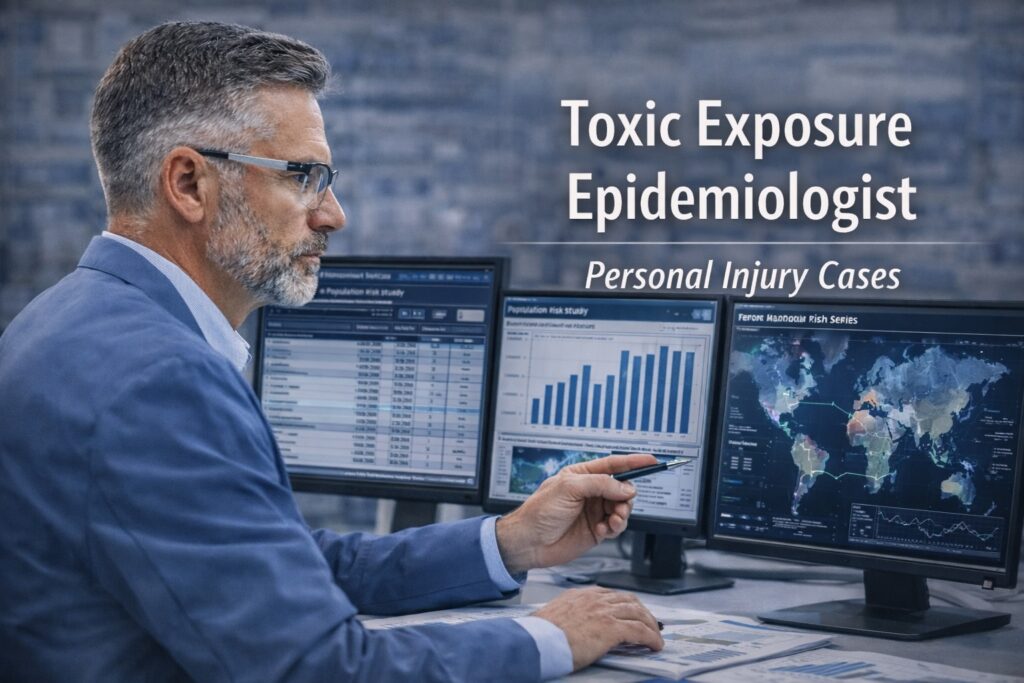
In personal injury cases involving toxic or environmental exposure, defendants almost always argue:
“There is no reliable scientific proof this exposure caused the injury.”
That argument is often aimed at confusing juries.
A toxic exposure epidemiologist exists to cut through that confusion.
At WIN Injury & Accident Trial Lawyers, epidemiologists play a critical role in proving that exposure to a harmful substance significantly increases the risk of disease or injury, even when symptoms appear years later.
What Is a Toxic Exposure Epidemiologist?
A toxic exposure epidemiologist is a public health scientist who studies how diseases and injuries occur across populations following exposure to harmful substances.
In personal injury cases, epidemiologists analyze:
- Disease patterns following toxic exposure
- Whether exposed populations suffer higher injury or illness rates
- Strength and consistency of scientific associations
- Latency periods between exposure and diagnosis
- Peer-reviewed medical and public health studies
Their central question is:
Does exposure to this substance increase the likelihood of this injury or disease?
When Epidemiologists Are Essential in Personal Injury Cases
Epidemiologists are especially important in cases involving:
- Chemical spills or industrial releases
- Environmental contamination (air, water, soil)
- Workplace exposure to toxic substances
- Pesticides, solvents, and heavy metals
- PFAS, benzene, asbestos, silica, or similar toxins
- Cancer, organ damage, or chronic illness claims
- Community-wide or occupational exposure cases
These cases often involve delayed injuries and hotly disputed causation.
What a Toxic Exposure Epidemiologist Does in a Personal Injury Case
1. Analyzes Population-Level Health Data
Epidemiologists review:
- Disease incidence rates
- Exposure vs. non-exposure comparisons
- Trends across affected populations
This shows whether illness occurs more frequently after exposure.
2. Evaluates Scientific Studies
They analyze:
- Peer-reviewed epidemiological research
- Meta-analyses and systematic reviews
- Consistency of findings across multiple studies
Well-established epidemiology defeats claims that evidence is “speculative.”
3. Explains Latency and Delayed Onset
Many toxic injuries develop years after exposure.
Epidemiologists explain:
- Why delayed diagnosis is medically expected
- Typical latency periods for specific diseases
- Why absence of immediate symptoms does not rule out causation
This is especially important in cancer and chronic disease cases.
4. Establishes General Causation
Epidemiologists primarily address general causation — whether a substance is capable of causing a particular disease.
They work alongside:
- Toxicologists, who explain biological mechanisms
- Medical doctors, who address specific causation to the individual
Together, they form a complete causation chain.
5. Rebuts Defense “No Proven Link” Arguments
Defendants often argue:
- Studies are inconclusive
- Risk increases are “too small”
- Other factors explain the illness
Epidemiologists respond by explaining:
- Statistical significance
- Strength and consistency of associations
- Accepted public-health causation frameworks (such as Bradford Hill factors)
- Why population-level evidence matters in real-world exposure cases
Epidemiologists vs. Toxicologists
These experts serve different — but complementary — roles:
- Epidemiologists show patterns and risk across populations
- Toxicologists explain how the substance harms the body
In serious toxic injury cases, both are often necessary.
Why Epidemiologist Testimony Matters to Juries
Jurors want credible science, not corporate talking points.
Epidemiologists help juries understand:
- That injuries are not isolated coincidences
- That exposure risks are well-documented
- That scientific conclusions are based on real-world data
- Why uncertainty does not mean lack of causation
When explained clearly, epidemiology is powerful evidence.
How WIN Injury & Accident Trial Lawyers Uses Epidemiologists
At WIN, toxic exposure cases are built deliberately and early.
We:
- Retain respected, trial-tested epidemiologists
- Integrate epidemiology with toxicology and medical testimony
- Anticipate Daubert and admissibility challenges
- Translate complex statistics into understandable narratives
- Build causation cases defendants cannot dismiss
That preparation creates leverage — and results.
Injured by Toxic Exposure?
If you developed illness or injury after chemical or environmental exposure, causation can be proven — with the right experts.
WIN Injury & Accident Trial Lawyers fights for victims of toxic exposure using science, medicine, and experience.
📞 Contact us today for a free consultation.
Expert Witnesses You’ll Need
Personal Injury cases are rarely proven without expert testimony. Establishing that an injury was caused by a defendant or a product was defective and caused injury typically requires qualified experts who can analyze design, manufacturing, and material failures. In complex product cases, the right experts provide the technical foundation that turns a dangerous product into a legally provable claim.
| Expert Type | Role / Focus |
| Mechanical Engineer | Analyze design/manufacturing flaws, recreate failure conditions |
| Design Engineer | Critique product blueprint, alternative safer designs |
| Materials Scientist | Examine material defects, metallurgical failures |
| Biomechanical Engineer | Model human‐product interactions, assess injury causation |
| Toxicologist | Test for chemical exposures, interpret Prop 65 and toxic injuries |
| Industrial Safety Expert | Review industry standards, OSHA regulations, consumer safety codes |
| Human Factors / Ergonomics Expert | Assess user interface, labeling, warning adequacy |
| Accident Reconstructionist | Reconstruct incident scene involving product failure |
| Medical Doctor / Specialist | Document physical injuries and prognosis |
| Economist / Life‐Care Planner | Quantify future medical costs, lost earning capacity |
| Forensic Accountant | Quantify economic damages, billing records |
| Warranty Law Specialist | Interpret UCC warranty provisions |
| Toxic Exposure Epidemiologist | Link exposure to long‑term health outcomes |
Get Help From WIN Injury & Accident Trial Lawyers
Why Legal Representation Matters
Insurance companies often undervalue pain and suffering—offering minimal settlements that ignore your daily struggles. A skilled attorney can:
- Present powerful evidence of your emotional and physical suffering
- Retain expert witnesses to quantify your losses
- Use verdict data to justify higher multipliers or per diem rates
- Argue your case persuasively before a jury
At WIN Trial Lawyers, our team fights to ensure that your recovery reflects the full extent of your suffering—not just your bills.

At WIN Trial Lawyers, we know how personal injury claims can be can be. Victims often face mounting medical bills, lost wages, and emotional trauma. Our team has successfully taken on insurance companies and third parties, recovering millions for injured clients.
If you or a loved one has been injured in an accident, don’t leave your future in the hands of the insurance company. You need experienced trial lawyers who know how to prove liability and fight for maximum compensation.
If you or a loved one has been injured, don’t face this alone. The sooner you act, the stronger your case will be.