
Construction sites are inherently dangerous environments. Uneven surfaces, open trenches, loose debris, temporary walkways, and poor lighting are common features of active construction zones—and each presents a serious risk of injury. These hazards do not affect only construction workers. Pedestrians, visitors, delivery drivers, tenants, and nearby residents are often exposed to dangerous conditions when construction sites are not properly secured or maintained.
When property owners, general contractors, or subcontractors fail to take reasonable steps to protect the public, slip and fall accidents can result in devastating injuries with long-term physical, financial, and emotional consequences. What may seem like a “simple fall” can quickly become a life-altering event.
At WIN Injury & Accident Trial Lawyers, we represent individuals who have suffered serious injuries in construction site slip and fall accidents throughout California. Below is what injured victims and their families should know.
Why Construction Sites Are High-Risk for Slip and Fall Accidents
Slip and fall incidents at construction sites are rarely unavoidable accidents. In many cases, they stem from preventable safety failures and poor site management. Construction areas are constantly changing, which means hazards can appear quickly and worsen if not addressed promptly.
Common causes of construction site slip and fall accidents include:
- Uneven pavement, trenches, or temporary flooring that is not properly leveled or secured
- Loose gravel, dirt, tools, or construction debris left in walkways
- Wet, muddy, or slick surfaces, especially after rain or cleaning
- Inadequate or poorly placed lighting in active or partially closed areas
- Missing guardrails, covers, or protective barriers around elevation changes or holes
- Insufficient warning signs or barricades to alert people to dangerous conditions
Construction zones must be actively and continuously monitored to ensure safety. The duty to maintain a reasonably safe environment extends beyond workers to anyone who may reasonably come into contact with the site, including members of the public.
Common Construction Site Slip and Fall Injuries
Slip and fall injuries at construction sites are often more severe than those occurring in ordinary premises liability cases. Hard surfaces, exposed concrete, steel materials, and sudden elevation changes significantly increase the risk of serious harm.
Common injuries include:
- Traumatic brain injuries (TBIs), including concussions and brain hemorrhages
- Back and spinal cord injuries, which may lead to chronic pain or permanent disability
- Broken hips, ankles, wrists, arms, and legs, often requiring surgery
- Knee and shoulder ligament tears, including ACL, meniscus, or rotator cuff injuries
- Internal injuries and organ damage caused by forceful impacts
Many victims face extended recovery periods, ongoing medical treatment, physical therapy, and significant time away from work. In severe cases, injuries may permanently affect a person’s ability to earn a living or enjoy daily life.rk.
Who Can Be Held Liable for a Construction Site Slip and Fall?
Liability in construction site slip and fall cases is often complex. Unlike ordinary premises accidents, construction sites typically involve multiple companies, layers of control, and overlapping safety responsibilities. Identifying all responsible parties is critical to ensuring injured victims have access to full compensation.
Depending on the facts of the case, one or more of the following parties may be held legally responsible:
Property Owners
Property owners have a legal duty to maintain their premises in a reasonably safe condition for anyone who may lawfully enter the property. This duty applies even when construction is ongoing.
Owners may be held liable if they:
- Knew or should have known about a dangerous condition
- Failed to repair the hazard within a reasonable time
- Failed to provide adequate warnings about unsafe conditions
- Retained control over the property or certain aspects of the construction work
In some cases, property owners cannot avoid liability simply by hiring contractors, particularly when hazards affect public walkways, entrances, or common areas.
General Contractors
General contractors often bear significant responsibility for overall site safety. They typically control daily operations, coordinate subcontractors, and are responsible for implementing and enforcing safety protocols.
A general contractor may be liable if they:
- Failed to maintain safe walkways or access points
- Allowed dangerous conditions to persist on the site
- Failed to properly supervise subcontractors
- Did not implement adequate safety plans or inspections
Because general contractors are frequently insured under larger policies, identifying their role can be critical in serious injury cases.
Subcontractors
Subcontractors may be directly liable when they create, contribute to, or fail to correct hazardous conditions within the scope of their work.
Examples include:
- Leaving debris, tools, or materials in walkways
- Failing to cover trenches or openings
- Creating slick or uneven surfaces
- Removing safety barriers without replacing them
Even when subcontractors are not responsible for overall site safety, they remain accountable for hazards arising from their own actions or negligence.
Public Entities
When construction affects sidewalks, roadways, or public rights-of-way, a government entity—such as a city, county, or state agency—may share responsibility.
Public entities may be liable if they:
- Approved unsafe construction plans
- Failed to inspect or correct known hazards
- Allowed dangerous conditions to remain in public areas
⚠️ Important: Claims involving public entities are subject to strict procedural rules and shortened deadlines, often requiring a formal government claim to be filed within six months of the incident. Failure to meet these deadlines can permanently bar recovery.
Why Identifying All Liable Parties Matters
Construction site slip and fall injuries often result in significant medical costs, lost income, and long-term consequences. Identifying all responsible parties helps ensure that injured victims are not limited to a single insurance policy or underfunded defendant.
An early and thorough investigation can uncover:
- Who controlled the site
- Who created the hazard
- Who failed to correct or warn about it
This multi-party analysis is essential to maximizing recovery in serious construction site injury cases.
What Makes a Construction Site Slip and Fall Legally Actionable?
Not every fall results in a valid claim. To pursue compensation, evidence often must show that:
- A dangerous condition existed
- The responsible party knew or should have known about it
- The hazard was not properly repaired or warned against
- The condition directly caused the injury
Construction cases frequently involve photographs, incident reports, maintenance logs, and witness testimony—making early investigation critical.
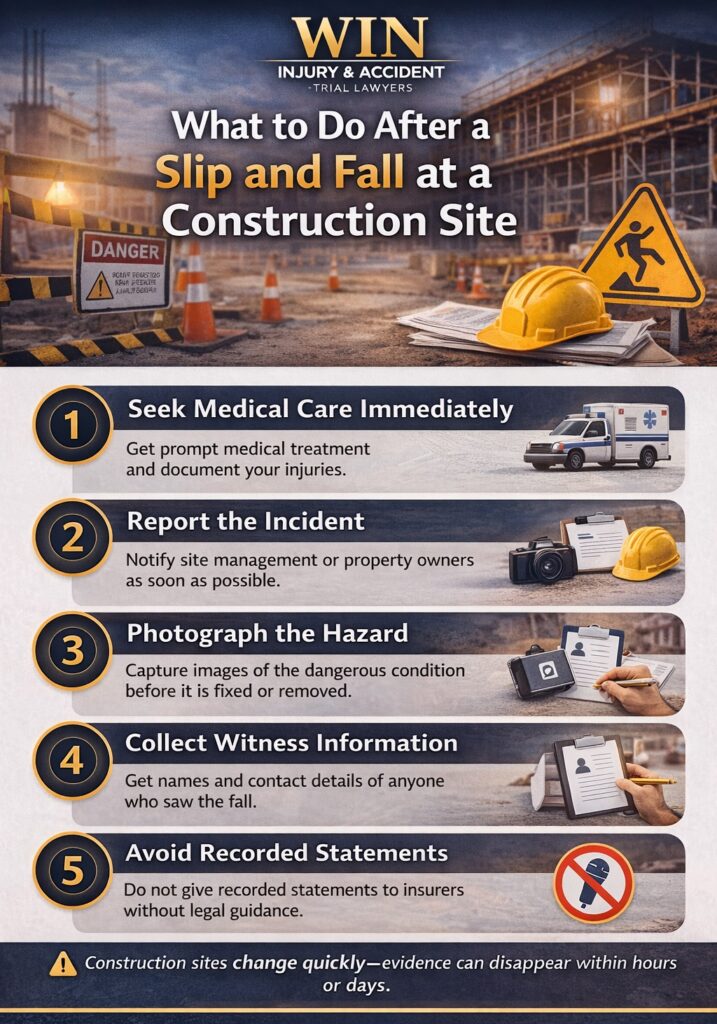
What to Do After a Slip and Fall at a Construction Site
If you are injured at or near a construction site, the steps you take immediately afterward can significantly affect both your medical recovery and your legal rights. Construction sites change rapidly, and critical evidence can be altered or removed shortly after an incident.
Key steps to take include:
- Seek medical care immediately
Even if injuries seem minor, some conditions—such as head injuries, internal bleeding, or spinal trauma—may not be immediately apparent. Prompt medical documentation also creates an important record linking your injuries to the fall. - Report the incident as soon as possible
Notify site management, a property owner, or a supervisor and request that an incident report be created. Delays in reporting can be used to question whether the injury occurred as claimed. - Photograph or video the hazard
Capture images of the dangerous condition, surrounding area, lack of warnings, lighting, and any debris before the site changes. Construction hazards are often repaired or removed quickly. - Collect witness information
Obtain names and contact details of anyone who saw the fall or the hazardous condition. Independent witnesses can be critical if liability is later disputed. - Avoid recorded statements to insurance companies without legal guidance
Insurers may contact injured individuals quickly and ask for recorded statements. These statements can be used to minimize or deny claims, even when injuries are legitimate.
Construction sites evolve daily. Evidence that proves negligence can disappear within hours or days, making early documentation and investigation especially important.
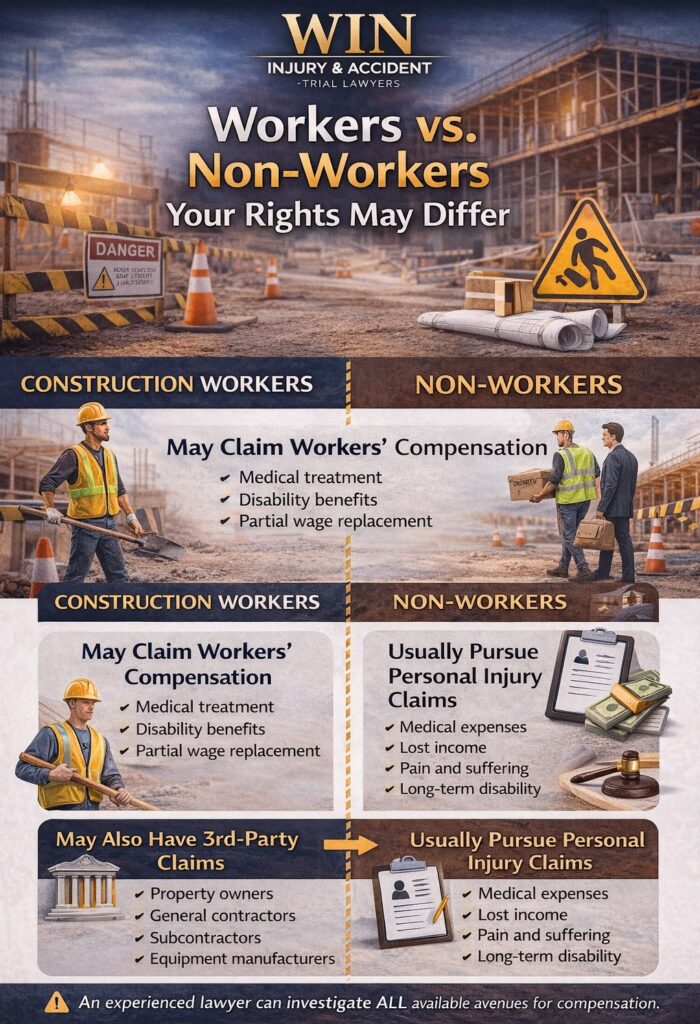
Workers vs. Non-Workers: Your Rights May Differ
The legal options available after a construction site slip and fall depend largely on who you are and why you were on the site at the time of the injury.
Construction Workers
Construction workers are often covered by workers’ compensation, which may provide:
- Medical treatment
- Temporary or permanent disability benefits
- Partial wage replacement
However, workers’ compensation generally does not cover pain and suffering. In many cases, injured workers may also have third-party claims against non-employer entities, such as:
- Property owners
- General contractors
- Subcontractors
- Equipment manufacturers
These third-party claims can provide access to additional compensation beyond workers’ comp benefits.
Pedestrians, Visitors, and Delivery Drivers
Non-workers injured at construction sites typically pursue personal injury claims, not workers’ compensation. These claims may allow recovery for:
- Medical expenses
- Lost income
- Pain and suffering
- Long-term disability or impairment
Because these cases often involve multiple defendants and insurance carriers, they can be legally complex.
Why Legal Guidance Matters
Construction site injury cases are rarely straightforward. An experienced attorney can:
- Identify all responsible parties
- Preserve critical evidence early
- Determine whether workers’ compensation, third-party claims, or both apply
- Navigate strict deadlines, especially when public entities are involved
An experienced construction site injury lawyer can ensure that all available avenues of recovery are explored, not just the most obvious one..
How WIN Injury & Accident Trial Lawyers Can Help
Construction site slip and fall cases are fact-intensive and aggressively defended. Insurance companies and contractors often try to shift blame or minimize injuries.
At WIN Injury & Accident Trial Lawyers, we:
- Investigate construction site safety violations
- Identify all responsible parties
- Preserve critical evidence early
- Handle cases involving private and public entities
- Fight for full compensation for medical bills, lost income, and long-term harm
Get Help From WIN Injury & Accident Trial Lawyers
Why Legal Representation Matters
Insurance companies often undervalue pain and suffering—offering minimal settlements that ignore your daily struggles. A skilled attorney can:
- Present powerful evidence of your emotional and physical suffering
- Retain expert witnesses to quantify your losses
- Use verdict data to justify higher multipliers or per diem rates
- Argue your case persuasively before a jury
At WIN Trial Lawyers, our team fights to ensure that your recovery reflects the full extent of your suffering—not just your bills.

At WIN Trial Lawyers, we know how personal injury claims can be can be. Victims often face mounting medical bills, lost wages, and emotional trauma. Our team has successfully taken on insurance companies and third parties, recovering millions for injured clients.
If you or a loved one has been injured in an accident, don’t leave your future in the hands of the insurance company. You need experienced trial lawyers who know how to prove liability and fight for maximum compensation.
If you or a loved one has been injured, don’t face this alone. The sooner you act, the stronger your case will be.
🔗 Related Posts:
Frequently Asked Questions (FAQs)
What is the difference between a worker and a non-worker in a construction site injury?
A worker is someone injured while performing job duties at the construction site (such as a laborer, electrician, or subcontractor). A non-worker includes pedestrians, visitors, delivery drivers, tenants, or passersby who are not employed on the site.
If I am a construction worker, am I limited to workers’ compensation?
Not always. While workers’ compensation typically covers medical treatment and disability benefits, injured workers may also have third-party claims against non-employer entities such as property owners, general contractors, or subcontractors who contributed to the hazardous condition.
Can construction workers recover pain and suffering?
Workers’ compensation generally does not cover pain and suffering. However, a third-party personal injury claim may allow recovery for pain, suffering, and other damages if someone other than the employer was negligent.
What legal options do non-workers have after a construction site fall?
Non-workers usually pursue personal injury claims, which may allow compensation for:
- Medical expenses
- Lost wages
- Pain and suffering
- Long-term or permanent disability
These claims are handled differently from workers’ compensation cases.
What if I was a delivery driver or vendor on the site?
Delivery drivers and vendors are typically considered non-workers for workers’ compensation purposes and may pursue personal injury claims against responsible parties, depending on the circumstances.
What if the construction site is on a public sidewalk or street?
If the fall occurred on a sidewalk, roadway, or public right-of-way, a government entity may be partially responsible. These claims have shortened deadlines, sometimes requiring notice within six months.
Can more than one party be responsible for my injuries?
Yes. Construction site cases often involve multiple liable parties, including property owners, contractors, subcontractors, and public entities. Identifying all responsible parties is key to full recovery.
Why does it matter to determine whether I’m a worker or non-worker?
Your classification affects:
- The type of claim you can file
- The damages you may recover
- The deadlines that apply
An incorrect assumption can limit or eliminate available compensation.
What if the hazard was “open and obvious”?
Even if a hazard was visible, property owners and contractors may still be liable. California law does not automatically bar recovery simply because a danger was noticeable—especially if the condition was unavoidable, poorly marked, or unreasonably dangerous.
What if the construction site was partially open to the public?
Construction sites that remain open or accessible to the public must take extra precautions to protect pedestrians and visitors. Failure to properly block off or secure hazardous areas can support a slip and fall claim.
Do I need photos of the hazard to file a claim?
Photos are extremely helpful, but they are not required to file a claim. Other evidence—such as witness testimony, incident reports, surveillance footage, or maintenance records—may also establish liability.
What if the construction site fixed the hazard after I fell?
Repairs made after an accident do not eliminate liability. In fact, evidence that a hazard was corrected shortly after a fall may support the argument that the condition was dangerous and should have been addressed sooner.