

Unfortunately, slip and fall accidents at hotels are far more common than most people realize, especially in busy tourist destinations and high-traffic properties. Guests often assume hotels are carefully maintained and safe, but the reality is that overlooked hazards are everywhere. Wet floors, poorly maintained walkways, inadequate lighting, and ignored safety issues can quickly turn an ordinary stay into a painful, stressful, and even life-altering experience.
Unlike private homes, hotels invite the public onto their property for profit. That means they have a heightened responsibility to keep guests safe. When they cut corners on maintenance, staffing, or inspections, guests pay the price.
If you were injured in a hotel slip and fall, California law may allow you to pursue a premises liability claim against the hotel, resort, or property owner. These claims are designed to hold property owners accountable when preventable hazards cause harm. At WIN Injury & Accident Trial Lawyers, we represent injured hotel guests and aggressively pursue compensation for medical bills, lost income, pain and suffering, and long-term injuries caused by hotel negligence.
Why Slip and Falls Are So Common at Hotels
Hotels are uniquely prone to slip and fall accidents because they are high-traffic, constantly changing environments. Guests are frequently unfamiliar with the property layout, distracted by luggage or children, and moving through areas that are actively being cleaned or serviced. At the same time, hotel staff may be stretched thin, leading to delayed cleanups and missed inspections.
Some of the most common hotel slip and fall hazards include:
- Wet lobby floors without warning signs
Recently mopped floors, tracked-in rainwater, or spills that are not promptly cleaned or marked can create invisible dangers for guests entering or exiting the hotel. - Spilled drinks or food in hallways
Hallways near bars, conference rooms, or vending areas are frequent sites of spills that go unnoticed—especially late at night or during busy events. - Slippery pool decks and spa areas
Pool areas are notorious for slick surfaces. Hotels are expected to use slip-resistant materials, proper drainage, and clear warnings—yet many fail to do so. - Uneven walkways, loose tiles, or torn carpet
Poor maintenance inside guest rooms, hallways, and common areas can create tripping hazards that should have been repaired long before an injury occurred. - Poor lighting in stairwells or parking garages
Inadequate lighting makes it difficult for guests to see steps, elevation changes, or hazards—significantly increasing the risk of serious falls. - Leaking air conditioners or ice machines
Slow leaks often create recurring wet spots that hotels know about but fail to permanently fix, leading to repeated guest injuries.
When a hotel knows—or reasonably should know—about a dangerous condition and fails to repair it, block it off, or warn guests, that failure constitutes negligence under California premises liability law. These are not “accidents” in the legal sense—they are preventable injuries caused by unsafe conditions.
What Is a Premises Liability Claim?
Most hotel slip-and-fall cases in California are governed by premises liability law, which is rooted in California Civil Code § 1714(a). That statute requires property owners—including hotels and resorts—to use reasonable care in maintaining their property and to avoid exposing guests to unnecessary danger.
In practical terms, hotels invite the public onto their property for profit. Because of that, they have a legal duty to inspect, maintain, repair, and warn about unsafe conditions that could reasonably injure guests.
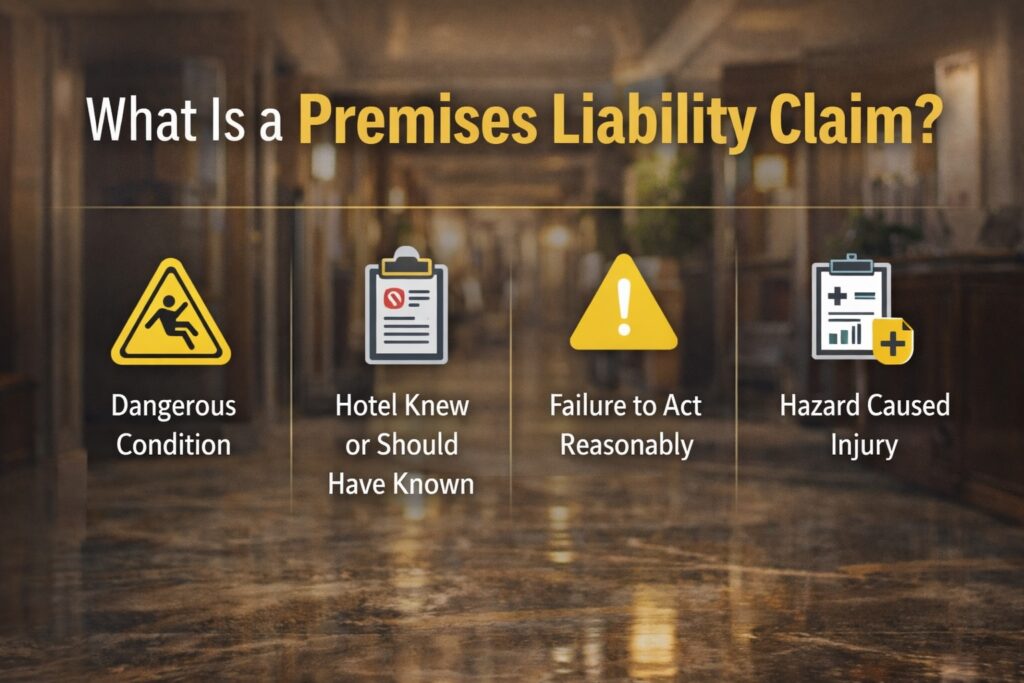
A valid premises liability claim generally requires proof of four key elements.
1. A Dangerous Condition Existed
A dangerous condition is any property defect or hazard that creates an unreasonable risk of harm. In hotel cases, this commonly includes wet floors, slippery pool decks, uneven walkways, loose tiles, torn carpet, broken steps, or poor lighting in stairwells and parking structures.
These are not “freak accidents.” They are conditions hotels are expected to prevent through routine maintenance and inspections.
2. The Hotel Knew or Should Have Known About the Hazard
This is known as notice, and it can be proven in two ways:
- Actual notice: Hotel staff knew about the hazard (for example, a reported spill or recurring leak).
- Constructive notice: The hazard existed long enough that the hotel should have discovered it through reasonable inspections.
California courts—including the California Supreme Court—have made clear that a hotel’s failure to conduct reasonable inspections or follow cleaning protocols can itself establish notice. Hotels cannot avoid responsibility simply by claiming no one reported the hazard.
3. The Hotel Failed to Act Reasonably
Once a hotel knows—or should know—about a dangerous condition, it must take reasonable steps to address it. That may include cleaning the hazard, repairing the defect, blocking off the area, or clearly warning guests.
Failing to place warning signs, delaying repairs, understaffing maintenance, or ignoring recurring issues can all constitute negligence under California premises liability law.
4. The Hazard Caused Your Injury
Finally, the unsafe condition must be a substantial factor in causing your fall and resulting injuries. Medical records, imaging, incident reports, and witness statements are often critical in proving this connection.
Hotels Are Not Insurers of Safety—But They Are Responsible for Preventable Harm
Hotels are not automatically liable every time someone falls. But they are legally responsible for injuries caused by preventable hazards, especially when those hazards were known, recurring, or discoverable through routine inspections.
At WIN Injury & Accident Trial Lawyers, we focus on uncovering what the hotel knew, what it failed to do, and how that failure led to your injuries—then we hold them accountable.

Common Injuries From Hotel Slip and Fall Accidents
Slip and fall injuries can be far more serious than they initially appear. We routinely see:
- Traumatic brain injuries (TBIs) and concussions
- Broken wrists, ankles, hips, and arms
- Back injuries and herniated discs
- Shoulder and knee ligament tears
- Soft-tissue injuries that become chronic
Many victims require surgery, physical therapy, or extended time off work—costs hotels and insurers often try to minimize or deny.
What to Do After a Slip and Fall at a Hotel
Your actions in the minutes and days after a hotel slip and fall can significantly impact whether your claim succeeds—or gets denied. Hotels and their insurers often begin building their defense immediately. Taking the right steps early helps preserve evidence and protect your rights.
- Report the incident to hotel management immediately
Ask that an incident report be created and request a copy or reference number. Reporting the fall establishes a documented timeline and prevents the hotel from later claiming the incident never occurred. - Photograph or video the hazard as soon as possible
Capture the dangerous condition from multiple angles before it is cleaned, repaired, or covered up. This includes wet floors, missing warning signs, poor lighting, uneven surfaces, or leaking equipment. If possible, photograph nearby areas to show the lack of warnings. - Identify and collect witness information
Get names and contact details for anyone who saw the fall or the hazardous condition, including other guests and hotel employees. Witness statements often become critical when hotels later dispute what happened. - Seek medical attention right away—even if injuries seem minor
Adrenaline can mask serious injuries such as concussions, spinal trauma, or internal injuries. Prompt medical care protects your health and creates a medical record linking the fall to your injuries. - Do not give a recorded statement to the hotel’s insurance company
Insurance adjusters are trained to ask leading questions designed to shift blame or minimize injuries. You are not required to provide a statement, and doing so can seriously harm your claim. - Contact an experienced premises liability attorney early
A lawyer can secure surveillance footage, maintenance logs, and cleaning records before they are lost or overwritten—and prevent costly mistakes in dealing with the hotel or insurer.
Hotels often act quickly to protect themselves. You should too.
Can a Hotel Claim the Accident Was “Your Fault”?
Yes—and they almost always try. Hotels and their insurance companies routinely attempt to shift blame to injured guests in order to reduce or deny claims. Common defenses include:
- “You weren’t paying attention”
Insurers argue distraction, phone use, or inattention—even when the hazard was hidden or unavoidable. - “The condition was open and obvious”
Hotels often claim the danger was visible, even when lighting was poor, the hazard blended into the surroundings, or guests were reasonably distracted. - “Your footwear caused the fall”
This argument is frequently used regardless of what the guest was wearing and is often unsupported by evidence. - “We didn’t have enough time to fix it”
Hotels may argue the hazard appeared moments before the fall, despite evidence of recurring problems or inadequate inspection practices.
California follows a comparative negligence system, which means you can still recover compensation even if you are found partially at fault. Any percentage of fault attributed to you simply reduces your recovery—it does not eliminate it. These defenses are common, predictable, and often beatable with the right evidence and legal strategy.
At WIN Injury & Accident Trial Lawyers, we know these tactics well—and we know how to counter them.
Common Insurance Tactics in Hotel Slip and Fall Cases
Hotels and resorts carry substantial liability insurance, and those insurers are highly experienced at minimizing or denying slip and fall claims. From the moment an incident is reported, the focus often shifts from guest safety to claim defense. Understanding these common tactics can help you avoid costly mistakes.
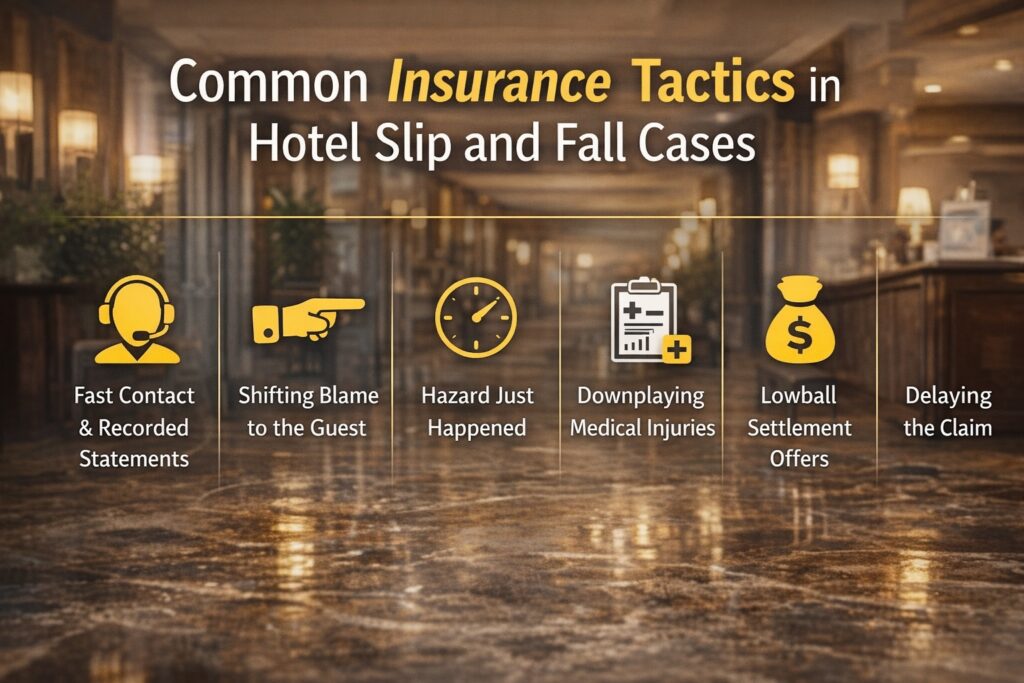
1. Fast Contact and “Friendly” Recorded Statements
One of the most common tactics is a quick call from the hotel’s insurance adjuster—often within days of the fall. The adjuster may sound helpful and sympathetic, but their goal is to lock you into a recorded statement that can later be used against you.
They may ask:
- What you were doing right before the fall
- Whether you saw the hazard beforehand
- What shoes you were wearing
- Whether you were distracted
Small, off-hand comments are often taken out of context to argue fault. You are not required to give a recorded statement, and doing so rarely helps your claim.
2. Shifting Blame to the Injured Guest
Insurers frequently argue that the accident was caused by the guest—not the hotel. Common blame-shifting arguments include:
- You “weren’t paying attention”
- You were walking too fast or distracted
- The hazard was “open and obvious”
- Your footwear caused the fall
These defenses are used even when the hotel clearly failed to clean, repair, or warn about a dangerous condition. In many cases, they are raised automatically—before the insurer has fully investigated the facts.
3. Claiming the Hazard Appeared “Moments Before” the Fall
Another standard defense is that the hotel didn’t have enough time to discover or fix the hazard. Insurers may claim:
- The spill just happened
- The floor was just mopped
- The leak was sudden and unexpected
In reality, surveillance footage, maintenance logs, and employee testimony often reveal that the condition existed far longer—or was a recurring issue the hotel already knew about.
4. Downplaying or Disputing Medical Injuries
Insurance companies frequently attempt to minimize the seriousness of slip and fall injuries by arguing:
- You were already injured before the fall
- Your symptoms are exaggerated
- You delayed treatment, so the injury “can’t be serious”
This is especially common with head injuries, back injuries, and soft-tissue damage that may not be immediately visible. Prompt medical care and proper documentation are critical to countering this tactic.
5. Pressuring You Into an Early, Low Settlement
Insurers may offer a quick settlement—sometimes before the full extent of your injuries is known. These offers are often framed as “fair” or “the best available,” but they typically fail to account for future medical care, ongoing pain, lost income, or long-term limitations.
Once a settlement is accepted, you generally cannot go back for more—even if your condition worsens.
6. Delaying the Claim to Gain Leverage
If early settlement pressure doesn’t work, insurers may switch strategies and slow the process down, hoping financial stress or frustration will push you to accept less than your case is worth. Delays can also result in lost evidence, including overwritten surveillance footage.
How WIN Injury & Accident Trial Lawyers Levels the Playing Field
At WIN Injury & Accident Trial Lawyers, we know these tactics—and we know how to stop them. We act quickly to preserve evidence, control communications with insurers, and build cases that are ready for trial if necessary.
Insurance companies negotiate differently when they know you’re prepared to take the case all the way.
What Compensation Can You Recover?
A successful hotel slip and fall claim may include compensation for:
- Medical bills (past and future)
- Lost wages and loss of earning capacity
- Pain and suffering
- Permanent disability or disfigurement
- Out-of-pocket expenses
Our goal is not quick settlements—it’s maximum recovery.
Why Choose WIN Injury & Accident Trial Lawyers?
Hotels and resorts have powerful insurance carriers and legal teams. You need a firm that knows how to fight back.
At WIN Injury & Accident Trial Lawyers, we are known for:
- Aggressive investigation and evidence preservation
- Experience against major hotel chains and insurers
- Trial-ready preparation—not lowball settlements
- No fees unless we win
We handle slip and fall cases throughout California and take pride in standing up for injured guests.
Get Help From WIN Injury & Accident Trial Lawyers
Why Legal Representation Matters
Insurance companies often undervalue pain and suffering—offering minimal settlements that ignore your daily struggles. A skilled attorney can:
- Present powerful evidence of your emotional and physical suffering
- Retain expert witnesses to quantify your losses
- Use verdict data to justify higher multipliers or per diem rates
- Argue your case persuasively before a jury
At WIN Trial Lawyers, our team fights to ensure that your recovery reflects the full extent of your suffering—not just your bills.

At WIN Trial Lawyers, we know how personal injury claims can be can be. Victims often face mounting medical bills, lost wages, and emotional trauma. Our team has successfully taken on insurance companies and third parties, recovering millions for injured clients.
If you or a loved one has been injured in an accident, don’t leave your future in the hands of the insurance company. You need experienced trial lawyers who know how to prove liability and fight for maximum compensation.
If you or a loved one has been injured, don’t face this alone. The sooner you act, the stronger your case will be.
🔗 Related Posts:
Frequently Asked Questions About Hotel Slip and Fall Accidents
What should I do immediately after slipping and falling at a hotel?
Report the incident to hotel management right away and ask that an incident report be created. Take photos or video of the hazardous condition, collect witness names and contact information, and seek medical care as soon as possible. Avoid giving a recorded statement to the hotel’s insurance company before speaking with a lawyer.
Can I sue a hotel if I slipped on a wet floor?
Yes—if the hotel knew or should have known about the wet floor and failed to clean it up or warn guests. Wet lobby floors, recently mopped areas without warning signs, and tracked-in water are common causes of valid premises liability claims.
What if there was no “wet floor” sign?
The absence of a warning sign can be strong evidence of negligence. Hotels are expected to warn guests of known hazards. Failing to place warning signage—especially in high-traffic areas—often supports liability.
What if the hotel says they didn’t know about the hazard?
Hotels can still be liable if the dangerous condition existed long enough that they should have discovered it through reasonable inspections or maintenance. Surveillance footage, cleaning logs, and employee testimony often reveal whether the hotel failed to follow proper safety procedures.
Can I still recover compensation if I was partially at fault?
Yes. California follows comparative negligence, meaning your compensation may be reduced by your percentage of fault—but you are not barred from recovery. Insurance companies often exaggerate guest fault to reduce payouts.
What injuries qualify for a hotel slip and fall claim?
Both severe and “invisible” injuries may qualify, including:
- Concussions and traumatic brain injuries
- Broken hips, ankles, wrists, or arms
- Herniated discs and spinal injuries
- Knee, shoulder, or ligament tears
- Chronic pain and soft-tissue injuries
If the fall required medical treatment, it’s worth having your case evaluated.
Do hotel slip and fall cases usually settle?
Many cases settle—but only after thorough investigation and pressure. Hotels and insurers often deny responsibility initially. Strong evidence and trial-ready preparation significantly increase settlement value.
How long do I have to file a hotel slip and fall lawsuit in California?
Generally, you have two years from the date of the injury to file a personal injury lawsuit. However, evidence preservation and witness availability are time-sensitive, so acting quickly is critical.
What if the slip and fall happened at a resort, casino, or luxury hotel?
The same premises liability rules apply. In fact, large resorts often have more extensive surveillance, maintenance records, and staffing, which can strengthen a claim when properly investigated.
What if I was visiting from out of state?
You can still bring a claim in California if the injury occurred here. Out-of-state guests are frequently targeted by insurers hoping they’ll return home and abandon the claim—don’t let that happen.
Should I talk to the hotel’s insurance company?
No—not without legal counsel. Insurance adjusters are trained to obtain statements that reduce or deny claims. Politely decline and direct them to your attorney.
How much is a hotel slip and fall case worth?
Every case is different. Value depends on factors like:
- Severity of injury
- Medical costs and future care
- Time missed from work
- Long-term limitations or disability
- Strength of liability evidence
Early low offers rarely reflect the true value of a case.
How much does it cost to hire a slip and fall lawyer?
Nothing upfront. Premises liability cases are typically handled on a contingency fee basis, meaning you pay nothing unless your lawyer recovers compensation for you.
Is a slip and fall really worth pursuing legally?
Yes—especially when injuries disrupt your health, work, or daily life. Hotels carry substantial insurance for these exact situations, and pursuing a claim can help prevent future injuries to other guests.