
Many people assume that if an injury happens on public property—such as a sidewalk, park, school, or government building—no one can be held responsible. That assumption is wrong.
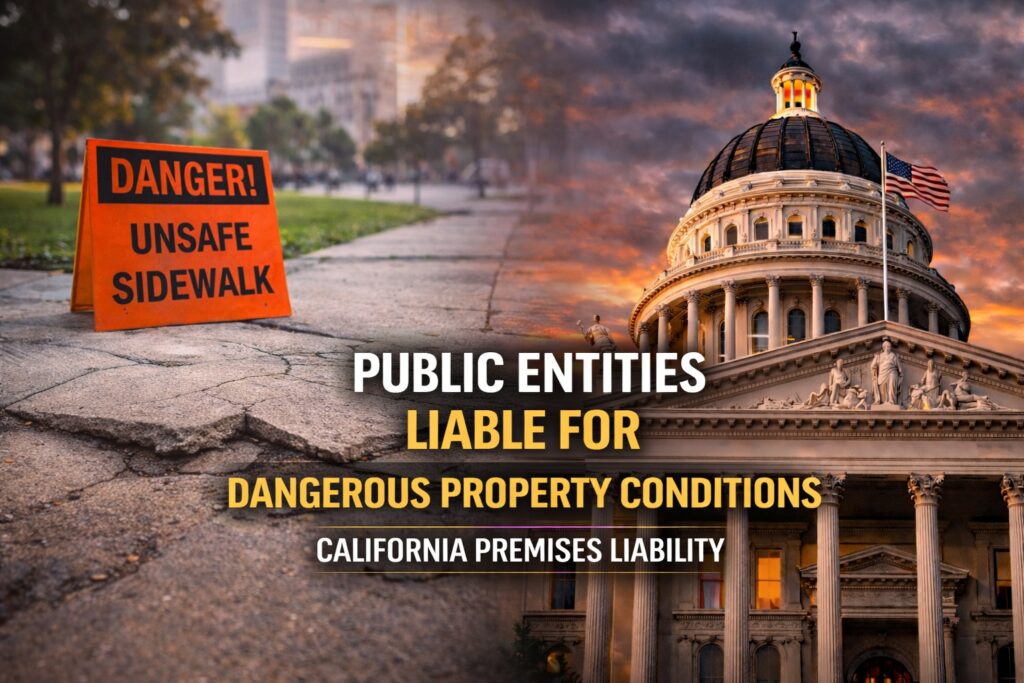
Under California law, public entities can be held liable for injuries caused by dangerous conditions on public property. While these cases involve special rules and strict deadlines, injured victims still have powerful legal rights.
At WIN Injury & Accident Trial Lawyers, we represent individuals injured by unsafe conditions on public property and hold cities, counties, and state agencies accountable when they fail to protect the public.
What Is a “Public Entity” Under California Law?
A public entity includes:
- Cities and counties
- State agencies and departments
- Public school districts and universities
- Transportation authorities
- Public utilities and special districts
If the property is owned or controlled by a government body, special premises liability rules apply—but liability is still possible.
The Legal Standard: Dangerous Condition of Public Property
Unlike private premises cases, public-entity liability is governed by a specific legal framework. A public entity may be held liable when:
- The property was in a dangerous condition
- The condition created a reasonably foreseeable risk of injury
- The public entity knew or should have known about the condition
- The entity failed to take reasonable corrective action
- The dangerous condition caused the injury
This standard applies to sidewalks, roads, public buildings, parks, and other government-controlled property.
Common Dangerous Conditions on Public Property
Public entity premises liability claims often arise from:
- Broken, uneven, or uplifted sidewalks
- Dangerous road or crosswalk conditions
- Poor lighting in public areas
- Unsafe stairways or ramps
- Defective handrails or guardrails
- Hazardous conditions in public parks or recreational facilities
- Unsafe conditions in government buildings
Public entities have a duty to maintain property that the public is expected to use.
The Core Question in Public Entity Premises Liability Cases
Every case turns on this question:
Did the public entity create, control, or allow a dangerous condition to exist—and fail to act reasonably after notice?
If the condition was foreseeable and preventable, liability may attach.
Notice: A Critical Issue in Public Entity Cases
To hold a public entity liable, it must be shown that the entity had:
- Actual notice (complaints, reports, prior incidents), or
- Constructive notice (the condition existed long enough that reasonable inspections would have discovered it)
Maintenance logs, work orders, inspection records, and prior claims are often key evidence.
Special Deadlines: Government Claims Act Requirements
One of the biggest traps in public-entity cases is timing.
Before filing a lawsuit, an injured person must typically:
- File a government claim within a short deadline
- Wait for the entity’s response or rejection
- Then file suit within the statutory time limits
Missing these deadlines can permanently bar the claim—even if liability is clear. Early legal action is critical.
Common Defenses Public Entities Raise
Public entities frequently argue:
- The condition was not “dangerous”
- The risk was trivial or minor
- They had no notice of the condition
- The injury was caused by the claimant’s own conduct
- Design immunity applies
These defenses are fact-intensive and often overcome with proper investigation and expert analysis.
Shared Liability With Contractors or Other Entities
Public entities often hire:
- Maintenance contractors
- Construction companies
- Private vendors
Delegating work does not automatically eliminate public-entity liability. In many cases, multiple parties may share responsibility.
Who Is Protected by Public Property Premises Liability Laws?
Public entities owe duties to:
- Pedestrians and cyclists
- Motorists
- Park and recreation users
- Students and parents
- Visitors to government buildings
If public use is foreseeable, safety obligations follow.
Why Holding Public Entities Accountable Matters
Public-entity accountability:
- Improves public safety
- Forces proper maintenance of infrastructure
- Prevents repeat injuries
- Ensures injured people are not left without recourse
Government ownership does not excuse dangerous conditions.
How WIN Handles Public Entity Premises Liability Cases
At WIN Injury & Accident Trial Lawyers, we:
- Identify the responsible public entity
- Preserve evidence immediately
- Obtain maintenance and inspection records
- Analyze notice and foreseeability
- Comply with all Government Claims Act requirements
- Retain civil engineering and safety experts
Public-entity cases are technical—and we handle them aggressively.
Frequently Asked Questions
Can I sue a city or county for a sidewalk injury?
Yes, if the sidewalk was in a dangerous condition and the entity had notice.
Are deadlines shorter for public-entity claims?
Yes. Government claims must be filed quickly.
What if the city says the defect was “minor”?
“Trivial defect” defenses are common—but often defeated with evidence.
Can multiple parties be liable?
Yes. Public entities and contractors may share responsibility.
Injured on Public Property? WIN Can Help.
If you were injured due to unsafe conditions on public property, you may still have a valid claim—but time is critical.
WIN Injury & Accident Trial Lawyers represents injured people statewide in complex public-entity premises liability cases.
📞 Contact us today for a confidential consultation.
Get Help From WIN Injury & Accident Trial Lawyers
Why Legal Representation Matters
Insurance companies often undervalue pain and suffering—offering minimal settlements that ignore your daily struggles. A skilled attorney can:
- Present powerful evidence of your emotional and physical suffering
- Retain expert witnesses to quantify your losses
- Use verdict data to justify higher multipliers or per diem rates
- Argue your case persuasively before a jury
At WIN Trial Lawyers, our team fights to ensure that your recovery reflects the full extent of your suffering—not just your bills.

At WIN Trial Lawyers, we know how personal injury claims can be can be. Victims often face mounting medical bills, lost wages, and emotional trauma. Our team has successfully taken on insurance companies and third parties, recovering millions for injured clients.
If you or a loved one has been injured in an accident, don’t leave your future in the hands of the insurance company. You need experienced trial lawyers who know how to prove liability and fight for maximum compensation.
If you or a loved one has been injured, don’t face this alone. The sooner you act, the stronger your case will be.