

Many people assume that when a defective product causes injury, only the manufacturer can be held responsible. In reality, that is not how product liability law works—especially in California. The law recognizes that dangerous products reach consumers through a network of companies, not just a single factory.
Distributors and suppliers can be just as legally responsible as manufacturers when a defective product causes harm. These companies play a direct role in placing products into the marketplace and profiting from their sale. As a result, they share responsibility for the safety of those products.
At WIN Injury & Accident Trial Lawyers, we routinely pursue claims not only against manufacturers, but also against distributors, wholesalers, and suppliers that helped put a dangerous product into circulation. In many cases, distributor liability is the difference between a limited recovery and full financial compensation—particularly when manufacturers deny responsibility or are located overseas.
This guide explains when distributors and suppliers can be held liable, why the law allows it, and how these cases are proven.
Why Distributors and Suppliers Can Be Liable
Product liability law is designed first and foremost to protect consumers—not corporations. To accomplish that goal, the law places responsibility on every entity in the chain of distribution that profits from selling a product, not just the company that physically manufactured it.
That means liability may extend to:
- Manufacturers
- Component part makers
- Distributors and suppliers
- Wholesalers
- Retailers
The reasoning is straightforward: companies that profit from selling products are in a far better position than consumers to evaluate safety, demand safer designs, carry insurance, and absorb the cost of injuries when something goes wrong.
A distributor does not escape liability simply because it did not design or manufacture the product. Under strict product liability principles, participation in the chain of distribution is enough. This prevents companies from avoiding responsibility by pointing fingers at each other and ensures that injured victims are not left without recourse.
By spreading responsibility across the entire distribution chain, product liability law creates powerful incentives for safer products, better oversight, and faster removal of dangerous items from the market.
What Is a Distributor or Supplier?
In product liability cases, distributors and suppliers are any entities that play a role in moving a product from the manufacturer to the end user. Their involvement may be direct or indirect, but if they helped place the product into the marketplace, they can be held legally responsible when that product causes injury.
Distributors and suppliers commonly include companies that:
- Import products into the United States, particularly when the manufacturer is overseas
- Store or warehouse products, even temporarily, before resale or shipment
- Sell products to retailers, contractors, employers, or end users
- Repackage, relabel, or rebrand products, including private-label sellers
- Act as intermediaries between manufacturers and consumers, facilitating sales and distribution
The key question is not whether the company built the product, but whether it participated in placing the product into the stream of commerce. If it did, the law may treat that company as a responsible party.
This broad definition prevents companies from escaping accountability by adopting different business labels or outsourcing parts of the supply chain.
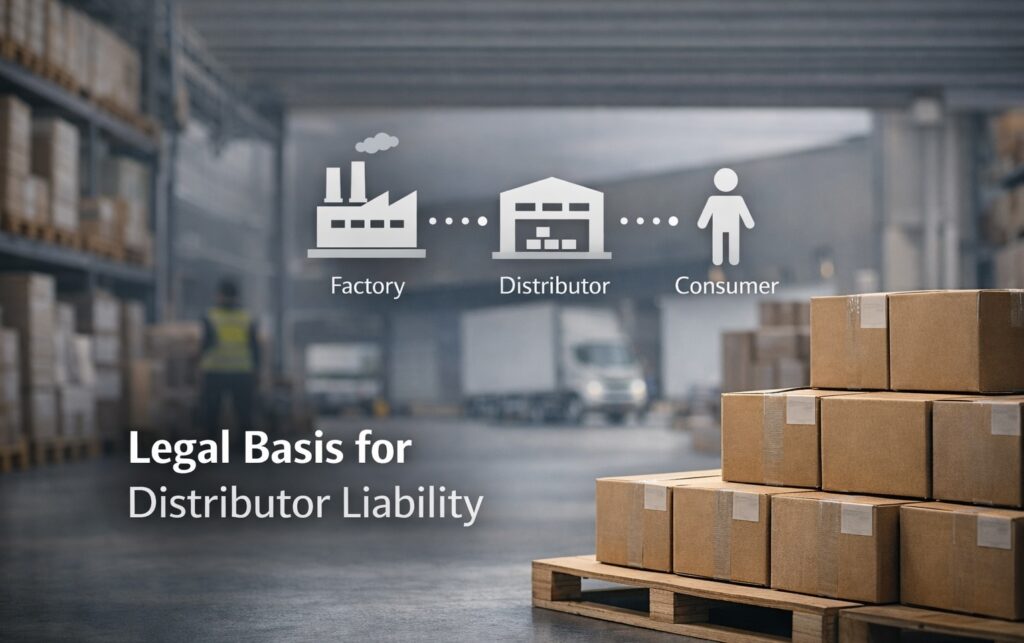
Legal Basis for Distributor Liability
Under strict product liability law, an injured person generally does not need to prove that a distributor acted negligently, carelessly, or intentionally. The focus is on the condition of the product, not the conduct of the distributor.
To establish distributor liability, the injured party must typically show:
- The product was defective (by design, manufacture, or failure to warn)
- The defect existed when the product left the distributor’s control
- The defect was a substantial factor in causing the injury
This legal framework exists because distributors are in a far better position than consumers to:
- Evaluate product safety before placing products into the market
- Pressure manufacturers to correct defects or improve warnings
- Spread the cost of injuries through insurance, rather than forcing injured individuals to bear the loss
- Remove dangerous products from circulation once hazards are discovered
By holding distributors accountable alongside manufacturers, the law ensures that injured consumers are not left without a remedy—and that every company profiting from a product shares responsibility for its safety.
Common Situations Where Distributors Are Liable
Distributors and suppliers are frequently held liable when their role in the supply chain contributes to a defective or dangerous product reaching the end user. Below are some of the most common scenarios in which distributor liability arises in product liability cases.
🔹 Defective Products Passed Through the Supply Chain
If a distributor sells or supplies a defective product—whether the defect involves unsafe design, manufacturing errors, or inadequate warnings—it may be held strictly liable for injuries that result. The distributor does not need to have caused the defect or even known about it. Liability attaches because the distributor participated in placing the defective product into the marketplace and profited from its sale.
This principle ensures that injured consumers are not forced to chase only the manufacturer, particularly when multiple entities were involved in getting the product to market.
🔹 Imported or Foreign-Manufactured Products
Distributor liability is especially important in cases involving imported or foreign-manufactured products. Distributors that bring products into the United States are often held liable when:
- The manufacturer is located overseas and outside U.S. jurisdiction
- The distributor acted as the U.S. seller, importer, or marketer
- The distributor controlled labeling, warnings, or regulatory compliance
In these cases, courts often treat the distributor as the primary defendant, recognizing that it is the most accessible and responsible party within the U.S. legal system.
🔹 Rebranding or Private Labeling
Distributors that sell products under their own name, logo, or private label may be treated as manufacturers under the law, even if they did not physically build the product. By presenting the product as their own, these companies assume responsibility for its safety.
Private-label and rebranded products frequently arise in cases involving tools, equipment, consumer goods, and imported products, where branding choices blur the lines between distributor and manufacturer.
🔹 Failure to Pass Along Warnings or Recalls
Distributors may also be liable when they fail to act after learning about safety risks. This includes situations where they:
- Failed to pass along updated safety warnings to retailers or end users
- Ignored or concealed recall notices
- Continued selling products despite knowledge of serious hazards
Once a distributor becomes aware of a dangerous defect, it may have a duty to warn or stop distribution. Failing to do so can significantly increase liability exposure.
🔹 Improper Storage or Handling
Some defects do not originate at the factory, but arise after manufacture due to distributor conduct. Liability may apply when products are rendered unsafe because of:
- Exposure to heat, moisture, or corrosive chemicals
- Improper storage of electrical or mechanical components
- Physical damage during shipping, loading, or warehousing
If a distributor’s storage or handling practices compromise product safety, the distributor may be held responsible for resulting injuries—even if the product left the manufacturer in a safe condition.
Distributor Liability in Workplace Injury Cases
Many product liability cases arise in workplace settings, particularly those involving:
- Industrial machinery
- Tools and heavy equipment
- Electrical components and control systems
- Safety devices and protective equipment
When a worker is injured by defective equipment on the job, liability does not end with workers’ compensation. If the injury was caused by a defective product, the distributor that supplied the equipment to the employer may be held legally responsible—even though the worker never personally purchased or selected the product.
This is a critical point. Product liability law focuses on who placed the product into the stream of commerce, not who signed the purchase order. If a distributor supplied dangerous machinery or equipment that injured a worker, that distributor can be a proper defendant in a third-party product liability claim.
This overlap is especially important in cases involving workers’ compensation. While workers’ comp typically covers medical care and partial wage replacement, it does not compensate for pain and suffering, disfigurement, or full future earnings losses. A third-party distributor claim can dramatically increase total recovery by allowing the injured worker to pursue these additional damages—often turning a limited workers’ comp case into a substantially higher-value claim.
Why Distributors Are Often Critical Defendants
In many product liability cases, distributors are not just additional defendants—they are essential to achieving full financial recovery.
Distributors often:
- Have U.S.-based assets and insurance, making recovery more realistic
- Are easier to identify, serve, and litigate against than foreign or dissolved manufacturers
- Carry commercial general liability or product liability insurance specifically designed to cover these claims
- Play a key role when manufacturers deny responsibility, blame misuse, or shift fault
In some cases, the manufacturer may be overseas, bankrupt, or otherwise difficult to pursue. In others, the manufacturer may argue that the product was altered or misused after sale. When that happens, distributor liability can be the difference between a viable case and no recovery at all.
For injured workers and consumers, pursuing distributor liability ensures that every responsible party is held accountable—and that financial responsibility does not fall unfairly on the injured person.
Manufacturer vs. Distributor vs. Retailer Liability in Product Liability Cases
| Entity | Role in Product Chain | Can Be Held Liable? | Common Grounds for Liability | Key Legal Notes |
|---|---|---|---|---|
| Manufacturer | Designs and/or builds the product | ✅ Yes | • Design defects • Manufacturing defects • Failure to warn • Unsafe materials or engineering | Often the primary defendant; liability exists even without negligence under strict liability |
| Distributor / Supplier | Imports, warehouses, supplies, or resells products | ✅ Yes | • Passing along defective products • Failure to relay warnings or recalls • Improper storage or handling • Private labeling or rebranding | Part of the “chain of distribution”; knowledge of defect not required |
| Retailer | Sells product directly to consumers or end users | ✅ Yes | • Selling defective products • Failure to warn at point of sale • Continuing sales after recall • Acting as seller of record (including online) | Liability applies even if retailer did not modify product |
Why This Comparison Matters
Product liability law focuses on consumer protection, not finger-pointing between companies. Injured victims are allowed to pursue all responsible parties in the distribution chain, letting courts decide how liability is ultimately allocated.
This means:
- You do not have to identify the “most at-fault” party to bring a claim
- Multiple defendants can be named in the same lawsuit
- Distributors and retailers cannot escape liability by blaming manufacturers
In many cases, distributors and retailers are critical defendants because they:
- Are easier to locate and serve
- Carry U.S.-based insurance
- Played a direct role in putting the product into circulation
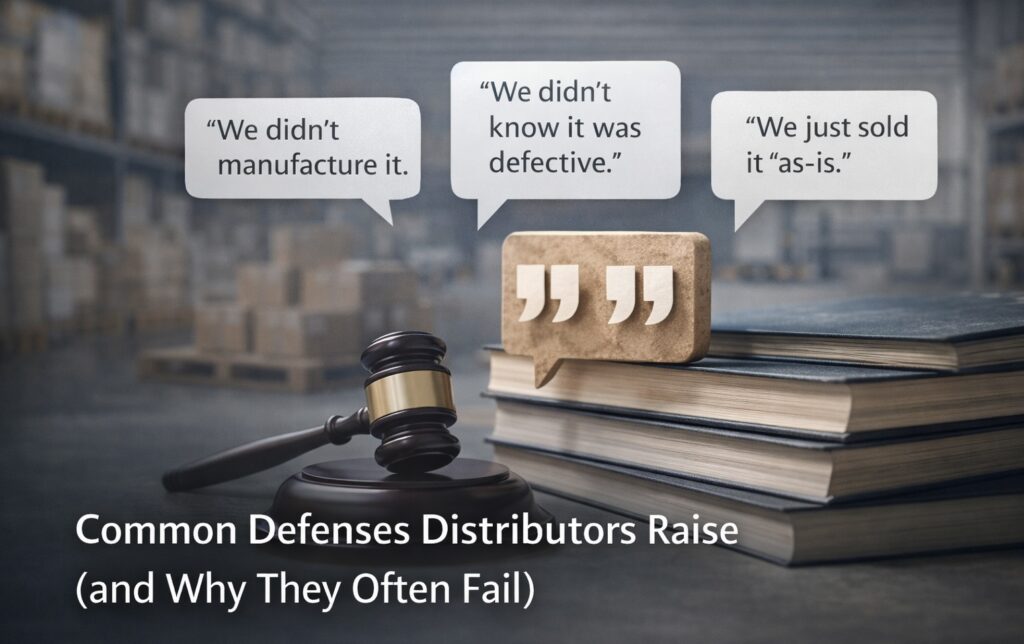
Common Defenses Distributors Raise (And Why They Often Fail)
In product liability cases, distributors frequently attempt to avoid responsibility by arguing that they were merely “middlemen” with no control over how the product was designed or built. While these arguments may sound persuasive, they often fail under strict product liability law.
Distributors commonly argue:
- “We didn’t manufacture it.”
While true in many cases, this defense misses the point. Product liability law does not limit responsibility to manufacturers alone. Any company that participated in placing the product into the stream of commerce can be held liable when the product is defective and causes injury. - “We didn’t know it was defective.”
Knowledge is generally irrelevant under strict liability. A distributor does not need to know a product is dangerous to be held responsible. The law focuses on protecting injured consumers, not on whether a distributor was aware of the defect. - “We just sold it ‘as-is.’”
“As-is” disclaimers may affect contractual warranties, but they do not shield distributors from liability for personal injuries caused by defective products. Courts routinely reject this defense in injury cases.
Under strict liability principles, knowledge, intent, and fault are not required. The injured party must only show that:
- The product was defective
- The defect existed when it left the distributor’s control
- The defect caused the injury
These defenses often fail because allowing them would undermine the purpose of product liability law—to ensure that the cost of injuries is borne by those who profit from selling products, rather than by the injured consumer.
By holding distributors accountable despite these defenses, courts encourage safer products, better oversight, and faster removal of dangerous items from the marketplace.
How WIN Proves Distributor and Supplier Liability
Product liability cases against distributors and suppliers require a methodical, evidence-driven approach. These companies often attempt to position themselves as passive middlemen, but the facts frequently tell a very different story.
At WIN Injury & Accident Trial Lawyers, we build distributor and supplier cases from the ground up. Our process includes:
- Tracing the entire chain of distribution, from manufacturer to importer, warehouse, wholesaler, retailer, and end user
- Identifying every entity involved in selling, supplying, rebranding, or handling the product, ensuring no responsible party is overlooked
- Analyzing storage, handling, labeling, and warning failures, including whether the product was damaged, mislabeled, or stripped of safety information while in the distributor’s control
- Using qualified experts—such as engineers, safety professionals, and logistics specialists—to show how the defect existed at the time of distribution or was introduced through improper handling
- Pursuing all available insurance coverage, including commercial general liability, product liability, and excess policies
This comprehensive approach prevents blame-shifting and ensures that distributors cannot hide behind manufacturers or other downstream sellers. By proving exactly where the product went wrong—and who had control at that point, we make sure accountability follows the product through the supply chain.
Injured by a Defective Product? Don’t Overlook Distributors.
If you were injured by a defective product, focusing only on the manufacturer can leave both money and accountability on the table. Distributors and suppliers often play a central role in putting dangerous products into circulation—and, in some cases, in keeping them there even after risks become known.
In many cases, distributors are responsible for:
- Making products available to employers, retailers, and consumers
- Ignoring or failing to pass along safety warnings or recalls
- Continuing sales despite known risks or prior incidents
When these failures contribute to injury, distributors can be just as legally responsible as manufacturers—and sometimes more practical to pursue due to U.S.-based operations, accessible insurance coverage, and clearer jurisdictional reach.
Why Experience With Distributors and Suppliers Matters
At WIN Injury & Accident Trial Lawyers, distributor and supplier liability is not an afterthought—it is a core focus of our product liability practice.
Our founder’s professional background in manufacturing and industrial operations gives our team a practical, insider-level understanding of how products move from design, to production, to distribution, and ultimately into real-world use. That experience allows us to:
- Identify where defects are introduced or ignored in the supply chain
- Understand distribution pressures, cost-cutting decisions, and warning failures
- Pinpoint which entities had control—and when
This perspective has led to real results. In prior product liability matters, we have:
- Resolved claims against suppliers and authorized distributors for $1,000,000, while
- Continuing the case separately against the manufacturer, ensuring no responsible party escaped accountability
That kind of outcome is only possible when the distribution chain is fully investigated and strategically litigated.
Accountability Protects More Than One Victim
Holding distributors and suppliers accountable does more than increase the potential for full financial recovery. It also:
- Forces unsafe products out of the marketplace
- Compels distributors to take warnings and recalls seriously
- Prevents the same defective product from injuring others
When dangerous products remain in circulation, it is rarely an accident—it is often the result of systemic failures across the supply chain. Our job is to expose those failures and hold every responsible party accountable.
How WIN Trial Lawyers Can Help
Insurance companies often downplay head injuries, especially when symptoms aren’t immediately visible. At WIN Trial Lawyers, we know how to fight back. Our attorneys work with top medical experts to prove the full extent of your injury and demand the compensation you deserve.
We’ve helped countless accident victims recover substantial settlements for concussion and brain injury claims — and we’ll do the same for you.
If you’ve suffered a concussion after a car accident, don’t wait to get help.
Contact WIN Trial Lawyers today for a free consultation.

At WIN Trial Lawyers, we know how devastating distracted driving accidents can be. Victims often face mounting medical bills, lost wages, and emotional trauma. Our team has successfully taken on insurance companies and distracted drivers, recovering millions for injured clients.
If you or a loved one has been injured in a speeding-related car accident, don’t leave your future in the hands of the insurance company. You need experienced trial lawyers who know how to prove liability and fight for maximum compensation.
If you or a loved one has been injured in a distracted driving accident, don’t face this alone. The sooner you act, the stronger your case will be.
🔗 Related Posts:
Frequently Asked Questions: Distributor & Supplier Liability in Product Liability Cases
Can a distributor be sued for a defective product?
Yes. Under product liability law, distributors and suppliers can be held strictly liable for defective products they place into the stream of commerce—even if they did not design or manufacture the product.
What is strict liability for distributors and suppliers?
Strict liability means an injured person generally does not need to prove the distributor was careless or negligent. Instead, the injured party must show:
- The product was defective
- The defect existed when it left the distributor’s control
- The defect caused the injury
Knowledge of the defect is not required.
Are distributors liable if the manufacturer is overseas?
Yes. In fact, distributor liability is especially important when the manufacturer is foreign or outside U.S. jurisdiction. Distributors that import or sell overseas products are often treated as the primary defendants in U.S. product liability lawsuits.
What if the distributor only sold the product “as-is”?
“As-is” sales do not protect distributors from strict product liability claims involving personal injury. Warranty disclaimers may affect contract claims, but they generally do not bar injury claims based on defective products.
Can a supplier be liable if it only provided one component?
Yes. Component part suppliers can be held liable if:
- The component itself was defective, or
- The supplier knew or should have known how the component would be used and failed to warn of dangers
Are distributors responsible for product warnings and recalls?
Distributors may be liable if they:
- Failed to pass along safety warnings
- Ignored or concealed recall notices
- Continued selling products after learning of known hazards
Once a distributor becomes aware of a serious safety risk, it may have a duty to act.
What if the defect occurred during storage or shipping?
If a product became unsafe due to improper storage, handling, or transportation—such as exposure to moisture, heat, or physical damage—the distributor or supplier responsible for that handling may be liable.
Can distributors be liable in workplace injury cases?
Yes. Distributors that supplied machinery, tools, or equipment to an employer can be held liable when defective products injure workers—even though the worker did not personally purchase the product.
These claims often exist in addition to workers’ compensation.
Why are distributors often key defendants in product liability cases?
Distributors often:
- Have U.S.-based insurance and assets
- Are easier to identify and serve legally
- Played a direct role in selling or supplying the product
- Provide an additional source of recovery
In many cases, distributor liability is critical to full compensation.
Do distributors ever avoid liability by blaming the manufacturer?
Distributors frequently attempt to shift blame—but under strict liability law, being “just the middleman” is not a defense. Courts routinely hold distributors accountable alongside manufacturers.
Can a distributor be liable even if it never touched the product?
Yes. Physical handling is not required for liability. If a distributor participated in selling, importing, or placing the product into the stream of commerce, it can still be held strictly liable for defects that caused injury.
What if the distributor didn’t know the product was defective?
Knowledge is not required under strict product liability. A distributor can be held liable even if it had no idea the product was dangerous. The focus is on consumer protection, not the distributor’s intent or awareness.
Are wholesalers and bulk suppliers treated the same as retailers?
Generally, yes. Wholesalers, bulk suppliers, and intermediaries are all considered part of the chain of distribution and may be held liable if they helped move a defective product to market.
Can a distributor be liable for failing to inspect the product?
In many cases, yes. While distributors are not expected to dismantle products, they may still be liable if:
- Defects were obvious or visible
- The product was damaged during storage or shipping
- Industry standards required inspection before resale
Does distributor liability apply to online sellers or platforms?
It can. Online sellers, marketplaces, and fulfillment entities may be treated as distributors if they:
- Control product listings or labeling
- Store and ship products
- Act as the seller of record
Courts increasingly scrutinize online distribution roles in product liability cases.
What if the distributor followed all manufacturer instructions?
Following manufacturer instructions does not automatically shield a distributor from liability. If the product was defective or unreasonably dangerous, distributors can still be held accountable regardless of compliance.
Can multiple distributors be sued in the same case?
Yes. Product liability cases often involve multiple distributors or suppliers, especially when products pass through several hands before reaching the injured person. All may be named defendants.
Are distributors liable for failure-to-warn claims?
Yes. Distributors may be liable if they:
- Failed to pass along warnings or safety updates
- Continued selling products despite known risks
- Did not update labeling or instructions when required
Once a distributor learns of a hazard, inaction can create liability.
Can a distributor be held liable years after selling a product?
Possibly. Liability depends on statutes of limitation and when the injury occurred—not simply when the product was sold. Latent defects may surface long after distribution.
Why do manufacturers often blame distributors (and vice versa)?
Manufacturers and distributors frequently attempt to shift responsibility to each other. Product liability law allows injured victims to pursue all responsible parties, letting courts allocate fault later.
Why is identifying every distributor important in a product liability case?
Because:
- It increases available insurance coverage
- It prevents blame-shifting from defeating the claim
- It ensures full financial accountability
How does WIN Injury & Accident Trial Lawyers handle distributor liability cases?
We investigate the entire chain of distribution, identify every responsible party, analyze storage and warning failures, and pursue all available insurance coverage to maximize recovery for injured clients.
📞 Contact WIN Injury & Accident Trial Lawyers for a free consultation.
We don’t stop at the manufacturer—we follow the product all the way down the supply chain.