
(Duty, Breach, Causation, and Damages)
Negligence remains a core cause of action in California products-liability cases, even when strict liability also applies.
While strict liability focuses on the product itself, a negligence claim examines the conduct of the manufacturer or seller—how decisions were made, what safety steps were taken (or ignored), and whether reasonable care was exercised in designing, manufacturing, testing, and warning about the product.
In many product-injury cases, negligence provides critical context for corporate decision-making and expands the scope of recoverable damages.
What Is Negligence in a Products Liability Case?
Negligence is based on a failure to use reasonable care under the circumstances.
In the product-liability context, negligence may arise when a company:
- Designs a product without adequate safety features
- Fails to test a product before releasing it
- Uses substandard materials or manufacturing processes
- Ignores known safety risks or prior incidents
- Fails to warn consumers of foreseeable dangers
Unlike strict liability, negligence requires proof that the defendant’s conduct fell below the standard of care expected of a reasonably careful manufacturer or seller.
The Four Elements of Negligence
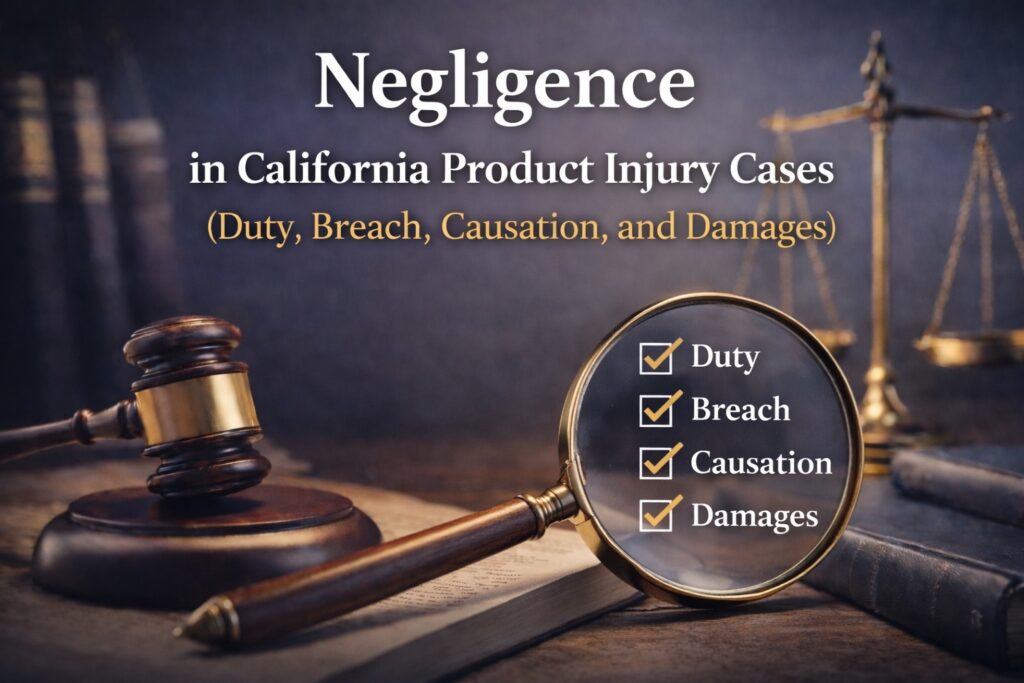
To prevail on a negligence claim in a California products-liability case, the plaintiff must prove four elements:
1. Duty of Care
Manufacturers, distributors, and sellers owe a duty to:
- Design reasonably safe products
- Manufacture products free from dangerous defects
- Conduct adequate testing and quality control
- Provide appropriate warnings and instructions
This duty extends not only to purchasers, but to any foreseeable user of the product.
2. Breach of Duty
A breach occurs when a defendant fails to meet the standard of reasonable care.
Common breaches in product cases include:
- Cutting corners to reduce production costs
- Failing to correct known defects
- Ignoring safety testing or consumer complaints
- Continuing to sell a product despite known risks
- Failing to update warnings as new dangers become known
Evidence of breach often comes from internal documents, safety reports, emails, and expert testimony.
3. Causation
The plaintiff must show that the breach of duty was a substantial factor in causing the injury.
This requires proof that:
- The injury would not have occurred without the defendant’s conduct, and
- The harm was a foreseeable result of that conduct
In product cases, causation is often established through engineering analysis, medical evidence, and accident reconstruction.
4. Damages
The plaintiff must have suffered legally compensable harm, such as:
- Physical injury
- Medical expenses
- Lost wages or loss of earning capacity
- Pain and suffering
Without damages, there is no negligence claim—even if the product was dangerous.
How Negligence Differs From Strict Liability
Negligence and strict liability often overlap, but they are not the same.
- Strict liability focuses on whether the product was defective
- Negligence focuses on how and why the defect occurred
Negligence claims are especially important when evidence shows:
- Knowledge of a defect before sale
- Deliberate cost-cutting decisions
- Failure to recall or redesign a dangerous product
- Ongoing misconduct after injuries occurred
These facts may also support claims for punitive damages.
Why Negligence Matters in Products Liability Cases
Negligence claims help expose corporate behavior that puts profit over safety.
They allow injured consumers to show not only that a product was dangerous, but that the danger was avoidable had reasonable care been exercised.
In many cases, negligence evidence becomes the foundation for broader liability theories and enhanced damages.
How Negligence Fits Into California Products Liability Law
Negligence is frequently pleaded alongside:
- Strict liability
- Failure-to-warn claims
- Breach of warranty
- Fraud or concealment
Together, these causes of action form the backbone of a comprehensive California products-liability case.
For a broader overview of how negligence fits into product-injury law, see our Products Liability Master Guide.
Get Help From WIN Injury & Accident Trial Lawyers
Why Legal Representation Matters
Insurance companies often undervalue pain and suffering—offering minimal settlements that ignore your daily struggles. A skilled attorney can:
- Present powerful evidence of your emotional and physical suffering
- Retain expert witnesses to quantify your losses
- Use verdict data to justify higher multipliers or per diem rates
- Argue your case persuasively before a jury
At WIN Trial Lawyers, our team fights to ensure that your recovery reflects the full extent of your suffering—not just your bills.

At WIN Trial Lawyers, we know how personal injury claims can be can be. Victims often face mounting medical bills, lost wages, and emotional trauma. Our team has successfully taken on insurance companies and third parties, recovering millions for injured clients.
If you or a loved one has been injured in an accident, don’t leave your future in the hands of the insurance company. You need experienced trial lawyers who know how to prove liability and fight for maximum compensation.
If you or a loved one has been injured, don’t face this alone. The sooner you act, the stronger your case will be.