

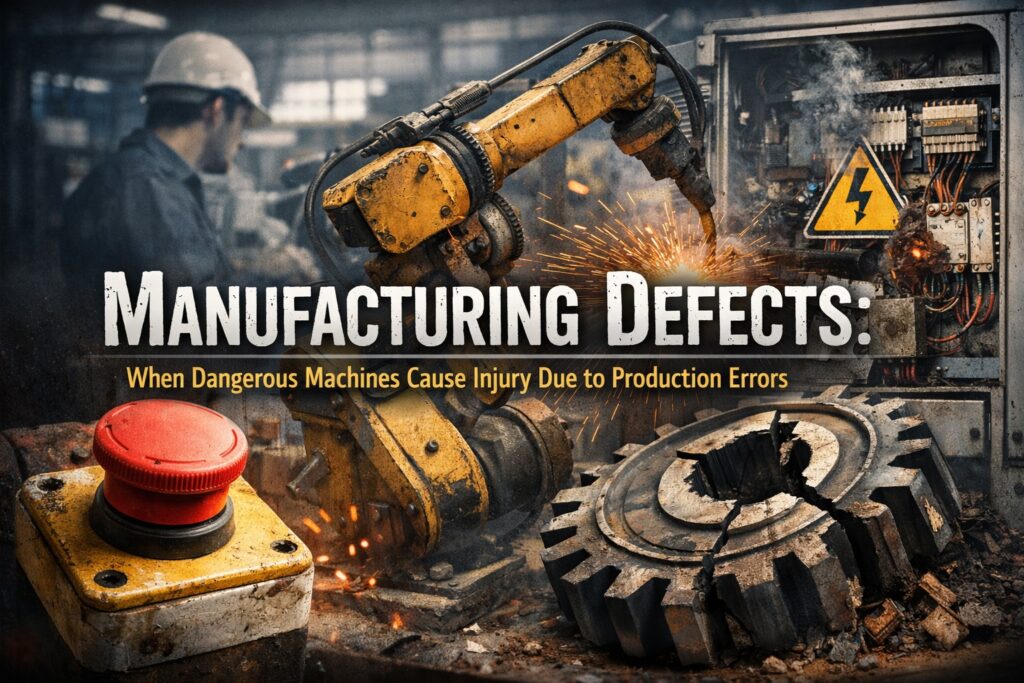
Industrial machines are often designed with safety in mind—but even a safe design can become deadly when something goes wrong during manufacturing. A manufacturing defect occurs when a machine deviates from its intended design because of errors in production, assembly, or quality control.
Unlike design defects, which affect every unit made, manufacturing defects typically impact individual machines or specific batches. But the consequences can be just as severe. A single faulty part, missing safeguard, or wiring error can turn ordinary equipment into an unpredictable hazard.
At WIN Injury & Accident Trial Lawyers, we represent workers and consumers who were seriously injured because machinery failed in ways it never should have. These cases often involve sudden malfunctions, unexpected startups, and catastrophic injuries that no one could have anticipated—or avoided.
What Is a Manufacturing Defect?
A manufacturing defect exists when a machine fails to conform to the manufacturer’s own design specifications because of an error that occurs during production. In these cases, the blueprint or intended design may be safe on paper, but the actual machine that leaves the factory is not.
Unlike design defects—which affect every machine made—manufacturing defects typically impact individual units or specific production batches. The danger arises not from the concept of the machine, but from how it was built, assembled, or tested before reaching the workplace.
These defects can occur at multiple stages of production, including:
- Poor quality control, where defective machines are not properly inspected or tested before shipment
- Assembly-line errors, such as loose fasteners, misaligned components, or improperly installed safety devices
- Use of incorrect or inferior parts, including substandard materials, wrong components, or parts that do not meet required tolerances
- Inadequate testing before shipment, allowing hidden defects to go undetected until the machine is placed into service
Because the machine does not function as the manufacturer intended, it may behave unpredictably. Manufacturing defects often cause equipment to:
- Start up unexpectedly
- Fail to shut down when commanded
- Bypass or disable critical safety mechanisms
- Break, fracture, or collapse under normal use
These failures are especially dangerous because workers cannot anticipate or guard against them. A machine that looks normal and was designed to be safe may suddenly malfunction without warning—often during routine operation, cleaning, or maintenance.
In short, a manufacturing defect turns an otherwise safe design into a hidden hazard. When production errors create machines that cannot be trusted to operate as intended, manufacturers can—and should—be held accountable for the injuries that result.
Common Examples of Manufacturing Defects in Machinery
Manufacturing defects are especially dangerous because they often cannot be detected through ordinary use, training, or visual inspection. Workers and employers reasonably assume that a machine leaving the factory meets safety and quality standards. When it doesn’t, the results can be sudden, severe, and impossible to anticipate.
Below are some of the most common manufacturing defects seen in serious machinery injury cases.
⚠️ Faulty or Missing Components
Machines may leave the factory with defective, improperly installed, or entirely missing safety components. These parts are often the last line of defense between normal operation and catastrophic injury.
Common examples include:
- Malfunctioning sensors that fail to detect human presence or unsafe conditions
- Inoperative emergency stop buttons that do not cut power when activated
- Missing guards or interlocks that were never installed or were improperly fitted
When these components fail, workers lose critical protection at the exact moment it’s needed most—often during emergencies when seconds matter.
⚠️ Improper Assembly
Even well-designed machines can become extremely dangerous if they are assembled incorrectly. Assembly-line mistakes frequently involve human error, rushed production schedules, or inadequate oversight.
Examples include:
- Loose bolts or fasteners that allow parts to shift or detach
- Misaligned moving components that create unexpected stress or friction
- Unsecured blades, rollers, or press elements that can break free or malfunction
Improper assembly can cause machines to vibrate excessively, bind, or fail without warning—often resulting in sudden collapses, ejections of parts, or crushing injuries.
⚠️ Substandard or Inferior Materials
Using cheaper, weaker, or incorrect materials is another common source of manufacturing defects. Even small material substitutions can significantly compromise safety.
This may include:
- Weak metals that crack, bend, or fracture under normal loads
- Components that wear out far earlier than expected, increasing failure risk
- Plastic or rubber parts that degrade when exposed to heat, pressure, or chemicals
Material failures are particularly dangerous because they often occur without visible warning and can trigger violent mechanical breakdowns during ordinary use.
⚠️ Electrical Defects
Electrical manufacturing defects are among the most dangerous because they can cause unpredictable and uncontrollable machine behavior.
These defects may result in:
- Unexpected startups, even when a machine appears powered down
- Failure to shut down when commanded, including emergency stop failures
- Power surges or shorts that bypass safety systems or interlocks
Electrical defects frequently cause severe injuries during cleaning, maintenance, or troubleshooting, when workers reasonably believe the machine is safe to approach.
In manufacturing defect cases, the common theme is unpredictability. A machine that does not operate as designed cannot be trusted, and no amount of training can protect workers from sudden failures caused by hidden production errors. When defective machinery causes injury, manufacturers must be held accountable for the risks they allowed into the workplace.
How Manufacturing Defect Cases Are Proven
Manufacturing defect cases often rely on detailed technical investigation, including:
- Examination of the failed machine and components
- Comparison to design specifications and exemplars
- Expert engineering and metallurgical analysis
- Quality control and production records
- Evidence of similar failures in other units or batches
At WIN Injury & Accident Trial Lawyers, we work with top experts to identify exactly how and why a machine deviated from its intended design—and who is responsible.
Who Can Be Held Liable?
Manufacturing defect cases often involve multiple responsible parties, not just a single manufacturer. Because these defects arise during the production process, liability may extend to any entity involved in building, assembling, or approving the machine before it entered the stream of commerce.
Depending on the facts, liable parties may include:
- The machine manufacturer, which is typically responsible for ensuring that each unit conforms to its design specifications and passes quality and safety checks
- Component or parts manufacturers, when a defective sensor, switch, motor, blade, or control unit causes the machine to malfunction
- Assembly contractors or subcontractors, especially when production or assembly is outsourced and errors occur during installation or integration
- Companies responsible for quality control, inspection, or testing, when defective machines are approved and shipped despite clear failures
Under strict product liability, injured victims often do not need to prove negligence, carelessness, or intent. Instead, the focus is on whether:
- The machine was defective when it left the manufacturer’s control, and
- That defect was a substantial factor in causing the injury.
This legal standard reflects a core principle of product liability law: those who profit from placing products into the marketplace must bear the cost of defects, not the workers who are harmed by them.
Injuries Commonly Caused by Manufacturing Defects
Because manufacturing defects cause machines to behave unpredictably, the resulting injuries are often sudden, severe, and catastrophic. Workers have little to no opportunity to react when a machine fails without warning.
Common injuries include:
- Amputations, particularly involving fingers, hands, arms, or legs caught in moving machinery
- Crushing injuries, caused by unexpected movement, collapsing components, or failed safety systems
- Severe hand and arm trauma, including fractures, nerve damage, and permanent loss of function
- Electrical burns or electrocution, often resulting from faulty wiring, shorts, or power surges
- Permanent disability or death, when injuries prevent a worker from ever returning to their job—or to work at all
These injuries are often life-altering, affecting not only a worker’s ability to earn a living but also their long-term health, independence, and quality of life. In many cases, the harm was entirely preventable had the machine been built correctly and tested properly before reaching the workplace.
When manufacturing defects lead to devastating injuries, accountability is essential—not only to compensate victims, but to ensure defective machinery does not continue putting others at risk.
Injured by a Defective Machine? We Can Help.
If you or a loved one was injured because a machine malfunctioned, failed unexpectedly, or behaved unpredictably, a manufacturing defect may be to blame.
At WIN Injury & Accident Trial Lawyers, we aggressively pursue manufacturers and insurers to secure full compensation—and to ensure defective machinery is taken out of circulation.
Get Help From WIN Injury & Accident Trial Lawyers
Why Legal Representation Matters
Insurance companies often undervalue pain and suffering—offering minimal settlements that ignore your daily struggles. A skilled attorney can:
- Present powerful evidence of your emotional and physical suffering
- Retain expert witnesses to quantify your losses
- Use verdict data to justify higher multipliers or per diem rates
- Argue your case persuasively before a jury
At WIN Trial Lawyers, our team fights to ensure that your recovery reflects the full extent of your suffering—not just your bills.

At WIN Trial Lawyers, we know how personal injury claims can be can be. Victims often face mounting medical bills, lost wages, and emotional trauma. Our team has successfully taken on insurance companies and third parties, recovering millions for injured clients.
If you or a loved one has been injured in an accident, don’t leave your future in the hands of the insurance company. You need experienced trial lawyers who know how to prove liability and fight for maximum compensation.
If you or a loved one has been injured, don’t face this alone. The sooner you act, the stronger your case will be.
🔗 Related Posts:
Frequently Asked Questions: Manufacturing Defects in Dangerous Machinery
What is a manufacturing defect in a machine?
A manufacturing defect occurs when a machine deviates from its intended design because of an error during production, assembly, or quality control. The design itself may be safe, but the specific unit that caused the injury was not built correctly.
How is a manufacturing defect different from a design defect?
A manufacturing defect affects individual machines or specific batches due to production errors. A design defect affects every machine made under the same blueprint. Manufacturing defect cases focus on what went wrong during assembly or production—not the original design.
What if the machine worked fine before the accident?
That is very common in manufacturing defect cases. A defective component may function normally for weeks or months before failing suddenly. The fact that the machine previously worked does not rule out a manufacturing defect.
Can a missing or broken safety feature be a manufacturing defect?
Yes. If a safety component—such as an emergency stop, sensor, guard, or interlock—was missing, improperly installed, or malfunctioning when the machine left the factory, it may constitute a manufacturing defect.
What if the defect involved electrical wiring or controls?
Electrical defects are a frequent basis for manufacturing defect claims. Faulty wiring, loose connections, or defective control systems can cause unexpected startups, shutdown failures, or bypassed safety mechanisms, making the machine dangerously unpredictable.
Do I have a claim if only one machine failed?
Yes. Manufacturing defects often involve a single machine or a limited batch. You do not need to show that every machine was defective—only that the one that injured you deviated from the intended design.
Who can be held responsible for a manufacturing defect?
Liability may extend to:
- The machine manufacturer
- Component or parts manufacturers
- Assembly or fabrication contractors
- Companies responsible for quality control or inspection
Under strict product liability, injured victims generally do not need to prove negligence.
What types of injuries are common in manufacturing defect cases?
Manufacturing defects frequently cause:
- Amputations
- Crushing injuries
- Severe hand or arm trauma
- Electrical burns or electrocution
- Permanent disability or fatal injuries
These injuries often occur suddenly and without warning.
What if my employer maintained the machine?
Routine maintenance does not excuse a manufacturing defect. If the defect existed when the machine left the manufacturer’s control, the manufacturer may still be liable—even if the employer serviced the equipment.
How long do I have to file a manufacturing defect lawsuit?
Strict deadlines apply and vary by state. Delays can result in lost evidence or barred claims. Speaking with an experienced product liability attorney as soon as possible is critical.
Can a quality control failure support a manufacturing defect claim?
Yes. Inadequate quality control is a common cause of manufacturing defects. If a machine left the factory without proper inspection, testing, or verification—and that failure allowed a defective component to reach the workplace—the manufacturer may be held strictly liable for resulting injuries.
What if the machine was new or recently installed?
A machine does not need to be old or heavily used to be defective. Many manufacturing defect cases involve brand-new equipment that fails shortly after installation due to hidden assembly or material defects present from the outset.
Can recalls or prior complaints help prove a manufacturing defect?
Yes. Evidence of recalls, safety bulletins, warranty claims, or prior complaints involving similar machines can strongly support a manufacturing defect claim. This evidence may show that the defect was part of a broader production issue or affected a specific batch of machines.
What if the defective part was supplied by another company?
Manufacturers often rely on third-party suppliers for components. If a defective sensor, switch, or control unit caused the injury, both the machine manufacturer and the component manufacturer may be liable under product liability law.
Does a manufacturing defect claim require proof of negligence?
No. Manufacturing defect claims are typically brought under strict product liability, meaning the injured person does not need to prove carelessness or wrongdoing—only that the machine was defective when it left the manufacturer’s control and that the defect caused the injury.
Can a manufacturing defect still exist if the machine met specifications on paper?
Yes. Paper specifications do not guarantee safe assembly. A machine may technically meet design specs while still being unsafe due to improper installation, loose components, faulty wiring, or defective materials used during production.
What should I do if I believe a machine malfunction caused my injury?
It is critical to:
- Preserve the machine and failed components
- Avoid repairs or alterations before inspection
- Document the scene and injuries
- Speak with a product liability attorney as soon as possible
Early investigation often makes the difference between proving—or losing—a manufacturing defect claim.
Why are manufacturing defect cases difficult without legal representation?
Manufacturers and insurers often argue that injuries were caused by misuse or poor maintenance. Without expert analysis and access to production records, injured workers are at a significant disadvantage. Experienced counsel is essential to uncover hidden defects and rebut these defenses.
How can WIN Injury & Accident Trial Lawyers help?
At WIN Injury & Accident Trial Lawyers, we work with engineering, electrical, and manufacturing experts to identify defects, preserve failed components, and hold manufacturers accountable. Our goal is to secure full compensation and prevent defective machines from injuring others.
📞 Contact WIN Injury & Accident Trial Lawyers today for a free consultation.
You don’t pay unless we win.