

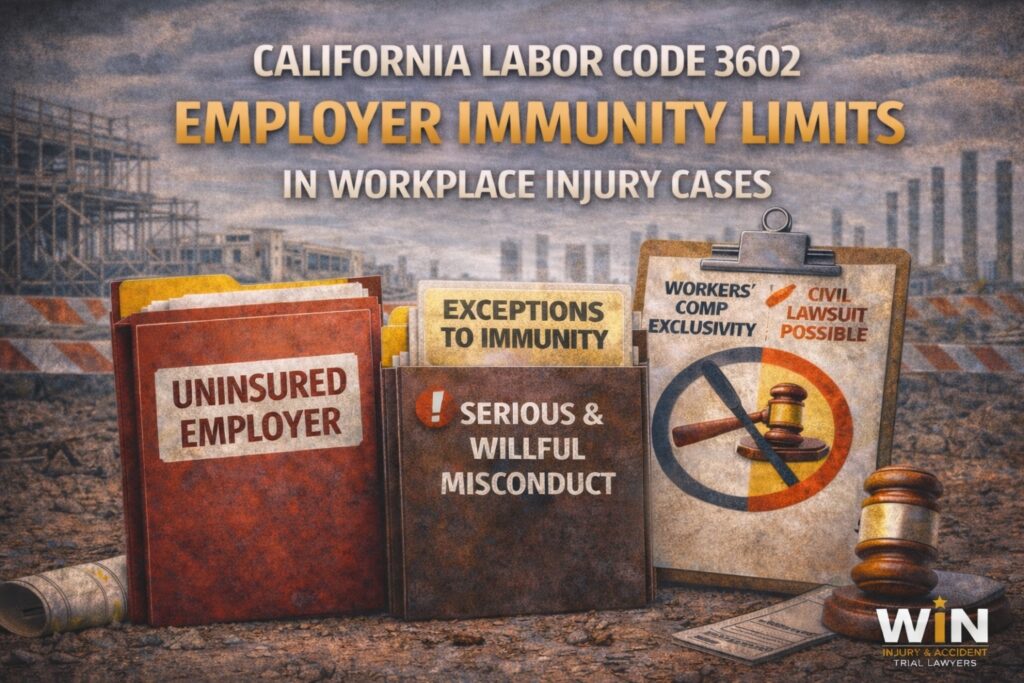
One of the most common questions injured workers ask is:
“Can I sue my employer for my workplace injury?”
In most cases, the answer is no — because workers’ compensation is the exclusive remedy.
But California Labor Code § 3602 defines the limits of that immunity — and those limits matter more than most employers and insurers want workers to know.
When certain conditions exist, employer immunity disappears, and civil liability may be back on the table.
What Is Labor Code § 3602?
Labor Code § 3602 establishes the general rule of workers’ compensation exclusivity, meaning:
- Workers’ comp benefits usually replace the right to sue an employer
- Employers are protected from civil lawsuits for workplace injuries
- Fault generally does not matter
But § 3602 also makes clear that this immunity is not absolute.
The Core Rule: Workers’ Comp Is Usually the Exclusive Remedy
Under § 3602(a), when:
- The injury arises out of and in the course of employment, and
- Workers’ compensation coverage exists
the employee’s remedy is typically limited to:
- Medical treatment
- Temporary disability benefits
- Permanent disability benefits
Pain and suffering damages are usually barred.
When Employer Immunity Breaks Down
Labor Code § 3602 establishes workers’ compensation as the default remedy for workplace injuries — but it also recognizes that employer immunity has limits.
When certain conditions exist, exclusivity no longer applies, and injured workers may pursue claims beyond workers’ compensation.
Below are the most important exceptions.
1. Uninsured Employers
Workers’ compensation immunity only applies if the employer actually carries workers’ comp insurance.
If an employer fails to maintain valid coverage:
- Workers’ comp exclusivity does not apply
- The injured worker may file a civil personal injury lawsuit against the employer
- The employer may be exposed to full damages, including pain and suffering
This is one of the clearest and most powerful exceptions to employer immunity.
2. Serious and Willful Misconduct
Employer immunity is not meant to shield reckless or intentional safety violations.
When an employer knowingly engages in dangerous conduct that makes injury likely — such as:
- Ignoring known safety hazards
- Violating safety laws or regulations
- Forcing employees to work under obviously dangerous conditions
additional remedies may apply, including:
- Increased compensation
- Penalties against the employer
These cases often arise where injuries were predictable and preventable.
3. Dual Capacity Situations
Employer immunity applies only when the employer is acting as an employer.
If the employer also acts in a separate legal role, civil liability may arise. Common examples include:
- An employer that manufactures defective equipment used by employees
- An employer that owns or controls property in a non-employment capacity
In these situations, the employer may be treated like any other negligent party, not a protected employer.
4. Concealment or Aggravation of Injury
Employer immunity can also be lost when an employer:
- Conceals the existence of a workplace injury or exposure
- Fails to disclose known hazards or medical risks
- Takes intentional actions that worsen an employee’s condition
Fraudulent or deceptive conduct that aggravates an injury undermines the purpose of workers’ compensation and can open the door to civil liability.
5. Third-Party Involvement
Even when employer immunity applies, it does not protect everyone else.
In many workplace injury cases, injured workers may still sue third parties such as:
- Contractors or subcontractors
- Property owners
- Equipment or product manufacturers
- Vendors or maintenance companies
These third-party injury claims often exist alongside a workers’ comp case and may allow recovery for:
- Pain and suffering
- Emotional distress
- Full wage loss
Employer immunity stops at the employer — it does not extend to unrelated negligent parties.
Key Takeaway
Workers’ compensation exclusivity is the starting point, not the end of the analysis.
When employers are uninsured, ignore safety, conceal injuries, act outside their employer role, or when third parties are involved, employer immunity can disappear — and civil liability may apply.
Understanding these exceptions is often the difference between a routine workers’ comp claim and a high-value injury case.
Employer Immunity Is Not a Free Pass
A common misconception is that workers’ comp immunity excuses unsafe behavior.
It does not.
Employers must still:
- Maintain safe workplaces
- Follow safety regulations
- Provide proper training and equipment
When employers cross the line from negligence into intentional or unlawful conduct, § 3602 protections can erode.
How Employers and Insurers Misuse § 3602
Insurers often rely on § 3602 to:
- Shut down legitimate civil claims prematurely
- Discourage injured workers from exploring third-party liability
- Minimize the seriousness of employer misconduct
But exclusivity must be earned — and it can be lost.
Why Labor Code § 3602 Matters in High-Value Cases
Employer immunity limits often determine whether a case is:
- A standard workers’ comp claim, or
- A multi-six- or seven-figure civil injury case
Understanding § 3602 can dramatically change:
- Case value
- Litigation strategy
- Settlement leverage
Workers’ Comp vs. Civil Lawsuits: A Key Difference
| Workers’ Compensation | Civil Lawsuit |
|---|---|
| No fault required | Fault must be proven |
| Limited benefits | Full damages available |
| No pain & suffering | Pain & suffering allowed |
| Faster but capped | Higher risk, higher reward |
Labor Code § 3602 defines which path applies.
The Bottom Line
Labor Code § 3602 protects employers — but only up to a point.
When employers step outside the bounds of lawful, insured, and safe conduct, that protection can disappear.
Understanding employer immunity limits is often the difference between a routine claim and a case with real accountability.
Workers’ Comp vs. Personal Injury: Key Differences
| Workers’ Comp | Personal Injury |
|---|---|
| No fault required | Fault must be proven |
| Limited benefits | Full damages available |
| No pain & suffering | Pain & suffering allowed |
| No jury | Jury trial available |
Exclusivity determines which path—or both—are available.
Get Help From WIN Injury & Accident Trial Lawyers
Why Legal Representation Matters
Insurance companies often undervalue pain and suffering—offering minimal settlements that ignore your daily struggles. A skilled attorney can:
- Present powerful evidence of your emotional and physical suffering
- Retain expert witnesses to quantify your losses
- Use verdict data to justify higher multipliers or per diem rates
- Argue your case persuasively before a jury
At WIN Trial Lawyers, our team fights to ensure that your recovery reflects the full extent of your suffering—not just your bills.

At WIN Trial Lawyers, we know how personal injury claims can be can be. Victims often face mounting medical bills, lost wages, and emotional trauma. Our team has successfully taken on insurance companies and third parties, recovering millions for injured clients.
If you or a loved one has been injured in an accident, don’t leave your future in the hands of the insurance company. You need experienced trial lawyers who know how to prove liability and fight for maximum compensation.
If you or a loved one has been injured, don’t face this alone. The sooner you act, the stronger your case will be.
🔗 Related Posts:
Frequently Asked Questions About Labor Code 3602 & Employer Immunity
What is California Labor Code 3602?
Labor Code 3602 is the law that establishes workers’ compensation as the “exclusive remedy” for most workplace injuries — meaning employees usually cannot sue their employer in civil court.
What does “exclusive remedy” mean?
It means that instead of suing your employer for negligence, you receive workers’ compensation benefits like:
- Medical treatment
- Temporary disability payments
- Permanent disability benefits
But you generally cannot recover pain and suffering — unless an exception applies.
Are there limits to employer immunity under Labor Code 3602?
Yes. Labor Code 3602 has important exceptions where employer immunity does not apply and a civil lawsuit may be allowed.
When can I sue my employer despite workers’ comp?
You may be able to sue your employer if:
- The employer was uninsured
- The injury resulted from serious and willful misconduct
- The employer fraudulently concealed the injury or exposure
- A dual capacity relationship exists
- The injury was caused by a third party
What if my employer did not carry workers’ compensation insurance?
If your employer was uninsured at the time of injury, workers’ comp exclusivity does not protect them. You may:
- File a workers’ comp claim, and/or
- Sue the employer directly in civil court for full damages
This is one of the strongest exceptions to employer immunity.
What is “serious and willful misconduct”?
Serious and willful misconduct involves knowing or reckless disregard for worker safety, such as:
- Ignoring known hazards
- Violating safety laws
- Ordering dangerous work without protection
These cases can lead to additional penalties and increased compensation.
Does violating safety laws affect employer immunity?
Yes. Repeated or intentional violations of safety laws — including Cal/OSHA regulations — can help establish serious and willful misconduct, which limits immunity.
Can I sue if my injury was caused by defective equipment?
Yes. If a third party (like an equipment manufacturer or subcontractor) caused your injury, you can:
- Pursue workers’ comp benefits, and
- File a separate personal injury lawsuit against the third party
Employer immunity does not protect third parties.
What is a “dual capacity” exception?
A dual capacity claim arises when an employer acts in a role outside the employment relationship, such as:
- Manufacturer of defective equipment
- Medical provider providing negligent treatment
In rare cases, this can open the door to civil liability.
Does employer immunity apply to intentional acts?
Generally no. If an employer intentionally harms an employee or knowingly exposes them to extreme danger, immunity may be lost.
Can my employer blame my injury on intoxication?
Employers often try — but intoxication alone does not automatically bar benefits. If unsafe conditions or safety failures contributed to the injury, employer immunity may still be challenged.
What if my employer ordered me to do something unsafe?
Orders to perform unsafe work can:
- Support a serious and willful misconduct claim
- Undermine employer immunity
- Increase the value of the case
Unsafe orders are a major red flag.
Does workers’ comp exclusivity cover emotional distress?
Usually yes — but severe or intentional emotional harm tied to misconduct may fall outside exclusivity depending on the facts.
Can multiple employers share liability?
Yes. In some cases, liability may be allocated among:
- Multiple employers
- Prior insurers
- Successor companies
This often arises in cumulative trauma or long-term exposure cases.
What damages can I recover if immunity doesn’t apply?
If an exception applies, you may recover:
- Pain and suffering
- Emotional distress
- Full wage loss
- Punitive damages (in some cases)
These damages are not available in standard workers’ comp claims.
How do I know if an exception applies to my case?
Employer immunity issues are fact-specific. Key factors include:
- Insurance coverage
- Safety history
- Nature of employer conduct
- Third-party involvement
These cases require experienced legal analysis.
Should I talk to a lawyer if I think my employer immunity doesn’t apply?
Yes. These cases move fast, evidence disappears, and employers aggressively defend immunity claims. Early legal review can dramatically change case value.
Can workers’ comp and a civil lawsuit happen at the same time?
Yes. It’s common to pursue:
- A workers’ comp claim for benefits, and
- A civil lawsuit against an employer or third party
The claims run on separate tracks.
Does employer immunity protect supervisors or managers?
Not always. Individual supervisors may be personally liable if their actions fall outside the scope of protected employment conduct.
Why do employers fight immunity exceptions so hard?
Because losing immunity exposes them to:
- Jury trials
- Large verdicts
- Pain and suffering damages
- Punitive exposure
That’s why these cases are aggressively contested.
What should I do if I was seriously injured at work?
You should:
- Report the injury
- Seek medical care
- Preserve evidence
- Speak with an experienced injury lawyer
Waiting can permanently limit your options.