

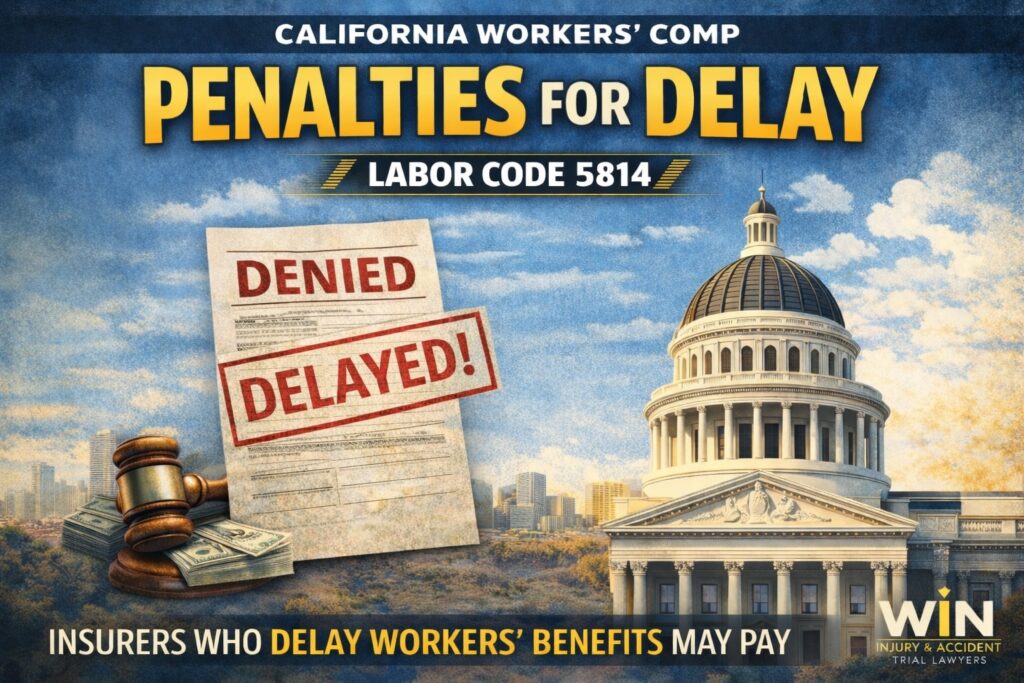
In the workers’ compensation system, delay is power.
Insurance companies know that when benefits are late, injured workers feel financial pressure, uncertainty, and stress. That pressure is often used to force injured workers into unfair settlements or silence.
California Labor Code § 5814 exists for one reason:
to punish unreasonable delay or denial of workers’ compensation benefits.
What Is Labor Code § 5814?
Labor Code § 5814 authorizes penalties when an employer or insurance carrier unreasonably delays or denies workers’ compensation benefits.
If a delay or denial is found to be unreasonable, the law allows for:
- Increased compensation
- Monetary penalties
- Interest on unpaid benefits
The statute is designed to deter insurers from using delay as a tactic.
What Types of Benefits Are Covered?
Penalties under LC § 5814 can apply to delays or denials involving:
- Temporary disability payments
- Permanent disability payments
- Medical treatment
- Mileage reimbursement
- Medical-legal costs
- Death benefits
In short: any benefit owed under workers’ compensation law.
What Counts as an “Unreasonable” Delay?
Not every delay triggers a penalty. The key issue is reasonableness.
A delay may be unreasonable when:
- No valid investigation is ongoing
- The insurer ignores medical evidence
- Payments are stopped without explanation
- Treatment requests are stalled without proper review
- The insurer fails to follow statutory timelines
Cost-saving motives are not a valid justification.
Common Delay Tactics We See
In practice, insurers often delay benefits by:
- Claiming “more information is needed” indefinitely
- Ignoring work-status reports from treating doctors
- Using Utilization Review as a shield, not a process
- Stopping payments without issuing formal notices
- Repeatedly requesting duplicate documentation
Many of these tactics fail under scrutiny.
How Penalties Are Calculated Under LC § 5814
When a violation is found, penalties are typically calculated as:
- An increase in the delayed or denied benefit
- Interest added to unpaid amounts
- In some cases, penalties applied separately to each delayed benefit
Importantly, penalties can apply even if benefits are eventually paid.
Delay vs. Denial: Both Can Trigger Penalties
Some insurers argue that because a benefit was “eventually approved,” penalties should not apply.
That is incorrect.
Unreasonable delay alone — even without a final denial — can trigger penalties under Labor Code § 5814.
Why LC § 5814 Matters So Much
Penalties change leverage.
A delayed benefit without consequences encourages insurers to delay again.
A delayed benefit with penalties changes behavior.
LC § 5814:
- Discourages bad-faith delay
- Compensates injured workers for harm caused by delay
- Creates accountability in a system tilted toward insurers
How Delay Penalties Affect Case Value
When delay penalties are in play, cases often see:
- Increased settlement value
- Faster resolution
- Greater insurer accountability
- Stronger negotiating positions
Delay evidence can also support broader arguments about insurer misconduct.
What Injured Workers Should Do When Benefits Are Delayed
If your benefits are delayed or denied:
- Keep copies of all notices, checks, and medical reports
- Track dates — timing is critical
- Request written explanations for delays
- Do not assume delays are lawful
- Speak with a workers’ compensation attorney early
Delay penalties are fact-driven and deadline-sensitive.
The Bottom Line
Labor Code § 5814 exists because delay harms injured workers.
When insurers use delay as a strategy instead of a mistake, the law provides consequences. Those consequences are often the only thing that forces compliance.
If benefits are late, missing, or denied without justification, penalties may apply — and they matter.
Workers’ Comp vs. Personal Injury: Key Differences
| Workers’ Comp | Personal Injury |
|---|---|
| No fault required | Fault must be proven |
| Limited benefits | Full damages available |
| No pain & suffering | Pain & suffering allowed |
| No jury | Jury trial available |
Exclusivity determines which path—or both—are available.
Get Help From WIN Injury & Accident Trial Lawyers
Why Legal Representation Matters
Insurance companies often undervalue pain and suffering—offering minimal settlements that ignore your daily struggles. A skilled attorney can:
- Present powerful evidence of your emotional and physical suffering
- Retain expert witnesses to quantify your losses
- Use verdict data to justify higher multipliers or per diem rates
- Argue your case persuasively before a jury
At WIN Trial Lawyers, our team fights to ensure that your recovery reflects the full extent of your suffering—not just your bills.

At WIN Trial Lawyers, we know how personal injury claims can be can be. Victims often face mounting medical bills, lost wages, and emotional trauma. Our team has successfully taken on insurance companies and third parties, recovering millions for injured clients.
If you or a loved one has been injured in an accident, don’t leave your future in the hands of the insurance company. You need experienced trial lawyers who know how to prove liability and fight for maximum compensation.
If you or a loved one has been injured, don’t face this alone. The sooner you act, the stronger your case will be.
🔗 Related Posts:
Frequently Asked Questions – Labor Code § 5814 (Penalties for Delay)
What is Labor Code § 5814?
Labor Code § 5814 allows penalties when a workers’ compensation insurance carrier unreasonably delays or denies benefits owed to an injured worker.
What does “unreasonable delay” mean?
A delay is unreasonable when the insurer lacks a valid legal or factual basis for delaying payment or treatment. Cost-saving, administrative backlog, or “we’re still reviewing” are not valid excuses.
Do penalties apply only if benefits are denied?
No. Delay alone is enough. Even if benefits are eventually paid, penalties may apply if the delay itself was unreasonable.
What types of benefits can trigger 5814 penalties?
Penalties may apply to delays involving:
- Temporary disability payments
- Permanent disability payments
- Medical treatment authorizations
- Mileage reimbursement
- Medical-legal expenses
- Death benefits
Any benefit owed under workers’ compensation law may qualify.
How much is the penalty under Labor Code § 5814?
Penalties are generally calculated as an increase to the delayed benefit, plus interest. Multiple delays can result in multiple penalties.
Are penalties automatic?
No. Penalties are not automatic. They must be requested and proven, usually through litigation before the Workers’ Compensation Appeals Board (WCAB).
What must an injured worker prove to get a penalty?
The worker must show:
- A benefit was owed
- The benefit was delayed or denied
- The delay or denial was unreasonable
The burden then shifts to the insurer to justify its conduct.
Can Utilization Review protect the insurer from penalties?
Not always. UR must be timely, compliant, and medically supported. Improper or delayed UR can still expose the insurer to penalties.
What if the insurance company says it was “investigating”?
An investigation must be reasonable and time-limited. Endless investigation without action often supports a penalty claim.
Can stopping temporary disability payments trigger penalties?
Yes. Improperly stopping or suspending TD payments is one of the most common bases for 5814 penalties.
Can delayed medical treatment result in penalties?
Yes. Delaying or refusing necessary medical treatment without justification may trigger penalties — especially when delays worsen the injury.
What if the delay was caused by paperwork issues?
Administrative errors do not excuse unreasonable delay. Insurers are responsible for processing claims properly.
Can penalties apply if the insurer later pays everything owed?
Yes. Late payment does not erase the violation. Penalties may still apply for the period of unreasonable delay.
Is there a deadline to request 5814 penalties?
Yes. Timing matters. Delay penalties are fact-specific and deadline-driven, and waiting too long may bar recovery.
Can penalties apply to each delayed benefit separately?
Yes. Courts may impose penalties per delayed benefit, not just once per case.
Do penalties increase settlement value?
Often, yes. Proven delay penalties:
- Increase leverage
- Pressure insurers to resolve cases
- Expose bad claims handling
They frequently change settlement dynamics.
Are penalties capped?
While penalties are tied to the delayed benefit, repeated violations can significantly increase exposure.
Can penalties apply to self-insured employers?
Yes. Labor Code § 5814 applies to both insured and self-insured employers.
What evidence helps prove unreasonable delay?
Helpful evidence includes:
- Late payment records
- Gaps in medical authorization
- Unanswered requests
- Contradictory insurer explanations
- Medical reports ignored by the carrier
Documentation is critical.
Should I keep copies of late checks and notices?
Absolutely. Dates and documentation are often the strongest evidence in a 5814 claim.
Do penalties require bad faith?
No. The standard is reasonableness, not intent. Even negligent delay can trigger penalties.
Should I talk to a lawyer if benefits are delayed?
Yes. Delay penalties are technical, procedural, and highly strategic. Early legal review can preserve penalties and prevent further harm.
Why do insurers delay if penalties exist?
Because many injured workers don’t know the law — and penalties must be enforced to matter.