

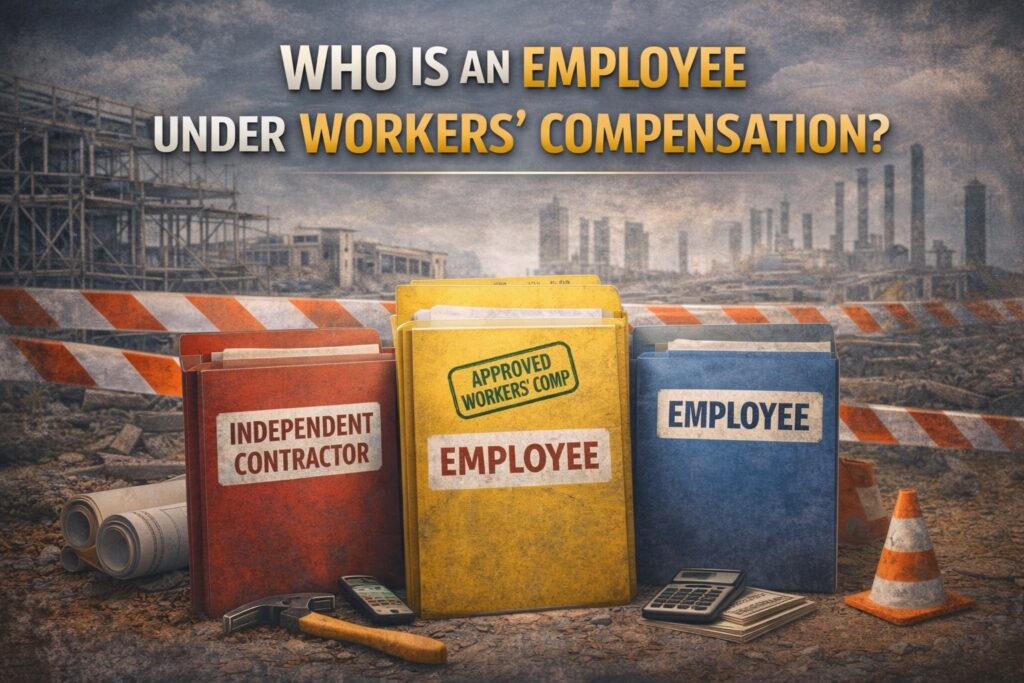
Why Employee Status Matters in Workers’ Compensation Cases
One of the first — and most important — questions in any California workers’ compensation case is simple:
Was the injured person an “employee”?
California Labor Code 3351 defines who qualifies as an employee for workers’ compensation purposes. That definition determines whether an injured worker is entitled to medical care, wage replacement, and permanent disability benefits — or whether the employer can try to deny responsibility.
Employers and insurance companies frequently dispute employee status to avoid paying benefits. Understanding how the law works is critical.
What DoeWhat Does Labor Code 3351 Say?
Labor Code 3351 defines an employee broadly and intentionally. The goal of the statute is to include workers, not exclude them.
In general, an employee includes:
- Anyone engaged in service to an employer
- Under any appointment or contract of hire
- Whether the agreement is express or implied
- Whether it is oral or written
This means a formal employment contract is not required.
California courts interpret Labor Code 3351 in favor of coverage, not denial. When there is doubt, the law leans toward protecting the injured worker rather than shielding the employer or insurance carrier.
If a worker was performing tasks that:
- Benefited the employer, and
- Were part of the employer’s business or operations,
the law will often treat that worker as an employee — even if the employer claims otherwise or labels the worker as something else.
What matters most is the real working relationship, not job titles, contracts, or labels.
Common Workers Who Qualify as Employees Under LC 3351
Many injured workers are incorrectly told they are “not employees” and therefore not covered by workers’ compensation. In reality, Labor Code 3351 often includes a wide range of workers.
Common examples include:
- Full-time employees
- Part-time employees
- Temporary workers
- Seasonal workers
- Probationary or newly hired employees
- Paid trainees or apprentices
Coverage does not depend on how long the worker has been employed or how many hours they work.
If the employer:
- Directs how the work is performed, and
- Benefits from the services provided,
employee status is often established — even when the employer disputes it.
This is especially important in industries that rely on short-term labor, labor agencies, or rotating workforces, where misclassification is common.
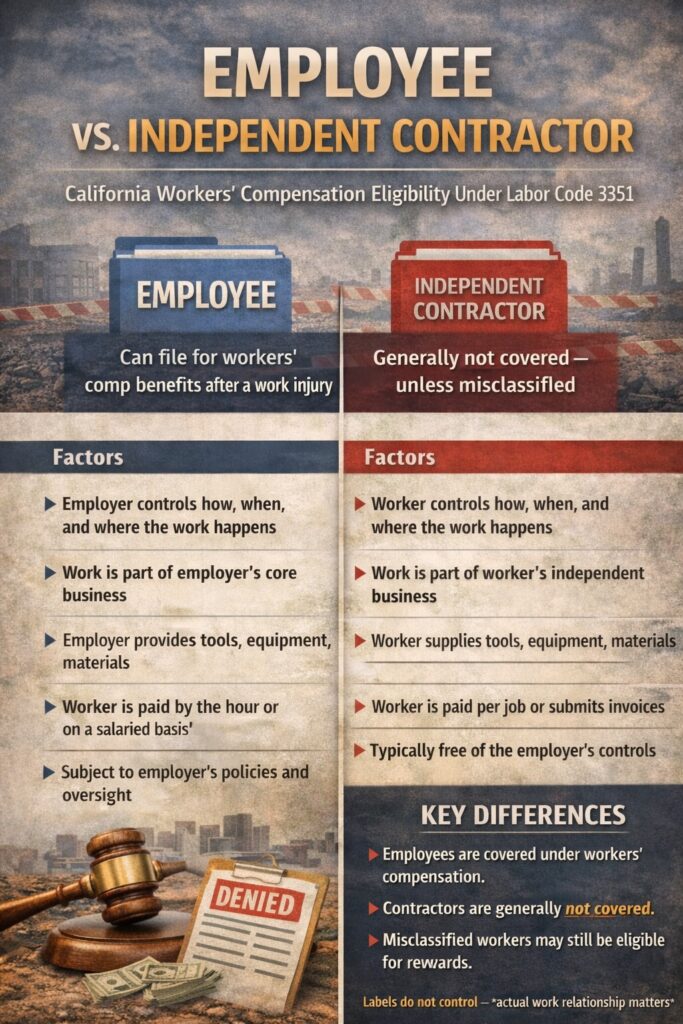
Independent Contractors vs. Employees
One of the most common disputes in workers’ compensation cases involves independent contractor misclassification.
Just because an employer labels someone an “independent contractor” does not make it true for workers’ compensation purposes. Job titles, contracts, and tax forms do not control.
Instead, courts and the Workers’ Compensation Appeals Board look at the real working relationship.
Factors Used to Determine Employee Status
When deciding whether a worker is truly an independent contractor or an employee, decision-makers often consider factors such as:
- Who controls how the work is performed
- Whether the worker is engaged in a separate, independent business
- Whether the work is part of the employer’s regular operations
- Who supplies tools, equipment, and materials
If the employer exercises meaningful control and the work is central to the business, the worker may still qualify as an employee under Labor Code 3351.
The ABC Test and Misclassification
In many misclassification cases, California applies the ABC test, which places the burden squarely on the employer.
Under the ABC test, a worker is presumed to be an employee unless the employer proves all three of the following:
A — Autonomy
The worker is free from the control and direction of the hiring entity in performing the work, both under the contract and in practice.
B — Business of the Employer
The worker performs work that is outside the usual course of the employer’s business.
C — Customarily Engaged in an Independent Trade
The worker is customarily engaged in an independently established trade, occupation, or business of the same nature as the work performed.
If the employer fails to prove any one of these elements, the worker is treated as an employee.
Why the ABC Test Matters in Workers’ Compensation
The ABC test is powerful because it:
- Starts with a presumption of employee status
- Forces employers to prove true independence
- Exposes sham contractor arrangements
- Protects workers performing core business functions
In many industries, workers labeled as “independent contractors” fail Part B of the test because they perform work that is central to the company’s business.
The Bottom Line
If an employer:
- Controls how the work is done, and
- Uses the worker to perform its core business operations,
the worker may still qualify as an employee under Labor Code 3351 — even if the employer calls them an independent contractor.
Misclassification is common, but it is not legal.
Why Employers Fight Employee Status
Employers dispute employee status because:
- Workers’ comp insurance premiums increase
- Uninsured employers face severe penalties
- Civil liability exposure may increase
- Back benefits and penalties can add up quickly
For injured workers, this often results in delayed care, denied claims, or pressure not to file.
Special Categories of Workers
Some workers fall into special statutory categories under California law, including:
- Corporate officers
- Working owners
- Certain volunteers
- Family members employed by a business
These cases require careful analysis, but many are still covered when injuries occur during work activities.
What If the Employer Claims You’re Not an Employee?
If your employer claims you are not an employee:
- Do not assume they are correct
- Do not delay medical treatment
- Do not accept a denial without review
Employee status disputes are legal questions — and they are often resolved in favor of injured workers when properly litigated.
How Labor Code 3351 Affects Workers’ Compensation Benefits
If you are found to be an employee under Labor Code 3351, you may be entitled to:
- Medical treatment for work-related injuries
- Temporary disability benefits
- Permanent disability benefits
- Vocational retraining benefits (when applicable)
Misclassification can unlawfully strip workers of these rights.
Workers’ Comp vs. Personal Injury: Key Differences
| Workers’ Comp | Personal Injury |
|---|---|
| No fault required | Fault must be proven |
| Limited benefits | Full damages available |
| No pain & suffering | Pain & suffering allowed |
| No jury | Jury trial available |
Why These Cases Require Experienced Representation
Employee-definition disputes often overlap with:
- Uninsured employer cases
- Serious and willful misconduct claims
- Wage-and-hour misclassification issues
- Retaliation for filing a workers’ comp claim
Insurance carriers aggressively litigate these issues. Early legal guidance can make the difference between a denied claim and full benefits.
Talk to a California Workers’ Compensation Lawyer
If you were injured at work and told you are “not an employee,” that does not end the analysis.
At WIN Injury & Accident Trial Lawyers, we help injured workers challenge improper denials, uncover misclassification, and pursue the full benefits California law provides.
Get Help From WIN Injury & Accident Trial Lawyers
Why Legal Representation Matters
Insurance companies often undervalue pain and suffering—offering minimal settlements that ignore your daily struggles. A skilled attorney can:
- Present powerful evidence of your emotional and physical suffering
- Retain expert witnesses to quantify your losses
- Use verdict data to justify higher multipliers or per diem rates
- Argue your case persuasively before a jury
At WIN Trial Lawyers, our team fights to ensure that your recovery reflects the full extent of your suffering—not just your bills.

At WIN Trial Lawyers, we know how personal injury claims can be can be. Victims often face mounting medical bills, lost wages, and emotional trauma. Our team has successfully taken on insurance companies and third parties, recovering millions for injured clients.
If you or a loved one has been injured in an accident, don’t leave your future in the hands of the insurance company. You need experienced trial lawyers who know how to prove liability and fight for maximum compensation.
If you or a loved one has been injured, don’t face this alone. The sooner you act, the stronger your case will be.
🔗 Related Posts:
Frequently Asked Questions (FAQs): Labor Code 3351 – Employee Definition
What is Labor Code 3351?
California Labor Code 3351 defines who qualifies as an employee for workers’ compensation purposes. If you meet this definition, you may be entitled to medical treatment and disability benefits after a work injury.
Why does employee status matter in a workers’ comp case?
Workers’ compensation benefits are generally only available to employees. Employers often dispute employee status to avoid paying benefits, especially in high-value injury cases.
Who is considered an employee under Labor Code 3351?
In general, an employee is anyone who:
- Performs services for an employer
- Under an express or implied agreement
- Where the employer benefits from the work
The law is interpreted broadly in favor of coverage.
Do part-time employees qualify for workers’ compensation?
Yes. Part-time employees are fully covered under workers’ compensation if they are injured while performing job duties.
Are temporary or seasonal workers considered employees?
Yes. Temporary, seasonal, and short-term workers are typically employees under Labor Code 3351.
What about probationary or newly hired workers?
Probationary and newly hired workers are covered. There is no waiting period for workers’ compensation coverage.
Does my employer have to control my work for me to be an employee?
Control is a key factor. If the employer controls how, when, or where the work is done, employee status is more likely.
Can an employer call me an independent contractor to avoid workers’ comp?
No. Labels do not control. Courts look at the actual working relationship, not what the employer calls it.
What is misclassification?
Misclassification occurs when an employer improperly labels a worker as an independent contractor instead of an employee. Misclassified workers may still be entitled to workers’ compensation benefits.
How does Labor Code 3351 relate to independent contractors?
True independent contractors are generally excluded — but many workers labeled as contractors still qualify as employees under the law.
What factors are used to determine employee vs. contractor status?
Common factors include:
- Who controls the work
- Whether the work is part of the employer’s regular business
- Who provides tools and equipment
- Whether the worker can work for others
- How the worker is paid
No single factor controls the outcome.
Are paid trainees or apprentices employees?
Yes. Paid trainees and apprentices are usually considered employees for workers’ compensation purposes.
Are interns covered by workers’ compensation?
Paid interns are typically employees. Unpaid interns require careful legal analysis, but many are still covered depending on the circumstances.
Are corporate officers or owners considered employees?
Sometimes. Working owners and corporate officers may be covered unless they properly opt out under specific statutory rules.
Are family members working for a family business covered?
Often yes. Family relationships do not automatically exclude workers from employee status.
What if my employer doesn’t carry workers’ compensation insurance?
If an employer is uninsured, the worker may still be an employee and may have additional legal remedies beyond standard workers’ comp.
Can an employee definition dispute delay my medical treatment?
Unfortunately, yes. Employers and insurers may delay care while disputing status — which is why early legal action is critical.
What if my claim is denied because the employer says I’m not an employee?
A denial is not the final word. Many employee-status denials are overturned through litigation.
Who decides whether I am an employee?
Ultimately, the Workers’ Compensation Appeals Board (WCAB) decides employee-status disputes based on the evidence.
What evidence helps prove employee status?
Helpful evidence includes:
- Work schedules
- Pay records
- Texts or emails from supervisors
- Training materials
- Tool or uniform requirements
- Witness testimony
Does being paid in cash mean I’m not an employee?
No. Payment method does not determine employee status. Cash-paid workers are often still employees.
Does receiving a 1099 mean I’m not an employee?
No. A 1099 does not control workers’ compensation eligibility.
Can I be an employee for workers’ comp but a contractor for other purposes?
Yes. Worker classification can differ depending on the law being applied.
Can employee status affect the value of my case?
Absolutely. Establishing employee status unlocks medical care, disability benefits, and sometimes additional penalties or claims.
Can retaliation occur if I assert employee status?
Yes — and retaliation is illegal. Workers who assert their rights may have separate retaliation claims.
How long do I have to challenge an employee-status denial?
Strict deadlines apply. Delaying action can permanently harm your claim.
Should I talk to a lawyer if my status is disputed?
Yes. Employee-definition disputes are highly technical and aggressively defended by insurers.
How can WIN Injury & Accident Trial Lawyers help?
WIN represents injured workers in:
- Employee-status disputes
- Misclassification cases
- Denied workers’ comp claims
- Uninsured employer cases
We focus on forcing employers and insurers to recognize worker protections under California law.