

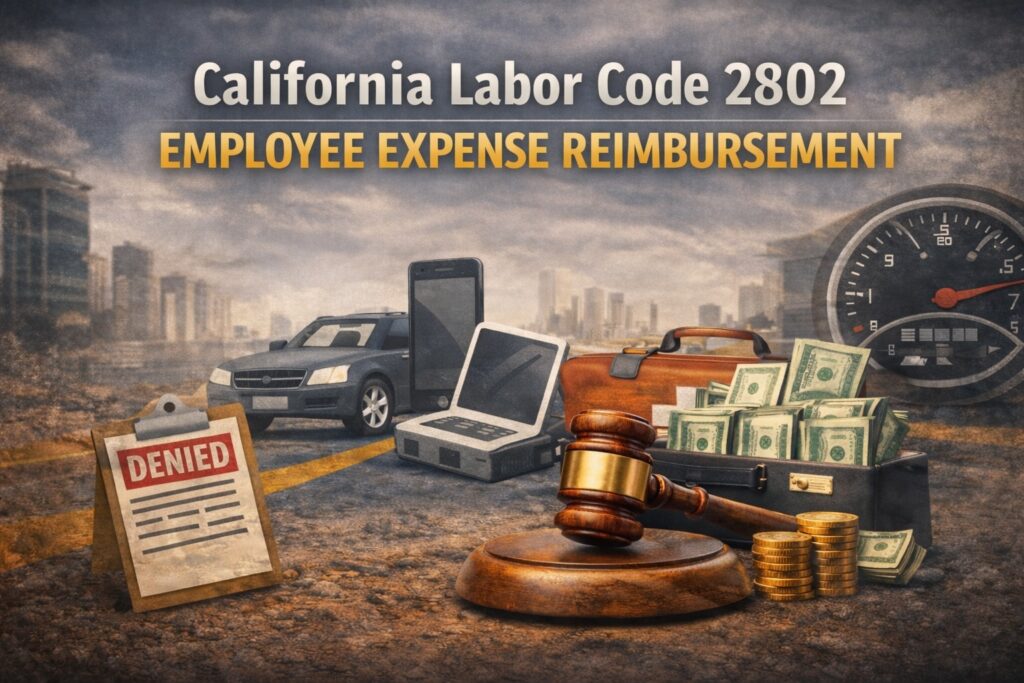
California employers cannot shift the cost of doing business onto their employees.
That principle is codified in California Labor Code 2802, which requires employers to reimburse employees for all necessary business expenses incurred while performing their job duties.
This statute is one of the most commonly violated — and most powerful — wage-and-hour laws in California.
What Does Labor Code 2802 Require?
Labor Code 2802 requires employers to indemnify (reimburse) employees for all necessary expenditures or losses incurred in direct consequence of performing their job duties.
In simple terms:
If an employee has to spend their own money to do their job, the employer must pay them back.
This obligation applies regardless of the employee’s pay rate, job title, or whether the employer has a written reimbursement policy.
What Counts as a “Necessary” Business Expense?
An expense does not have to be extraordinary or unavoidable to be reimbursable.
It only needs to be reasonably necessary to perform the job.
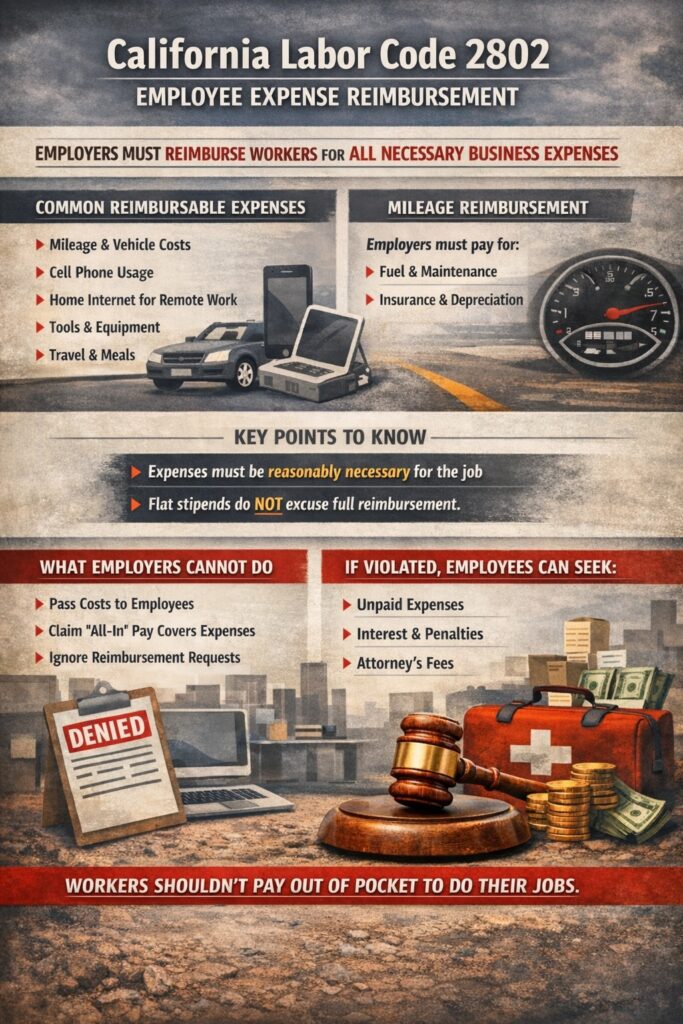
Common reimbursable expenses include:
- Mileage and vehicle expenses for work-related driving
- Cell phone use for work calls, texts, or apps
- Home internet used for remote work
- Uniforms or required clothing
- Tools, equipment, or supplies
- Travel expenses
- Meals incurred during required travel
- Licensing or certification fees required by the employer
If the expense primarily benefits the employer, it is usually reimbursable.
Mileage Reimbursement Under Labor Code 2802
Mileage claims are among the most frequent LC § 2802 violations.
When employees use their personal vehicles for work, employers must reimburse them for:
- Fuel
- Maintenance and repairs
- Insurance
- Registration
- Depreciation
Most employers use the IRS mileage rate, which is generally considered a safe harbor — but reimbursement must still reflect the actual cost of operating the vehicle for work.
Cell Phone and Internet Expenses
Even partial work use can trigger reimbursement obligations.
If an employer requires or expects employees to:
- Use their personal cell phone
- Answer work calls or texts
- Use work apps
- Work remotely using home internet
then the employer must reimburse a reasonable percentage of those costs.
Employees do not have to show that the expense caused them financial hardship — only that it was required for work.
Employers Cannot Avoid Reimbursement With “All-In” Pay
A common employer defense is:
“The employee’s salary already covers expenses.”
That argument usually fails.
California courts have repeatedly held that expense reimbursement cannot be waived, and lump-sum pay or higher wages do not eliminate the employer’s duty unless reimbursement is clearly identified and reasonably calculated.
What Happens If an Employer Violates Labor Code 2802?
Employees may recover:
- Unreimbursed expenses
- Interest
- Attorneys’ fees and costs
In class and representative actions, exposure can grow quickly — especially where reimbursement practices are uniform across a workforce.
Common Labor Code 2802 Violations
Employers frequently violate the statute by:
- Failing to reimburse mileage
- Requiring employees to use personal phones without reimbursement
- Requiring remote work without covering internet costs
- Treating reimbursement as optional
- Using flat stipends that do not reflect actual expenses
- Ignoring reimbursement requests
Even small monthly expenses can create significant liability over time.
How These Claims Are Litigated
Labor Code 2802 claims are often brought alongside:
- Unpaid wage claims
- Overtime violations
- Meal and rest break claims
- PAGA representative actions
Documentation, policies, and uniform practices are usually the key evidence.
Key Takeaway
Employers must pay for the cost of doing business.
When employees are forced to subsidize their employer’s operations, Labor Code 2802 provides a clear remedy.
Workers’ Comp vs. Personal Injury: Key Differences
| Workers’ Comp | Personal Injury |
|---|---|
| No fault required | Fault must be proven |
| Limited benefits | Full damages available |
| No pain & suffering | Pain & suffering allowed |
| No jury | Jury trial available |
Exclusivity determines which path—or both—are available.
Get Help From WIN Injury & Accident Trial Lawyers
Why Legal Representation Matters
Insurance companies often undervalue pain and suffering—offering minimal settlements that ignore your daily struggles. A skilled attorney can:
- Present powerful evidence of your emotional and physical suffering
- Retain expert witnesses to quantify your losses
- Use verdict data to justify higher multipliers or per diem rates
- Argue your case persuasively before a jury
At WIN Trial Lawyers, our team fights to ensure that your recovery reflects the full extent of your suffering—not just your bills.

At WIN Trial Lawyers, we know how personal injury claims can be can be. Victims often face mounting medical bills, lost wages, and emotional trauma. Our team has successfully taken on insurance companies and third parties, recovering millions for injured clients.
If you or a loved one has been injured in an accident, don’t leave your future in the hands of the insurance company. You need experienced trial lawyers who know how to prove liability and fight for maximum compensation.
If you or a loved one has been injured, don’t face this alone. The sooner you act, the stronger your case will be.
🔗 Related Posts:
Frequently Asked Questions (FAQs): Labor Code 2802 – Expense Reimbursement
What is Labor Code 2802?
California Labor Code 2802 requires employers to reimburse employees for all necessary business expenses they incur while performing their job duties.
In simple terms:
If the employer benefits from the expense, the employer must pay for it.
What types of expenses must employers reimburse?
Employers must reimburse any reasonable and necessary work-related expense, including:
- Mileage and vehicle expenses
- Cell phone and internet usage
- Tools and equipment
- Home office costs
- Travel, meals, and lodging
- Uniforms and required clothing
- Professional licenses and certifications
The list is broad and fact-specific.
Does an employer have to reimburse mileage?
Yes.
If an employee uses their personal vehicle for work, the employer must reimburse mileage or actual vehicle expenses. This includes:
- Driving between job sites
- Client visits
- Required errands during the workday
Commuting to and from work is usually excluded.
Are employers required to reimburse cell phone expenses?
Yes — when the phone is used for work.
If an employee:
- Uses their personal cell phone for work calls, texts, or apps, and
- Is required or expected to be reachable
The employer must reimburse a reasonable portion of the bill.
A flat monthly stipend may be sufficient — but it must reasonably cover the cost.
What about internet or home office expenses?
If an employee works remotely or from home at the employer’s direction, the employer may need to reimburse:
- Internet service
- Phone service
- Equipment (monitors, printers, chairs)
- Other necessary home office costs
Even partial work-from-home arrangements can trigger reimbursement duties.
Do employers have to reimburse tools and equipment?
Yes.
If employees must purchase or maintain tools to do their job — such as:
- Hand tools
- Safety gear
- Laptops or tablets
- Specialized equipment
Those costs must be reimbursed.
Can employers require employees to pay for uniforms?
Generally no.
If a uniform:
- Is required by the employer, and
- Is not usable as ordinary streetwear
The employer must cover the cost and cleaning expenses.
Are independent contractors covered by Labor Code 2802?
It depends.
True independent contractors are not covered — but misclassified workers are.
If an employer labels someone a contractor but treats them like an employee, Labor Code 2802 may still apply.
Misclassification claims often go hand-in-hand with reimbursement claims.
Can an employer limit or cap reimbursement?
Only if the cap is reasonable.
Employers may set policies, but they cannot shift business costs onto employees.
If actual expenses exceed a cap, the employer may still owe additional reimbursement.
What if the employer provides a stipend?
A stipend is allowed — if it actually covers the expense.
If the stipend is too low, the employer must make up the difference.
Do employees have to submit receipts?
Employers may require reasonable documentation, but:
- Receipts are not always required
- Mileage logs, phone records, or estimates may be sufficient
An employer cannot deny reimbursement simply to avoid paying.
Can employers refuse reimbursement because expenses weren’t pre-approved?
No — not if the expenses were necessary for the job.
Pre-approval policies cannot override Labor Code 2802.
What happens if an employer refuses to reimburse expenses?
Failure to reimburse expenses can result in:
- Reimbursement of all unpaid expenses
- Interest
- Penalties
- Attorney’s fees
These claims can become expensive for employers quickly.
Can expense reimbursement claims be brought as class actions?
Yes.
Expense reimbursement claims are commonly litigated as class actions, especially involving:
- Cell phone use
- Mileage reimbursement
- Uniform costs
- Remote work expenses
How far back can an employee recover expenses?
Generally, employees may recover expenses going back up to four years, depending on how the claim is brought.
Can expense reimbursement claims be combined with other claims?
Yes.
Labor Code 2802 claims are often paired with:
- Wage and hour violations
- Misclassification claims
- Overtime and minimum wage claims
- PAGA actions
Does reimbursement affect overtime calculations?
Yes.
Improper expense shifting can effectively reduce wages below minimum wage or impact overtime calculations.
Can employers retaliate against employees who request reimbursement?
No.
Retaliation for asserting rights under Labor Code 2802 is illegal and can create additional liability.
Should I talk to a lawyer about unpaid expenses?
Yes.
Expense reimbursement cases are highly fact-specific and often undervalued.
Early legal review can significantly increase recovery.