

Why Misclassification Matters in Workers’ Compensation Cases
One of the most common reasons workers’ compensation claims are denied in California is misclassification.
Employers often label injured workers as “independent contractors” to avoid responsibility for:
- Workers’ compensation insurance
- Medical treatment
- Disability benefits
- Increased premiums and penalties
California Labor Code 2750.3 directly addresses this problem by adopting the ABC test, one of the strongest worker-protection standards in the country.
If you were injured at work and told you are “not an employee,” this statute may be the key to your case.
What Is Labor Code 2750.3?
Labor Code 2750.3 establishes that workers are presumed to be employees, not independent contractors, unless the employer can prove otherwise.
The law was designed to stop employers from shifting business risks onto workers by mislabeling them as contractors.
For workers’ compensation purposes, this presumption is critical.
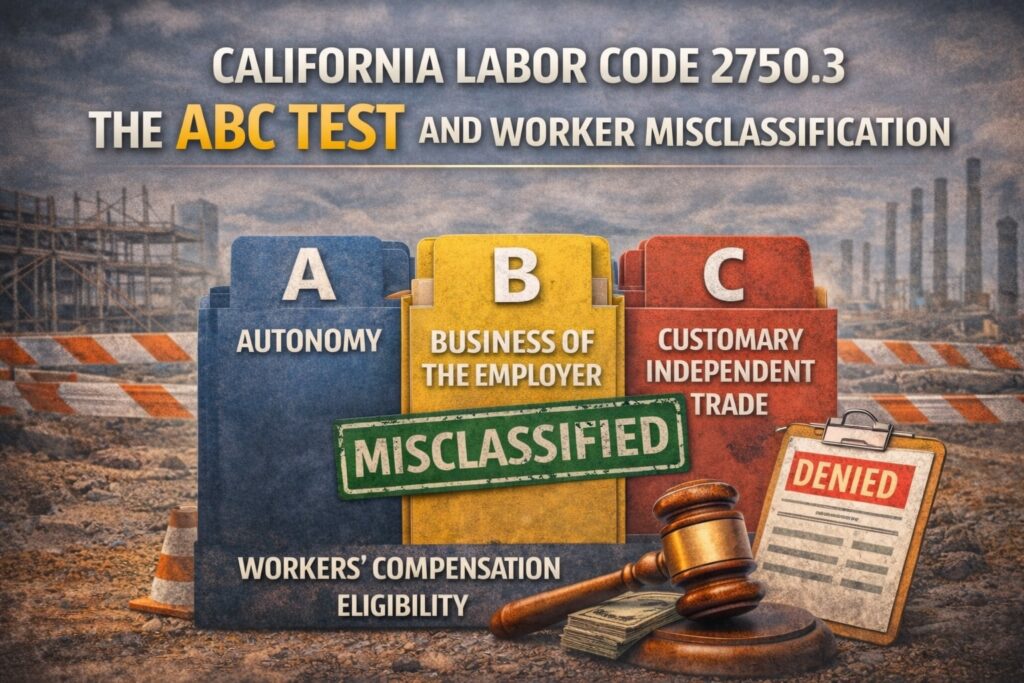
The ABC Test Explained
Under Labor Code 2750.3, a worker is presumed to be an employee unless the employer proves all three parts of the ABC test.
If the employer fails any one of these elements, the worker is treated as an employee.
A — Freedom From Control
The employer must show that the worker is free from its control and direction in performing the work.
This looks at real-world facts, such as:
- Who sets the schedule
- Who directs how the work is done
- Whether the worker must follow company rules or procedures
If the employer controls how, when, or where the work is performed, this element often fails.
B — Work Outside the Employer’s Usual Business
The employer must prove the worker performs work outside the usual course of the company’s business.
This is one of the hardest parts for employers to meet.
If a company:
- Uses the worker to perform its core services, or
- Relies on the worker to carry out its regular operations
the worker is often an employee — regardless of any contract language.
C — Independent Trade or Business
The employer must show that the worker is customarily engaged in an independently established trade or business of the same type.
Relevant factors include:
- Whether the worker advertises services to the public
- Whether they have multiple clients
- Whether they can suffer a profit or loss
- Whether they operate a separate business entity
A worker who depends primarily on one company for income often fails this prong.
How the ABC Test Affects Workers’ Compensation
The ABC test has major consequences in workers’ compensation cases.
If a worker is misclassified:
- The employer may still owe workers’ comp benefits
- The employer may be uninsured for comp purposes
- Additional penalties and exposure may apply
Misclassification does not eliminate workers’ compensation rights.
Common Industries Where Misclassification Is an Issue
Misclassification frequently arises in industries such as:
- Construction
- Trucking and delivery
- Rideshare and transportation
- Warehousing and logistics
- Gig economy work
- Home services and skilled trades
In many of these industries, workers perform the core business of the employer — making Part B of the ABC test especially difficult to satisfy.
Employers Cannot Avoid the ABC Test With Labels
Employers often argue that a worker is a contractor because:
- They issued a 1099
- The worker signed an independent contractor agreement
- The worker was paid per job or per project
None of these factors override Labor Code 2750.3.
Courts look at substance over form — what actually happens on the job.
What If My Workers’ Comp Claim Was Denied Because I’m a “Contractor”?
A denial based on contractor status is not the end of the case.
Many denials are overturned when:
- Control is proven
- The work is shown to be part of the employer’s business
- The worker lacks a true independent operation
Employee status disputes are legal questions that often require litigation.
Why These Cases Require Experienced Representation
Misclassification cases often overlap with:
- Uninsured employer claims
- Serious and willful misconduct
- Wage-and-hour violations
- Retaliation for reporting injuries
Insurance carriers and employers aggressively defend these cases because the financial exposure can be significant.
Early legal intervention matters.
Talk to a California Workers’ Compensation Lawyer
If you were injured on the job and told you are an “independent contractor,” do not assume the employer is right.
At WIN Injury & Accident Trial Lawyers, we represent injured workers in misclassification disputes and fight to secure the workers’ compensation benefits California law provides.
Workers’ Comp vs. Personal Injury: Key Differences
| Workers’ Comp | Personal Injury |
|---|---|
| No fault required | Fault must be proven |
| Limited benefits | Full damages available |
| No pain & suffering | Pain & suffering allowed |
| No jury | Jury trial available |
Get Help From WIN Injury & Accident Trial Lawyers
Why Legal Representation Matters
Insurance companies often undervalue pain and suffering—offering minimal settlements that ignore your daily struggles. A skilled attorney can:
- Present powerful evidence of your emotional and physical suffering
- Retain expert witnesses to quantify your losses
- Use verdict data to justify higher multipliers or per diem rates
- Argue your case persuasively before a jury
At WIN Trial Lawyers, our team fights to ensure that your recovery reflects the full extent of your suffering—not just your bills.

At WIN Trial Lawyers, we know how personal injury claims can be can be. Victims often face mounting medical bills, lost wages, and emotional trauma. Our team has successfully taken on insurance companies and third parties, recovering millions for injured clients.
If you or a loved one has been injured in an accident, don’t leave your future in the hands of the insurance company. You need experienced trial lawyers who know how to prove liability and fight for maximum compensation.
If you or a loved one has been injured, don’t face this alone. The sooner you act, the stronger your case will be.
🔗 Related Posts:
Frequently Asked Questions (FAQs): Labor Code 2750.3 – The ABC Test
What is Labor Code 2750.3?
California Labor Code 2750.3 establishes the ABC test, which determines whether a worker is an employee or an independent contractor. Under this law, workers are presumed to be employees unless the employer proves otherwise.
Why is Labor Code 2750.3 important in workers’ compensation cases?
Workers’ compensation benefits are generally only available to employees. Employers often rely on contractor labels to deny claims. Labor Code 2750.3 makes it much harder for employers to avoid workers’ comp responsibility through misclassification.
What is the ABC test?
The ABC test is a three-part test that employers must satisfy to classify a worker as an independent contractor. If the employer fails any one part, the worker is treated as an employee.
What does “A” stand for in the ABC test?
A — Autonomy.
The employer must show the worker is free from its control and direction, both in the contract and in actual practice.
If the employer sets schedules, gives instructions, or supervises the work, this prong often fails.
What does “B” stand for in the ABC test?
B — Business of the Employer.
The worker must perform work outside the usual course of the employer’s business.
This is the most common failure point. If a company hires workers to perform its core services, they are usually employees.
What does “C” stand for in the ABC test?
C — Customarily Engaged in an Independent Trade.
The worker must be engaged in a genuinely independent business of the same nature.
This includes factors such as:
- Multiple clients
- Advertising services
- Independent business operations
- Risk of profit or loss
Workers dependent on a single company often fail this prong.
Who has the burden of proof under the ABC test?
The employer.
The worker does not have to prove employee status. The employer must prove all three ABC elements to avoid employee classification.
Does the ABC test apply automatically in workers’ compensation cases?
Yes, in many misclassification disputes involving workers’ compensation, the ABC test is a central framework used to evaluate employee status.
Can an employer avoid the ABC test with a contract?
No.
Independent contractor agreements, 1099 forms, and written labels do not override Labor Code 2750.3. Courts look at what actually happens on the job.
Does being paid per job mean I’m a contractor?
No.
Payment structure alone does not determine classification. Many employees are paid per task, per project, or by piece rate.
What if I signed an independent contractor agreement?
Signing an agreement does not waive workers’ compensation rights. If the ABC test is not met, the worker may still be an employee.
What if my workers’ comp claim was denied because I’m a contractor?
A denial based on contractor status is not final. Many claims are later approved once misclassification is proven.
Can misclassified workers still receive workers’ compensation benefits?
Yes.
Misclassified workers may still be entitled to:
- Medical treatment
- Temporary disability benefits
- Permanent disability benefits
Misclassification does not eliminate coverage.
What industries commonly violate the ABC test?
Misclassification is common in:
- Construction
- Trucking and delivery
- Gig economy work
- Warehousing
- Home services
- Skilled trades
In these industries, workers often perform the employer’s core business functions.
How does Labor Code 2750.3 relate to uninsured employers?
If an employer misclassifies workers, they may also fail to carry workers’ compensation insurance — exposing them to separate penalties and liability.
Can misclassification increase the value of a workers’ comp case?
Yes.
Misclassification can lead to:
- Employer-paid benefits
- Uninsured employer exposure
- Additional penalties
- Greater settlement leverage
Can employers retaliate if I challenge misclassification?
No.
Retaliation for asserting workers’ compensation rights or employee status is illegal and may create separate claims.
How long do I have to challenge misclassification?
Strict deadlines apply in workers’ compensation cases. Delaying action can permanently harm your rights.
What evidence helps prove misclassification?
Common evidence includes:
- Work schedules
- Supervisor instructions
- Required uniforms or tools
- Company training materials
- Pay records
- Witness testimony
Who decides ABC test disputes?
Ultimately, the Workers’ Compensation Appeals Board (WCAB) decides classification disputes based on the evidence.
Should I talk to a lawyer about ABC test issues?
Yes.
Misclassification cases are aggressively defended by employers and insurers. Early legal guidance is critical.
How can WIN Injury & Accident Trial Lawyers help?
WIN represents injured workers in:
- ABC test disputes
- Misclassification cases
- Denied workers’ comp claims
- Uninsured employer cases
We focus on forcing employers and insurers to comply with California law.