
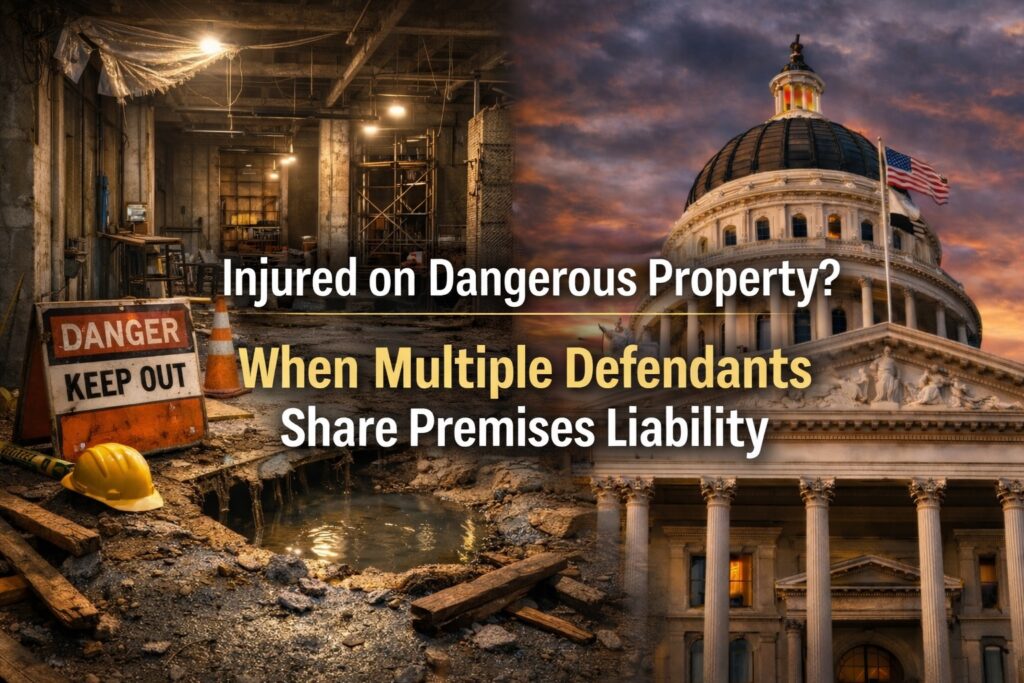
Slip-and-fall accidents, negligent security claims, and other dangerous-property injuries are rarely as simple as “one bad owner.” In many California premises liability cases, multiple defendants share responsibility for the same unsafe condition.
Commercial and residential properties are often controlled by layers of owners, managers, tenants, and contractors. When an injury occurs, California law allows all responsible parties to be held accountable — not just the most visible one.
Premises Liability Isn’t Always a One-Defendant Case
Modern properties involve overlapping control:
- Property owners who retain ultimate responsibility
- Management companies tasked with inspections and repairs
- Tenants or businesses controlling daily operations
- Contractors hired to maintain, repair, or secure the premises
When more than one party had the ability to prevent the harm, liability may be shared.
The Primary Question in Shared Premises Liability Cases
When multiple defendants are involved, the case does not turn on who held title to the property or whose name appeared on the lease.
The primary question in these cases is this:
Who had the ability to discover the dangerous condition and the authority to fix it or warn about it?
California premises liability law focuses on control, knowledge, and responsibility — not finger-pointing.
A defendant cannot avoid liability simply by saying:
- “Another company handled maintenance,” or
- “We didn’t personally create the hazard.”
If a party had control over the area, knowledge of the danger (actual or constructive), or the practical or contractual authority to correct it, that party may share responsibility — even if others were also involved.
The Legal Standard: Control, Knowledge, and Duty
Under California law, a defendant may be liable if it:
- Owned, leased, occupied, or controlled the property
- Knew or reasonably should have known of the dangerous condition
- Failed to take reasonable steps to repair, secure, or warn
Multiple parties can satisfy this standard at the same time, which is why premises cases often expand beyond a single defendant.
Common Situations Where Liability Is Shared
Shared premises liability frequently arises in:
- Shopping centers and strip malls
- Apartment complexes and HOAs
- Hotels and resorts
- Parking structures and garages
- Office buildings and industrial properties
For example, a broken stairway might implicate the owner, the management company, and the contractor responsible for prior repairs.
Joint and Several Liability Protects Injured Victims
California applies joint and several liability to economic damages in personal injury cases.
This means:
- Each defendant may be responsible for the full amount of economic damages
- Fault is allocated among defendants, but the injured person is not penalized if one party lacks insurance or assets
This framework prevents defendants from escaping responsibility by spreading blame across multiple entities.
Why Defendants Blame Each Other — and Why That Often Helps Plaintiffs
In multi-defendant premises cases, defendants commonly argue:
- “We didn’t control that area.”
- “Maintenance was outsourced.”
- “The tenant was responsible.”
- “The owner failed to approve repairs.”
These arguments often backfire. They frequently establish overlapping control and confirm that more than one party knew about — or should have addressed — the dangerous condition.
Why Early Investigation Matters
Shared-liability cases depend on early, aggressive investigation. Key evidence can disappear quickly, including:
- Maintenance logs and inspection records
- Management and vendor contracts
- Surveillance footage
- Prior incident reports and complaints
Identifying all responsible parties early preserves leverage and prevents defendants from reshaping the narrative later.
Why Multi-Defendant Premises Cases Are More Complex — and Often More Valuable
Cases involving multiple defendants often include:
- Larger combined insurance policies
- Greater settlement leverage
- More aggressive defense coordination
They also require precision. Failing to identify a responsible party early can limit recovery and complicate litigation.
How WIN Injury & Accident Trial Lawyers Handles Shared Liability Cases
At WIN Injury & Accident Trial Lawyers, we don’t stop with the obvious defendant. Our team digs into:
- Ownership and control structures
- Property management agreements
- Maintenance and security contracts
- Prior safety complaints and violations
We pursue every entity that contributed to the unsafe condition, ensuring our clients are not under-compensated because responsibility was divided behind the scenes.
Injured on Someone Else’s Property? We’ll Identify Every Responsible Party.
If you were hurt on a dangerous property, you don’t have to guess who’s responsible — that’s our job.
📞 Contact WIN Injury & Accident Trial Lawyers for a free consultation.
We’ll uncover every liable party and fight to hold them accountable.
Get Help From WIN Injury & Accident Trial Lawyers
Why Legal Representation Matters
Insurance companies often undervalue pain and suffering—offering minimal settlements that ignore your daily struggles. A skilled attorney can:
- Present powerful evidence of your emotional and physical suffering
- Retain expert witnesses to quantify your losses
- Use verdict data to justify higher multipliers or per diem rates
- Argue your case persuasively before a jury
At WIN Trial Lawyers, our team fights to ensure that your recovery reflects the full extent of your suffering—not just your bills.

At WIN Trial Lawyers, we know how personal injury claims can be can be. Victims often face mounting medical bills, lost wages, and emotional trauma. Our team has successfully taken on insurance companies and third parties, recovering millions for injured clients.
If you or a loved one has been injured in an accident, don’t leave your future in the hands of the insurance company. You need experienced trial lawyers who know how to prove liability and fight for maximum compensation.
If you or a loved one has been injured, don’t face this alone. The sooner you act, the stronger your case will be.