
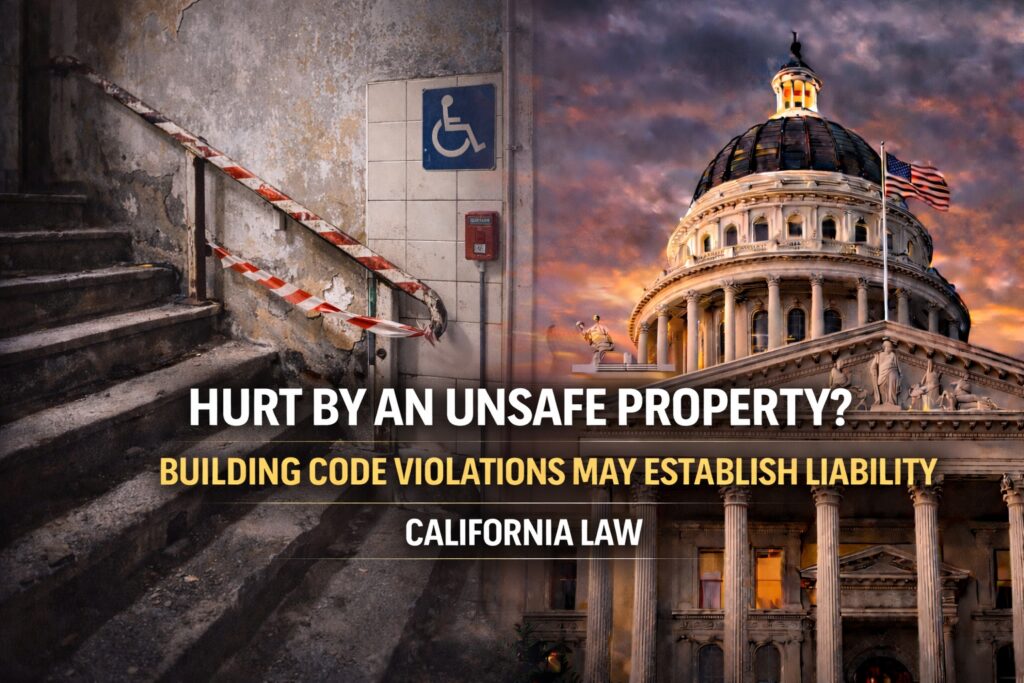
Some premises liability cases do not depend on debating what was “reasonable.” Instead, liability is established because a property owner violated a safety law designed to protect the public.
Under California law, violations of building, fire, safety, or accessibility codes may constitute negligence per se—meaning the law itself establishes breach of duty when specific conditions are met.
At WIN Injury & Accident Trial Lawyers, we routinely use code violations to prove premises liability claims involving unsafe buildings, inaccessible facilities, and preventable injuries.
What Is Negligence Per Se in Premises Liability?
Negligence per se is a legal doctrine that applies when:
- A defendant violated a statute, regulation, or ordinance
- The law was designed to prevent the type of injury that occurred
- The injured person was within the class the law was meant to protect
- The violation was a substantial factor in causing the injury
When these elements are met, the violation replaces the need to prove ordinary negligence as to breach of duty.
Common Codes That Create Premises Liability Exposure
Premises liability claims based on negligence per se often involve violations of:
- Building codes (structural safety, stairs, handrails, guards)
- Fire codes (exits, alarms, sprinklers, emergency lighting)
- Accessibility laws (ADA requirements and California accessibility standards)
- Electrical and lighting codes
- Local municipal safety ordinances
Failure to comply with these requirements can establish liability even without prior complaints or notice.
Title 24 and California Safety Regulations
California’s Title 24 regulations govern building standards, including:
- Stairway and handrail dimensions
- Guardrail height and spacing
- Lighting requirements
- Means of egress
- Accessibility features
Violations of these standards frequently appear in serious slip-and-fall, trip-and-fall, and fall-from-height cases.
Accessibility Violations and Premises Liability
Failure to comply with accessibility requirements can expose property owners and operators to liability when injuries result from:
- Missing or non-compliant ramps
- Improper slope or surface conditions
- Inadequate handrails
- Obstructed accessible paths of travel
- Unsafe restroom or entry configurations
Accessibility laws are intended to protect individuals with disabilities—but everyone lawfully on the property may be protected when a violation creates a hazard.
The Core Question in Code-Violation Premises Cases
Every negligence-per-se premises case turns on this question:
Did the defendant violate a safety code that was designed to prevent the type of injury that occurred?
If the answer is yes, the code violation itself may establish liability.
Common Injury Scenarios Involving Code Violations
Negligence per se claims commonly arise from:
- Falls on non-compliant stairs
- Missing or improper handrails
- Inadequate lighting in stairwells or walkways
- Blocked or unsafe exits
- Fire-related injuries due to code non-compliance
- Falls involving non-compliant ramps or surfaces
These cases are often strengthened by expert inspections and code analysis.
Who Can Be Held Liable for Code Violations?
Liability may extend to:
- Property owners
- Landlords
- Commercial tenants
- Business operators
- Property management companies
- HOAs
- Contractors who performed non-compliant work
Responsibility depends on control, ownership, and role in creating or maintaining the violation.
Common Defenses Raised in Negligence Per Se Cases
Defendants often argue:
- The code does not apply
- The violation was minor or technical
- The code was adopted after construction
- The violation did not cause the injury
These defenses are fact-specific and often defeated through expert testimony and records analysis.
Why Negligence Per Se Is Powerful in Premises Liability
Using code violations:
- Simplifies jury analysis
- Anchors liability to objective safety standards
- Reduces disputes over “reasonableness”
- Increases settlement leverage
- Strengthens expert testimony
Courts and juries take safety codes seriously—because lawmakers enacted them to prevent injuries.
How WIN Proves Code-Violation Premises Liability Cases
At WIN Injury & Accident Trial Lawyers, we:
- Conduct on-site inspections
- Retain building and safety experts
- Identify applicable codes and ordinances
- Establish causation between the violation and injury
- Pursue all responsible parties
We don’t rely on vague safety arguments—we prove specific violations.
Frequently Asked Questions
Does any code violation automatically create liability?
No. The violation must be tied to the injury and the statute’s purpose.
Can older buildings still be liable?
Yes. Some codes apply retroactively; others depend on renovations or changes in use.
Can negligence per se apply alongside ordinary negligence?
Yes. These claims are often pleaded together.
Who decides whether a code applies?
Judges decide applicability; juries decide causation and damages.
Injured Due to a Building or Safety Code Violation? WIN Can Help.
If you were injured because a property owner or operator failed to comply with building, safety, or accessibility codes, you may have a strong negligence per se premises liability claim.
WIN Injury & Accident Trial Lawyers represents injured people statewide in serious premises liability cases.
📞 Contact us today for a confidential consultation.
Get Help From WIN Injury & Accident Trial Lawyers
Why Legal Representation Matters
Insurance companies often undervalue pain and suffering—offering minimal settlements that ignore your daily struggles. A skilled attorney can:
- Present powerful evidence of your emotional and physical suffering
- Retain expert witnesses to quantify your losses
- Use verdict data to justify higher multipliers or per diem rates
- Argue your case persuasively before a jury
At WIN Trial Lawyers, our team fights to ensure that your recovery reflects the full extent of your suffering—not just your bills.

At WIN Trial Lawyers, we know how personal injury claims can be can be. Victims often face mounting medical bills, lost wages, and emotional trauma. Our team has successfully taken on insurance companies and third parties, recovering millions for injured clients.
If you or a loved one has been injured in an accident, don’t leave your future in the hands of the insurance company. You need experienced trial lawyers who know how to prove liability and fight for maximum compensation.
If you or a loved one has been injured, don’t face this alone. The sooner you act, the stronger your case will be.