

Delivery trucks are everywhere—on freeways, residential streets, and busy commercial corridors. With the rise of same-day and next-day delivery, delivery truck accidents have increased across California, often resulting in serious injuries to drivers, pedestrians, cyclists, and occupants of passenger vehicles.
At WIN Injury & Accident Trial Lawyers, we represent individuals injured in delivery truck and commercial vehicle accidents. These cases are more complex than ordinary car crashes and require early, aggressive investigation.
Why Delivery Truck Accidents Are Especially Dangerous
Delivery trucks—such as box trucks, step vans, and cargo vans—pose unique and elevated risks compared to ordinary passenger vehicles. Their size, weight, and operating patterns significantly increase the likelihood of serious injury when a crash occurs.
Several factors make delivery truck collisions especially dangerous:
- Limited Visibility and Large Blind Spots
Delivery trucks often have substantial blind spots on all sides, particularly along the sides and rear. Smaller vehicles, cyclists, and pedestrians can easily disappear from a driver’s field of vision. - Longer Stopping Distances
Due to their weight and braking systems, delivery trucks require far more distance to stop than passenger cars—especially when fully loaded. Sudden stops in traffic can quickly turn into high-impact collisions. - Frequent Lane Changes and Curbside Stops
Delivery drivers are constantly maneuvering between lanes, pulling to the curb, backing up, or reentering traffic. These movements increase the risk of side-impact and rear-end collisions. - Drivers Under Tight Delivery Deadlines
Many delivery drivers work under intense time pressure to meet quotas or delivery windows. This pressure can encourage speeding, rolling stops, or risky driving decisions. - Operation in Residential and Pedestrian-Heavy Areas
Unlike long-haul trucks, delivery vehicles often operate on narrow residential streets, near schools, shopping areas, and apartment complexes—placing pedestrians and cyclists at heightened risk.
When a delivery truck collides with a smaller vehicle or a person on foot, the disparity in size and force often leads to catastrophic injuries.
Common Causes of Delivery Truck Accidents
Many delivery truck accidents are preventable and stem from negligence, inadequate safety practices, or corporate pressure. Common causes include:
- Driver Fatigue
Long shifts, early morning starts, and demanding delivery schedules can lead to exhausted drivers with slowed reaction times and impaired judgment. - Distracted Driving
Delivery drivers frequently rely on GPS devices, mobile apps, scanning addresses, or communicating with dispatch—often while driving. - Speeding and Unsafe Lane Changes
Attempts to stay on schedule may result in speeding, tailgating, or abrupt lane changes, especially on freeways and busy city streets. - Improper Parking or Blocking Traffic Lanes
Double-parking, stopping in bike lanes, or blocking travel lanes increases the risk of rear-end crashes and pedestrian injuries. - Inadequate Training or Supervision
Some delivery drivers receive minimal training, particularly when hired quickly during high-demand periods. - Poor Vehicle Maintenance
Worn brakes, bald tires, malfunctioning lights, or steering issues can all contribute to preventable crashes.
In many cases, delivery company policies and performance quotas directly contribute to unsafe driving behavior, even if the company later denies responsibility.
Common Injuries in Delivery Truck Accidents
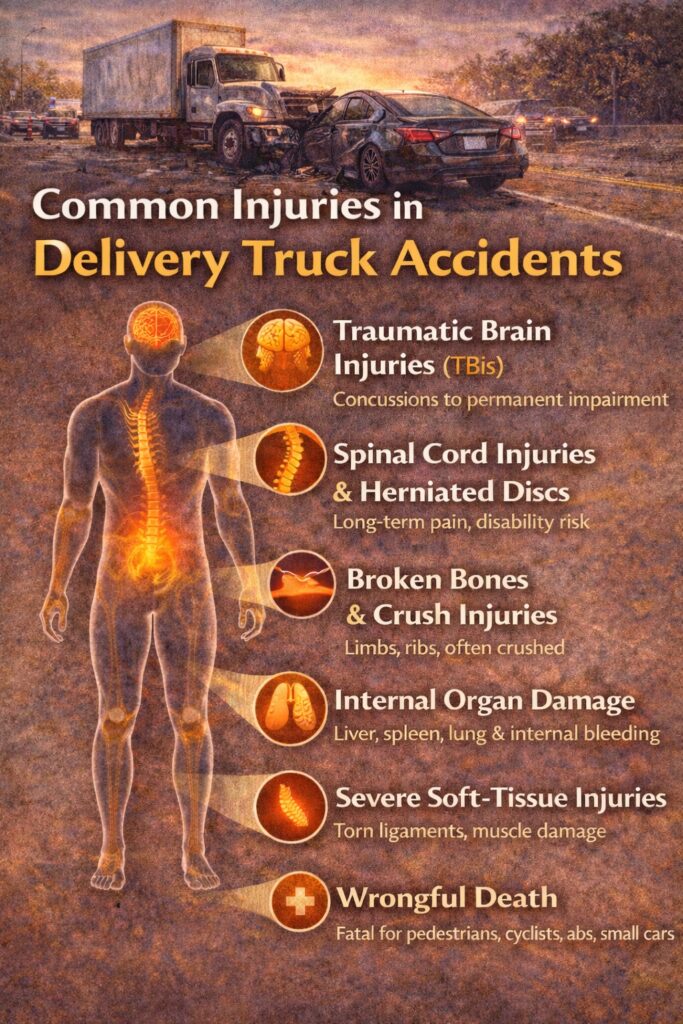
Due to the force and mechanics involved, delivery truck accidents often result in severe or life-altering injuries. Common injuries include:
- Traumatic Brain Injuries (TBIs)
Ranging from concussions to permanent cognitive impairment, even when airbags deploy. - Spinal Cord Injuries and Herniated Discs
These injuries can cause chronic pain, mobility limitations, or permanent disability. - Broken Bones and Crush Injuries
Arms, legs, ribs, and hips are especially vulnerable in side-impact or underride collisions. - Internal Organ Damage
Liver, spleen, lung, and internal bleeding injuries may not be immediately apparent but can be life-threatening. - Severe Soft-Tissue Injuries
Torn ligaments, muscle damage, and joint injuries often require extensive physical therapy. - Wrongful Death
Tragically, delivery truck crashes can be fatal—particularly for pedestrians, cyclists, and occupants of smaller vehicles.
Recovery from these injuries often involves surgery, hospitalization, long-term rehabilitation, and significant time away from work, with lasting financial and emotional consequences.
Who Can Be Held Liable After a Delivery Truck Accident?
Unlike standard car accidents, delivery truck cases may involve multiple responsible parties, including:
The Delivery Driver
If the driver was speeding, distracted, fatigued, or otherwise negligent.
The Delivery Company or Employer
Companies may be liable for:
- Unsafe delivery schedules
- Inadequate training or supervision
- Failure to maintain vehicles
- Negligent hiring practices
Third-Party Contractors
Many delivery drivers are classified as independent contractors, but that does not automatically shield companies from liability.
Vehicle Owners or Maintenance Providers
If mechanical failure or poor maintenance contributed to the crash.
Determining who controlled the driver, vehicle, and delivery schedule is a critical part of these cases.
Delivery Truck vs. Rideshare or Amazon-Style Vehicles
Delivery truck accidents often involve:
- Box trucks or step vans
- Cargo vans used for last-mile delivery
- Third-party logistics providers
These cases may raise issues involving commercial insurance policies, employment classification, and federal or state safety regulations—all of which can impact recovery.
What to Do After a Delivery Truck Accident
If you are injured in a delivery truck crash:
- Seek immediate medical attention
- Call law enforcement and ensure a report is made
- Photograph the vehicles, company markings, and scene
- Get witness contact information
- Avoid recorded statements to delivery company insurers without legal guidance
- Consult a truck accident attorney early
Critical evidence—such as driver logs, GPS data, and delivery schedules—can be lost quickly if not preserved.
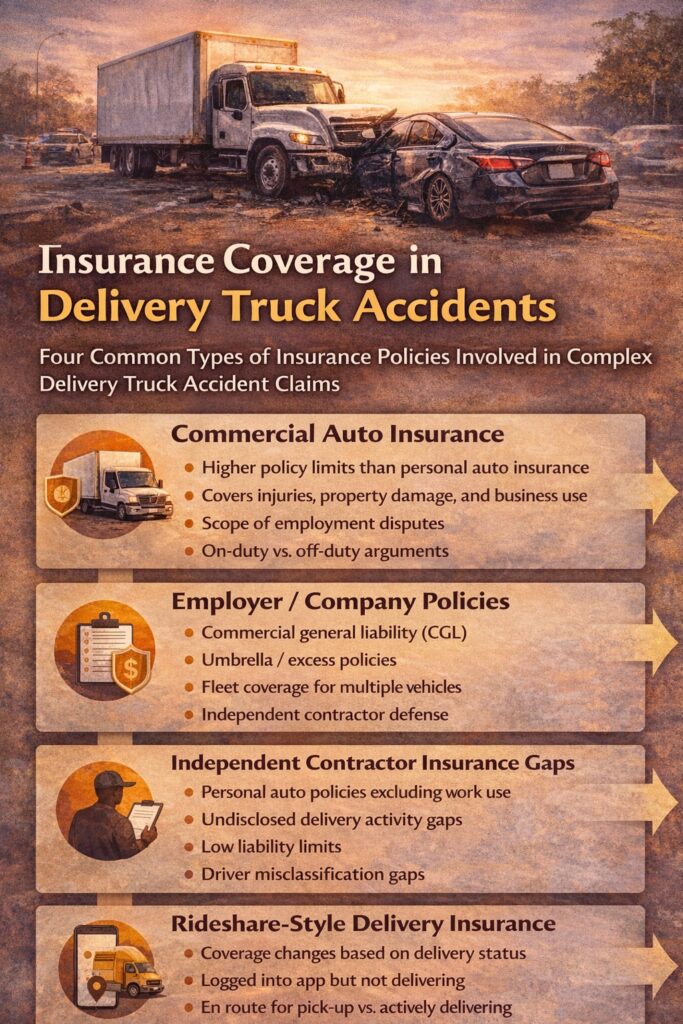
Commercial Auto Insurance Policies
Most delivery trucks are required to carry commercial auto insurance, which generally provides significantly higher limits than a personal auto policy.
These policies may cover:
- Bodily injury to other drivers, pedestrians, or cyclists
- Property damage
- Injuries caused while the vehicle is being used for business purposes
Typical Commercial Auto Policy Limits
While coverage varies by carrier and vehicle type, common limits include:
- $750,000 (federal minimum for many interstate commercial vehicles)
- $1,000,000 per occurrence (very common for delivery trucks and box trucks)
- $2,000,000 or more for larger fleets or higher-risk operations
Despite these higher limits, insurers frequently dispute:
- Whether the driver was on duty at the time of the crash
- Whether the delivery was within the scope of employment
- Which policy is primary vs. excess
These disputes are often used to delay payment or reduce payouts.
Employer and Company Insurance Policies
Delivery companies frequently carry additional layers of insurance beyond basic commercial auto coverage. These policies can dramatically increase available compensation—but are rarely disclosed voluntarily.
Common company policies include:
Commercial General Liability (CGL)
- Often provides $1,000,000 per occurrence
- May apply to negligent hiring, supervision, or unsafe delivery practices
Umbrella or Excess Insurance Policies
- Typically provide $1,000,000 to $10,000,000+ in additional coverage
- Sit on top of commercial auto or CGL policies
- Triggered in catastrophic injury cases
Fleet Insurance Policies
- Cover multiple vehicles under a single policy
- Often used by regional or national delivery companies
- May involve multiple insurers and layered coverage structures
Companies frequently attempt to avoid these policies by labeling drivers as independent contractors, even when company control is substantial.
Independent Contractor Coverage Gaps
Many delivery drivers are classified as independent contractors and required to carry their own insurance. This often creates dangerous coverage gaps, especially when:
- A personal auto policy excludes commercial or delivery use
- The driver failed to disclose delivery work to their insurer
- The company’s policy denies coverage based on contractor status
Typical Personal Auto Policy Limits
When only personal auto insurance applies, limits are often much lower:
- $15,000 per person / $30,000 per accident (California minimum)
- $50,000 – $100,000 common individual policies
These limits are frequently insufficient to cover serious injuries, leaving victims undercompensated unless additional coverage is identified.
Rideshare-Style or “App-Based” Delivery Insurance
Some delivery companies use app-based insurance models, where coverage depends on the driver’s status at the time of the crash.
Coverage often changes depending on whether the driver was:
- Logged into the app but not accepting deliveries
- En route to pick up a delivery
- Actively making a delivery
Typical App-Based Coverage Tiers
- Offline / Not logged in: Driver’s personal auto insurance only
- Logged in but idle: Limited contingent coverage (often $50,000–$100,000)
- Active delivery: Commercial coverage up to $1,000,000
Because coverage hinges on precise timing, digital evidence—such as GPS data, app logs, and delivery timestamps—is often decisive.
Why Insurance Disputes Are So Common
Insurance companies frequently contest delivery truck claims by arguing:
- The wrong policy applies
- Coverage limits are lower than claimed
- The driver was acting outside the scope of work
- Another insurer is responsible
These arguments are often coordinated across multiple carriers to delay resolution and pressure injured victims into low settlements.
Why Early Legal Investigation Matters
An experienced delivery truck accident attorney can:
- Identify all applicable insurance policies
- Uncover umbrella and excess coverage
- Preserve driver logs, GPS data, and app activity
- Challenge improper coverage denials
- Force disclosure of policies insurers do not volunteer
Early investigation often determines whether a case is limited to minimum coverage or supported by seven-figure insurance layers.
Why Early Legal Help Matters
Delivery truck accident cases are heavily defended by insurers and corporate legal teams. An experienced attorney can:
- Identify all liable parties
- Preserve electronic and company records
- Analyze employment and contractor relationships
- Handle complex insurance coverage issues
- Fight for full compensation for medical bills, lost income, and long-term harm
Our Commitment at WIN Injury & Accident Trial Lawyers
At WIN Injury & Accident Trial Lawyers, we represent victims of delivery truck and commercial vehicle accidents throughout California. We understand the tactics used by delivery companies and their insurers—and we know how to hold them accountable.
If you or a loved one has been injured in a delivery truck accident, our team is here to help you understand your rights and next steps.
Get Help From WIN Injury & Accident Trial Lawyers
Why Legal Representation Matters
Insurance companies often undervalue pain and suffering—offering minimal settlements that ignore your daily struggles. A skilled attorney can:
- Present powerful evidence of your emotional and physical suffering
- Retain expert witnesses to quantify your losses
- Use verdict data to justify higher multipliers or per diem rates
- Argue your case persuasively before a jury
At WIN Trial Lawyers, our team fights to ensure that your recovery reflects the full extent of your suffering—not just your bills.

At WIN Trial Lawyers, we know how personal injury claims can be can be. Victims often face mounting medical bills, lost wages, and emotional trauma. Our team has successfully taken on insurance companies and third parties, recovering millions for injured clients.
If you or a loved one has been injured in an accident, don’t leave your future in the hands of the insurance company. You need experienced trial lawyers who know how to prove liability and fight for maximum compensation.
If you or a loved one has been injured, don’t face this alone. The sooner you act, the stronger your case will be.
🔗 Related Posts:
Frequently Asked Questions (FAQs)
What qualifies as a delivery truck accident?
A delivery truck accident involves a vehicle being used for commercial delivery purposes, such as a box truck, cargo van, step van, or app-based delivery vehicle. These crashes can occur on freeways, residential streets, parking lots, or during curbside deliveries.
Are delivery truck accidents different from regular car accidents?
Yes. Delivery truck accidents often involve commercial insurance policies, corporate defendants, and multiple layers of liability, making them more complex than standard car accidents.
Who can be held responsible in a delivery truck accident?
Depending on the facts, responsible parties may include:
- The delivery driver
- The delivery company or employer
- A third-party logistics provider
- The vehicle owner or maintenance company
- A manufacturer, if a defect played a role
More than one party may share liability.
What if the delivery driver is an independent contractor?
Independent contractor status does not automatically eliminate company liability. Courts look at who controlled the driver’s schedule, routes, vehicle, and work conditions—not just the label used by the company.
What insurance coverage applies to delivery trucks?
Coverage may include:
- Commercial auto insurance
- Company fleet or umbrella policies
- Commercial general liability (CGL) coverage
- App-based or rideshare-style delivery insurance
Coverage disputes are common, especially over whether the driver was “on duty” at the time of the crash.
Can insurance companies deny coverage if the driver was off duty?
Insurers often try to deny or limit coverage by arguing the driver was off duty or outside the scope of work. Digital evidence—such as GPS data, delivery logs, and app status—often determines whether coverage applies.
What if the delivery driver’s personal auto policy applies?
Personal auto policies frequently exclude commercial use, which can create coverage gaps. In these situations, identifying company or umbrella coverage becomes especially important.
What injuries are common in delivery truck accidents?
Common injuries include:
- Traumatic brain injuries (TBIs)
- Back and spinal injuries
- Broken bones and crush injuries
- Internal organ damage
- Long-term or permanent disability
These injuries often require extended medical treatment and rehabilitation.
What should I do immediately after a delivery truck accident?
You should:
- Seek medical care right away
- Call law enforcement and obtain a report
- Photograph the vehicles, company markings, and scene
- Gather witness information
- Avoid recorded statements to insurers without legal guidance
Early steps can significantly affect your claim.
How long do I have to file a claim in California?
Deadlines depend on the type of claim and parties involved. Some cases—especially those involving public entities—have shortened notice requirements. Acting early helps preserve your rights.
Why is early legal investigation important in delivery truck cases?
Critical evidence such as driver logs, GPS data, app activity, maintenance records, and insurance policies can be lost or overwritten quickly. Early investigation helps ensure all liable parties and coverage sources are identified.
What if the delivery truck was parked illegally when the accident happened?
Improper parking—such as double parking, blocking bike lanes, or stopping in travel lanes—can establish negligence. Delivery companies and drivers may still be liable even if the truck was stationary.
Can pedestrians or cyclists file claims after a delivery truck accident?
Yes. Pedestrians and cyclists injured by delivery trucks often have strong claims due to visibility issues, right-of-way violations, and unsafe stopping practices common with delivery vehicles.
What if multiple insurance companies are involved?
Delivery truck cases often involve several insurers arguing over who is responsible. While insurers dispute coverage, injured victims can face delays—making early legal intervention critical to force coordination and disclosure.
Does it matter what kind of delivery truck was involved?
Yes. Liability and insurance coverage can vary depending on whether the vehicle was:
- A box truck or step van
- A cargo van
- A personally owned vehicle used for deliveries
- An app-based or fleet-owned vehicle
Each scenario can trigger different policies and coverage limits.
What if the delivery company claims the driver was off duty?
Companies often argue the driver was off duty to avoid liability. Evidence such as GPS data, delivery logs, app activity, and dispatch records is often used to challenge these claims.
Can delivery companies be held responsible for unrealistic delivery quotas?
Potentially, yes. If company policies or delivery quotas encourage unsafe driving—such as speeding or skipping rest breaks—that evidence may support liability claims against the company.
What if my injuries don’t show up right away?
Delayed symptoms are common after serious crashes, especially with head, neck, and spinal injuries. Seeking medical care promptly and documenting symptoms as they appear is critical.
Can passengers in another vehicle file a claim?
Yes. Passengers injured in delivery truck accidents typically have claims independent of the driver and may pursue compensation from all responsible parties.
What damages may be recoverable after a delivery truck accident?
Depending on the case, damages may include:
- Medical expenses (past and future)
- Lost wages and loss of earning capacity
- Pain and suffering
- Permanent disability
- Wrongful death damages for surviving family members
Why are delivery truck accident cases often harder to resolve?
These cases involve corporate defendants, layered insurance coverage, and aggressive defense strategies. Without thorough investigation, victims risk being pushed into low settlements.