

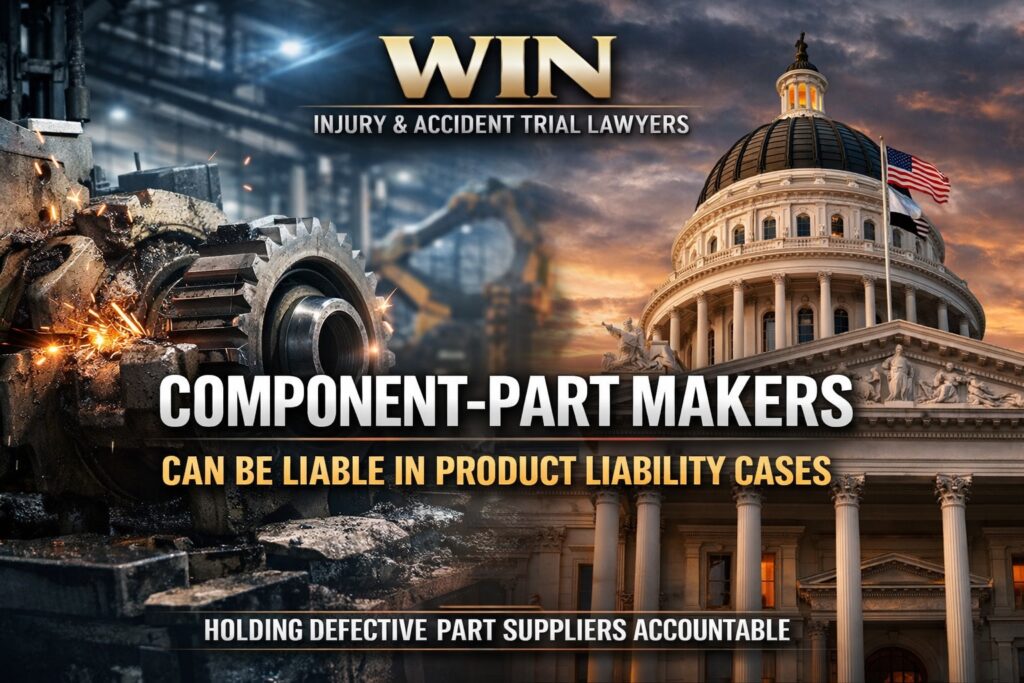
When a product causes serious injury, manufacturers often try to shift blame—especially when the failure involves a component part made by another company. But under California products liability law, component-part manufacturers can absolutely be held responsible when their parts are defective or unreasonably dangerous.
At WIN Injury & Accident Trial Lawyers, we routinely pursue claims not just against the final product manufacturer, but against every entity in the chain of distribution, including component-part makers whose defective parts cause catastrophic injuries.
What Is a Component-Part Manufacturer?
A component-part manufacturer is a company that designs, manufactures, or supplies a part that is later incorporated into a finished product. Examples include:
- Brakes, airbags, or steering components in vehicles
- Motors, switches, or sensors in industrial machinery
- Valves, seals, or pressure regulators in equipment
- Electrical components in consumer products
- Structural or load-bearing parts in tools or devices
If a component part fails—and that failure causes injury—the company that made the part may be liable.
The Key Legal Question
In component-part cases, the core issue is:
Was the component itself defective or unreasonably dangerous when it left the component manufacturer’s control?
If the answer is yes, liability can attach—even if another company assembled the final product.
When Component-Part Makers Are Liable
1. Defective Component Design or Manufacturing
A component-part maker may be held strictly liable when:
- The part was manufactured incorrectly
- The design made the part inherently unsafe
- The part failed under foreseeable use
- The defect existed before integration into the final product
If the component malfunctions exactly as designed—but that design is unsafe—the component maker can still be liable.
2. Failure to Warn About Known Dangers
Component-part manufacturers also have a duty to warn when they:
- Know (or should know) the part poses dangers
- Understand how the part will be used in the final product
- Fail to warn the assembler or end users of non-obvious risks
A “silent” component that introduces hidden dangers can be just as deadly as a visibly defective one.
3. Substantial Participation in the Final Product’s Design
A component-part maker cannot escape liability by saying “we just made the part” if it:
- Helped design how the part would function in the final product
- Customized the component for a specific application
- Knew the final product’s intended use and risks
- Played a meaningful role in safety-critical decisions
The more involvement a component maker has, the stronger the liability case.
When Component-Part Makers Try to Avoid Responsibility
Defendants often argue:
- “The final manufacturer misused the part”
- “The assembler installed it incorrectly”
- “We had no control over the finished product”
- “The danger came from integration, not our component”
These defenses do not automatically defeat liability. Courts look closely at foreseeability, design responsibility, warnings, and whether the component was safe for its intended use.
Real-World Examples of Component-Part Liability
Component-part claims commonly arise in cases involving:
- Industrial machinery and manufacturing equipment
- Automotive crashes caused by part failures
- Product explosions or mechanical failures
- Electrical fires and burn injuries
- Tools, appliances, and consumer products
In many catastrophic injury cases, the component manufacturer is the only party with the resources or insurance coverage necessary to fully compensate the victim.
Why These Cases Matter for Injured Consumers
Holding component-part makers accountable:
- Expands the pool of responsible defendants
- Prevents manufacturers from hiding behind suppliers
- Forces safer component design across industries
- Increases the likelihood of full financial recovery
From a litigation standpoint, these cases require technical expertise, expert witnesses, and aggressive discovery—all areas where WIN excels.
How WIN Approaches Component-Part Product Liability Cases
At WIN Injury & Accident Trial Lawyers, we:
- Trace defects through the entire supply chain
- Retain engineering and industry experts early
- Analyze design responsibility and failure modes
- Pursue strict liability, negligence, and failure-to-warn claims
- Refuse to let manufacturers shift blame onto injured victims
If a defective component played any role in causing harm, we pursue accountability—no matter how complex the manufacturing chain.
Frequently Asked Questions
Can a component-part maker be liable even if another company assembled the product?
Yes. If the component was defective or unreasonably dangerous when supplied, liability may attach.
What if the final manufacturer modified the component?
Modification does not automatically absolve the component maker. Courts analyze foreseeability and design responsibility.
Do component-part cases require expert testimony?
Almost always. Engineering, human-factors, and materials experts are critical.
Can multiple companies be liable at once?
Yes. California law allows liability against multiple entities in the chain of distribution.
Who Can Be Held Responsible in a Products Liability Case?
| Entity | How They May Be Liable |
|---|---|
| Manufacturers | Liable for defects in design, manufacturing, or failure to warn when the product is unsafe as intended or foreseeably used. |
| Component-Part Makers | Liable when a defective component causes injury, or when they fail to warn about dangers associated with the part’s intended use. |
| Distributors & Suppliers | Liable for placing defective products into the stream of commerce, even if they did not manufacture the product. |
| Wholesalers & Retailers | Liable for selling defective products to consumers, regardless of fault or knowledge of the defect. |
| Importers | Liable for bringing unsafe foreign-made products into the U.S. market and ensuring compliance with safety and warning requirements. |
Injured by a Defective Product? We Can Help.
If you were injured by a product that failed—even if the defect came from a hidden component—you may have powerful legal claims.
WIN Injury & Accident Trial Lawyers handles complex product liability cases statewide, including those involving component-part manufacturers.
📞 Contact us today for a confidential consultation.
Get Help From WIN Injury & Accident Trial Lawyers
Why Legal Representation Matters
Insurance companies often undervalue pain and suffering—offering minimal settlements that ignore your daily struggles. A skilled attorney can:
- Present powerful evidence of your emotional and physical suffering
- Retain expert witnesses to quantify your losses
- Use verdict data to justify higher multipliers or per diem rates
- Argue your case persuasively before a jury
At WIN Trial Lawyers, our team fights to ensure that your recovery reflects the full extent of your suffering—not just your bills.

At WIN Trial Lawyers, we know how personal injury claims can be can be. Victims often face mounting medical bills, lost wages, and emotional trauma. Our team has successfully taken on insurance companies and third parties, recovering millions for injured clients.
If you or a loved one has been injured in an accident, don’t leave your future in the hands of the insurance company. You need experienced trial lawyers who know how to prove liability and fight for maximum compensation.
If you or a loved one has been injured, don’t face this alone. The sooner you act, the stronger your case will be.