When you’re involved in a car accident in California, one of the first questions that comes up is:
“What if I was partially at fault?”
The good news: California uses a pure comparative negligence system — one of the most consumer-friendly fault systems in the country. That means you can still recover money for your injuries even if you were mostly at fault, as long as someone else contributed to the crash.
At WIN Trial Lawyers, we explain this rule to clients every day, because understanding how fault works can dramatically increase the value of your personal injury claim.
What Is Comparative Negligence?
ComparatComparative negligence is a legal rule used to determine how responsibility is shared when more than one person contributes to a car accident. Instead of placing all the blame on one driver, the law assigns a percentage of fault to each party involved based on their actions leading up to the crash.
Your total compensation is then reduced by your percentage of responsibility, but it is not eliminated simply because you share some fault.
California follows a pure comparative negligence system. This means injured people can still pursue compensation regardless of how high their assigned fault percentage is—a rule that is more favorable to accident victims than the laws in many other states.
Examples:
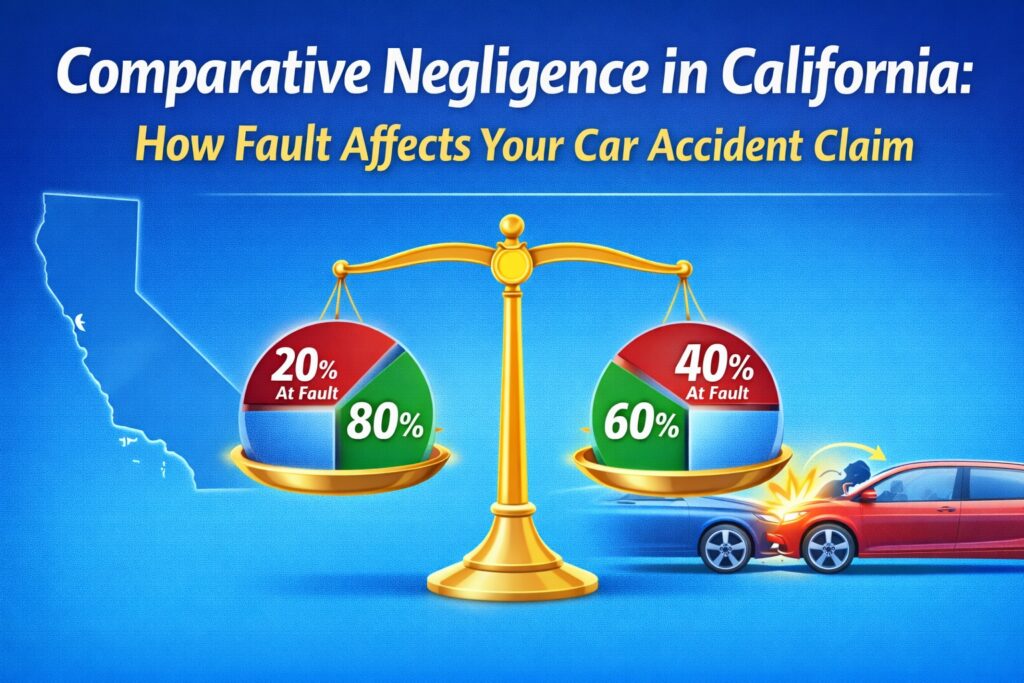
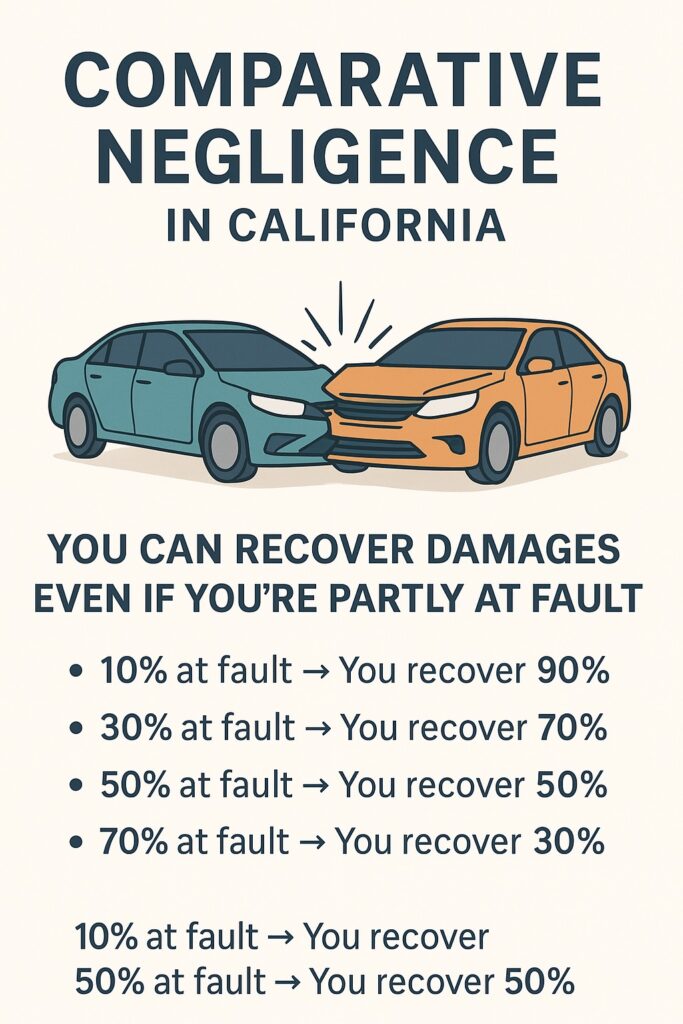
- If you are 20% at fault, you may still recover 80% of your total damages
- If you are 40% at fault, you may still recover 60%
- Even if you are 70% at fault, you may still recover 30%
Unlike states that bar recovery once a person reaches 50% or 51% fault, California has no cutoff. Your right to compensation is never completely eliminated. Instead, recovery is simply reduced in proportion to your share of responsibility.
This makes fault allocation a critical part of any injury claim, as even small changes in fault percentages can significantly affect the amount of compensation you receive.
Why California’s System Benefits Injured Drivers
Pure comparative negligence offers several advantages:
You are not punished for honest mistakes.
Even if you made a driving error, you can still obtain compensation for medical bills, lost wages, and pain and suffering.
Insurance companies cannot completely deny claims unless you are 100% at fault.
Many insurers try to shift blame to avoid paying. Under this system, they must pay something as long as their driver shares any portion of fault.
It encourages a deeper investigation into the crash.
Because fault percentages matter, your lawyer can push to uncover video, witnesses, and crash-reconstruction evidence to reduce your share of liability.
How Fault Is Determined in a California Accident
Determining fault is rarely simple — especially in T-bone collisions, lane-change crashes, rideshare accidents, or cases involving multiple vehicles. Insurance companies routinely argue that the injured person is more at fault than they actually are.
Fault is typically determined using:
- Traffic camera or dashcam footage
- Police reports
- Witness statements
- Crash reconstruction and physical evidence
- Vehicle black box (EDR) data
- Cell phone records (to prove distraction)
- Medical records showing timing of injuries
The stronger your evidence, the lower your assigned fault percentage — and the higher your recovery.
How Comparative Negligence Impacts Your Settlement
Let’s say your total damages are $250,000, including medical bills, lost income, and pain and suffering.
If you are found:
- 10% at fault, your recovery = $225,000
- 30% at fault, your recovery = $175,000
- 50% at fault, your recovery = $125,000
- 70% at fault, your recovery = $75,000
This is why insurance companies fight aggressively to blame you — every percent matters.
WIN Trial Lawyers pushes back against insurers who exaggerate or invent fault arguments to undervalue your claim.
Common Scenarios Where Both Drivers Share Fault
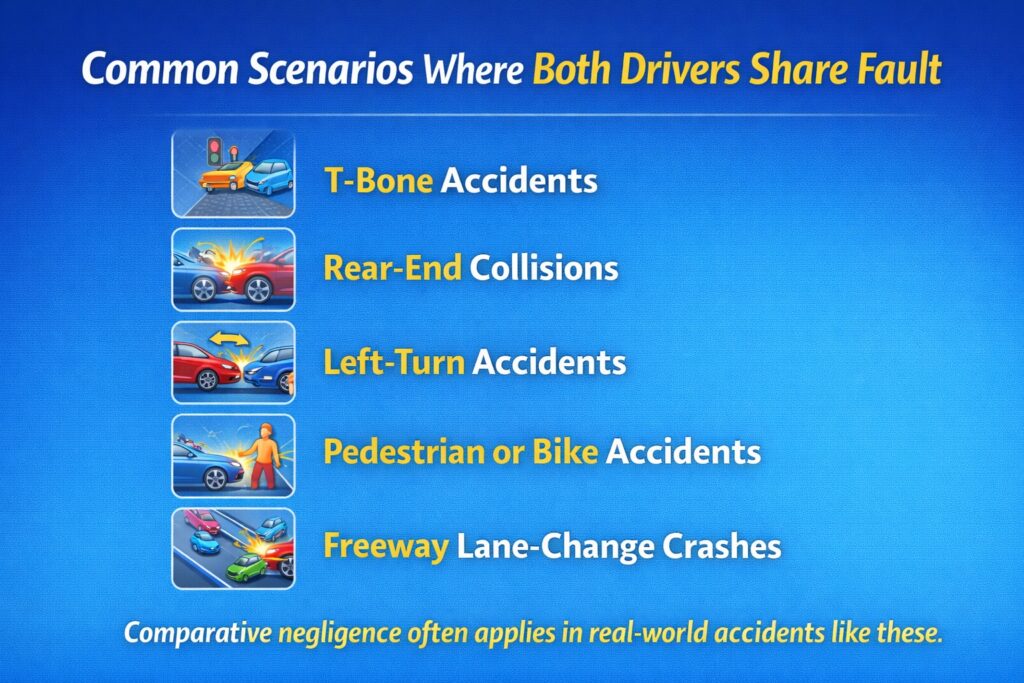
Comparative negligence frequently applies in real-world accidents where more than one person’s actions contribute to the crash. These cases are rarely black-and-white, and fault is often divided based on driving behavior, traffic laws, and the surrounding circumstances.
Below are common scenarios where fault is commonly shared:
T-Bone Accidents
One driver may run a red light or stop sign, clearly violating traffic laws. However, the other driver may also share fault if they were speeding, distracted, or failed to keep a proper lookout. In these cases, investigators often examine signal timing, vehicle speed, and whether either driver could have avoided the collision.
Rear-End Collisions
The trailing driver is typically presumed at fault for following too closely. That said, the lead driver may share responsibility if they braked suddenly without cause, had non-functioning brake lights, or stopped unexpectedly in moving traffic. Evidence such as vehicle data, dashcam footage, and witness statements can play a critical role in reallocating fault.
Left-Turn Accidents
Drivers making left turns are usually required to yield, placing much of the fault on them. However, oncoming drivers may also be partially responsible if they were speeding, running a yellow or red light, or distracted at the time of impact. Even a small increase in the other driver’s fault can meaningfully affect compensation.
Pedestrian or Bicycle Accidents
A driver may fail to yield the right of way, but fault may be shared if a pedestrian or cyclist was outside a crosswalk, crossing against a signal, riding at night without lights, or suddenly entering traffic. These cases often depend on visibility, lighting conditions, and reaction time.
Freeway Lane-Change Crashes
Lane-change collisions frequently involve multiple unsafe maneuvers, such as improper signaling, blind-spot failures, speeding, or tailgating. Determining fault often requires accident reconstruction, analysis of vehicle positions, and review of traffic-flow patterns rather than simple assumptions.
In all of these scenarios, insurance companies commonly attempt to assign as much blame as possible to reduce payouts. A skilled attorney can challenge those assumptions, present evidence strategically, and shift the fault percentage in your favor—which can substantially increase the value of your claim even when some fault is unavoidable.
How WIN Trial Lawyers Protects You Under Comparative Negligence
Insurance companies use comparative negligence as a weapon — trying to pin as much blame on you as possible to reduce what they owe. We counter this by:
- Conducting deep investigations
- Securing surveillance video and dashcam footage
- Interviewing witnesses early
- Using accident reconstruction experts when necessary
- Obtaining black box data
- Challenging false or biased police conclusions
- Presenting clear medical evidence connecting your injuries to the crash
Every percentage point of fault we reduce puts more money in your pocket.
Injured in California? Partial Fault Doesn’t Stop You.
If you were injured in a car accident — even if someone says you were partially to blame — you still have the right to pursue substantial compensation. California’s pure comparative negligence system protects your ability to recover.
At WIN Trial Lawyers, we know how to fight fault disputes and maximize your settlement.
Free Consultation • No Fees Unless We Win
Contact WIN Trial Lawyers today and let us hold the insurance company accountable.
Contact WIN Trial Lawyers
If you were injured in a T-bone collision, don’t face the insurance company alone.
Call WIN Trial Lawyers today for a free consultation and let our trial-tested team fight for you.

At WIN Trial Lawyers, we know how devastating distracted driving accidents can be. Victims often face mounting medical bills, lost wages, and emotional trauma. Our team has successfully taken on insurance companies and distracted drivers, recovering millions for injured clients.
If you or a loved one has been injured in a speeding-related car accident, don’t leave your future in the hands of the insurance company. You need experienced trial lawyers who know how to prove liability and fight for maximum compensation.
If you or a loved one has been injured in a distracted driving accident, don’t face this alone. The sooner you act, the stronger your case will be.