

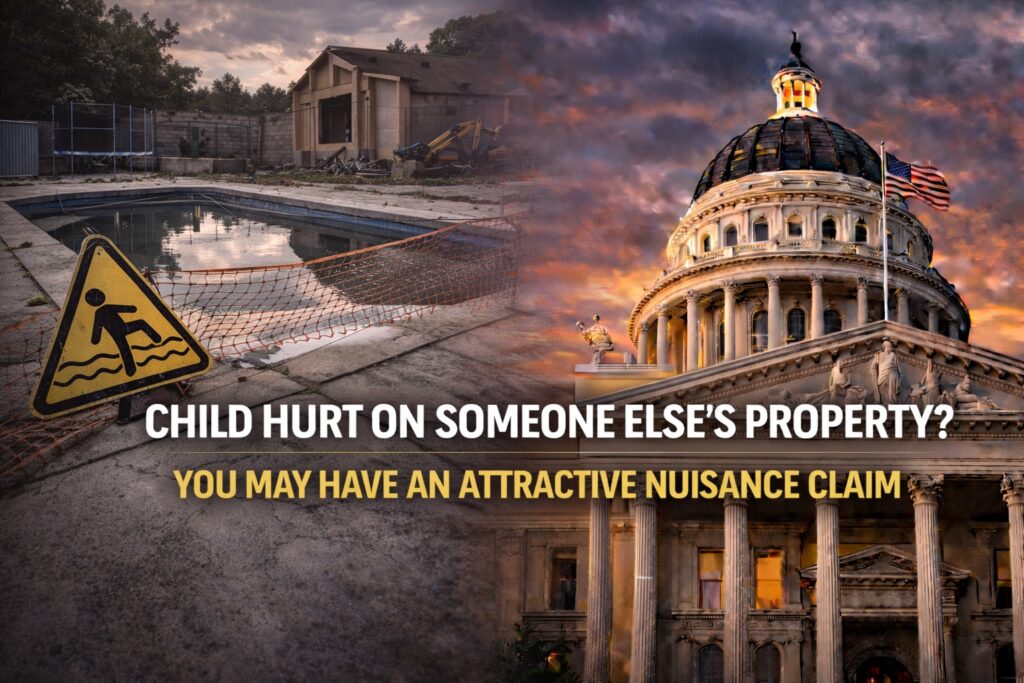
Children are naturally curious—and the law recognizes that property owners must take special precautions when dangerous conditions are likely to attract them.
Under California law, property owners may be held liable for injuries to children caused by hazardous conditions on their property, even when the child was not invited onto the premises. This legal doctrine is known as attractive nuisance.
At WIN Injury & Accident Trial Lawyers, we represent families whose children were seriously injured because a property owner failed to protect against foreseeable risks to children.
What Is the Attractive Nuisance Doctrine?
The attractive nuisance doctrine applies when a dangerous condition on property is likely to attract children who are unable to appreciate the risk involved.
Unlike ordinary premises liability, attractive nuisance cases recognize that children do not perceive danger the same way adults do, and property owners must account for that reality.
Common examples of attractive nuisances include:
- Swimming pools and spas
- Construction sites
- Abandoned or unsecured equipment
- Play structures or trampolines
- Open pits, trenches, or excavations
- Unfenced yards with dangerous features
The Legal Duty Owed to Children
Property owners have a duty to take reasonable steps to protect children from dangerous conditions when:
- The owner knows or should know children are likely to be present
- The condition poses an unreasonable risk of serious harm
- The child, due to age, cannot appreciate the danger
- The burden of eliminating the danger is slight compared to the risk
This duty exists even if the child technically trespassed.
The Core Question in Attractive Nuisance Cases
Every attractive nuisance case turns on this question:
Did the property owner fail to take reasonable steps to protect children from a dangerous condition that was likely to attract them?
If the danger was foreseeable and preventable, liability may attach.
Common Attractive Nuisance Scenarios
1. Swimming Pools and Water Hazards
Pools are one of the most common attractive nuisances. Owners may be liable for failing to provide:
- Fencing
- Locked gates
- Pool covers
- Alarms
Unsecured pools pose a serious risk to young children.
2. Construction Sites
Construction areas often contain:
- Heavy machinery
- Open trenches
- Loose materials
Failing to secure these sites or restrict access can expose owners and contractors to liability.
3. Play Equipment and Backyard Hazards
Items like trampolines, climbing structures, or abandoned vehicles can attract children and create foreseeable risks if not properly secured.
4. Vacant or Abandoned Property
Vacant lots and abandoned buildings often draw children. Property owners must take reasonable steps to prevent access to dangerous conditions.
Who Can Be Held Liable?
Attractive nuisance claims may be brought against:
- Property owners
- Landlords
- HOAs
- Property management companies
- Commercial property owners
- Contractors (in some cases)
Liability depends on control over the property and the dangerous condition.
Common Defenses Property Owners Raise
Property owners often argue:
- The child was trespassing
- The danger was obvious
- Parents should have supervised the child
- The condition was not attractive to children
These defenses are not absolute. Courts focus on foreseeability, age, and reasonable precautions.
Why Attractive Nuisance Cases Matter
Holding property owners accountable:
- Encourages safer property design
- Prevents repeat injuries
- Protects children who cannot protect themselves
- Provides families with needed compensation after devastating injuries
These cases are about preventable harm to children.
How WIN Handles Attractive Nuisance Cases
At WIN Injury & Accident Trial Lawyers, we:
- Investigate property conditions immediately
- Retain child-safety and premises experts
- Analyze foreseeability and neighborhood conditions
- Identify all responsible parties
- Build cases with sensitivity and strength
We understand what’s at stake—and we handle these cases accordingly.
Frequently Asked Questions
Can a property owner be liable if a child trespassed?
Yes. Trespassing does not automatically bar attractive nuisance claims.
Does this apply to very young children only?
The doctrine applies when a child’s age prevents them from appreciating the risk.
Are parents ever blamed?
Comparative fault may be argued, but it does not automatically defeat the claim.
Are these cases hard to prove?
They are fact-intensive but often very strong when hazards were obvious and preventable.
Child Injured by a Dangerous Property Condition? WIN Can Help.
If a child was injured because a property owner failed to protect against a hazardous condition likely to attract children, you may have a valid attractive nuisance premises liability claim.
WIN Injury & Accident Trial Lawyers represents families statewide in serious premises liability cases involving children.
📞 Contact us today for a confidential consultation.
Get Help From WIN Injury & Accident Trial Lawyers
Why Legal Representation Matters
Insurance companies often undervalue pain and suffering—offering minimal settlements that ignore your daily struggles. A skilled attorney can:
- Present powerful evidence of your emotional and physical suffering
- Retain expert witnesses to quantify your losses
- Use verdict data to justify higher multipliers or per diem rates
- Argue your case persuasively before a jury
At WIN Trial Lawyers, our team fights to ensure that your recovery reflects the full extent of your suffering—not just your bills.

At WIN Trial Lawyers, we know how personal injury claims can be can be. Victims often face mounting medical bills, lost wages, and emotional trauma. Our team has successfully taken on insurance companies and third parties, recovering millions for injured clients.
If you or a loved one has been injured in an accident, don’t leave your future in the hands of the insurance company. You need experienced trial lawyers who know how to prove liability and fight for maximum compensation.
If you or a loved one has been injured, don’t face this alone. The sooner you act, the stronger your case will be.