

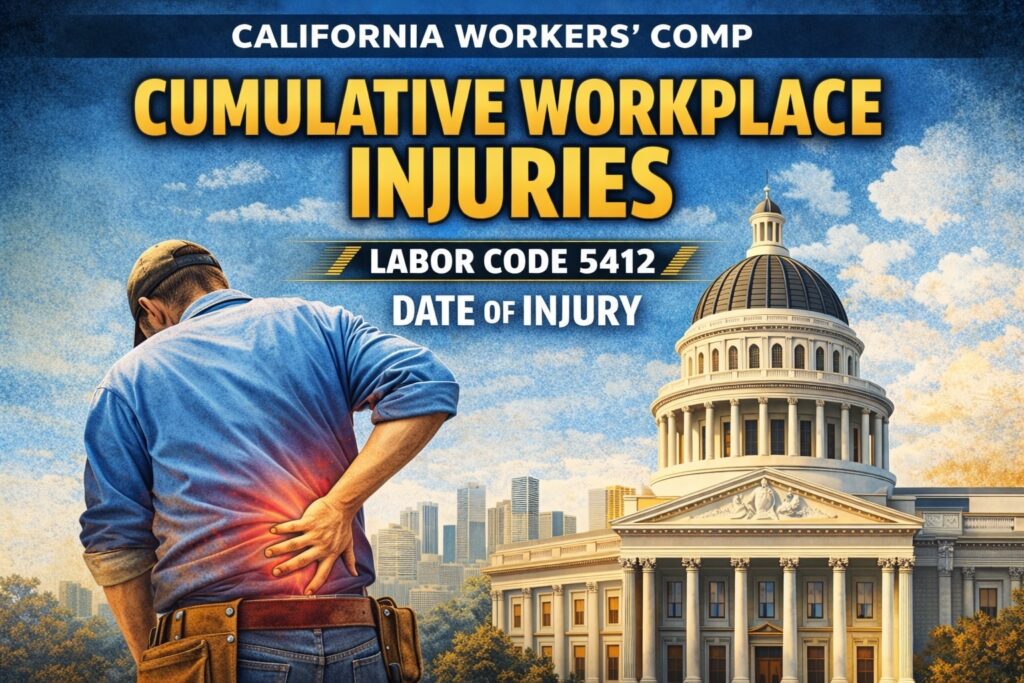
When an employee is hurt on the job — whether from a sudden accident or a condition that develops over time — a crucial legal question is: When did the injury actually occur? In California, this question can determine not only whether you qualify for workers’ compensation benefits, but also which benefits you can receive and how the claim is processed.
For injuries that occur in a single event — like a slip-and-fall — the answer is usually straightforward. But for occupational diseases and cumulative trauma injuries, the law takes a more nuanced approach under California Labor Code § 5412.
What Is Labor Code § 5412?
California Labor Code § 5412 defines the “date of injury” specifically for cases involving occupational diseases and cumulative injuries — conditions that develop over time from repetitive work activities rather than one definite event. According to the statute:
The date of injury is the date upon which the employee first suffered disability therefrom and either knew, or in the exercise of reasonable diligence should have known, that such disability was caused by his present or prior employment.
This definition requires two things to happen together:
- You first suffered a disability — e.g., you can’t do your job normally, need medical attention, or have lost earning capacity; and
- You knew (or should have known) — with reasonable diligence — that the disability was related to your job.
It’s this concurrence of disability and knowledge that locks in your official date of injury under the law.
Why the Date of Injury Matters
Impact on Statute of Limitations
In California, you typically have one year from the date of injury to file a workers’ compensation claim with the Division of Workers’ Compensation (DWC). For cumulative cases, determining the “date of injury” correctly is essential, because the clock doesn’t start running until the legal date is established — not necessarily the first time you felt pain.
For example:
If you only realize that years of repetitive lifting caused your shoulder disability after a doctor tells you it’s work-related, the date of injury doesn’t occur until both disability and knowledge coincide — even if pain started long before that.
Cumulative Trauma vs. Specific Injury
- Specific injuries — like a fall or a cut — usually occur on a clear date, and that date triggers the claim timeline.
- Cumulative trauma injuries — like carpal tunnel or back degeneration from years of repetitive work — don’t have a single event to point to. Instead, the law looks to the first time you were disabled and knowingly connected that disability to your job.
This is the core of Labor Code § 5412’s rule: the “date of injury” for cumulative cases is not the last day of work, the first symptom, or the last exposure — it’s the first day disability and knowledge coincide.
Key Considerations in Cumulative Trauma Claims
Knowledge is Not Immediate
You don’t have to immediately know that your condition is work-related. But once a medical professional diagnoses the condition and you reasonably should have known it’s caused by work, that triggers the statutory date. If a doctor didn’t advise you earlier, the date could be later — even after leaving the job.
Disability Doesn’t Mean Total Disability
“Disability” here can mean:
- Temporary loss of ability to perform job duties,
- Need for medical treatment,
- Loss of earning capacity,
or similar limitations. It isn’t limited to complete disability.
Why Employers and Insurers Contest the Date
A correct date of injury affects:
- Who is liable (especially if you worked for multiple employers),
- Whether benefits are payable, and
- Whether the claim is timely filed.
For example, liability under Labor Code § 5500.5 for cumulative trauma claims often depends on the one-year period before the date of injury — meaning employers who employed the worker in that year may partially or fully share responsibility.
Case Law Clarifies the Rule
Recent decisions, like the Fourth District Court of Appeal in Travelers Indemnity Co. v. WCAB (Zeber), stress that the “date of injury” is not when you learn you can file a claim, but when you are disabled and know your disability is work-related. Being aware of your right to file is a separate issue that relates to statutes of limitations — but not to the date of injury itself.
What Workers Should Do
If you suspect or know you have a cumulative injury caused by your job:
- Seek medical evaluation early. Documentation of disability and causation is critical.
- Report your symptoms promptly. Even if you’re unsure it’s work-related, early notice helps preserve your rights.
- Monitor when you first knew your injury was work-related. Because that knowledge impacts your legal timelines.
- Consult an experienced workers’ compensation attorney. Especially in cumulative cases — they can be technically demanding and often contested.
Bottom Line
California Labor Code § 5412 plays a crucial role in workers’ compensation claims involving occupational diseases and cumulative trauma. It ensures that workers aren’t penalized simply because their injury developed over time or wasn’t immediately diagnosed — by tying the date of injury to when disability and knowledge coincide.
Understanding this rule can make the difference between a denied claim and the benefits a worker rightfully deserves.
Workers’ Comp vs. Personal Injury: Key Differences
| Workers’ Comp | Personal Injury |
|---|---|
| No fault required | Fault must be proven |
| Limited benefits | Full damages available |
| No pain & suffering | Pain & suffering allowed |
| No jury | Jury trial available |
Exclusivity determines which path—or both—are available.
Get Help From WIN Injury & Accident Trial Lawyers

Why Legal Representation Matters
Insurance companies often undervalue pain and suffering—offering minimal settlements that ignore your daily struggles. A skilled attorney can:
- Present powerful evidence of your emotional and physical suffering
- Retain expert witnesses to quantify your losses
- Use verdict data to justify higher multipliers or per diem rates
- Argue your case persuasively before a jury
At WIN Trial Lawyers, our team fights to ensure that your recovery reflects the full extent of your suffering—not just your bills.

At WIN Trial Lawyers, we know how personal injury claims can be can be. Victims often face mounting medical bills, lost wages, and emotional trauma. Our team has successfully taken on insurance companies and third parties, recovering millions for injured clients.
If you or a loved one has been injured in an accident, don’t leave your future in the hands of the insurance company. You need experienced trial lawyers who know how to prove liability and fight for maximum compensation.
If you or a loved one has been injured, don’t face this alone. The sooner you act, the stronger your case will be.
🔗 Related Posts:
Frequently Asked Questions About Labor Code 5412 (Date of Injury)
What does “date of injury” mean under Labor Code 5412?
For cumulative trauma or occupational disease claims, the date of injury is not the first day you felt pain. It is the date when two things first occurred together:
- You suffered a disability, and
- You knew (or reasonably should have known) that the disability was caused by your work.
What is considered a “cumulative trauma” injury?
A cumulative trauma injury develops over time due to repetitive job duties, such as:
- Carpal tunnel syndrome
- Chronic back or neck injuries
- Shoulder or knee degeneration
- Repetitive stress injuries
- Hearing loss
- Lung or chemical exposure conditions
These injuries do not happen on one specific day.
Is the date of injury my last day of work?
Not necessarily. The date of injury is not automatically your last day worked, last day exposed, or last day employed. It depends on when disability and knowledge first coincided.
Does pain alone establish the date of injury?
No. Pain alone is not enough. You must have disability, such as:
- Needing medical treatment
- Being unable to perform your regular job duties
- Missing work
- Losing earning capacity
Pain without disability does not trigger the date of injury under 5412.
What does “knowledge” mean under the statute?
Knowledge means you knew — or reasonably should have known — that your condition was caused by your job. Often, this happens when:
- A doctor tells you your condition is work-related
- Medical records link your condition to work activities
You do not need to know the law or your right to file a claim.
What if I didn’t realize my injury was work-related until years later?
That happens often in cumulative trauma cases. If you were not informed earlier and had no reason to know the condition was work-related, the date of injury may be much later, even after you stopped working.
Does the date of injury affect whether my claim is timely?
Yes. In most cases, you must file a workers’ compensation claim within one year of the date of injury. That’s why determining the correct 5412 date is critical.
Can the insurance company dispute my date of injury?
Yes — and they often do. Insurers frequently argue for an earlier date to claim the case is time-barred or shift liability to a different employer or insurer.
Why does the date of injury matter so much to insurance companies?
The date of injury affects:
- Whether the claim is barred by time limits
- Which employer or insurer is responsible
- Which benefits apply
- Apportionment between multiple employers
That’s why cumulative trauma cases are often heavily litigated.
What if I worked for multiple employers over the years?
Labor Code 5412 interacts with other statutes that determine which employer(s) are liable. In many cumulative trauma cases, liability may be shared by employers who employed you during the period leading up to the date of injury.
Can I have a cumulative trauma injury even if I never missed work?
Yes. Disability does not require total disability. Needing medical treatment, work restrictions, or modified duties can qualify.
Does a doctor’s report control the date of injury?
Medical opinions are extremely important, but they are not the only factor. The judge looks at medical records, work history, testimony, and credibility to determine when disability and knowledge coincided.
What if my employer never told me my injury was work-related?
Failure to inform an employee can delay the date of injury and may impact statute-of-limitations defenses. Employers have reporting obligations once they are aware of a potential work-related injury.
Can my date of injury be after I stopped working?
Yes. Many cumulative trauma cases have dates of injury after termination or retirement, especially where diagnosis and disability occur later.
Is the date of injury the same as the date I file my claim?
No. Filing the claim does not establish the date of injury. The date of injury is determined by the facts under Labor Code 5412.
What happens if the wrong date of injury is used?
An incorrect date of injury can lead to:
- Denial of benefits
- Wrong insurer being named
- Loss of medical care
- Litigation delays
Correcting it early is crucial.
How is the date of injury decided if there’s a dispute?
If disputed, a workers’ compensation judge decides the date of injury based on:
- Medical evidence
- Worker testimony
- Employment records
- Timing of diagnosis and disability
Why are cumulative trauma cases more complex than other claims?
Because they involve:
- Long exposure periods
- Multiple employers or insurers
- Delayed diagnosis
- Legal disputes over timing and knowledge
These cases require careful legal analysis.
Should I talk to a lawyer if I think I have a cumulative trauma injury?
Yes. Cumulative trauma cases are among the most contested in workers’ compensation. An experienced attorney can help establish the correct date of injury and protect your benefits.
Does WIN Injury & Accident Trial Lawyers handle cumulative trauma claims?
Yes. WIN Injury & Accident Trial Lawyers represents injured workers in complex cumulative trauma and occupational disease cases, including disputes over date of injury under Labor Code 5412.