

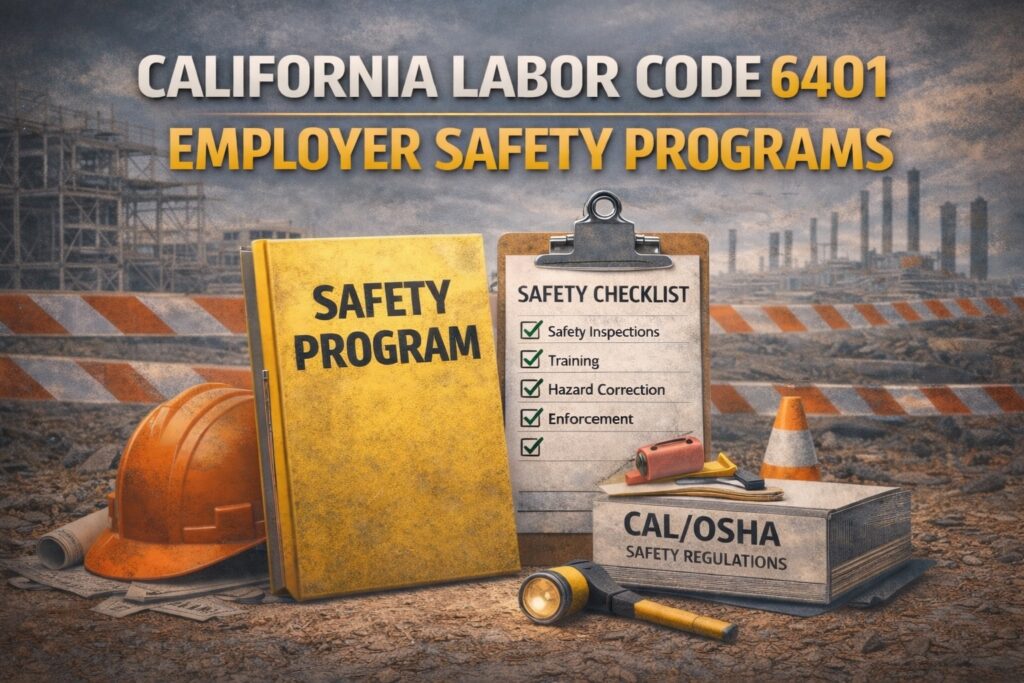
California law does not leave workplace safety to chance.
Labor Code 6401 requires employers to establish, implement, and maintain effective safety programs designed to protect employees from injury.
When employers ignore this duty, the consequences can extend far beyond workers’ compensation — including civil liability in serious injury cases.
What Does Labor Code 6401 Require?
Labor Code 6401 mandates that employers:
- Establish safety programs that identify workplace hazards
- Implement procedures to prevent injuries
- Regularly inspect worksites for unsafe conditions
- Correct hazards in a timely manner
- Ensure safety policies are actually followed, not just written
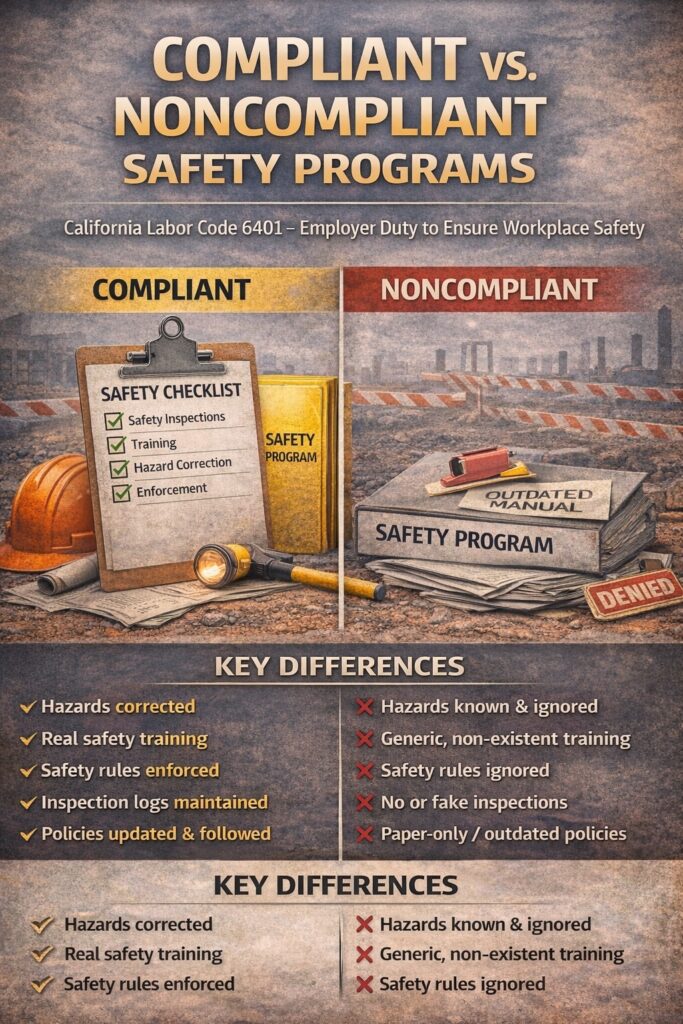
A safety program must be real, active, and enforced — not a binder collecting dust.
Why Safety Programs Matter in Injury Cases
When a worker is injured, one of the first questions investigators and attorneys ask is:
Did the employer have an effective safety program in place — and did they follow it?
A failure to comply with Labor Code 6401 can demonstrate:
- The hazard was known or should have been known
- The injury was foreseeable
- Reasonable safety measures were available but ignored
- The employer cut corners or failed to enforce its own rules
This can significantly impact liability in both workers’ compensation and civil injury claims.
Safety Program Failures We Commonly See
In real cases, employers often claim they had a safety program — but the evidence tells a different story:
- No documented safety inspections
- Outdated or generic safety manuals
- No employee safety training
- No enforcement of safety rules
- No corrective action after prior incidents
A paper policy without real-world enforcement does not satisfy Labor Code 6401.
How Labor Code 6401 Can Affect Case Value
Safety program violations can increase exposure in multiple ways:
1. Workers’ Compensation Penalties
A lack of safety programs may support claims for:
- Increased benefits
- Serious and willful misconduct findings
- Employer fault beyond routine industrial injury
2. Civil Personal Injury Claims
When an employer’s failure rises beyond ordinary negligence — or when third parties are involved — safety program violations may support:
- Negligence claims
- Negligence per se arguments
- Expanded damages exposure
Safety Programs vs. OSHA Violations
Labor Code 6401 works hand-in-hand with Cal/OSHA regulations.
When an employer:
- Fails to implement a safety program and
- Violates OSHA safety standards
those violations may be used as powerful evidence that the injury was preventable.
Why Injured Workers Should Care About Safety Programs
Injured workers often assume safety compliance is an employer’s internal issue. It’s not.
Safety programs affect:
- Whether injuries happen in the first place
- Whether employers can deny responsibility
- How much leverage exists in settlement negotiations
Understanding whether an employer complied with Labor Code 6401 can materially change the direction of a case.
Frequently Asked Questions (FAQs)
Do all employers have to maintain safety programs?
Yes. California law requires employers to maintain safety programs appropriate to their operations, size, and risks.
Is having a written safety manual enough?
No. The program must be implemented, enforced, and updated. Paper compliance alone is not sufficient.
Can safety program violations increase compensation?
They can. Violations may support increased workers’ comp benefits and strengthen civil liability claims.
What if my employer ignored prior safety complaints?
Ignoring known hazards or complaints can strongly support liability and penalty arguments.
How is this different from workers’ comp exclusivity?
While most workplace injuries fall under workers’ comp, serious safety failures, uninsured employers, or third-party involvement can open the door to civil lawsuits.
The Bottom Line
Labor Code 6401 exists to prevent injuries — not excuse them.
When employers fail to create and enforce real safety programs, they put workers at risk and expose themselves to serious legal consequences.
If you were injured at work and believe safety failures played a role, those violations matter.
Workers’ Comp vs. Personal Injury: Key Differences
| Workers’ Comp | Personal Injury |
|---|---|
| No fault required | Fault must be proven |
| Limited benefits | Full damages available |
| No pain & suffering | Pain & suffering allowed |
| No jury | Jury trial available |
Get Help From WIN Injury & Accident Trial Lawyers
Why Legal Representation Matters
Insurance companies often undervalue pain and suffering—offering minimal settlements that ignore your daily struggles. A skilled attorney can:
- Present powerful evidence of your emotional and physical suffering
- Retain expert witnesses to quantify your losses
- Use verdict data to justify higher multipliers or per diem rates
- Argue your case persuasively before a jury
At WIN Trial Lawyers, our team fights to ensure that your recovery reflects the full extent of your suffering—not just your bills.

At WIN Trial Lawyers, we know how personal injury claims can be can be. Victims often face mounting medical bills, lost wages, and emotional trauma. Our team has successfully taken on insurance companies and third parties, recovering millions for injured clients.
If you or a loved one has been injured in an accident, don’t leave your future in the hands of the insurance company. You need experienced trial lawyers who know how to prove liability and fight for maximum compensation.
If you or a loved one has been injured, don’t face this alone. The sooner you act, the stronger your case will be.
🔗 Related Posts:
Frequently Asked Questions About Labor Code 6401 (Safety Programs)
What is Labor Code 6401?
Labor Code 6401 requires California employers to establish, implement, and maintain effective workplace safety programs to prevent employee injuries.
Do all California employers have to follow Labor Code 6401?
Yes. All employers must maintain safety programs appropriate to the size, nature, and hazards of their workplace.
Is a written safety manual enough to comply with Labor Code 6401?
No. A written manual alone is not enough. Safety programs must be actively implemented, enforced, and updated.
What must an employer’s safety program include?
A compliant safety program typically includes:
- Hazard identification
- Regular safety inspections
- Employee safety training
- Procedures for correcting unsafe conditions
- Enforcement of safety rules
How often must safety inspections be conducted?
There is no single schedule, but inspections must be frequent enough to identify and correct hazards before injuries occur.
What happens if an employer ignores known safety hazards?
Ignoring known hazards can strongly support liability claims, penalties, and findings that the employer failed to meet legal safety obligations.
Can Labor Code 6401 violations affect a workers’ compensation case?
Yes. Safety program failures may support increased benefits, serious and willful misconduct claims, or disputes over employer responsibility.
Can safety program violations support a personal injury lawsuit?
In some cases, yes. Serious safety failures, uninsured employers, or third-party involvement can allow civil lawsuits beyond workers’ comp.
How does Labor Code 6401 relate to OSHA violations?
Labor Code 6401 works alongside Cal/OSHA regulations. OSHA violations can be powerful evidence that an employer failed to maintain a lawful safety program.
What is the difference between a safety policy and a safety program?
A policy is written guidance. A safety program includes training, enforcement, inspections, and real-world implementation.
Does Labor Code 6401 apply to construction sites?
Yes. Construction sites are one of the most heavily regulated workplaces, and safety program violations are frequently cited after jobsite injuries.
Can prior accidents be used to show safety program failures?
Yes. Prior incidents can show that hazards were known and not corrected.
What if employees were never trained on safety rules?
Failure to train employees is a strong indicator that the employer did not maintain an effective safety program.
Can an employer be liable if safety rules exist but aren’t enforced?
Yes. Safety rules that are ignored or unenforced do not satisfy Labor Code 6401.
Who investigates safety program violations after an injury?
Investigations may involve Cal/OSHA, insurance carriers, and attorneys reviewing safety records, training logs, and inspection history.
What types of evidence show safety program failures?
Common evidence includes:
- Missing inspection logs
- Lack of training records
- Prior safety complaints
- OSHA citations
- Witness testimony
Does Labor Code 6401 apply even if workers’ comp benefits are paid?
Yes. Paying workers’ comp benefits does not erase safety violations or eliminate employer exposure in all cases.
Can safety program failures increase settlement value?
They can. Safety violations may strengthen claims, increase leverage, and expose employers to additional penalties.
What should injured workers do if they suspect safety violations?
Document conditions, report hazards, seek medical care, and avoid assuming the employer complied with safety laws.
Are employers required to update safety programs?
Yes. Safety programs must be updated when conditions, equipment, or risks change.
Why is Labor Code 6401 important for injured workers?
Because safety program compliance can affect liability, benefits, penalties, and overall case value.