

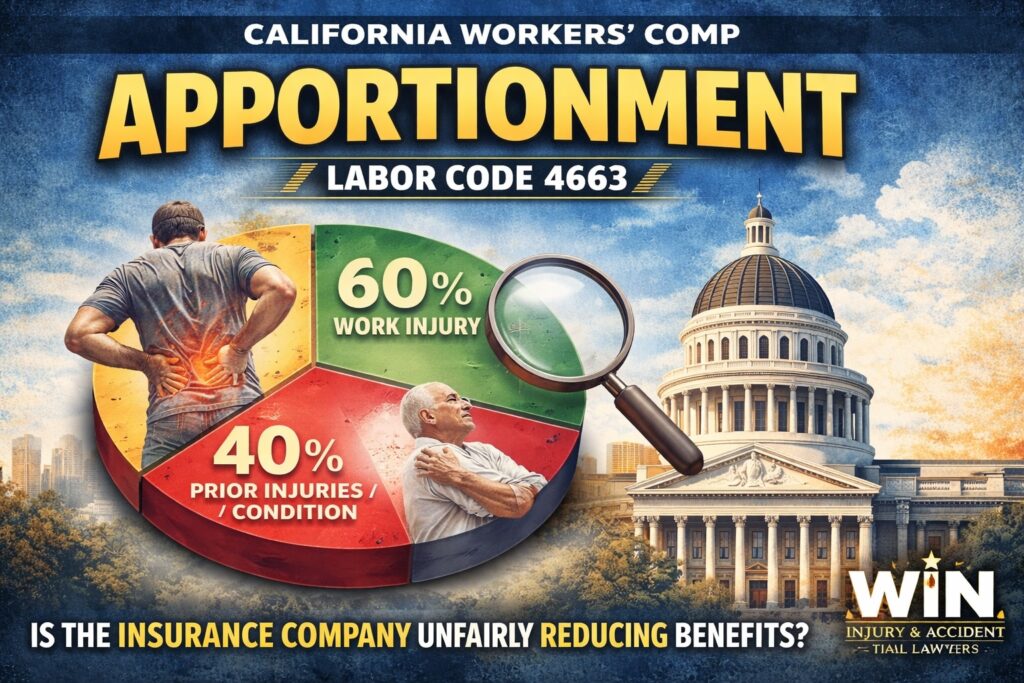
When an injured worker is told that only part of their injury is work-related, apportionment is usually the reason.
California Labor Code 4663 governs how permanent disability is divided between work-related causes and non-industrial factors. Insurers rely heavily on apportionment to reduce payouts, but the law places strict limits on how it can be used.
Understanding apportionment — and how it is often misused — is critical to protecting the full value of a workers’ compensation case.
What Is Apportionment Under Labor Code 4663?
Apportionment is the process of determining what percentage of a worker’s permanent disability was caused by the industrial injury versus other factors, such as:
- Prior injuries
- Preexisting medical conditions
- Degenerative changes
- Prior non-work accidents
Under Labor Code 4663, employers are only responsible for the portion of permanent disability directly caused by the work injury — but only if apportionment is properly supported.
Apportionment Applies Only to Permanent Disability
A key point many injured workers are not told:
Apportionment does NOT reduce medical treatment or temporary disability benefits.
Labor Code 4663 applies only to permanent disability. Employers must still provide:
- Full medical treatment
- Temporary disability payments
- Diagnostic testing
even if apportionment is later claimed.
The Employer Has the Burden of Proof
Apportionment is not automatic.
To be valid, it must be supported by substantial medical evidence, usually from a QME or AME. That medical opinion must:
- Identify the specific cause of disability
- Assign a percentage to each cause
- Explain the reasoning with medical facts — not speculation
Statements like “degeneration played a role” or “some portion is preexisting” are not enough.
Apportionment Is About Cause — Not Labels
One of the most common insurance tactics is confusing cause with diagnosis.
Apportionment cannot be based on:
- A prior diagnosis without disability
- Age-related changes that were asymptomatic
- Conditions that did not impair work ability before the injury
If the worker was able to do their job before the injury, apportionment may be improper — even if imaging shows degeneration.
Common Apportionment Tactics Used by Insurers
Insurance companies frequently attempt to overreach by claiming apportionment based on:
- “Degenerative disc disease”
- Arthritis seen on imaging
- Old injuries that fully resolved
- Prior workers’ comp claims with no lasting disability
These arguments often fail when challenged properly.
Why Apportionment Dramatically Affects Case Value
Apportionment directly reduces permanent disability benefits.
For example:
- 40% permanent disability with no apportionment = full benefits
- 40% permanent disability with 50% apportionment = benefits cut in half
That reduction can mean tens or hundreds of thousands of dollars in long-term cases.
Apportionment Must Be Carefully Challenged
Invalid apportionment can be challenged by:
- Cross-examining the QME or AME
- Requesting supplemental reports
- Filing for trial at the WCAB
- Using prior medical and employment records to rebut claims
Once accepted without challenge, apportionment often becomes locked into the case.
Apportionment Does Not Apply to Employer Misconduct
Apportionment cannot be used to excuse:
- Serious and willful misconduct
- Unsafe workplace conditions
- Employer negligence that aggravated a condition
If work accelerated, worsened, or lit up an underlying condition, apportionment may be limited or eliminated.
Why Legal Representation Matters in Apportionment Cases
Apportionment is one of the most technical areas of workers’ compensation law. Small mistakes can permanently reduce benefits.
An experienced workers’ compensation attorney can:
- Identify invalid apportionment
- Challenge defective medical opinions
- Protect permanent disability ratings
- Maximize settlement value
Talk to a Workers’ Compensation Lawyer Before Accepting Apportionment
If an insurance company or doctor says part of your disability is “not work-related,” that does not mean it is legally correct.
At WIN Injury & Accident Trial Lawyers, we aggressively challenge improper apportionment and fight to ensure injured workers are not unfairly blamed for conditions caused by their work.
Workers’ Comp vs. Personal Injury: Key Differences
| Workers’ Comp | Personal Injury |
|---|---|
| No fault required | Fault must be proven |
| Limited benefits | Full damages available |
| No pain & suffering | Pain & suffering allowed |
| No jury | Jury trial available |
Exclusivity determines which path—or both—are available.
Get Help From WIN Injury & Accident Trial Lawyers
Why Legal Representation Matters
Insurance companies often undervalue pain and suffering—offering minimal settlements that ignore your daily struggles. A skilled attorney can:
- Present powerful evidence of your emotional and physical suffering
- Retain expert witnesses to quantify your losses
- Use verdict data to justify higher multipliers or per diem rates
- Argue your case persuasively before a jury
At WIN Trial Lawyers, our team fights to ensure that your recovery reflects the full extent of your suffering—not just your bills.

At WIN Trial Lawyers, we know how personal injury claims can be can be. Victims often face mounting medical bills, lost wages, and emotional trauma. Our team has successfully taken on insurance companies and third parties, recovering millions for injured clients.
If you or a loved one has been injured in an accident, don’t leave your future in the hands of the insurance company. You need experienced trial lawyers who know how to prove liability and fight for maximum compensation.
If you or a loved one has been injured, don’t face this alone. The sooner you act, the stronger your case will be.
🔗 Related Posts:
Frequently Asked Questions About Labor Code 4663 (Apportionment)
What is apportionment in California workers’ compensation?
Apportionment is the process of dividing permanent disability between work-related causes and non-industrial factors, such as prior injuries or preexisting conditions. Labor Code 4663 limits what employers are legally responsible for.
Does apportionment apply to all workers’ comp benefits?
No. Apportionment applies only to permanent disability benefits.
It does not reduce:
- Medical treatment
- Temporary disability payments
- Diagnostic testing
Can an insurance company automatically apportion my disability?
No. Apportionment is not automatic. The employer must prove it with substantial medical evidence that clearly explains the percentage caused by non-industrial factors.
Who has the burden of proving apportionment?
The employer or insurance company has the burden of proof. They must show:
- The specific cause of disability
- The percentage attributable to each cause
- A medically reasoned explanation
Can apportionment be based on degeneration or arthritis?
Not automatically. Apportionment cannot be based solely on:
- Age-related degeneration
- Imaging findings alone
- Conditions that caused no disability before the injury
If you were working without limitations before the injury, apportionment may be improper.
What if I had a prior injury but fully recovered?
A prior injury does not justify apportionment if:
- It fully resolved
- It caused no ongoing disability
- You were able to perform your job normally before the work injury
Can apportionment reduce my settlement value?
Yes. Apportionment directly reduces permanent disability benefits, which can significantly lower the value of a workers’ compensation settlement.
Can a QME or AME decide apportionment?
Doctors can recommend apportionment, but their opinion must meet strict legal standards. Unsupported or speculative opinions can be challenged.
Can I challenge apportionment in my case?
Yes. Apportionment can be challenged by:
- Requesting supplemental medical reports
- Cross-examining the QME or AME
- Taking the case to trial before the WCAB
What happens if apportionment is accepted without challenge?
If not challenged, apportionment often becomes locked into the case and permanently reduces benefits.
Does apportionment apply if work made a condition worse?
If work aggravated, accelerated, or lit up an underlying condition, apportionment may be limited or eliminated.
Can apportionment apply to serious and willful misconduct cases?
Apportionment generally cannot be used to excuse employer misconduct, unsafe workplaces, or intentional wrongdoing.
Can apportionment be based on a prior workers’ comp claim?
Only if the prior claim caused actual permanent disability that still existed at the time of the new injury.
What if the doctor says “some portion” is non-industrial?
That is not enough. Apportionment requires specific percentages and reasoning. Vague statements are legally insufficient.
Can apportionment be used to deny medical care?
No. Apportionment does not limit medical treatment rights under California law.
How much can apportionment reduce benefits?
In some cases, apportionment can cut permanent disability benefits by 50% or more, depending on the percentages assigned.
Should I have a lawyer if apportionment is raised?
Yes. Apportionment is highly technical and often misused. Mistakes can permanently reduce your benefits.
What should I do if apportionment is mentioned in my case?
Do not accept it at face value. Speak with a workers’ compensation attorney before agreeing to any apportionment finding or settlement.
Can apportionment be reversed later?
It is very difficult to reverse once finalized. Early legal action is critical.